

Air Purification
Industrial-grade carbon solutions for clean air and emission control.
Activated carbon is the workhorse of air and gas purification. From stripping volatile organic compounds (VOCs) in manufacturing exhaust to controlling H₂S odor at wastewater plants, carbon adsorption is one of the most effective and cost-efficient air treatment technologies available — handling flows from small HVAC filters to large industrial gas streams.
Air Treatment Applications
Carbon solutions for every gas-phase duty — click to explore detailed guides.
VOC Removal & Recovery
High-CTC pellet carbon for paint booths, printing, chemical exhaust
H₂S & Mercaptan Removal
KOH-impregnated pellet for wastewater, biogas & sour-gas odor
Biogas Purification
H₂S + siloxane removal — protect CHP engines, biomethane upgrade
Odor Control Systems
Municipal & industrial odor abatement at stack & fenceline
Mercury Removal (Flue Gas)
Sulfur-impregnated GAC for coal-fired & waste incineration plants
Solvent Recovery
Adsorption-desorption systems for toluene, xylene, ethyl acetate
Common Air Treatment Challenges
Gas-phase adsorption is unforgiving of poor design. These are the problems engineers bring to us.
VOCs & Solvents
Manufacturing, printing, and coating exhaust carries toluene, xylene, and acetone. High-CTC carbon captures them; heavier, higher-boiling VOCs adsorb most readily.
H₂S & Mercaptans
Wastewater and biogas produce corrosive, odorous H₂S. Plain carbon has limited capacity — impregnated (KOH/NaOH) grades react chemically for far higher removal.
Pressure Drop
Air systems move huge volumes. Granular carbon packs tight and chokes flow; extruded pellet carbon gives low pressure drop and even gas distribution.
Humidity & Temperature
Water vapor competes for adsorption sites and hot gas lowers capacity. Bed design must account for relative humidity and inlet temperature.
How It Works
Physical adsorption is the core mechanism: gas molecules are drawn onto the carbon's internal surface (800–1,200 m²/g) and held by van der Waals forces. Heavier VOCs with higher boiling points adsorb most readily and hold tightest. For contaminants that adsorb weakly — H₂S, ammonia, acid gases — impregnated carbon adds a chemical reaction at the surface (chemisorption), dramatically raising capacity. Performance depends on residence time: the longer the gas contacts the bed, the more complete the removal.
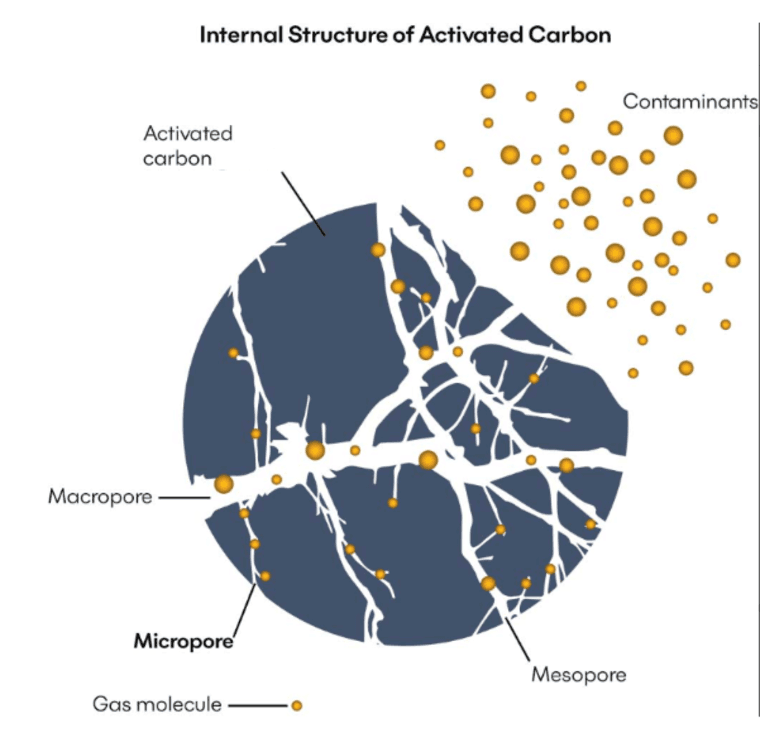
Gas Adsorption Process
Low-pressure-drop pellet carbon keeps fan energy down across high-volume gas streams.
System Design & Configuration
Gas-phase design differs from liquid. The four key decisions:
Residence Time (EBRT)
Empty bed residence time drives removal. VOC control typically needs 1–2 seconds; deep odor control 2–4 seconds. Too short means immediate breakthrough.
Carbon Form
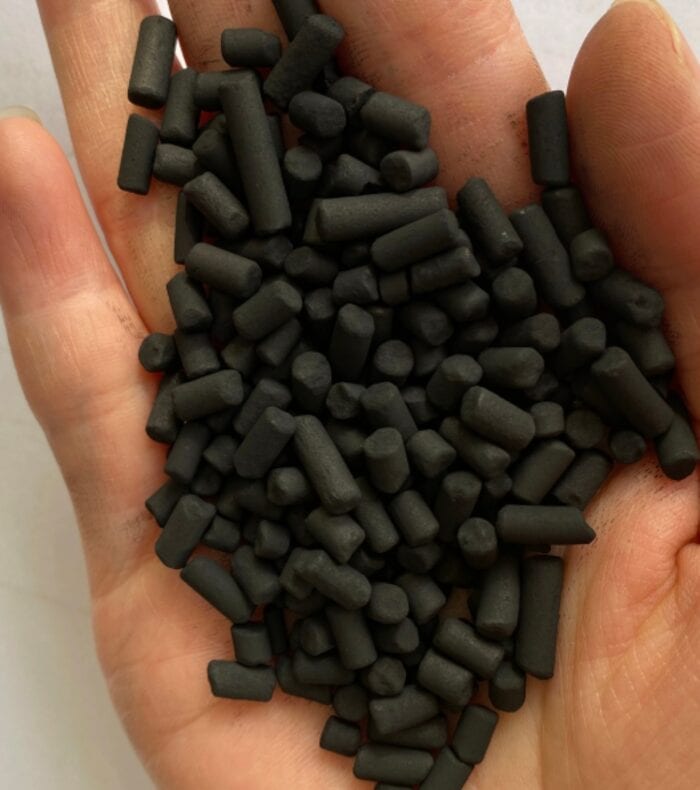
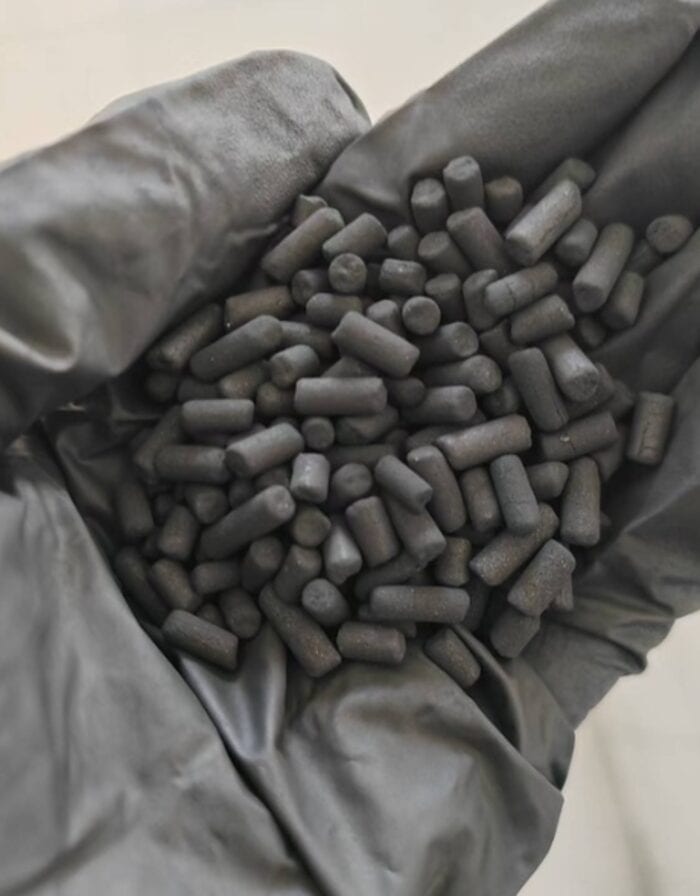
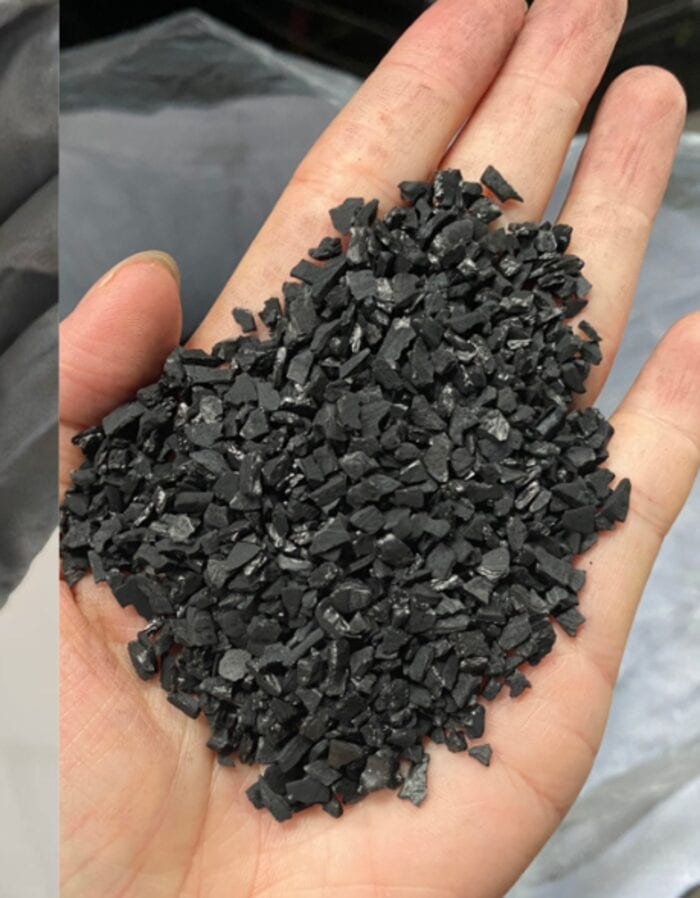
Extruded pellet (3–4 mm) for low pressure drop in high-flow ducts; granular for packed filters and lower flows. Pellet is standard for industrial gas streams.
Impregnation
KOH/NaOH for H₂S, sulfur for mercury, KI for acid gases. Match the impregnant to the target — plain carbon wastes capacity on chemisorbing contaminants.
Bed Depth & Velocity
Face velocity 0.2–0.5 m/s and adequate bed depth prevent channeling and premature breakthrough. Deeper beds extend change-out intervals.
Carbon Selection Guide
| Air Treatment Duty | Recommended Carbon | Key Spec | EBRT |
|---|---|---|---|
| VOC removal / recovery | Pellet 4 mm, high CTC | CTC ≥60% | 1–2 s |
| H₂S / odor control | KOH-impregnated pellet | H₂S cap ≥0.14 g/g | 2–4 s |
| Mercury (flue gas) | Sulfur-impregnated GAC | S ≥10% | 1–2 s |
| HVAC / indoor air | Granular 4×8 | Iodine ≥900 mg/g | 0.5–1 s |
| Solvent recovery | Pellet 3–4 mm | CTC ≥65% | 1–2 s |
 Extruded Pellet CarbonGranular Activated Carbon (GAC)
Send us your gas composition, flow rate, and temperature — we'll spec the right carbon and impregnation.
Get Technical ProposalQuality & Certifications
Recommended Products
Pellet Activated Carbon
Low pressure drop, gas-phase adsorption
Impregnated Carbon
H₂S, mercury, acid gas removal
Granular AC
HVAC filters, general air purification
Technical Specifications
| Parameter | Pellet (VOC / Solvent) | Impregnated (H₂S / Odor) |
|---|---|---|
| CTC Value | ≥60% | ≥50% |
| Pellet Size | 3–4 mm | 3–4 mm |
| Hardness | ≥95% | ≥95% |
| H₂S Capacity | — | ≥0.14 g/g |
| Ash Content | ≤12% | ≤15% |
Standard grades shown. Impregnant type (KOH / NaOH / sulfur / KI) and pellet size can be customized to your target gas — contact us for a tailored specification.
Field Performance
Typical operating ranges for gas-phase activated carbon.
Case: Wastewater pump station odor control
A wastewater pump station using KOH-impregnated pellet carbon at 2.5 s EBRT held H₂S below detection at the stack for 14 months before change-out, eliminating neighborhood odor complaints.
Recent Air Purification Projects
Real bulk shipments of pellet activated carbon for gas treatment and VOC control — verified specs, delivered worldwide.
 🇸🇦 Saudi Arabia110 Tons
110t Pellet Carbon for H₂S Sour Gas Treatment
Supplied KOH-impregnated pellet carbon for sour gas desulfurization — engineered to strip hydrogen sulfide from gas streams at an oil & gas facility in the Gulf.
Read full case → 🇨🇱 Chile44 Tons
44t Pellet Carbon for Industrial VOC Removal
Shipped CTC 50 pellet carbon for volatile organic compound abatement — matched to the customer's solvent load for reliable VOC capture in industrial exhaust.
Read full case →Frequently Asked Questions
What type of activated carbon is best for air purification?
Pellet (extruded) carbon is ideal for air due to its low pressure drop and high gas-phase capacity. For specific contaminants like H₂S or mercury, impregnated carbon adds a chemical reaction for far higher removal than plain carbon.
How does activated carbon remove VOCs from air?
Through physical adsorption — VOC molecules are held on the carbon's internal surface (800–1,200 m²/g) by van der Waals forces. Heavier VOCs with higher boiling points adsorb most readily and are retained longest.
How long does carbon last in air systems?
Bed life depends on pollutant concentration, flow, temperature, and humidity — typically 6–18 months for industrial air. Breakthrough monitoring with PID meters or sampling determines change-out timing.
When do I need impregnated carbon?
For contaminants that adsorb weakly on plain carbon — H₂S, ammonia, mercury, acid gases. Impregnants (KOH, sulfur, KI) add a chemical reaction that raises capacity many times over. Match the impregnant to your target gas.
What EBRT should I design for?
Empty bed residence time drives removal. VOC control typically needs 1–2 seconds; deep odor control 2–4 seconds. Too short an EBRT causes immediate breakthrough regardless of carbon quality.
What is the MOQ and lead time?
Minimum order is 1 ton, FCL pricing for bulk. Standard grades ship in 7–15 days; free samples are available for evaluation before you commit.
Air Treatment Project?
Send us your gas composition and flow rate for a tailored carbon solution.
Get Technical ProposalAir Purification Carbon — Complete Guide
Complete Guide
Activated Carbon for Air Purification: Complete Systems Guide
How carbon air systems work, grade selection and design basics for indoor and industrial air.
Process Guide
Activated Carbon for VOC Removal: Industrial Air Treatment
CTC value, bed sizing and pellet carbon selection for volatile organic compound abatement.
Product Guide
Pelletized Activated Carbon for Air Treatment
Why 4mm pellet carbon is the workhorse for VOC, H₂S and odor control in gas streams.
Application
Activated Carbon for Odor Control: Industrial & Municipal
Wastewater plants, composting and industrial odor abatement with carbon adsorption.
Process Guide
Activated Carbon for Flue Gas Treatment: SO₂ & Dioxin Removal
Powdered and impregnated carbon for flue gas desulfurization and dioxin capture.
Technical Guide
Impregnated Activated Carbon: Types & Selection
KOH, KI and KMnO₄ impregnation for H₂S, acid gases and specialty air applications.