
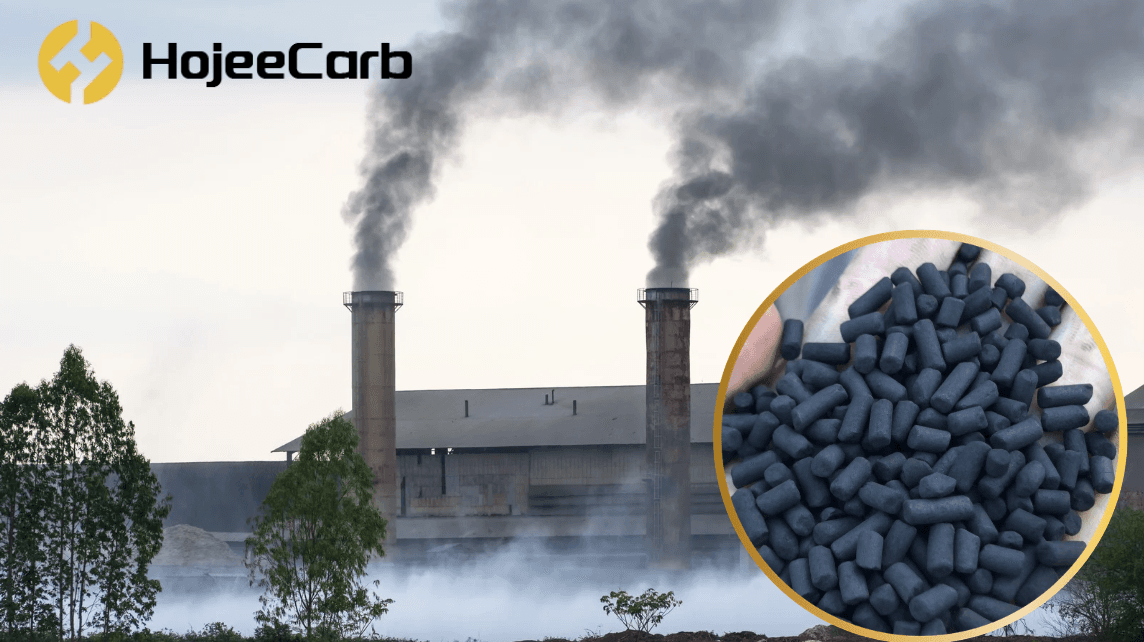
Coal-fired boilers, municipal waste incinerators, sinter plants, glass furnaces, and cement kilns all share the same headache: the flue gas coming off the process carries SO2, NOx, HCl, HF, dioxins, furans, PAHs, mercury, and fine particulate, and the permit limits keep dropping every revision cycle. We have been selling activated carbon into these applications for over a decade, and the technology that keeps winning on cost and reliability is a dry or semi-dry activated carbon bed — sometimes alone, more often as the polishing step after wet scrubbing or SCR.
This guide covers where activated carbon fits in flue gas cleaning, which pollutants it actually handles, how to pick between virgin pellet, impregnated pellet, and powdered activated carbon (PAC), what specs matter on the datasheet, and what a realistic consumption and cost picture looks like when you build the system. If you are coming from the solvent side, our VOC removal guide is the better starting point — flue gas is a harsher neighborhood.
Why Activated Carbon for Flue Gas Cleaning?
Flue gas cleaning used to be all about bag filters, wet scrubbers, and electrostatic precipitators. Those technologies are fine for particulate and gross SO2, but they do not touch the micro-pollutants that regulators now chase: dioxins at pg TEQ/Nm³ levels, mercury at μg/Nm³, PAHs, PCBs, and residual SO3 mist. Activated carbon fills that gap — one material, one bed, and you get measurable capture across a dozen different compounds at the same time.
The reasons flue gas engineers keep specifying activated carbon:
Need activated carbon?
Get Factory-Direct Pricing — No Middlemen
20+ years manufacturing. MOQ 1 ton. Free samples. Reply within 2 hours.
How Activated Carbon Removes Flue Gas Pollutants
Flue gas capture is not a single mechanism. Different pollutants bind through different chemistry, which is why the choice between virgin and impregnated carbon matters so much. Here is what we see on real plants for each major pollutant:
| Pollutant | Removal Efficiency | Best Carbon Type | Mechanism |
|---|---|---|---|
| SO2 | 80–95% | Virgin or KOH-impregnated pellet | Catalytic oxidation to H2SO4 on carbon surface |
| NOx (NO + NO2) | 60–85% | NH3-impregnated pellet | Low-temperature SCR with NH3 injection |
| Dioxins / Furans | 95–99% | Virgin pellet or PAC injection | Physical adsorption + surface decomposition |
| Mercury (elemental) | 85–95% | Sulfur- or Br-impregnated PAC | Chemisorption forming HgS or HgBr2 |
| Mercury (oxidized) | 90–99% | Virgin or sulfur-impregnated | Physical adsorption of HgCl2 |
| HCl, HF | 90–99% | NaOH- or KOH-impregnated pellet | Acid-base neutralization in pore structure |
| PAHs | 95–99% | Virgin pellet | Physical adsorption (high MW, low volatility) |
| SO3 / H2SO4 mist | 70–90% | Virgin pellet | Capillary condensation in mesopores |
Two practical notes from these numbers. First, dioxin removal is the application where activated carbon has no real competitor — no other technology delivers 99% dioxin capture at 150°C without generating a secondary waste stream. Second, if NOx is in your permit, do not try to hit it with plain carbon. You need NH3 dosing and an ammonia-impregnated grade, or you need to keep SCR upstream and use the carbon only for polishing.
Not sure which grade fits your flue gas?
Send us your flue gas composition — temperature, flow, SO2, NOx, Hg, and dioxin levels — and we will come back with a grade recommendation, consumption estimate, and quoted price inside 48 hours.
Request a carbon recommendation →Types of Activated Carbon for Flue Gas
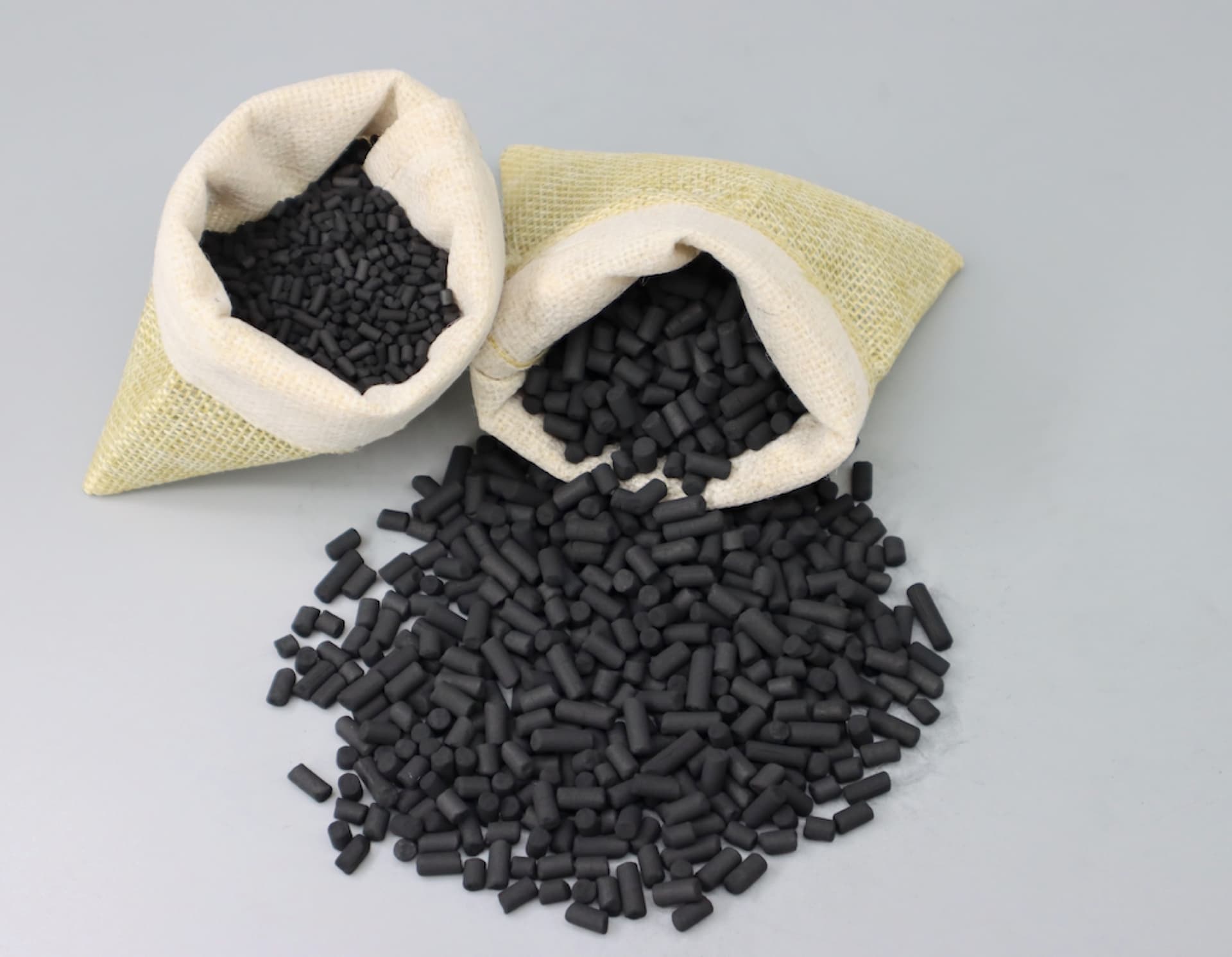
Flue gas applications live on three product families: columnar (pellet) carbon for fixed and moving beds, powdered activated carbon for injection into the flue gas duct, and specialty impregnated grades for specific pollutants. Granular irregular carbon and coconut carbon are rarely used — the former because of dust, the latter because it is too hard to pelletize economically and the pore structure is overkill for flue gas molecules.
| Carbon Type | Typical Application | Size / Form | Key Spec |
|---|---|---|---|
| Coal-based pellet (virgin) | Fixed-bed FGD, dioxin adsorber, moving-bed polisher | 3 / 4 / 6 / 8 mm cylinders | Iodine 900–1,050, hardness >95% |
| KOH / NaOH impregnated pellet | Acid gas polishing (SO2, HCl, HF) | 4 mm pellet, 5–10% impregnation | SO2 capacity >130 mg/g |
| NH3-impregnated pellet | Low-temp deNOx, combined SO2+NOx | 4 mm pellet | NOx conversion >70% at 150°C |
| Sulfur-impregnated pellet / PAC | Mercury capture in boiler / WtE | 4 mm pellet or 20 μm PAC | Hg capacity 4–8 mg/g |
| Brominated PAC | Elemental Hg injection, cement kilns | 15–25 μm powder, 5% Br | Hg capacity 10–15 mg/g |
| Lignite-based PAC | Dioxin + Hg injection in WtE | 15–30 μm powder | Iodine 500–650, fast kinetics |
| Activated coke | Large moving-bed combined SO2/NOx | 8–10 mm pellet | Iodine 300–500, very hard |
The two grades we ship most often into flue gas projects are columnar activated carbon (4 mm pellet, iodine 900–1,000, for fixed-bed FGD and dioxin polishing) and coal-based granular activated carbon (as the base material for impregnation and for some retrofit projects where vessel geometry favors granular). Lignite PAC for injection is a separate line — if that is what you need, tell us the injection rate and we will route it to the right mill.
Carbon Specifications for Flue Gas Treatment
When a buyer sends us a flue gas enquiry, the first thing we ask for is the guarantee list — what specs will be on the contract. These are the numbers we guarantee on our standard flue gas pellet carbon, tested to GB/T 7702 (Chinese national method), with parallel ASTM D3467 and EN 12915 methods available on request:
| Parameter | Unit | FGD Pellet 4 mm | Dioxin Pellet 4 mm |
|---|---|---|---|
| Iodine number | mg/g | ≥ 900 | ≥ 1,000 |
| CTC adsorption | % | ≥ 55 | ≥ 60 |
| BET surface area | m²/g | ≥ 950 | ≥ 1,050 |
| Ball-pan hardness | % | ≥ 95 | ≥ 95 |
| Bulk density | g/cm³ | 0.48–0.55 | 0.45–0.52 |
| Ash content | % | ≤ 12 | ≤ 10 |
| Moisture (packed) | % | ≤ 5 | ≤ 5 |
| SO2 dynamic capacity | mg/g | ≥ 80 (virgin) | — |
| Pellet diameter | mm | 4.0 ± 0.2 | 4.0 ± 0.2 |
A few things to watch on the datasheet that trip up buyers:
For background on how these numbers are measured and why test methods matter, see our air purification guide — it covers the same test framework from a different angle.
System Design: Fixed Bed vs Moving Bed vs PAC Injection
There are three dominant configurations in the field, and the choice is driven mostly by flue gas volume, dust load, and whether you want to recover the captured pollutants or just dispose of them with the fly ash.
1. Fixed-bed activated carbon adsorber
A vertical or horizontal vessel packed with 4 mm pellet carbon. Flue gas enters after the baghouse, passes downward through a bed 0.8–1.5 m deep, and exits to the stack. Empty bed contact time (EBCT) is typically 2–4 seconds, face velocity 0.3–0.5 m/s. This is the standard layout for municipal WtE plants in Europe and Japan and for medium-sized cement kilns.
Design rules we use:
- Inlet dust below 10 mg/Nm³, or the bed channels within 6 months.
- Inlet temperature 120–180°C — below 120°C you get acid condensation, above 180°C dioxins desorb.
- Two beds in lead-lag for continuous operation with offline change-out.
- Bed life: 2–4 years for dioxin service, 12–18 months for SO2-heavy streams.
- CAPEX rule of thumb: USD 80–150 per Nm³/h of treated flue gas, turnkey.
2. Moving-bed activated coke system
Developed for large coal power plants. Activated coke (8–10 mm pellets, iodine ~400) moves slowly downward through a tall adsorber while flue gas crosses horizontally. Spent coke is drawn off the bottom, thermally regenerated at 400–450°C, and returned to the top. This is how the Japanese steel and power industry has handled combined SO2/NOx for 30 years. Removal: >95% SO2, 70–80% NOx, >99% Hg and dioxins. CAPEX is high but OPEX is very low because carbon is regenerated in place.
3. Powdered activated carbon (PAC) injection
The simplest and cheapest option. PAC (lignite or brominated) is pneumatically injected into the flue gas duct between the economizer and the baghouse. Contact time is brief (1–2 seconds) but the high surface-to-volume ratio of the powder still delivers >99% dioxin capture and 85–95% Hg capture. Spent PAC is collected on the baghouse filter cake and removed with the fly ash. No regeneration, no vessel, no replacement shutdown — just a silo, a feeder, and a lance.
When buyers ask us which to pick: PAC injection wins on CAPEX and for small streams (<50,000 Nm³/h). Fixed bed wins on OPEX for mid-sized plants (50,000–500,000 Nm³/h) and when lower dioxin guarantees (pg TEQ/Nm³) are in the permit. Moving bed is only economical above 500,000 Nm³/h with serious SO2 and NOx loads together. For biogas and low-temperature gas polishing, the design thinking is different — see our biogas purification guide.
Practical bed-sizing walk-through
We get asked for a quick hand-calculation almost every week. Here is how we size a fixed-bed dioxin polisher for a 300 tpd waste-to-energy line generating roughly 120,000 Nm³/h of flue gas at 150°C with inlet dioxin of 3 ng TEQ/Nm³ and target outlet below 0.08 ng TEQ/Nm³:
- Pick EBCT of 3.5 seconds for 97% dioxin capture at 150°C.
- Bed volume = 120,000 / 3,600 × 3.5 = 117 m³ of carbon.
- At 0.50 g/cm³ bulk density that is 58.5 tonnes per bed.
- Two beds in lead-lag — total carbon inventory 117 tonnes.
- Face area at 0.40 m/s face velocity = 83 m², so a 10.3 m × 8.1 m horizontal bed, 1.4 m deep.
- Expected bed life 3 years — annual carbon budget 39 tonnes × USD 1,400 = USD 54,600 / year.
These numbers are the starting point of a full design, not the final answer — you still need CFD or empirical data to confirm flow distribution, and you need a pilot or prior installation to confirm dioxin capacity on your specific flue gas chemistry. But they are close enough for early CAPEX/OPEX estimating, and they mirror what we see on actual WtE lines in Europe and China.
Upstream conditioning — the part that is usually underbuilt
The most common reason a flue gas carbon bed underperforms is not the carbon — it is the conditioning upstream. Three things need to happen before the flue gas hits the bed: dust below 10 mg/Nm³ (otherwise the bed fouls in months), temperature controlled to 140–170°C (outside that window either acid condenses or dioxins desorb), and acid-gas removal upstream if SO2 exceeds 200 mg/Nm³ (otherwise the carbon is exhausted by SO2 before it can do dioxin duty). A properly sized dry scrubber with hydrated lime or sodium bicarbonate sitting ahead of the carbon bed does more for carbon life than any grade upgrade.
Humidity is the other quiet killer. Water content above 10% by volume competes with organic molecules for the carbon pores, and we have seen dioxin capacity drop 30–40% when a plant accidentally ran its quench too wet. Keep the dew point at least 20°C below the bed operating temperature.
Carbon Consumption & Cost Analysis
Consumption is the number that decides whether the project pencils out. Here is what we see across delivered projects — numbers that are useful for first-pass budgeting before you run a full flue gas balance:
| Application | Carbon Type | Consumption | Annual Cost (500 tpd plant) |
|---|---|---|---|
| MSW incinerator (dioxin + Hg) | Lignite PAC injection | 80–150 kg / tonne waste | USD 45,000–90,000 |
| MSW incinerator (brominated Hg) | Br-PAC injection | 40–80 kg / tonne waste | USD 35,000–75,000 |
| Coal boiler (SO2 polish) | 4 mm pellet fixed bed | 0.5–1.2 kg / tonne coal | USD 110,000–260,000 |
| Cement kiln (Hg + dioxin) | PAC injection | 15–40 mg / Nm³ | USD 60,000–160,000 |
| Sinter plant (combined) | Activated coke moving bed | 3–5% annual makeup | USD 180,000–400,000 |
| WtE dioxin polishing | 4 mm pellet fixed bed | 30–60 tonnes per bed, 3-year life | USD 30,000–70,000 amortized |
Ex-works prices from China, FOB Qingdao or Tianjin, as of Q2 2026:
Container freight to Europe adds USD 80–150 per tonne, to US Gulf USD 120–180, to Southeast Asia USD 40–80. Duties vary — 0% in most free-trade partners, 6.5% under the EU CN 38021000 code, 4.8% into the US under HTS 3802.10.00. Full-container loads (20–24 tonnes) always beat LCL on landed cost by a wide margin.
A useful way to benchmark total cost of ownership is the USD-per-tonne-waste (for WtE) or USD-per-MWh (for power plants) metric. On a 500 tpd WtE with PAC injection at 100 kg/t waste and USD 1,200 carbon, flue gas carbon contributes roughly USD 0.12 per tonne of waste processed, or about 1–2% of the plant's gate fee revenue. On a 600 MW coal plant using 0.8 kg pellet carbon per tonne of coal, carbon spend lands near USD 0.25 per MWh — small compared to coal and sorbent costs, but large enough that a poorly specified grade costs real money.
Sourcing Flue Gas Carbon from China
China produces more than 70% of the world's flue gas activated carbon. The quality spread between the top tier and the bottom tier is wider than in water-treatment carbon because the raw coal sources, activation temperatures, and QC discipline vary more. A few points we tell every new buyer:
Need flue gas activated carbon?
We manufacture coal pellet, impregnated pellet, lignite PAC, and brominated PAC for flue gas service — full-container direct shipment from Ningxia and Shanxi, with SGS/BV inspection and written hardness guarantees. Send your specs and we will come back with a quotation inside two working days.
Request a flue gas quotation →FAQ
Which activated carbon type is best for flue gas desulfurization?
Coal-based pellet carbon with 4 mm diameter, iodine number 900–1,050 mg/g, and ball-pan hardness above 95% is the workhorse for fixed-bed FGD. For combined SO2 and NOx removal, we supply ammonia- or KOH-impregnated pellet carbon. Wood-based or coconut grades are almost never used here — they are too soft for the high dust load and abrasion in flue gas service.
How much activated carbon does a waste incinerator consume for dioxin control?
Powdered activated carbon (PAC) injection for dioxin and mercury control on municipal solid waste incinerators typically runs 50–150 mg/Nm³ of flue gas, which translates to roughly 80–250 kg of PAC per tonne of waste burned. Brominated PAC cuts the dose by 30–50% when mercury is the governing pollutant. A 500 tpd incinerator consumes around 40–100 tonnes of PAC per year.
Can activated carbon remove NOx from flue gas directly?
Standard carbon has limited NOx capacity on its own. For NOx reduction we supply two options: ammonia-impregnated pellet carbon that catalyzes low-temperature SCR at 80–200°C, and combined SO2/NOx systems where the carbon adsorbs SO2 while catalyzing NH3 + NOx reaction. Typical NOx removal ranges 60–85% depending on ammonia slip tolerance and bed design.
What is the difference between virgin and impregnated activated carbon for flue gas?
Virgin pellet carbon relies on physical adsorption and catalytic oxidation at the carbon surface — best for SO2, dioxins, PAHs, and heavy hydrocarbons. Impregnated grades add chemistry: KOH or NaOH for acid gases (SO2, HCl, HF), sulfur for mercury, copper or silver for specific metals, and bromine for elemental mercury in low-temperature flue gas. Impregnation adds USD 300–800 per tonne to the base price.
How long does flue gas activated carbon last in service?
In fixed-bed FGD with periodic water washing and regeneration, 4 mm pellet carbon lasts 2–4 years before replacement. In moving-bed systems with continuous thermal regeneration, the same carbon can run 5–8 years with 3–5% annual makeup for attrition losses. PAC injection is single-pass — the carbon goes out with the fly ash to the baghouse and is disposed of or co-combusted.
Talk to a flue gas carbon specialist
Bring us the flue gas data and we will recommend a grade, forecast consumption, and ship from stock. Most quotes turn around inside 48 hours.
Contact us