
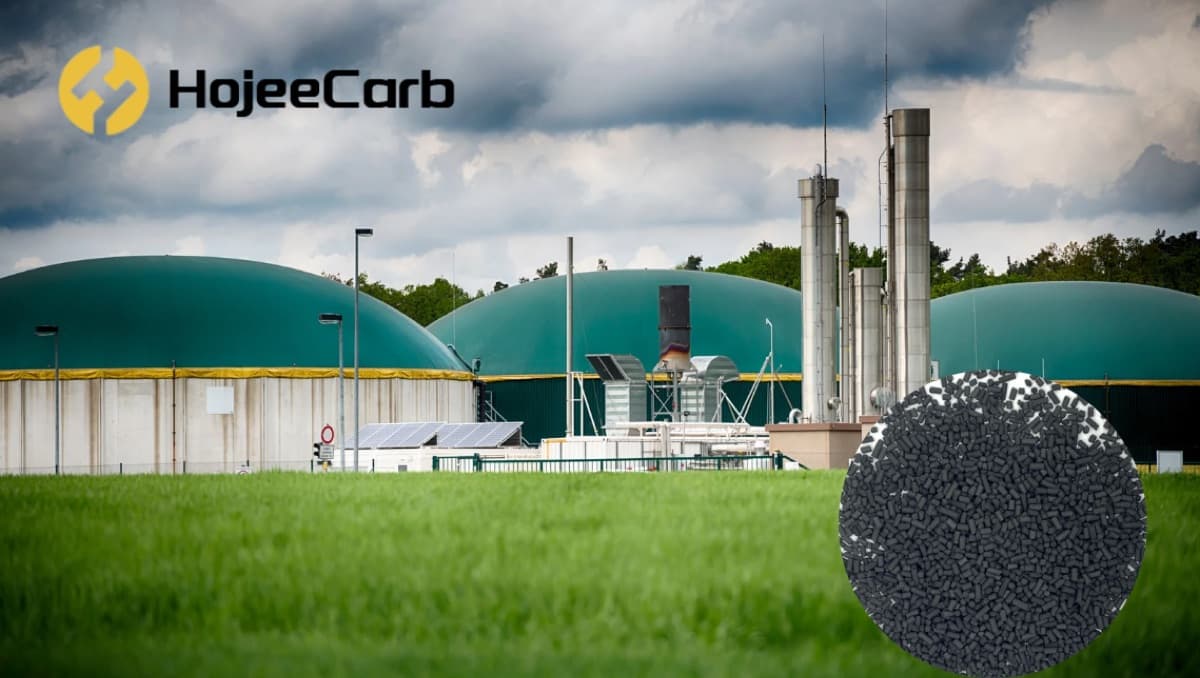
Need activated carbon?
Get Factory-Direct Pricing — No Middlemen
20+ years manufacturing. MOQ 1 ton. Free samples. Reply within 2 hours.
In This Guide
Why Biogas Needs Purification
Raw biogas from anaerobic digesters, landfills, and wastewater treatment plants typically contains 50–70% methane (CH₄), 30–50% carbon dioxide (CO₂), and a cocktail of trace contaminants that must be removed before the gas can be used in engines, boilers, fuel cells, or upgraded to biomethane/renewable natural gas (RNG).
The two most problematic contaminants for biogas utilization are:
- Hydrogen sulfide (H₂S): Present at 100–10,000+ ppm. Highly corrosive to engines, turbines, and piping. Toxic at concentrations above 100 ppm. Combustion produces SO₂, an air pollutant regulated under emission standards.
- Siloxanes: Organosilicon compounds (D4, D5, L2, etc.) at 1–100+ mg/m³. Combustion converts siloxanes to abrasive silicon dioxide (SiO₂) deposits that damage engine cylinders, turbine blades, and catalyst surfaces — causing hundreds of thousands of dollars in maintenance costs.
Activated carbon adsorption is one of the most widely used and cost-effective technologies for removing both H₂S and siloxanes from biogas. The global biogas market — growing at 4.3% CAGR through 2032 — is driving rapid expansion of activated carbon demand for gas purification, particularly in Europe, China, and North America where biogas-to-energy and RNG projects are accelerating.
H₂S Removal with Activated Carbon: How It Works
Activated carbon removes hydrogen sulfide from biogas through two distinct mechanisms, depending on whether the carbon is impregnated or virgin (non-impregnated).
Catalytic Oxidation (Virgin Carbon)
On virgin activated carbon, H₂S undergoes catalytic oxidation in the presence of oxygen and moisture:
H₂S + ½O₂ → S⁰ + H₂O (on carbon surface)
The elemental sulfur deposits in the carbon pores, gradually filling them until the carbon is exhausted. This mechanism requires 2–4% oxygen in the gas stream and relative humidity >50% to function optimally. Typical H₂S loading capacity for virgin carbon ranges from 0.1–0.3 kg H₂S per kg carbon.
Chemical Reaction (Impregnated Carbon)
Impregnated activated carbon — treated with alkaline chemicals like KOH (potassium hydroxide), NaOH (sodium hydroxide), or Na₂CO₃ (sodium carbonate) — removes H₂S through acid-base neutralization:
H₂S + 2KOH → K₂S + 2H₂O
K₂S + ½O₂ + H₂O → 2KOH + S⁰ (partial regeneration)
The alkaline impregnant reacts directly with H₂S, achieving 2–5× higher loading capacity than virgin carbon — typically 0.3–0.8 kg H₂S per kg carbon. The partial in-situ regeneration of KOH means the effective capacity can be even higher under optimal conditions. This mechanism works even without oxygen in the gas stream, making it versatile for different biogas compositions.
H₂S Removal Performance Data
| Carbon Type | H₂S Capacity (kg/kg) | Inlet H₂S Range | Outlet Achievable | O₂ Required? |
|---|---|---|---|---|
| Virgin GAC (coal-based) | 0.10–0.25 | 100–3,000 ppm | <1 ppm | Yes (2–4%) |
| KOH-Impregnated Pellet | 0.30–0.60 | 100–5,000 ppm | <1 ppm | No (optional) |
| NaOH-Impregnated Pellet | 0.25–0.50 | 100–5,000 ppm | <1 ppm | No (optional) |
| Iron Oxide-Impregnated | 0.15–0.35 | 1,000–10,000+ ppm | <5 ppm | Yes (for regen) |
| Catalytic Carbon (KI/NaI) | 0.20–0.40 | 100–2,000 ppm | <0.5 ppm | Yes (1–2%) |
Siloxane Removal with Activated Carbon
Siloxanes in biogas originate from personal care products, industrial silicone compounds, and building materials that enter wastewater or landfill leachate. The most common siloxanes in biogas are:
- D4 (Octamethylcyclotetrasiloxane) — boiling point 175°C
- D5 (Decamethylcyclopentasiloxane) — most abundant, boiling point 210°C
- L2 (Hexamethyldisiloxane) — most volatile, hardest to capture
Why Activated Carbon Works for Siloxanes
Siloxane molecules are relatively large (molecular weight 236–370 g/mol) and moderately hydrophobic, making them well-suited for physical adsorption on activated carbon. Unlike H₂S removal, siloxane adsorption is purely physical (van der Waals) — no chemical reaction involved. This means:
- Virgin (non-impregnated) GAC is preferred — impregnants can actually reduce siloxane capacity by occupying pore space
- High surface area (>1,000 m²/g) with mesopores and macropores provides the best siloxane loading
- Coconut shell GAC (mostly micropores) is less effective than coal-based GAC for siloxanes
- Typical loading capacity: 5–15% by weight (50–150 g siloxane per kg carbon)
Two-Stage Approach: H₂S + Siloxane
Because H₂S removal often requires impregnated carbon while siloxane removal works best with virgin carbon, many biogas plants use a two-stage activated carbon system:
- Stage 1: Impregnated pellet carbon — removes H₂S to <1 ppm. Protects the downstream siloxane bed from sulfur poisoning.
- Stage 2: Virgin GAC (coal-based, 4×8 or 8×16) — removes siloxanes to engine/turbine specifications (<5 mg/m³ total Si).
This two-stage design optimizes media utilization, as each carbon type is deployed where it performs best. For a broader look at carbon selection across industrial gas streams, see our H₂S removal application page. Our client operating a 2 MW landfill gas-to-energy plant in Southeast Asia adopted this approach and reduced their total carbon consumption by 35% compared to a single-stage virgin GAC system.
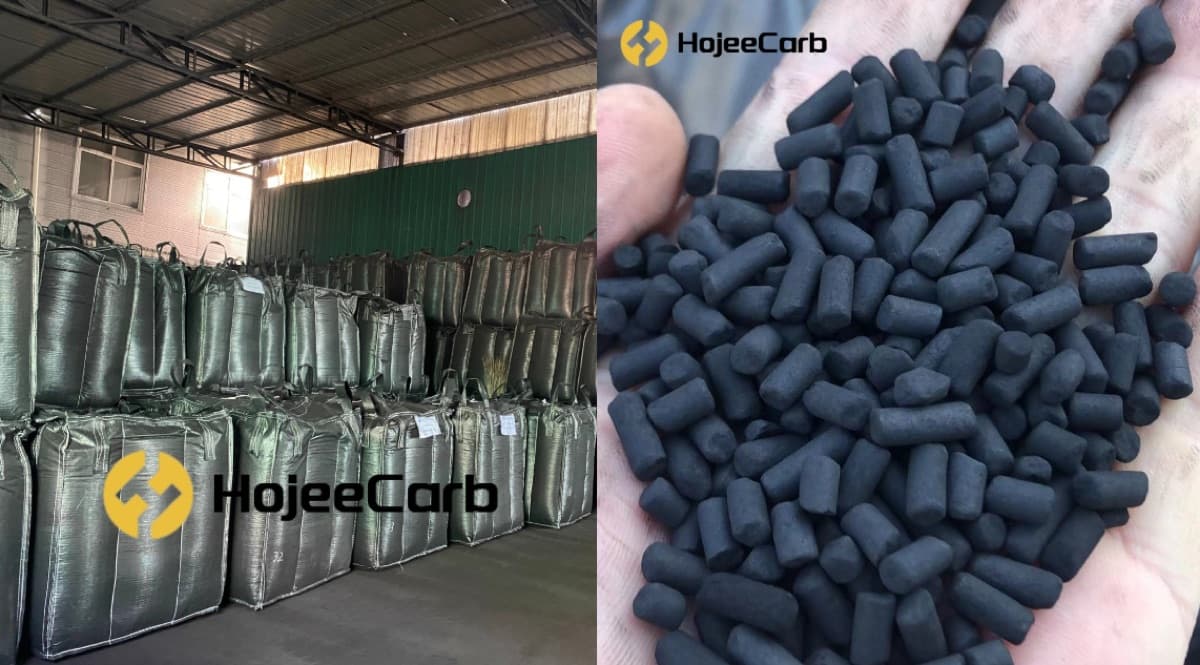
Our warehouse stocked with impregnated activated carbon pellets (4mm) ready for biogas purification projects. Right: close-up of the pelletized carbon used for H₂S scrubbing.
Activated Carbon Media Selection for Biogas
Choosing the right activated carbon for your biogas application requires matching the media properties to your specific contaminant profile and treatment goals.
Selection Decision Tree
Step-by-Step Media Selection:
- What's your primary contaminant?
- H₂S only → Impregnated pellet carbon (KOH or NaOH)
- Siloxanes only → Virgin GAC (coal-based, high surface area)
- Both H₂S + siloxanes → Two-stage system (impregnated + virgin)
- What's your H₂S concentration?
- <500 ppm → Impregnated carbon alone is sufficient
- 500–3,000 ppm → Impregnated carbon, possibly with iron sponge pre-treatment
- >3,000 ppm → Iron sponge first stage + impregnated carbon polishing
- What form factor?
- Pelletized (4mm) — lowest pressure drop, best for high-flow systems
- Granular (4×8 mesh) — good balance of capacity and pressure drop
- Granular (8×16 mesh) — highest surface contact, smaller vessels
- What's your target outlet quality?
- CHP engine: H₂S <200 ppm, siloxane <20 mg/m³
- Microturbine: H₂S <30 ppm, siloxane <5 mg/m³
- Fuel cell: H₂S <1 ppm, siloxane <0.1 mg/m³
- RNG/biomethane: H₂S <4 ppm, siloxane <0.5 mg/m³
Media Comparison for Biogas Applications
| Property | KOH-Impregnated Pellet | Virgin Coal GAC | Iron Oxide Media |
|---|---|---|---|
| Primary Target | H₂S | Siloxanes, VOCs | H₂S (bulk removal) |
| H₂S Capacity | High (0.3–0.6 kg/kg) | Low (0.1–0.25 kg/kg) | Very High (0.5+ kg/kg) |
| Siloxane Capacity | Low (impregnant fills pores) | High (5–15 wt%) | None |
| Regenerable? | Partially (in-situ with O₂) | Thermal only | Yes (with air) |
| Pressure Drop | Low (pellet form) | Moderate | Moderate-High |
| Cost (FOB China, $/MT) | $1,400–2,200 | $800–1,200 | $400–800 |
| Outlet H₂S Achievable | <1 ppm | <1 ppm (with O₂) | <5 ppm |
Biogas Carbon Adsorber System Design
Designing an activated carbon system for biogas purification involves several key parameters. Here's a practical design framework used across hundreds of installations:
Key Design Parameters
- Gas velocity: 0.1–0.3 m/s through the carbon bed (linear velocity). Lower = better removal but larger vessels.
- Bed depth: Minimum 0.5 m; typically 1.0–1.5 m for H₂S and 0.8–1.2 m for siloxanes.
- Contact time: 2–6 seconds for H₂S (impregnated carbon); 4–8 seconds for siloxanes (virgin GAC).
- Vessel orientation: Vertical downflow is most common; horizontal for space constraints.
- Temperature: 20–40°C optimal. Above 50°C reduces adsorption. Below 5°C slows reaction kinetics.
- Moisture: Gas should be dehumidified to <80% RH. Liquid water in the bed causes channeling and premature breakthrough.
Sizing Example: 500 m³/h Biogas Plant
Design Scenario: Agricultural Digester
- Biogas flow: 500 m³/h
- H₂S concentration: 1,500 ppm
- Target: <100 ppm (CHP engine specification)
- Carbon type: KOH-impregnated 4mm pellets
- Gas velocity: 0.2 m/s → vessel cross-section = 500/3600/0.2 = 0.69 m² → diameter ≈ 0.94 m (use 1.0 m)
- Bed depth: 1.2 m
- Carbon volume: π × 0.5² × 1.2 = 0.94 m³
- Carbon weight: 0.94 m³ × 550 kg/m³ (bulk density) ≈ 517 kg
- H₂S mass loading: 500 × 0.0015 × 1.54 g/L / 1000 = 1.155 kg H₂S/hour
- Bed life (at 0.4 kg/kg capacity): 517 × 0.4 / 1.155 ≈ 179 hours ≈ 7.5 days
- Annual carbon consumption: ~25,000 kg → 25 MT/year
- Annual carbon cost: 25 × $1,800/MT = $45,000
Note: At 1,500 ppm H₂S, consider adding an iron sponge pre-treatment stage to reduce H₂S to 200–500 ppm before the activated carbon bed. This could reduce carbon consumption by 60–70% and lower annual cost to ~$15,000.
Lead-Lag Configuration
For continuous biogas operations, a lead-lag (two-vessel) configuration is standard practice. The lead vessel takes the bulk of contaminant loading while the lag vessel provides polishing. When the lead bed reaches breakthrough, it becomes the lag and the fresh bed becomes the lead. This ensures:
- Zero downtime for carbon change-out
- Maximum carbon utilization (lead bed fully exhausted before replacement)
- Consistent outlet quality even during the last 10% of bed life
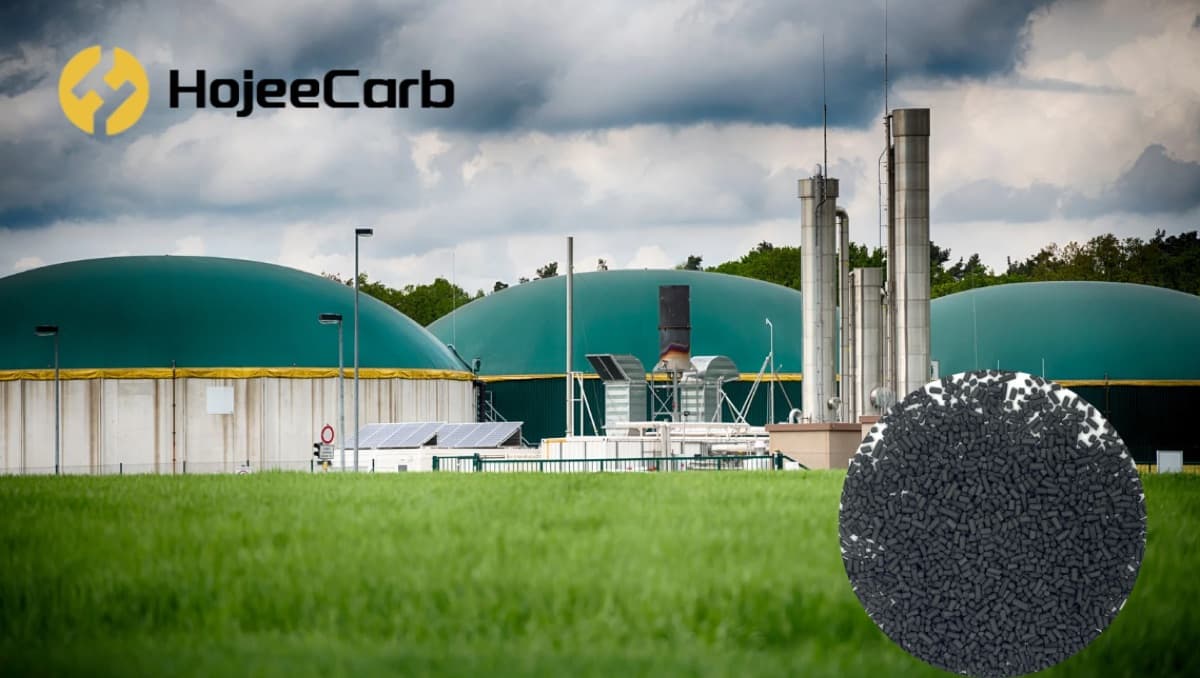
A biogas plant with multiple anaerobic digesters — activated carbon adsorbers are installed downstream to remove H₂S and siloxanes before the gas reaches CHP engines or biomethane upgrading units.
Cost Analysis & ROI of Activated Carbon Biogas Treatment
Understanding the economics of activated carbon biogas treatment helps operators make informed decisions about media selection and system design.
Treatment Cost Benchmarks
| Scenario | H₂S (ppm) | Flow (m³/h) | Carbon Type | Annual Carbon Cost | Cost per 1,000 m³ |
|---|---|---|---|---|---|
| Small farm digester | 500 | 50 | KOH pellet | $3,600 | $8.20 |
| Municipal WWTP | 1,000 | 200 | KOH pellet | $18,000 | $10.30 |
| Agricultural co-digester | 2,000 | 500 | Iron sponge + KOH | $22,000 | $5.00 |
| Landfill gas (H₂S + siloxane) | 200 | 1,000 | Virgin GAC (2-stage) | $35,000 | $4.00 |
ROI Considerations
The return on investment for activated carbon biogas treatment is driven by avoided costs:
- Engine protection: H₂S corrosion can cause $50,000–200,000 in engine overhaul costs. Carbon treatment cost is typically 5–10% of repair cost.
- Siloxane damage prevention: SiO₂ deposits on engine components can require $100,000+ in cylinder head and turbine blade replacements. Prevention is 10–20× cheaper than repair.
- Emission compliance: SO₂ emissions from untreated H₂S combustion can result in permit violations and fines.
- Biomethane premium: Upgrading biogas to RNG quality (H₂S <4 ppm) enables injection into natural gas grid at $15–30/MMBtu including RINs — far exceeding the value of on-site power generation.
2026 Market Trends & Outlook
The biogas purification carbon market is experiencing several transformative trends:
Renewable Natural Gas (RNG) Driving Premium Carbon Demand
The push to upgrade biogas to pipeline-quality biomethane is creating demand for higher-performance carbon grades. RNG specifications require H₂S below 4 ppm and total sulfur below 15 ppm — far more stringent than CHP engine requirements. This is driving adoption of:
- Multi-stage carbon systems (rough cut + polish)
- High-capacity impregnated carbons with >0.5 kg/kg H₂S loading
- Catalytic carbon (KI-impregnated) for ultra-low outlet specifications
European Biogas Boom
Europe — particularly Germany, France, and the UK — is aggressively expanding biogas production as part of energy security and decarbonization strategies. The EU's REPowerEU plan targets 35 billion m³ of biomethane production by 2030, up from ~3 billion m³ in 2022. This represents enormous growth in activated carbon demand for gas purification.
Innovation in Carbon Regeneration
Research published in the Journal of the Air & Waste Management Association shows that in-situ regeneration of GAC used for biogas desulfurization can extend bed life by 30–50% through controlled air exposure. Emerging electrochemical regeneration techniques (reported by ACS Publications) can concentrate adsorbed PFAS and sulfur compounds, further reducing carbon consumption.
Coconut Shell Carbon Supply Constraints
Global coconut shell activated carbon supply chains remain strained due to reduced exports from Indonesia and the Philippines, combined with surging demand from PFAS water treatment. For biogas applications, this has accelerated the shift toward coal-based and wood-based carbons as cost-effective alternatives, particularly for non-potable-water gas treatment where NSF certification is not required.
For the latest industry data and pricing trends, follow our 2026 activated carbon market outlook.
Frequently Asked Questions
What type of activated carbon is best for H₂S removal in biogas?
For biogas H₂S removal, impregnated pelletized activated carbon (4mm diameter) is the standard choice. KOH-impregnated or NaOH-impregnated carbon provides 2–5x higher H₂S capacity than virgin carbon because the alkaline impregnant reacts with H₂S to form sulfides and sulfates, while the carbon provides the surface for this reaction. For very high H₂S concentrations (>5,000 ppm), iron oxide-impregnated carbon or dedicated iron sponge beds may be more cost-effective as a first stage.
How long does activated carbon last in a biogas scrubber?
Activated carbon bed life in biogas systems depends on H₂S concentration, flow rate, and carbon type. As a general guide: impregnated carbon treating 1,000 ppm H₂S at standard flow typically lasts 6–12 months. Virgin (non-impregnated) carbon may last only 2–4 months under the same conditions. Research shows 1 kg of GAC can treat approximately 230–570 m³ of biogas at 1,000–2,100 ppm H₂S. Monitoring outlet H₂S concentration weekly is essential for scheduling replacement.
Can activated carbon remove siloxanes from biogas?
Yes. Activated carbon is one of the most effective technologies for siloxane removal from biogas. Virgin (non-impregnated) GAC with high surface area (>1,000 m²/g) and broad pore distribution works best for siloxanes, as these larger molecules require mesopores and macropores for adsorption. Typical siloxane loading capacity ranges from 5–15% by weight. Some operators use a two-stage system: impregnated carbon for H₂S followed by virgin carbon for siloxanes.
What is the cost of activated carbon treatment for biogas per 1,000 m³?
Based on published research, the cost to purify 1,000 m³ of biogas containing ~2,100 ppm H₂S using granular activated carbon is approximately $16.50 USD. For lower H₂S concentrations (1,000 ppm), costs drop to $8–12 per 1,000 m³. Using impregnated carbon with higher capacity further reduces the per-volume treatment cost despite the higher media price. For large-scale biogas plants (>500 m³/hour), the carbon treatment cost typically represents 5–10% of total operating expenses.
Should I use activated carbon or iron sponge for biogas desulfurization?
The choice depends on H₂S concentration, gas volume, and downstream requirements. Iron sponge (iron oxide media) is more cost-effective for very high H₂S (>3,000 ppm) as a bulk removal first stage. Activated carbon excels at polishing to very low H₂S levels (<1 ppm) required for CNG/biomethane upgrading and engine fuel. Many operations use a hybrid approach: iron sponge for rough cut, followed by impregnated activated carbon for final polishing. This extends overall media life and minimizes cost.
Source Biogas Purification Carbon Directly From the Manufacturer
We supply the full range of activated carbon for biogas applications — KOH/NaOH-impregnated pellets for H₂S removal, virgin GAC for siloxane adsorption, and iron oxide-impregnated media for bulk desulfurization. Factory-direct pricing starting from 1 MT, technical support for system design, and batch COA with every shipment.