
Impregnated activated carbon is standard activated carbon that has been treated with a chemical reagent — such as potassium hydroxide (KOH), sulfuric acid, silver, sulfur, or potassium permanganate — to enhance its ability to remove specific pollutants. While virgin activated carbon relies on physical adsorption (Van der Waals forces pulling molecules into pores), impregnated carbon adds a second removal mechanism: chemisorption, where the impregnant reacts with the target compound and converts it to a stable, non-volatile product.
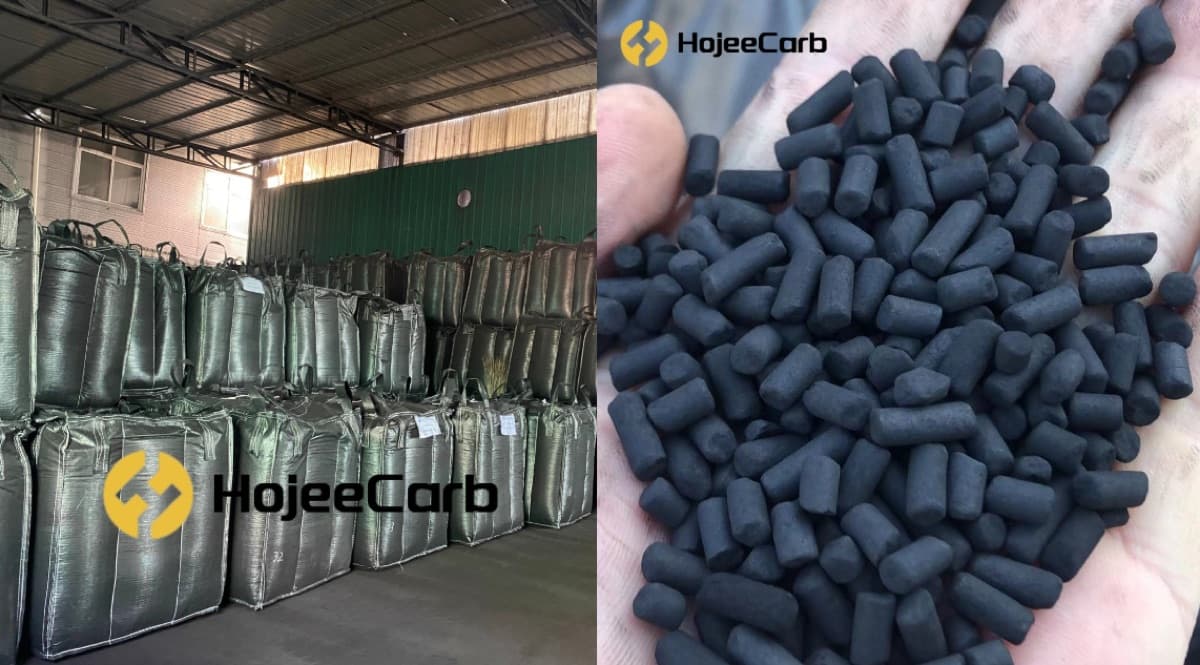
Impregnated activated carbon pellets in various diameters (1.5 mm, 3 mm, 4 mm) — the most common form factor for gas-phase purification applications.
The difference matters. Virgin carbon might adsorb 1–3% of its weight in hydrogen sulfide (H₂S) before breakthrough. KOH-impregnated carbon achieves 15–25% H₂S capacity by weight — a 5–10× improvement. Similarly, virgin carbon has negligible capacity for mercury vapor, but sulfur-impregnated carbon captures mercury with over 99% efficiency. For applications where a specific contaminant must be removed to very low concentrations, impregnated carbon is not optional — it is the only activated carbon solution that works.
As a manufacturer with 15+ years of experience producing both virgin and impregnated activated carbon, we supply custom-formulated products to clients in wastewater treatment, biogas upgrading, nuclear power, drinking water, industrial emissions control, and military/CBRN protection across 40+ countries. This guide covers the full spectrum of impregnation chemistry, application sectors, base carbon selection, quality specifications, and sourcing considerations.
How Impregnation Works
Impregnation is a post-activation process — the base carbon is first manufactured through standard carbonization and activation (steam or chemical), then treated with the desired reagent. The three main impregnation methods are:
Regardless of method, impregnation affects the base carbon properties. The chemical reagent occupies pore volume, so the iodine number (a measure of micropore capacity) typically drops 10–30% compared to the unimpregnated base carbon. BET surface area decreases proportionally. This is a normal and expected trade-off — the lost physical adsorption capacity is more than compensated by the gained chemisorption capacity for the target compound. When evaluating impregnated carbon quality, focus on the breakthrough capacity for your target compound rather than iodine number alone.
Need activated carbon?
Get Factory-Direct Pricing — No Middlemen
20+ years manufacturing. MOQ 1 ton. Free samples. Reply within 2 hours.
Major Impregnation Types: Complete Comparison
Each impregnation chemistry targets a specific class of pollutants through a distinct reaction mechanism. The table below summarizes the seven most commercially important impregnation types:
| Impregnant | Target Compounds | Mechanism | Typical Capacity | Key Applications |
|---|---|---|---|---|
| KOH / NaOH (caustic) | H₂S, SO₂, HCl, Cl₂, mercaptans | Acid-base neutralization → salts | 15–25% H₂S by weight | WWTP, biogas, natural gas, refineries |
| H₂SO₄ / H₃PO₄ (acid) | NH₃, amines, basic gases | Acid-base → ammonium salts | 5–12% NH₃ by weight | Composting, livestock, chemical plants |
| KI / TEDA | Radioactive I-131, methyl iodide | Isotopic exchange & chemisorption | >99% removal efficiency | Nuclear power plants, medical facilities |
| KMnO₄ (permanganate) | Formaldehyde, low-conc H₂S, ethylene | Oxidation → CO₂, H₂O, MnO₂ | 3–8% HCHO by weight | Indoor air, fruit storage, museums |
| Silver (Ag) | Bacteria, pathogens | Bacteriostatic / bactericidal | 0.01–0.1% Ag loading | Drinking water POU, medical, spacecraft |
| Sulfur (S) | Mercury vapor (Hg⁰) | Chemisorption → HgS (cinnabar) | 10–20% S loading, >99% Hg removal | Coal power plants, chlor-alkali, crematoriums |
| Copper oxide (CuO) | HCN, arsine (AsH₃), phosphine | Chemisorption → stable Cu compounds | 5–10% CuO loading | Military/CBRN, semiconductor fabs |
KOH / NaOH (Caustic) Impregnation
Caustic-impregnated carbon is the most widely used impregnated product globally. KOH or NaOH is loaded at 5–15% by weight onto pelletized or granular carbon. When H₂S contacts the alkaline surface in the presence of moisture, it reacts to form potassium sulfide (K₂S) and eventually potassium sulfate (K₂SO₄). The same mechanism neutralizes SO₂, HCl, Cl₂, and organic acids (mercaptans). Typical H₂S breakthrough capacity per ASTM D6646 is 15–25% by weight — the highest of any impregnation type for acid gas removal. KOH is preferred over NaOH in most markets because it provides slightly higher capacity per unit weight and better moisture resistance.
H₂SO₄ / H₃PO₄ (Acid) Impregnation
Acid-impregnated carbon targets basic gases — primarily ammonia (NH₃) and amines (trimethylamine, dimethylamine). The acid reagent reacts with ammonia to form ammonium sulfate or ammonium phosphate salts that are trapped in the carbon pore structure. Without acid impregnation, virgin carbon has almost zero capacity for ammonia because NH₃ is a small, polar molecule that does not adsorb well through physical forces alone. H₂SO₄ impregnation is more common; H₃PO₄ is used where sulfate contamination of downstream processes is a concern. Typical loading is 5–10% acid by weight, achieving 5–12% NH₃ capacity.
KI / TEDA Impregnation for Nuclear Applications
Potassium iodide (KI) and triethylenediamine (TEDA) impregnated carbon is a critical safety component in nuclear power plants and medical facilities that handle radioactive isotopes. The primary target is radioactive iodine-131 (I-131) and organic iodides (methyl iodide, CH₃I). KI works through isotopic exchange — radioactive iodine atoms swap with stable iodine on the carbon surface. TEDA enhances the capture of organic iodides that KI alone cannot effectively remove. Nuclear-grade impregnated carbon must meet stringent standards including ASTM D3803 testing at high temperature (180°C) and high humidity (95% RH) with methyl iodide challenge. Typical loading is 1–5% KI and 1–5% TEDA.
KMnO₄ (Potassium Permanganate) Impregnation
Permanganate-impregnated carbon combines physical adsorption with chemical oxidation. KMnO₄ is a strong oxidizer that converts formaldehyde to CO₂ and water, oxidizes low-concentration H₂S, and breaks down ethylene (the ripening gas in fruit storage). This makes it uniquely suited for indoor air quality applications where formaldehyde from building materials, furniture, and adhesives must be removed to meet health standards. It is also used in museums and archives to protect artifacts from oxidizing pollutants. Typical loading is 3–8% KMnO₄ by weight. The purple color of fresh permanganate carbon fades to brown as the reagent is consumed, providing a visual indicator of remaining capacity.
Silver (Ag) Impregnation
Silver-impregnated activated carbon is used in drinking water point-of-use (POU) filters, medical devices, and even spacecraft water recycling systems. Silver ions (Ag⁺) are bacteriostatic — they prevent bacterial growth on the carbon surface and in the treated water. At higher concentrations, silver is bactericidal, actively killing bacteria and pathogens. This solves a critical problem with standard carbon water filters: without silver impregnation, the carbon bed can become a breeding ground for bacteria, especially in warm climates or when filters sit unused for extended periods. Silver loading is typically very low — 0.01–0.1% by weight — because silver is expensive and only trace amounts are needed for antimicrobial effect. The silver must be applied as silver nitrate (AgNO₃) or colloidal silver to ensure uniform distribution across the carbon surface.
Sulfur (S) Impregnation for Mercury Removal
Sulfur-impregnated activated carbon is the industry standard for capturing elemental mercury vapor (Hg⁰) from flue gas streams. Mercury has a strong chemical affinity for sulfur — when Hg⁰ contacts the sulfur-loaded carbon surface, it reacts to form mercuric sulfide (HgS, also known as cinnabar), which is thermally stable and non-volatile. Sulfur loading is typically 10–20% by weight, applied via vapor deposition at elevated temperatures. This method ensures the sulfur is chemically bonded to the carbon rather than simply coating the surface, which prevents sulfur loss during handling and operation. Applications include coal-fired power plants (meeting EPA MATS regulations), chlor-alkali plants, waste incinerators, crematoriums, and cement kilns. Removal efficiencies exceed 99% at typical flue gas temperatures of 120–180°C.
Copper Oxide (CuO) Impregnation
Copper oxide impregnated carbon is a specialty product used primarily in military and CBRN (Chemical, Biological, Radiological, Nuclear) protective equipment and semiconductor manufacturing. CuO reacts with hydrogen cyanide (HCN), arsine (AsH₃), and phosphine (PH₃) — highly toxic gases that virgin carbon cannot effectively remove through physical adsorption alone. In military gas mask canisters, CuO-impregnated carbon (often combined with silver, zinc, molybdenum, and TEDA in the ASZM-TEDA formulation) provides broad-spectrum protection against chemical warfare agents. In semiconductor fabs, CuO carbon removes arsine and phosphine from exhaust streams. Typical CuO loading is 5–10% by weight.
Application Sectors
Biogas & Natural Gas Purification
Biogas from anaerobic digesters and landfill gas typically contains 100–10,000 ppm H₂S that must be removed before combustion in engines, turbines, or upgrading to biomethane. KOH-impregnated pelletized activated carbon is the standard polishing media, reducing H₂S from 50–200 ppm (after bulk removal by iron sponge or biological scrubbers) to below 1 ppm. The pellet form is critical for biogas applications because it provides uniform airflow distribution and low pressure drop across the carbon bed, minimizing energy consumption from blowers. Natural gas sweetening uses the same chemistry to remove H₂S and mercaptans that cause pipeline corrosion and odor complaints.
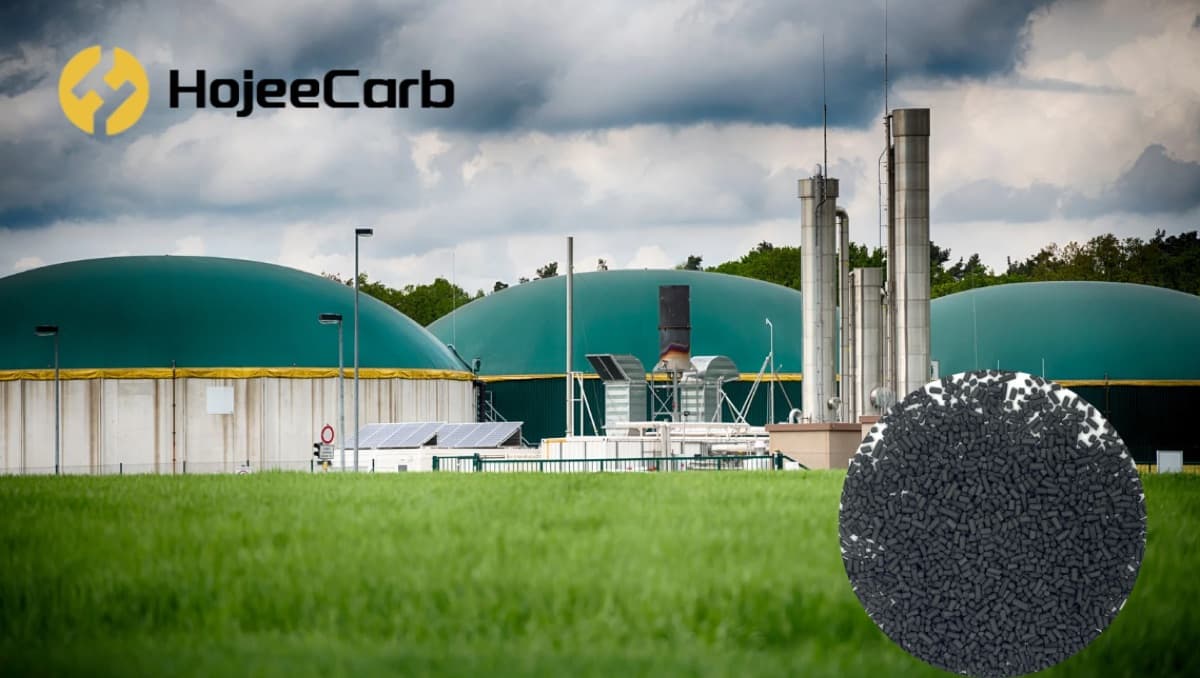
A biogas plant using KOH-impregnated activated carbon vessels for H₂S polishing before engine combustion — the most common application for caustic-impregnated carbon.
Nuclear Industry
Nuclear power plants use KI/TEDA-impregnated activated carbon in charcoal adsorber systems within the reactor containment building ventilation and the standby gas treatment system (SGTS). These systems must capture radioactive iodine-131 released during normal operations or accident conditions. The carbon must pass ASTM D3803 qualification testing — demonstrating >99% removal of methyl iodide at 30°C/95% RH and >99% at 180°C/95% RH. Nuclear-grade carbon is typically coconut shell based (for its high hardness and low dust generation) with 1–5% KI and 2–5% TEDA loading. Quality requirements are among the most stringent in the activated carbon industry, with full traceability from raw material to installed filter.
Drinking Water Treatment
Silver-impregnated activated carbon is widely used in point-of-use (POU) drinking water filters — the carbon block or granular filters found in pitcher filters, under-sink systems, and refrigerator filters. The coconut shell activated carbon base provides excellent chlorine, taste, and odor removal through physical adsorption, while the silver impregnation prevents bacterial colonization of the filter media. This is especially important in warm climates and for filters that may sit unused for days between uses. Silver-impregnated carbon for drinking water must meet NSF/ANSI 42 and NSF/ANSI 61 standards, which limit silver leaching to safe levels (below 0.1 mg/L in treated water).
Industrial Emissions Control
Industrial facilities use various impregnated carbons to meet emission regulations. Coal-fired power plants inject sulfur-impregnated or brominated activated carbon into flue gas ducts to capture mercury before the particulate control device (baghouse or ESP). Chlor-alkali plants use sulfur-impregnated carbon beds to remove mercury from hydrogen gas streams. Chemical plants use KOH-impregnated carbon for acid gas and odor control from process vents. Waste incinerators combine multiple impregnation types to address the complex mix of mercury, acid gases, and dioxins in flue gas.
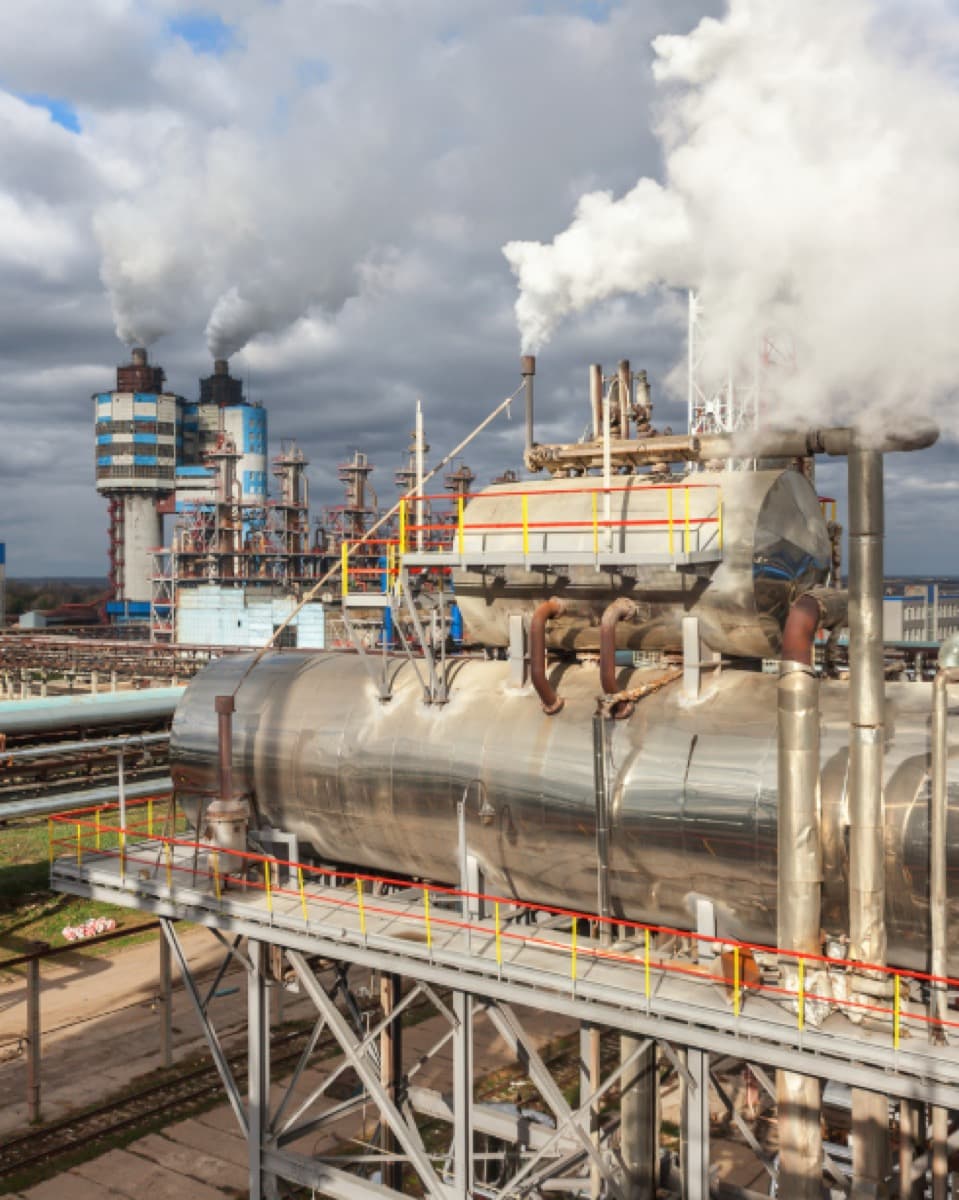
An industrial chemical plant using impregnated activated carbon adsorption systems for emission control — multiple impregnation types may be deployed across different process streams.
Indoor Air Quality
New buildings, renovated spaces, and manufactured homes often have elevated formaldehyde levels from composite wood products, adhesives, paints, and insulation. KMnO₄-impregnated carbon in HVAC filters or standalone air purification units removes formaldehyde through oxidation, while the carbon base simultaneously adsorbs VOCs and other organic pollutants. For museums, archives, and art storage, KMnO₄ carbon also removes ozone, SO₂, and NO₂ that degrade paper, textiles, and pigments. Fruit storage and distribution facilities use KMnO₄ carbon to remove ethylene gas, extending shelf life of produce.
Military & CBRN Protection
Military gas mask canisters and collective protection filters use multi-impregnated activated carbon — typically the ASZM-TEDA formulation containing copper, silver, zinc, molybdenum, and triethylenediamine on a coconut shell carbon base. This combination provides broad-spectrum protection against chemical warfare agents (nerve agents, blister agents, blood agents), toxic industrial chemicals (TICs), and radioactive iodine. Military-grade carbon must meet MIL-DTL-32101 or equivalent national standards, with extremely high hardness (>95 ball-pan hardness) to prevent dust generation inside respiratory equipment. This is the most demanding application for impregnated carbon in terms of quality specifications and testing requirements.
Carbon Base Selection: Which Form for Which Impregnation
The base carbon form — pelletized, granular, or powdered — significantly affects impregnation uniformity, system performance, and application suitability. Choosing the right base is as important as choosing the right impregnant.
Pelletized (Extruded) Carbon
Pelletized carbon is the preferred base for most gas-phase impregnated products. Extruded pellets offer uniform diameter (typically 1.5 mm, 3 mm, or 4 mm), consistent density, low dust generation, and predictable pressure drop. The uniform shape ensures even impregnant distribution during wet impregnation — every pellet receives approximately the same chemical loading. Standard diameters: 1.5 mm for low-flow applications requiring maximum contact surface; 3 mm for general industrial use; 4 mm for high-airflow systems where pressure drop must be minimized. Pelletized carbon is the standard choice for H₂S removal in biogas, WWTP odor control, and industrial emission systems.
Pelletized activated carbon in 1.5 mm, 3 mm, and 4 mm diameters — the most common base form for gas-phase impregnated products.
Granular Activated Carbon (GAC)
Granular carbon (irregular-shaped particles from crushed and screened coal-based or coconut shell carbon) is versatile for both gas and liquid phase impregnated applications. Common mesh sizes for impregnated GAC are 4×8 (gas phase) and 8×30 or 12×40 (liquid phase). GAC is less uniform than pellets, so impregnant distribution can vary slightly between particles, but it is generally less expensive and available in a wider range of raw materials and pore structures. Silver-impregnated GAC is the standard for drinking water POU filters. Sulfur-impregnated GAC is used in mercury removal beds.
Powdered Activated Carbon (PAC)
Powdered carbon (particle size <0.1 mm, typically 80% passing 200 mesh) is used exclusively in liquid-phase applications and injection systems. Impregnated PAC is less common than impregnated pellets or GAC, but it has important niche applications. Brominated PAC is injected into coal-fired power plant flue gas ducts for mercury capture — the fine particle size provides rapid contact with mercury vapor in the short residence time available before the particulate collector. Sulfur-impregnated PAC serves the same mercury removal function where brominated products are not suitable. PAC cannot be used in fixed-bed adsorbers due to excessive pressure drop.
Specifications & Quality Parameters
When specifying impregnated activated carbon, the standard physical parameters (iodine number, surface area, hardness) still matter — but additional impregnation-specific parameters are equally important. Here are the key specifications to include in your purchase order:
| Parameter | Typical Range | Test Method | Why It Matters |
|---|---|---|---|
| Impregnation loading (% w/w) | 5–20% (varies by type) | Gravimetric / titration | Directly determines chemisorption capacity |
| Residual iodine number | 600–900 mg/g | ASTM D4607 | Indicates remaining physical adsorption capacity |
| H₂S breakthrough capacity | 15–25% w/w (KOH type) | ASTM D6646 | The primary performance metric for acid gas carbons |
| Moisture content | <5% (as packed) | ASTM D2867 | Excess moisture reduces effective capacity |
| Hardness number | >90 (pellets), >85 (GAC) | ASTM D3802 | Prevents dust and fines during handling and operation |
| Dust / fines content | <2% (passing 60 mesh) | ASTM D5158 | Fines increase pressure drop and can clog downstream equipment |
Sourcing & Custom Impregnation
With 15+ years of manufacturing experience and dedicated impregnation lines, we produce the full range of chemically impregnated activated carbon products — from high-volume KOH pellets for biogas plants to specialty silver-impregnated coconut shell carbon for drinking water filters. Our impregnation capabilities include:
Frequently Asked Questions: Impregnated Activated Carbon
What is the difference between impregnated and virgin activated carbon?
Virgin (non-impregnated) activated carbon removes contaminants through physical adsorption — Van der Waals forces attract molecules into the carbon pore structure. Impregnated activated carbon has chemical reagents added to the carbon surface that react with specific target compounds, converting them to non-volatile salts, oxides, or other stable compounds. Impregnated carbon has much higher capacity for specific pollutants (e.g., 15–25% H₂S capacity for KOH-impregnated vs 1–3% for virgin carbon) but reduced capacity for general-purpose adsorption because the impregnant occupies some pore volume. Choose impregnated carbon when you have a specific target compound; choose virgin carbon for broad-spectrum removal.
Does impregnation reduce the iodine number of activated carbon?
Yes. Impregnation typically reduces the iodine number by 10–30% compared to the base carbon, because the chemical reagent occupies micropore volume that would otherwise be available for iodine adsorption. For example, a base carbon with an iodine number of 1,000 mg/g may test at 700–900 mg/g after KOH impregnation depending on loading level. This is expected and does not indicate poor quality — the lost physical adsorption capacity is more than compensated by the gained chemisorption capacity for the target compound. When specifying impregnated carbon, focus on the breakthrough capacity for your target compound (e.g., H₂S capacity per ASTM D6646) rather than iodine number alone.
Can impregnated activated carbon be regenerated?
In most cases, no. The chemical reactions that give impregnated carbon its enhanced capacity are irreversible — KOH-impregnated carbon converts H₂S to potassium sulfide/sulfate, sulfur-impregnated carbon converts mercury to mercuric sulfide, and these reaction products cannot be easily removed. The spent carbon must be replaced with fresh media. Some specialty applications use thermal regeneration to restore a portion of the physical adsorption capacity, but the impregnant is lost in the process and must be re-applied. For most industrial users, the economics favor replacement over regeneration for impregnated products.
How do I choose the right impregnation type for my application?
Start with the target compound. For H₂S, SO₂, HCl, and acid gases, use KOH or NaOH (caustic) impregnation. For ammonia and amines, use H₂SO₄ or H₃PO₄ (acid) impregnation. For mercury vapor, use sulfur impregnation. For radioactive iodine, use KI or TEDA impregnation. For formaldehyde and ethylene, use KMnO₄ impregnation. For bacteria in drinking water, use silver impregnation. For HCN and arsine in military/CBRN applications, use copper oxide impregnation. If you have multiple target compounds, a multi-stage system with different impregnation types in each stage is often the best approach. Contact us with your gas composition and we can recommend the optimal formulation.
What is the minimum order quantity for custom-impregnated activated carbon?
For standard impregnation types (KOH, NaOH, H₂SO₄, H₃PO₄), our minimum order quantity is typically 1 MT (one metric ton), which fits on a single pallet. For specialty impregnations (silver, KI/TEDA, KMnO₄, sulfur, copper oxide), the MOQ is usually 2–5 MT depending on the specific formulation and loading level, because these require dedicated production runs. We can provide 5–10 kg samples of any impregnation type for laboratory testing before committing to a production order. Lead time is typically 2–4 weeks for standard impregnations and 4–6 weeks for specialty products.
Need Custom Impregnated Activated Carbon?
Request samples of our KOH, acid, silver, sulfur, or specialty impregnated carbon products. We provide technical data sheets, breakthrough capacity reports, and application engineering support.
Request Impregnated Carbon Samples →Related Articles & Products
- Activated Carbon for Odor Control: Industrial & Municipal Guide →
- Activated Carbon for Air Purification: Complete Systems Guide →
- Activated Carbon for VOC Removal: Industrial Air Treatment Guide →
- Activated Carbon Quality Testing: Iodine, CTC, BET & More →
- Activated Carbon Mesh Size Explained: 4×8, 8×30, 12×40 & More →
- Pellet Activated Carbon Products →
- Coal-Based Activated Carbon Products →
- Coconut Shell Activated Carbon Products →