
“What mesh size do I need?” is one of the most common questions we receive from buyers. The answer depends on your application, system design, and the trade-off between adsorption speed and pressure drop. This guide explains what mesh numbers mean, how they translate to actual particle dimensions, and which sizes are standard for common applications.
What Does “Mesh Size” Mean?
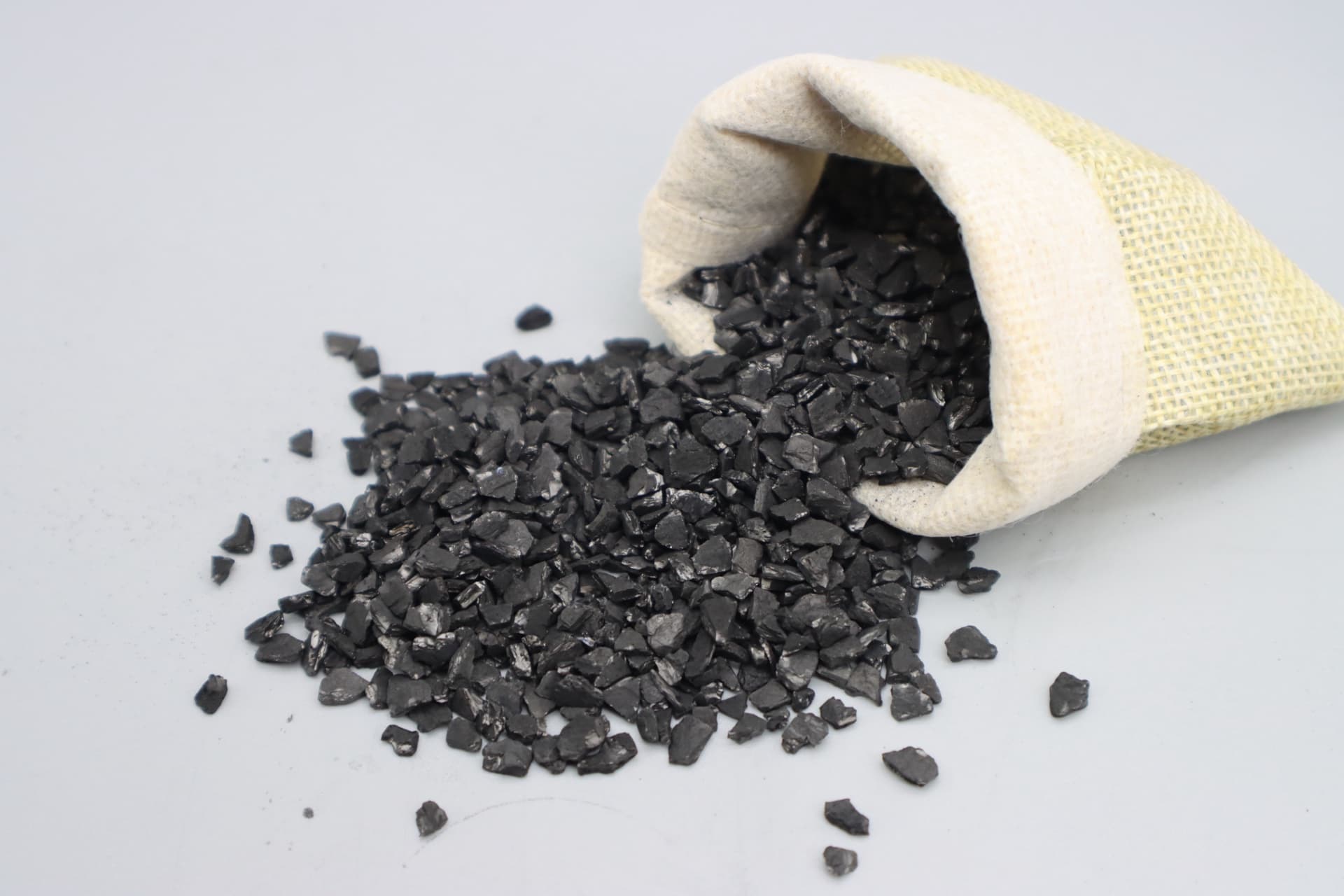
Mesh size refers to the number of openings per linear inch in a wire sieve. A “30 mesh” sieve has 30 openings per inch, meaning each opening is approximately 0.6 mm wide. The higher the mesh number, the smaller the particles that pass through.
When you see a designation like 8×30 mesh, it means: particles pass through an 8-mesh sieve (≤2.36 mm) but are retained on a 30-mesh sieve (≥0.60 mm). So 8×30 activated carbon consists of granules between 0.60 mm and 2.36 mm in diameter.
Need activated carbon?
Get Factory-Direct Pricing — No Middlemen
20+ years manufacturing. MOQ 1 ton. Free samples. Reply within 2 hours.
Mesh-to-Millimeter Conversion Chart
| US Mesh | Opening (mm) | Opening (inch) | Category |
|---|---|---|---|
| 4 | 4.75 | 0.187 | Coarse GAC |
| 6 | 3.35 | 0.132 | Coarse GAC |
| 8 | 2.36 | 0.0937 | Standard GAC |
| 12 | 1.70 | 0.0661 | Standard GAC |
| 16 | 1.18 | 0.0469 | Fine GAC |
| 20 | 0.85 | 0.0331 | Fine GAC |
| 30 | 0.60 | 0.0234 | Fine GAC |
| 40 | 0.425 | 0.0165 | Very fine GAC |
| 60 | 0.250 | 0.0098 | Coarse PAC |
| 100 | 0.150 | 0.0059 | PAC |
| 200 | 0.075 | 0.0029 | Standard PAC |
| 325 | 0.045 | 0.0017 | Fine PAC |
Standard Activated Carbon Mesh Sizes by Application
| Mesh Size | Particle Range | Primary Applications |
|---|---|---|
| 4×6 | 3.35–4.75 mm | Gold recovery (CIP/CIL), coarse bed filtration, vapor phase treatment with very low pressure drop requirements |
| 4×8 | 2.36–4.75 mm | Gold recovery, air purification deep beds, gravity-fed water filters |
| 6×12 | 1.70–3.35 mm | Gold recovery (elution-friendly), large-scale water treatment, catalytic applications |
| 8×16 | 1.18–2.36 mm | Industrial wastewater, point-of-entry (POE) water filters |
| 8×30 | 0.60–2.36 mm | Municipal water treatment, industrial wastewater, aquariums — the most versatile GAC size |
| 12×40 | 0.425–1.70 mm | Drinking water (POU/POE), chlorine removal, taste & odor control — AWWA standard size |
| 20×50 | 0.30–0.85 mm | Point-of-use (POU) water filters, under-sink cartridges, high-efficiency small systems |
| 200 mesh (80%+ passing) | <0.075 mm | PAC — batch dosing in water treatment, decolorization, emergency spill response |
The Fundamental Trade-Off: Kinetics vs. Pressure Drop
Understanding this trade-off is the key to choosing the right mesh size:
Smaller particles (finer mesh):
✅ Faster adsorption kinetics (shorter diffusion path to micropores)
✅ More external surface area per unit volume
✅ Better removal efficiency at shorter contact times
❌ Higher pressure drop across the bed
❌ Higher risk of channeling and bed compaction
❌ More difficult to backwash
Larger particles (coarser mesh):
✅ Lower pressure drop — less pumping energy required
✅ Easier backwashing and bed expansion
✅ More uniform flow distribution
❌ Slower adsorption kinetics
❌ Requires longer contact time (deeper bed or slower flow)
❌ May not achieve target removal at high flow rates
In practice, for most water treatment applications, 8×30 or 12×40 gives the optimal balance. Gold recovery requires coarser sizes (4×8, 6×12) for mechanical strength in the aggressive CIP/CIL environment.
Effective Size (ES) and Uniformity Coefficient (UC)
Beyond the mesh range, two additional particle size parameters matter for system design:
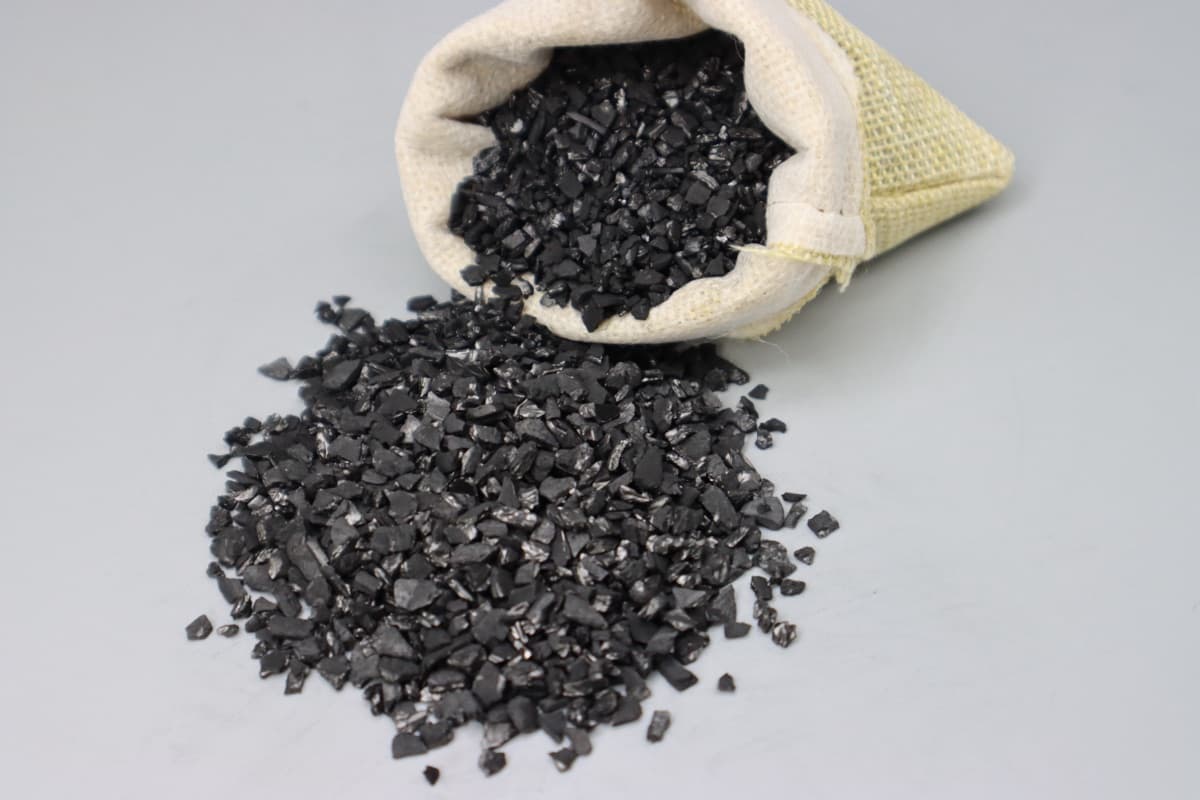
Effective Size (D10)
The sieve opening that passes 10% of the carbon by weight. For 12×40 coconut shell GAC, typical D10 is 0.55–0.75 mm. This is the number that determines the minimum head loss through the bed.
Uniformity Coefficient (D60/D10)
The ratio of D60 to D10. A UC of 1.0 means perfectly uniform particles (impossible in practice). The AWWA B604 standard requires UC ≤ 2.1 for GAC in water treatment. Lower UC means more uniform flow and more predictable performance.
How to Read a Sieve Analysis Report
Every activated carbon COA includes a sieve analysis (also called particle size distribution or PSD). Here's an example for 12×40 coconut shell GAC and what the numbers mean:
| Sieve | Opening | % Retained | Interpretation |
|---|---|---|---|
| +10 mesh | >2.00 mm | 2% | Oversize — should be ≤5% per AWWA spec |
| 10×14 | 1.40–2.00 mm | 18% | Coarse fraction |
| 14×20 | 0.85–1.40 mm | 35% | Main fraction — largest portion |
| 20×30 | 0.60–0.85 mm | 28% | Medium fraction |
| 30×40 | 0.425–0.60 mm | 14% | Fine fraction |
| −40 mesh | <0.425 mm | 3% | Undersize — should be ≤5% per AWWA spec |
Key things to check: oversize and undersize should each be ≤5%. The distribution should be bell-shaped, not bimodal. Excessive fines increase pressure drop and turbidity during startup.
Custom and Non-Standard Sizes
While 8×30 and 12×40 cover most applications, some industries require specific sizes:
Custom mesh sizes can be produced by adjusting the crushing and screening process. Minimum order for custom sizes is typically 5–10 MT, and lead time is 2–3 weeks longer than standard products.
Bottom Line: Quick Selection Guide
Frequently Asked Questions
What does mesh size mean for activated carbon?
Mesh size indicates particle size defined by US Standard sieve numbers. A designation like 8×30 means particles pass through an 8-mesh sieve (2.38 mm) but are retained on a 30-mesh sieve (0.595 mm). The first number is the coarse limit, the second is the fine limit.
Which mesh size is best for water filtration?
For gravity filters, 8×30 mesh offers the best balance of flow rate and efficiency. For pressure filters, 12×40 mesh provides better removal with more surface contact but requires more pressure. For home point-of-use filters, 20×50 mesh is sometimes used.
How does mesh size affect pressure drop?
Smaller mesh creates higher pressure drop. A 12×40 bed typically has 2–3 times the pressure drop of an 8×30 bed at the same flow rate. System designers must balance removal efficiency against energy costs and available pump head.
What mesh size is used for air treatment?
For air treatment, 4×8 or 4×10 mesh is standard, providing large particles with low pressure drop for high air volumes. For industrial adsorber vessels, 4×6 mesh columnar carbon is common. Larger particles mean lower pressure drop with slightly slower kinetics.
Can I mix different mesh sizes of activated carbon?
Mixing is not recommended. Different sizes settle at different rates, causing stratification and channeling — water follows the path of least resistance through coarser zones. Use a single consistent mesh size per bed. For different performance zones, use separate beds in series.
Not Sure Which Mesh Size You Need?
Tell us your application details — we'll recommend the optimal mesh size and provide samples for testing.
Get Product Recommendation