
I'll be honest — when a client calls and says “I need activated carbon,” the first question out of my mouth is always the same: granular or powdered? And about 40% of the time, they don't know. Or worse, they've already spec'd the wrong one because someone in procurement Googled it for ten minutes.
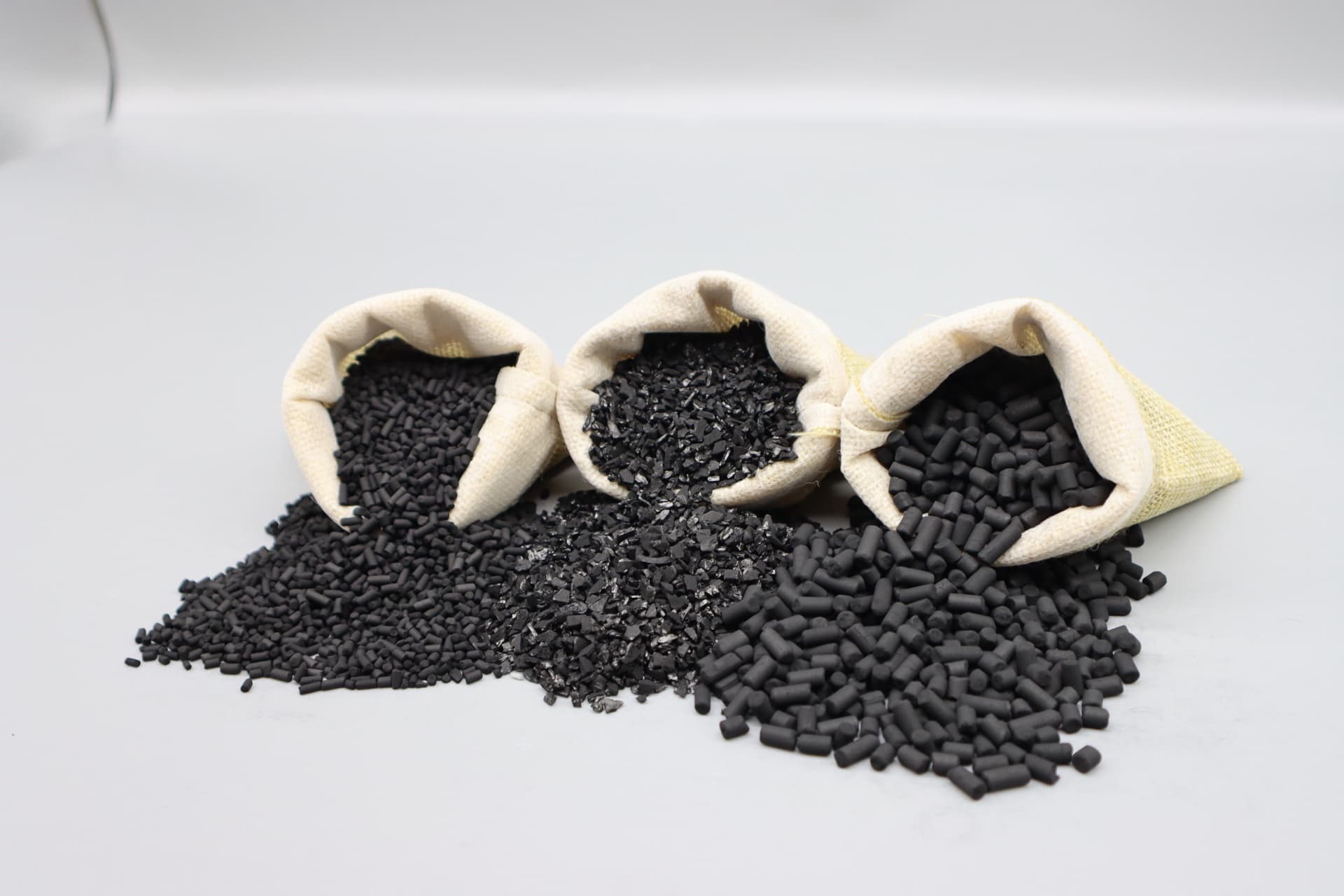
GAC and PAC aren't interchangeable. Full stop. They're manufactured differently, dosed differently, priced on completely different models, and they solve different problems. We produce both at our Fujian facility — roughly 15,000 tons of GAC and 8,000 tons of PAC annually — so we see the decision play out hundreds of times a year. Check our full activated carbon product catalog if you already know what you need.
This guide breaks down everything you actually need to decide. No fluff, no hedging, no “it depends.” (Okay, sometimes it depends. But I'll tell you exactly on what.)
The Basics: What Are GAC and PAC, Physically?
Granular Activated Carbon (GAC) — irregular granules or shaped pellets, typically 0.5–4.0 mm in diameter (that's roughly 8×30 to 4×8 mesh, US Standard). You can pick up a single particle between your fingers. The stuff fills fixed-bed adsorption columns, gravity filters, and pressure vessels. Think of it as the “install and run” option.
Powdered Activated Carbon (PAC) — fine particles, typically 44 µm or smaller (325 mesh pass rate >90%). Looks and feels like black flour. You dose it directly into a liquid stream, let it do its thing during mixing and sedimentation, then separate it out. It's the “add and remove” option.
The size difference isn't trivial — we're talking about a factor of 50–100× between the two. That gap drives every downstream difference in contact time, equipment design, regeneration economics, and dosing strategy.
How They're Made: Same Oven, Different Exit
Both start from the same raw materials — coconut shell, coal, wood, or bamboo — and both go through carbonization (400–600°C, oxygen-starved) followed by activation (800–1000°C with steam or CO₂). The fundamental chemistry is identical. What diverges is the post-activation processing.
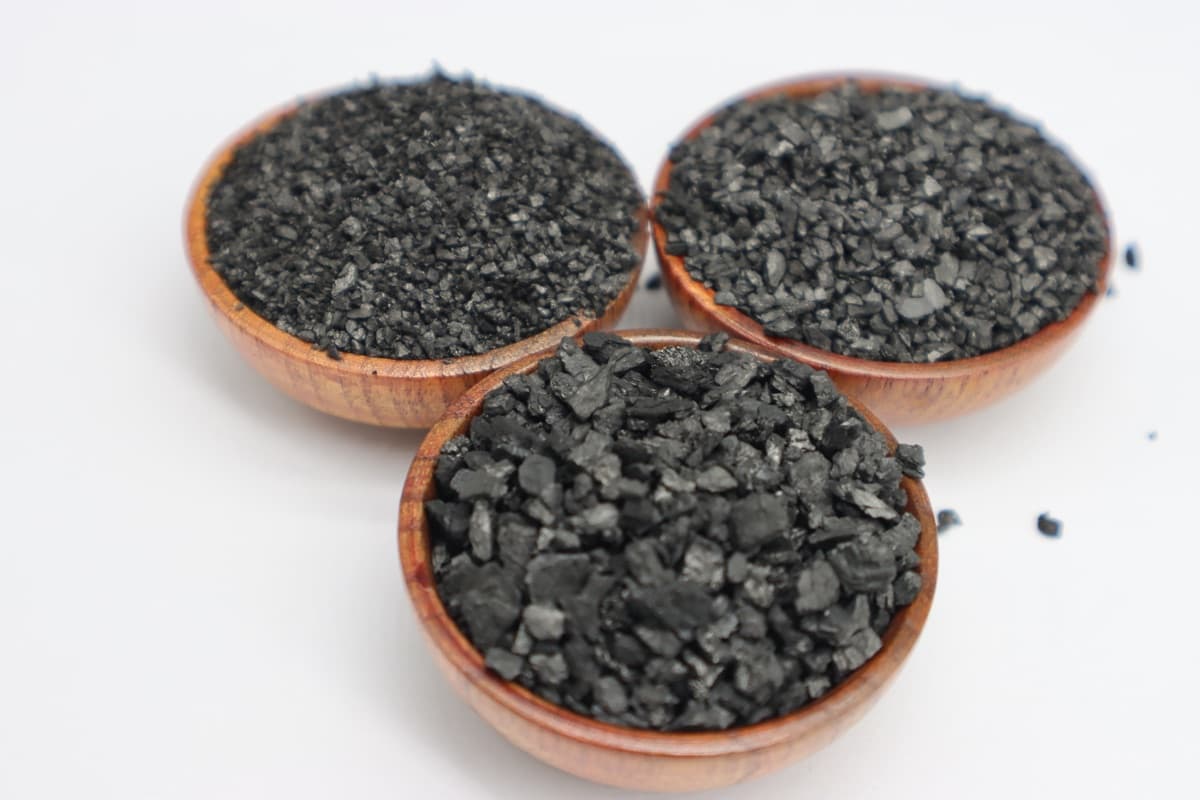
For GAC, we crush and screen the activated char to target mesh sizes. The crushing is actually the tricky part — over-crush and you generate excessive fines (wasted material). Under-crush and you get oversized particles with poor internal diffusion. Our screening lines run 4-deck vibrating screens with 98%+ cut accuracy.
For PAC, we feed the same activated char into a ball mill or Raymond mill and pulverize it. The target is D₅₀ around 15–25 µm with 90%+ passing 325 mesh (44 µm). Milling generates heat, which we manage with air classifiers and cooling systems — overheating degrades surface chemistry, which kills adsorption performance on VOCs and chlorinated organics.
Here's what most buyers don't realize: PAC is cheaper per ton to produce than GAC from the same feedstock. Why? Because GAC requires careful sizing with minimal fines generation — you're paying for yield loss. PAC doesn't care about particle shape. Crush it all. But the per-ton price difference often inverts at the application level because PAC is single-use.
Head-to-Head: The Comparison Table You Actually Need
I've sat through dozens of presentations with nice-looking comparison tables that leave out the numbers. Here's the real data, pulled from our production specs and project records:
| Parameter | GAC | PAC |
|---|---|---|
| Particle Size | 0.5–4.0 mm | <44 µm (90%+) |
| BET Surface Area | 800–1,100 m²/g | 800–1,200 m²/g |
| Required Contact Time | 5–20 minutes EBCT | 30 sec–5 min (mixing) |
| Capital Investment | High ($50K–$500K+ vessels) | Low ($5K–$30K dosing system) |
| Operating Cost (per 1,000 m³ treated) | $8–$25 | $15–$60 |
| Regeneration | Yes — thermal, 85–95% recovery | Rarely economical — single-use |
| Bed Life | 6–24 months before changeout | N/A — consumed per batch |
| Typical Dosing | Fixed bed, 200–600 kg/m³ bed density | 5–50 mg/L slurry injection |
| Best For | Continuous flow, long-term ops | Seasonal spikes, emergency response |
When GAC Is the Clear Winner
GAC dominates three scenarios, and in each case, trying to substitute PAC would be either impractical or insanely expensive.
1. Continuous-Flow Water Treatment
Municipal drinking water plants, industrial process water, tertiary wastewater polishing — anywhere you've got a steady flow rate and need consistent effluent quality 24/7. A properly designed GAC adsorption system for water treatment with 10–15 minute EBCT will strip organics, taste, odor, and residual chlorine to below detection limits for months on end.
We supplied a 2×50-ton GAC system to a municipal plant in Southeast Asia last year — 12,000 m³/day capacity. Their previous approach? PAC dosing at 20 mg/L. Annual carbon cost dropped from $185,000 to $62,000 after switching to GAC with thermal regeneration. Paid back the vessel investment in 14 months.
2. Air & Gas Phase Purification
You can't dose powder into an air stream. Well, you can — it's called activated carbon injection (ACI) in flue gas treatment — but for general industrial air purification, VOC removal, odor control, and solvent recovery, GAC in fixed beds is the only game in town. 4×8 mesh or 4 mm pellets, packed into canisters or deep-bed adsorbers.
Contact times are shorter in gas phase — 0.5 to 2 seconds residence time is common. But you need the structural integrity of granular particles to maintain airflow and prevent excessive pressure drop. PAC would compact, channel, and basically turn into a wall.
3. Fixed-Bed Adsorption with Regeneration
This is the big one economically. GAC can be thermally regenerated at 700–900°C, recovering 85–95% of its adsorption capacity. A well-managed GAC bed can go through 4–6 regeneration cycles before the particles degrade enough to warrant replacement. That's 3–5 years of service from one initial fill.
Regeneration isn't free — $400–$800/ton at third-party kilns, plus logistics. But compared to buying virgin carbon every time? It's a no-brainer for any system running more than about 20 tons. Below that threshold, the economics get fuzzy and you might be better off with virgin changeouts.
When PAC Makes More Sense
PAC gets a bad rap as the “cheap option.” That's wrong. It's the flexible option, and in certain scenarios, it's the only option that makes engineering sense.
1. Seasonal or Intermittent Contamination
Algal blooms. Agricultural runoff spikes. Taste-and-odor events that hit for 6–8 weeks in summer and disappear. You're not going to install a $200K GAC system for a problem that exists two months a year. You dose PAC at 15–30 mg/L into the rapid mix chamber, increase it when the geosmin/MIB levels spike, dial it back when they drop. Done.
A client in the Middle East runs exactly this playbook — PAC dosing from May to August when their reservoir source gets hammered with algal metabolites. Annual PAC cost: about $40,000. A GAC retrofit was quoted at $280,000 installed, and they didn't need it the other 8 months. Easy call.
2. Emergency & Spill Response
Chemical spill upstream. Pesticide contamination event. Sudden industrial discharge into a river intake. You need adsorption capacity now, not in the 6–12 weeks it takes to procure and install a GAC system. PAC can be stockpiled in bags, dosed within hours of a contamination event, and adjusted in real-time based on influent monitoring.
We keep emergency PAC inventory for several utility clients — pre-positioned 20-ton lots on pallets, ready to ship within 48 hours anywhere in Asia-Pacific. When the call comes at 2 AM, nobody's asking about regeneration economics.
3. Batch Processing & Low-Volume Applications
Decolorization in food and beverage. Pharmaceutical purification. Specialty chemical polishing. These are batch operations — you dose PAC into a tank, stir for 30–60 minutes, filter it out. The volumes are small (hundreds to low thousands of liters), the contact times are short, and the carbon demand per batch is measured in kilograms, not tons.
GAC columns exist for these applications too, but for small facilities running 2–3 batches per day, the capital cost of a column system doesn't pencil out. A 25 kg bag of PAC and a filter press will do the job.
Need GAC or PAC?
Get Factory-Direct Pricing — No Middlemen
20+ years manufacturing. MOQ 1 ton. Free samples. Reply within 2 hours.
Cost Analysis: The Math That Actually Matters
Here's where most comparison articles fall apart — they quote per-ton prices and call it a day. Per-ton price is almost meaningless without context. For current market benchmarks by carbon type and grade, see our activated carbon price guide. Let me walk through a real scenario.
Scenario: Municipal plant, 5,000 m³/day, moderate organic load
Option A — GAC: Two-column system, 8-ton fill each (16 tons total). Virgin GAC at $1,200/ton = $19,200 initial fill. Vessels, piping, instrumentation: ~$120,000 installed. Bed life: 12 months. Regeneration at $600/ton with 10% makeup = $11,520/year ongoing.
Option B — PAC: Dosing system (hopper, screw feeder, slurry tank): ~$15,000 installed. Average dose 20 mg/L × 5,000 m³/day = 100 kg/day = 36.5 tons/year. PAC at $800/ton = $29,200/year. No regeneration.
Year 1 total cost: GAC = $139,200 (heavy CAPEX) vs PAC = $44,200.
Year 3 cumulative: GAC = $162,240 vs PAC = $102,600.
Year 5 cumulative: GAC = $185,280 vs PAC = $161,000.
Breakeven: GAC wins around year 6. After that, the gap widens every year.
The takeaway: if you're running the plant for 10+ years (which... you are), GAC is the cheaper long-term play for continuous operations. PAC wins the short game and anything under ~3 years of expected operation.
But watch out for hidden costs. GAC systems need backwash water handling, media replacement logistics, and column maintenance. PAC systems increase sludge volume by 15–30%, which raises disposal costs — that $29,200/year in PAC can easily add another $8,000–$12,000 in excess sludge handling. Factor that in.
The Hybrid Play: Using GAC and PAC Together
This is what experienced operators do, and it's honestly the approach we recommend most often. The idea is simple: run GAC columns for baseline treatment and keep PAC dosing available for peak events.
Real example: a drinking water utility in China runs a two-stage treatment train. Stage one is conventional (coag-floc-sed-filtration) with PAC dosing at the rapid mix — they hit it with 10–15 mg/L year-round, spiking to 30–40 mg/L during algal season. Stage two is GAC post-filtration adsorbers with 12-minute EBCT for final polishing. The PAC handles the seasonal swings and protects the GAC beds from premature exhaustion.
Result? GAC bed life extended from 8 months to 18 months. Annual regeneration cycles cut in half. Net savings: around $35,000/year on a 20,000 m³/day plant. The PAC cost is real, but it's more than offset by the reduced GAC changeout frequency.
Other hybrid approaches we've seen work well:
- ◆PAC as pretreatment upstream of GAC columns — removes the bulk organics load so the GAC handles only trace compounds. Especially effective for high-NOM source waters.
- ◆PAC for emergency backup — keep 5–10 tons stockpiled. If your GAC bed exhausts unexpectedly or you have a changeout window, PAC dosing keeps you in compliance while the columns are offline.
- ◆GAC for organics, PAC for specific contaminants — some micropollutants (pharmaceuticals, PFAS precursors) adsorb better with the high surface contact of fine PAC particles. Target them specifically rather than asking your GAC bed to do everything.
The Decision Framework: A Step-by-Step Walkthrough
Forget the fancy flowchart. Here's how I actually walk clients through the decision. Five questions, in order:
Step 1 → Is this gas phase or liquid phase?
Gas phase = GAC. End of discussion. PAC in gas phase is a niche application (ACI for mercury in coal plants) and if that's your situation, you already know it. For everything else — VOC removal, odor control, solvent recovery — it's GAC in fixed beds or canisters.
Step 2 → Is the contamination continuous or intermittent?
Continuous (year-round, steady state) = lean toward GAC. Intermittent (seasonal, event-driven, <4 months/year) = lean toward PAC. If it's somewhere in between — say, 6–8 months of needed treatment — that's the gray zone. Move to Step 3.
Step 3 → What's your flow rate?
Below 500 m³/day, PAC almost always wins on total cost of ownership unless you're operating for 10+ years. Above 5,000 m³/day, GAC almost always wins if you have access to regeneration services. The 500–5,000 m³/day range is where you need to do the actual math — and that math depends on your contaminant load, target effluent limits, and local regeneration costs.
Step 4 → Can you handle the sludge?
PAC ends up in your sludge stream. If you're already struggling with sludge disposal costs or volumes, adding 20–50 mg/L of carbon to every cubic meter of water isn't going to help. Some plants in regions with strict sludge regulations (EU, Japan, parts of Australia) choose GAC specifically to avoid the sludge problem.
Step 5 → What's your CAPEX tolerance?
Sometimes the answer is simply: “we don't have $150K for a GAC system right now.” That's a perfectly valid reason to go PAC. Start with PAC, collect operational data for a year, and use that data to justify the GAC capital expenditure in next year's budget. We see this phased approach all the time — probably 30% of our GAC system sales start as PAC users who graduated.
If you go through all five steps and you're still not sure, that usually means hybrid is your answer. Or you need jar testing and a pilot study — and yeah, we can help with that too.
Mistakes I See Over and Over
- ✕Comparing per-ton prices without lifecycle analysis. PAC at $800/ton vs GAC at $1,200/ton — “PAC is cheaper!” No. Calculate cost per thousand cubic meters treated over your project lifetime. That's the number that matters.
- ✕Ignoring regeneration availability. GAC's cost advantage depends heavily on thermal regeneration. If the nearest reactivation kiln is 2,000 km away, your logistics costs might kill the economics. Check before committing.
- ✕Overdosing PAC without jar testing. I've seen plants running 40 mg/L PAC when 15 mg/L would hit the same target. That's $50,000+ per year in wasted carbon. Run the jar tests. Establish the dose-response curve. Optimize.
- ✕Undersizing GAC contact time. An 8×30 mesh GAC column with 3 minutes of EBCT isn't going to remove much beyond free chlorine. Organics need 10–15 minutes minimum. More for recalcitrant compounds. If you can't fit the contact time, you can't use GAC — go PAC or go bigger.
Bottom Line
GAC and PAC aren't competing products — they're complementary tools. The best systems use both strategically. GAC for the heavy lifting, PAC for the flexibility. If you're forced to pick one, go back to the five-step framework above and be honest about your flow rate, contamination pattern, budget, and operational capacity. For a broader look at how carbon fits into filtration systems, see our carbon filter guide.
We manufacture both from our own kilns and mills, so we genuinely don't care which one you buy — our margin's roughly the same either way. What we do care about is you getting the right product for your application, because that's how repeat orders happen.
Need help sizing a GAC system or determining PAC dosing rates for your specific water chemistry? We do free preliminary engineering assessments for projects over 5 tons annually. Get in touch and send us your water quality data — we'll come back with a recommendation within 48 hours.
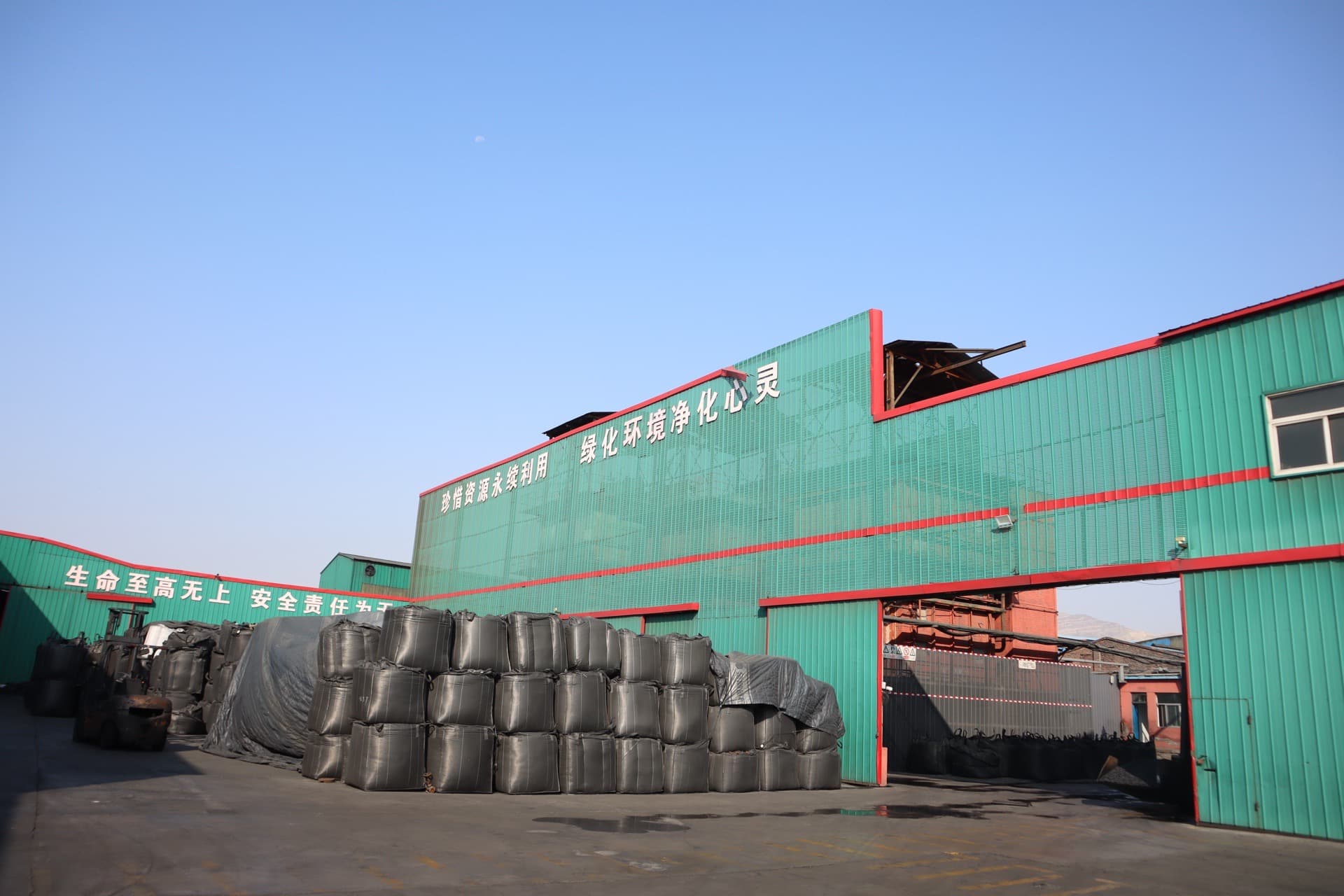
Our Manufacturing Facility
We produce both GAC and PAC at our integrated manufacturing facility. Our production lines include rotary kilns for granular carbon activation and ball mills for powdered carbon processing — allowing us to supply both product types from the same quality-controlled source.
Frequently Asked Questions
When should I use GAC instead of PAC?
Use GAC when continuous treatment is needed, consistent removal is required, high contaminant loads are present, long-term operation is planned, and regeneration/reuse is desired. GAC fixed beds provide predictable, stable treatment and are more cost-effective for continuous operation.
When is PAC the better choice?
Use PAC for seasonal or intermittent contamination events, emergency response, pilot testing before permanent GAC installation, when existing sedimentation/filtration infrastructure can incorporate PAC dosing, and when capital budget is limited but operating budget is available.
What is the cost difference between GAC and PAC treatment?
GAC has higher capital costs (vessels, piping, controls) but lower operating costs per unit treated. PAC has minimal capital costs but higher per-unit treatment costs due to single-use dosing. For continuous year-round treatment, GAC typically becomes more economical within 6–12 months.
Can I use GAC and PAC together?
Yes, combining both is common in water treatment. PAC can handle upstream spikes and seasonal contamination while downstream GAC contactors provide consistent polishing. This hybrid approach optimizes both cost and treatment reliability.
How do GAC and PAC compare in removal efficiency?
Given equal carbon mass, PAC achieves faster initial removal due to smaller particle size and more surface area. However, GAC in fixed beds achieves better overall efficiency through longer contact time and the mass transfer zone effect. For most applications, GAC provides superior contaminant removal per ton of carbon used.
Related Resources
Granular Activated Carbon
Full spec sheets, mesh sizes, and MOQ info
Product Specs →Powdered Activated Carbon
Particle distribution, iodine values, packaging
Application Guide →Water Treatment Solutions
Municipal, industrial, and wastewater applications
Get Started →Request a Quote
Free engineering assessment for 5+ ton projects