

Activated Carbon for Formaldehyde Removal
Formaldehyde (HCHO) off-gasses from building materials, furniture, and adhesives for years. Standard activated carbon saturates quickly — KMnO₄ impregnated carbon chemically oxidizes HCHO on contact, delivering longer bed life and reliable indoor air quality compliance.
The Indoor Air Problem
Formaldehyde — the #1 Indoor Air Pollutant You Can't See
Reviewed by HojeeCarb application engineers · Updated September 2026
Formaldehyde (HCHO) is a colorless, pungent gas classified as a Group 1 human carcinogen by IARC. It continuously off-gasses from particleboard, MDF, plywood, laminate flooring, paint, adhesives, and textiles — often for 3–15 years after installation. The WHO guideline value is 0.1 mg/m³ (30-min average); China's GB/T 18883 standard is stricter at 0.08 mg/m³. New construction, renovated offices, manufactured housing, and schools frequently exceed these limits. Unlike VOCs that ventilation can dilute, formaldehyde's persistent emission source means you need continuous, in-situ removal — and that's where impregnated activated carbon outperforms every alternative.
Source: WHO Guidelines for Indoor Air Quality · IARC Monograph on Formaldehyde
Key Takeaways
- KMnO₄ impregnated activated carbon chemically oxidizes HCHO to CO₂ and H₂O — not just physical adsorption, so it doesn't desorb.
- 3–6× longer formaldehyde capacity vs plain activated carbon, proven in accelerated chamber tests.
- WHO guideline: HCHO < 0.1 mg/m³; China GB/T 18883: < 0.08 mg/m³; US OSHA PEL: 0.75 ppm (8-hr TWA).
- Recommended media: KMnO₄ impregnated pellet carbon (Φ3–4 mm) or KMnO₄ honeycomb carbon panel for HVAC integration.
- Factory-direct from China — custom impregnation levels, pellet sizes, and OEM honeycomb panels available.
How It Works
Why KMnO₄ Carbon Beats Plain Activated Carbon for HCHO
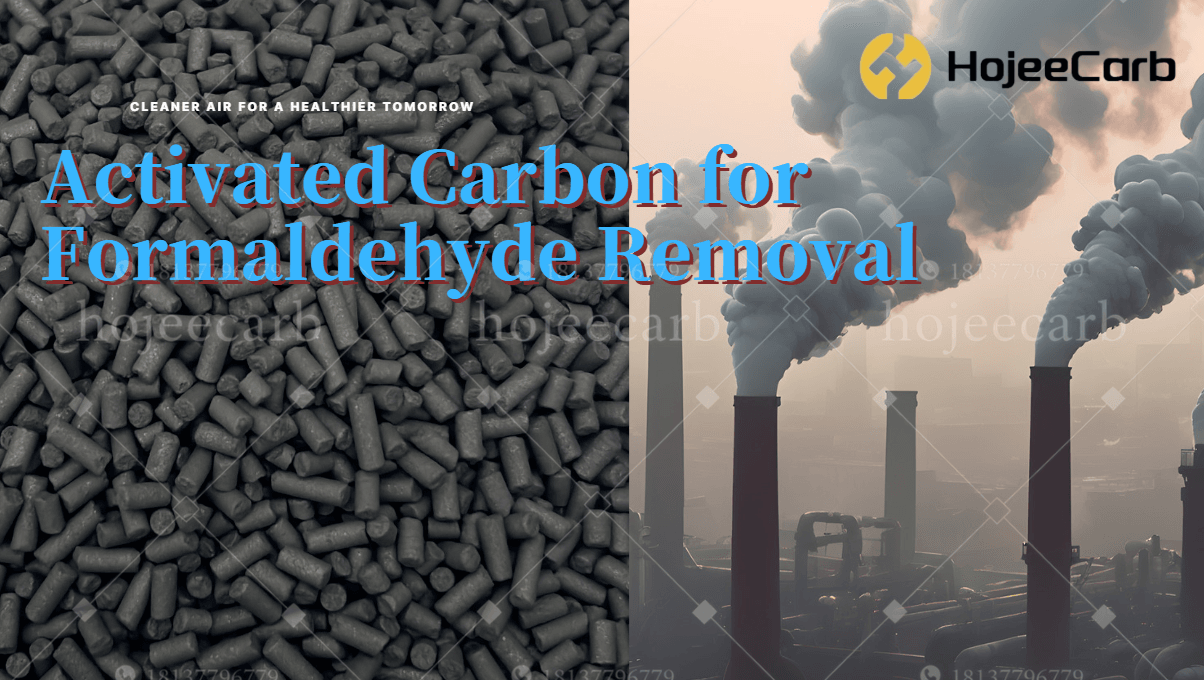
Standard activated carbon adsorbs formaldehyde into micropores. But HCHO is a very small, polar molecule (MW 30) that is weakly held — it saturates quickly and can desorb when concentration drops or temperature rises. Plain AC works for high-concentration industrial exhaust but fails for low-level indoor air duty.
KMnO₄ impregnated carbon adds a chemical destruction mechanism. Potassium permanganate oxidizes HCHO irreversibly: 3 HCHO + 2 KMnO₄ → 3 HCOOH + 2 MnO₂ + 2 KOH. The formaldehyde is converted to formic acid, CO₂, and water — it cannot desorb. This is why KMnO₄ carbon lasts 3–6× longer than plain AC in formaldehyde service.
For maximum performance, pair KMnO₄ pellets (chemical oxidation layer) with a downstream coconut shell GAC layer (polishing adsorption for residual VOCs and odors). This two-stage approach handles both HCHO and the co-emitted VOCs from building materials.
Carbon Selection
Which Carbon for Your Formaldehyde Application
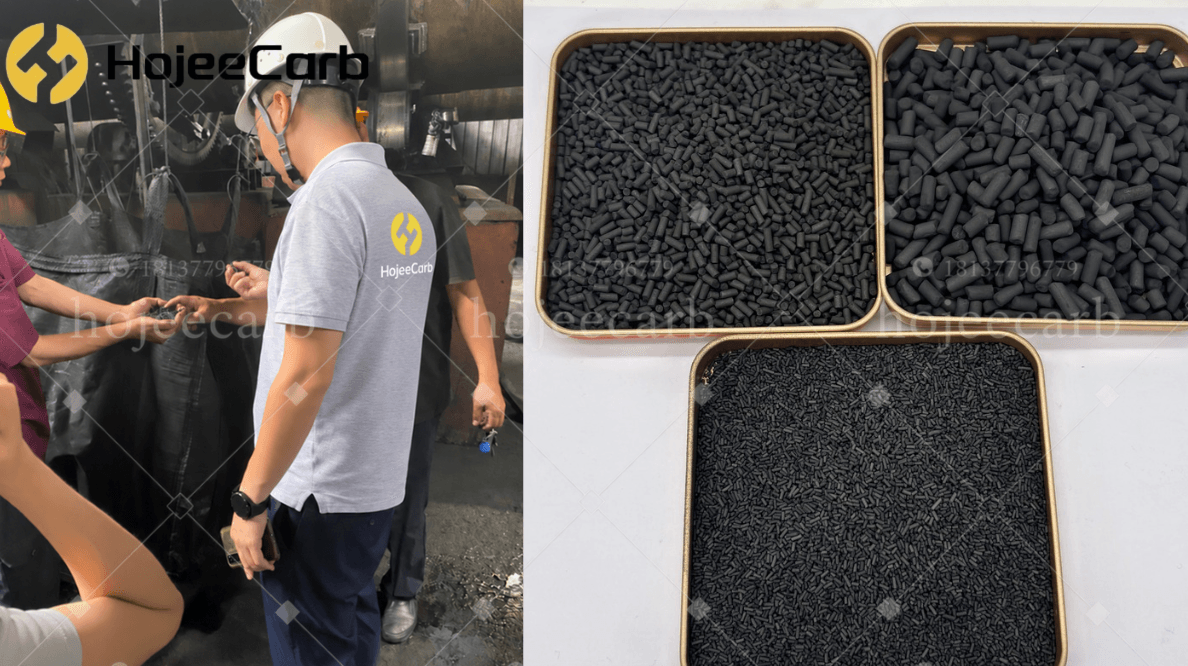
The right media depends on the HCHO concentration and the installation type. Low-level indoor air applications need KMnO₄ impregnation; industrial exhaust can use high-iodine plain GAC.
| Application | Recommended Carbon | Form | Why |
|---|---|---|---|
| Indoor air / HVAC | KMnO₄ impregnated pellet | Φ3–4 mm pellet | Irreversible chemical oxidation — no desorption risk at low ppm levels |
| HVAC panel filter | KMnO₄ honeycomb carbon | Panel / V-bank | Low pressure drop, high face velocity, drop-in replacement for AHU |
| New construction / renovation | KMnO₄ pellet + coconut GAC | Dual-layer cartridge | KMnO₄ handles HCHO; coconut GAC polishes co-emitted TVOC |
| Industrial exhaust (resin, plywood) | Coal-based GAC 4×8 | Granular, deep bed | High concentration — physical adsorption capacity is sufficient; regenerable |
| Portable air purifier | KMnO₄ pellet or impregnated granular | Φ2–3 mm | Consumer/commercial units — compact cartridge, 6–12 month life |
Not sure which formaldehyde carbon fits your project? Send us your airflow and HCHO data.
Get a RecommendationRecommended product: KMnO₄ Impregnated Activated Carbon · Also available: Coal pellet carbon for industrial exhaust duty.
Formaldehyde Sources
Where Formaldehyde Comes From — and Emission Levels
Understanding the source helps size the carbon system. New construction and renovation projects have the highest HCHO loads in the first 6–12 months, then slowly decline over years.
| Source | Typical HCHO Emission | Duration | Common Setting |
|---|---|---|---|
| Particleboard / MDF furniture | 0.05–0.30 mg/m³ contribution | 3–15 years | Offices, schools, residential |
| Plywood & laminate flooring | 0.03–0.20 mg/m³ | 2–10 years | Residential, commercial |
| Urea-formaldehyde insulation (UFFI) | 0.1–0.5+ mg/m³ initial | 5–20 years | Manufactured housing, older buildings |
| Latex paint & adhesives | 0.02–0.10 mg/m³ | 1–6 months | Post-renovation |
| Textile finishes (curtains, carpets) | 0.01–0.05 mg/m³ | 6–24 months | Hotels, hospitals, schools |
| Industrial resin / molding exhaust | 1–50+ mg/m³ | Continuous | Plywood mills, resin plants, foundries |
System Design
Designing an HCHO Removal System
Air Velocity: 0.5–2.5 m/s
For HVAC panel or tray-type systems, keep face velocity at 0.5–2.5 m/s. Lower velocity = longer contact time = better removal. Portable units typically run 1–1.5 m/s across the carbon bed.
Bed Depth: 25–50 mm (panel) or 150–300 mm (deep bed)
Honeycomb panels and tray systems use 25–50 mm carbon depth with multiple passes through recirculation. Industrial deep beds use 150–300 mm for single-pass removal at higher concentrations.
Replace by Color Change
Fresh KMnO₄ carbon is purple/dark violet. As the permanganate is consumed, it turns brown (MnO₂). When 70–80% of the bed has turned brown, schedule change-out. This visual indicator eliminates guesswork.
Temperature & Humidity
KMnO₄ oxidation works best at 15–35 °C and 30–70% RH. Moderate humidity actually helps — water is needed for the oxidation reaction. Avoid condensation (>90% RH) which can leach the impregnant.
Performance
Formaldehyde Removal Performance
Formaldehyde Removal — Frequently Asked Questions
Does regular activated carbon remove formaldehyde?
Regular activated carbon can adsorb formaldehyde, but it saturates quickly because HCHO is a very small, polar molecule (molecular weight 30) that is weakly held in micropores. In low-concentration indoor air applications, plain AC may even release previously adsorbed formaldehyde when room concentration drops (desorption). For reliable, long-term HCHO removal, KMnO₄ impregnated carbon is the industry standard — it chemically destroys formaldehyde rather than just trapping it.
How does KMnO₄ activated carbon remove formaldehyde?
Potassium permanganate (KMnO₄) is a strong oxidizer impregnated onto the carbon surface. When formaldehyde contacts the media, it is oxidized irreversibly: 3 HCHO + 2 KMnO₄ → 3 HCOOH + 2 MnO₂ + 2 KOH. The formaldehyde is converted to harmless products (formic acid, which further breaks down to CO₂ and water). Because this is a chemical reaction, not just physical trapping, the formaldehyde cannot desorb back into the air.
How long does KMnO₄ carbon last for formaldehyde removal?
In typical indoor air or HVAC applications (HCHO 0.05–0.3 mg/m³), KMnO₄ pellet carbon lasts 6–18 months depending on airflow, concentration, and humidity. You can monitor remaining capacity visually — fresh media is purple; spent media turns brown as MnO₂ forms. Replace when 70–80% of the bed has changed color.
What is the WHO guideline for formaldehyde in indoor air?
The WHO guideline is 0.1 mg/m³ (100 µg/m³) as a 30-minute average. China's GB/T 18883-2002 standard is stricter at 0.08 mg/m³. The US OSHA permissible exposure limit for workers is 0.75 ppm (approximately 0.92 mg/m³) as an 8-hour TWA, with a short-term exposure limit (STEL) of 2 ppm. For residential and commercial indoor air, the WHO/China limits are the relevant benchmarks.
Can I use KMnO₄ carbon in my HVAC system?
Yes — KMnO₄ impregnated carbon is available as honeycomb panels, V-bank filters, and tray inserts designed for standard HVAC air handling units. Pressure drop is comparable to standard chemical media filters. It's widely used in commercial buildings, hospitals, schools, and clean rooms for continuous formaldehyde and VOC control.
Is KMnO₄ carbon safe for indoor use?
Yes. The KMnO₄ is chemically bonded to the carbon surface and does not off-gas into the air stream under normal operating conditions (15–35 °C, <90% RH). The reaction products are solid MnO₂ (stays on the carbon) and trace amounts of CO₂ and water vapor. KMnO₄ impregnated carbon has been used in HVAC systems and air purifiers for decades with an excellent safety record.
Need Formaldehyde Carbon for Your Project?
Tell us your application (HVAC, air purifier, industrial exhaust), airflow rate, and target HCHO level. Our team responds within 24 hours with a media recommendation and factory-direct quotation.
Request a Formaldehyde Carbon Quote