
Application Guide
Pelletized Activated Carbon for Air Treatment
How to select, size, and operate pelletized activated carbon systems for VOC removal, H₂S scrubbing, odor control, and industrial emission compliance.
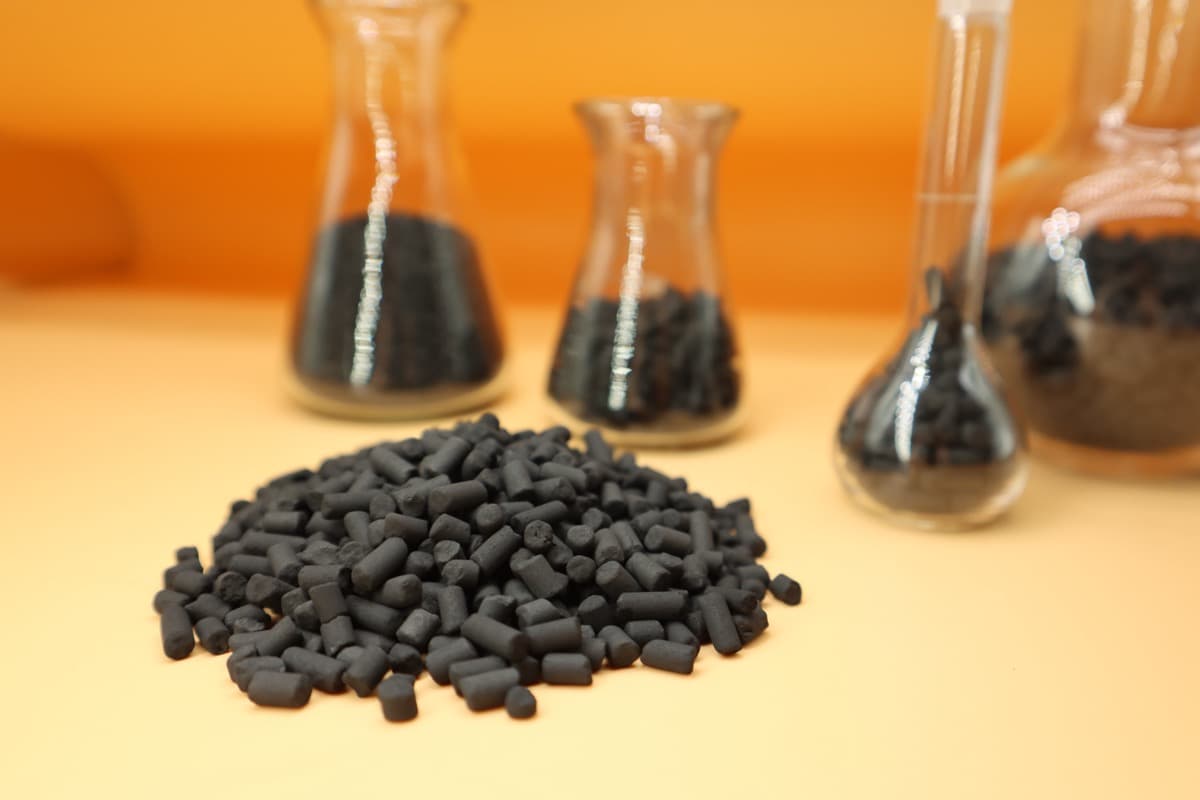
Why Pelletized Carbon for Gas Phase?
Gas-phase (air treatment) applications have fundamentally different requirements than liquid-phase (water treatment). In water, contaminants are dissolved and flow slowly through a packed bed. In air, contaminant concentrations are measured in ppm or ppb, airflow velocities are much higher, and pressure drop is a critical economic factor — every inch of water gauge pressure drop costs fan energy.
Pelletized (extruded) activated carbon is engineered specifically for these conditions. The uniform cylindrical shape — typically 3mm or 4mm diameter, 5–15mm length — provides the optimal balance of low pressure drop, high surface area exposure, and mechanical strength for gas-phase adsorbers.
Pelletized vs Granular vs Honeycomb Carbon
| Property | Pelletized (Extruded) | Granular (GAC) | Honeycomb |
|---|---|---|---|
| Shape | Uniform cylinders | Irregular fragments | Structured block |
| Pressure Drop | Low–moderate | Moderate–high | Very low |
| Adsorption Capacity | High | High | Lower (less carbon mass) |
| Dust Generation | Very low | Moderate | Very low |
| Replacement | Easy (pour in/out) | Easy | Block replacement |
| Cost per kg | $900–1,500/ton | $600–1,400/ton | $2,000–5,000/ton |
| Best For | Industrial air, HVAC, odor | Water treatment, general | Low concentration, high flow |
Need activated carbon?
Get Factory-Direct Pricing — No Middlemen
20+ years manufacturing. MOQ 1 ton. Free samples. Reply within 2 hours.
Applications by Industry
| Application | Target Contaminants | Carbon Type | Contact Time |
|---|---|---|---|
| Wastewater plant odor | H₂S, mercaptans, amines | KOH-impregnated pellet | 0.5–2.0 sec |
| Paint spray booth | VOCs (toluene, xylene, MEK) | Virgin coal-based pellet | 0.2–0.5 sec |
| Semiconductor fab | Acid gases, AMCs | Impregnated blend pellet | 0.1–0.3 sec |
| Indoor air (HVAC) | VOCs, odors, formaldehyde | Coconut shell pellet | 0.05–0.2 sec |
| Biogas purification | H₂S, siloxanes | Impregnated pellet | 1.0–3.0 sec |
| Mercury emission | Hg⁰ vapor | Sulfur-impregnated pellet | 0.5–2.0 sec |
| Kitchen exhaust | Grease odor, VOCs | Standard pellet | 0.1–0.3 sec |
Key Specifications for Air-Phase Pellet Carbon
| Parameter | Standard Grade | Premium Grade | Test Method |
|---|---|---|---|
| Pellet Diameter | 4 mm | 3 mm | Caliper |
| CTC Activity | ≥50% | ≥60% | ASTM D3467 |
| Iodine Number | ≥800 mg/g | ≥1000 mg/g | ASTM D4607 |
| Hardness | ≥90% | ≥95% | ASTM D3802 |
| Moisture | ≤5% | ≤5% | ASTM D2867 |
| Ash Content | ≤12% | ≤8% | ASTM D2866 |
| Bulk Density | 0.40–0.50 g/mL | 0.42–0.48 g/mL | ASTM D2854 |
| Pressure Drop | <300 Pa per 100mm bed at 0.5 m/s | <250 Pa | Lab measurement |
Note: For gas-phase applications, CTC (carbon tetrachloride) activity is more relevant than iodine number. CTC measures the carbon's ability to adsorb gas-phase molecules from air, while iodine number measures liquid-phase capacity.
Impregnated vs Virgin Pellet Carbon
Standard (virgin) pellet carbon removes organic compounds through physical adsorption. For inorganic gases and specific challenging compounds, impregnated carbon adds chemical reactivity:
Virgin Pellet Carbon
- • Removes VOCs, solvents, organic odors
- • Physical adsorption only
- • Regenerable (thermal desorption possible)
- • Lower cost
- • Broad-spectrum organic removal
Impregnated Pellet Carbon
- • KOH/NaOH: H₂S, SO₂, HCl, mercaptans
- • Sulfur: Mercury (Hg⁰) vapor
- • KMnO₄: Formaldehyde, ethylene
- • Phosphoric acid: Ammonia, amines
- • Chemical reaction + physical adsorption
- • Not regenerable (impregnant consumed)
System Design Basics
Key design parameters for pellet carbon air treatment systems:
Design Parameters
Face velocity:
0.1–0.5 m/s (20–100 fpm)
Bed depth (light duty):
25–50 mm (1–2 inches)
Bed depth (standard):
100–300 mm (4–12 inches)
Bed depth (deep bed):
300–600 mm (12–24 inches)
Residence time:
0.1–2.0 seconds typical
Operating temperature:
<40°C optimal (<50°C max)
Rule of thumb: Higher concentrations and more difficult compounds need deeper beds and longer contact times. For trace-level odor control (ppb range), even thin beds (25–50 mm) can be effective.
Monitoring and Replacement
- Outlet monitoring: Install a sensor or sample port downstream of the carbon bed. For H₂S: electrochemical sensor. For VOCs: PID (photoionization detector) or FID.
- Breakthrough definition: When outlet concentration reaches 10–20% of inlet (or exceeds the regulatory limit), the bed is approaching exhaustion.
- Weight gain method: For small canisters, weigh periodically. Weight increase equals mass of adsorbed contaminants — correlate with estimated capacity.
- Calendar replacement: For applications where monitoring is impractical, establish a replacement schedule based on initial pilot testing or supplier's capacity data.
Spent Carbon Disposal
Spent carbon from air treatment may contain concentrated hazardous compounds. Handle according to local regulations:
- • Non-hazardous spent carbon: Landfill disposal or thermal regeneration
- • Hazardous spent carbon: Licensed hazardous waste facility. Mercury-laden carbon and solvent-laden carbon are commonly classified as hazardous.
- • Self-heating risk: Spent carbon with adsorbed solvents can self-heat. Store in sealed containers, keep away from ignition sources, do not mix with oxidizers.
Frequently Asked Questions
Why use pelletized carbon instead of granular for air treatment?
Pelletized (extruded) carbon offers lower pressure drop than irregular granular carbon at the same bed depth, allowing higher air velocities without excessive fan energy costs. The uniform cylindrical shape (typically 3mm or 4mm diameter) provides consistent airflow distribution and predictable performance. Pellets also generate less dust during handling and loading, which is important for indoor air handling units.
What contaminants can pelletized activated carbon remove from air?
Standard pelletized carbon removes: VOCs (benzene, toluene, xylene, formaldehyde), organic solvents (acetone, MEK, IPA), odor compounds (mercaptans, amines, aldehydes), and some inorganic gases. Impregnated pellets extend the range to: H₂S (caustic or KOH impregnated), mercury vapor (sulfur impregnated), acid gases (HCl, SO₂, NOx — caustic impregnated), and formaldehyde (permanganate or amine impregnated).
How long does pelletized activated carbon last in an air treatment system?
Bed life depends on contaminant concentration, airflow rate, temperature, and humidity. Typical ranges: light VOC applications (indoor air quality): 12–24 months, moderate industrial VOC: 6–12 months, H₂S scrubbing (wastewater plant): 6–18 months depending on H₂S concentration, heavy industrial emission control: 3–6 months. Monitor outlet concentrations to predict replacement timing.
What is the ideal bed depth for air phase activated carbon?
Minimum 50mm (2 inches) for light-duty applications (HVAC panels). Standard industrial: 100–300mm (4–12 inches). Deep bed for high concentrations: 300–600mm (12–24 inches). Contact time (residence time) should be 0.1–0.5 seconds for most applications. Deeper beds provide longer contact time and higher removal efficiency but increase pressure drop and carbon cost.
Does humidity affect activated carbon performance in air treatment?
Yes, significantly. At relative humidity >50%, water molecules compete with contaminant molecules for adsorption sites, reducing capacity by 20–40%. At >80% RH, capacity may drop 50% or more. Solutions: pre-cool air to reduce RH, use hydrophobic carbon types, or install a dehumidifier upstream of the carbon bed. For H₂S removal with impregnated carbon, moderate humidity (40–60% RH) actually improves performance.
Need Pelletized Carbon for Air Treatment?
We manufacture pelletized activated carbon in 3mm and 4mm diameters — virgin and impregnated (KOH, sulfur, KMnO₄). CTC ≥60%, suitable for VOC, H₂S, mercury, and odor control applications. Samples available for pilot testing.
Request Quote →