
Wastewater Treatment Guide
Quaternary Treatment Activated Carbon: GAC vs Ozone Under the EU UWWTD
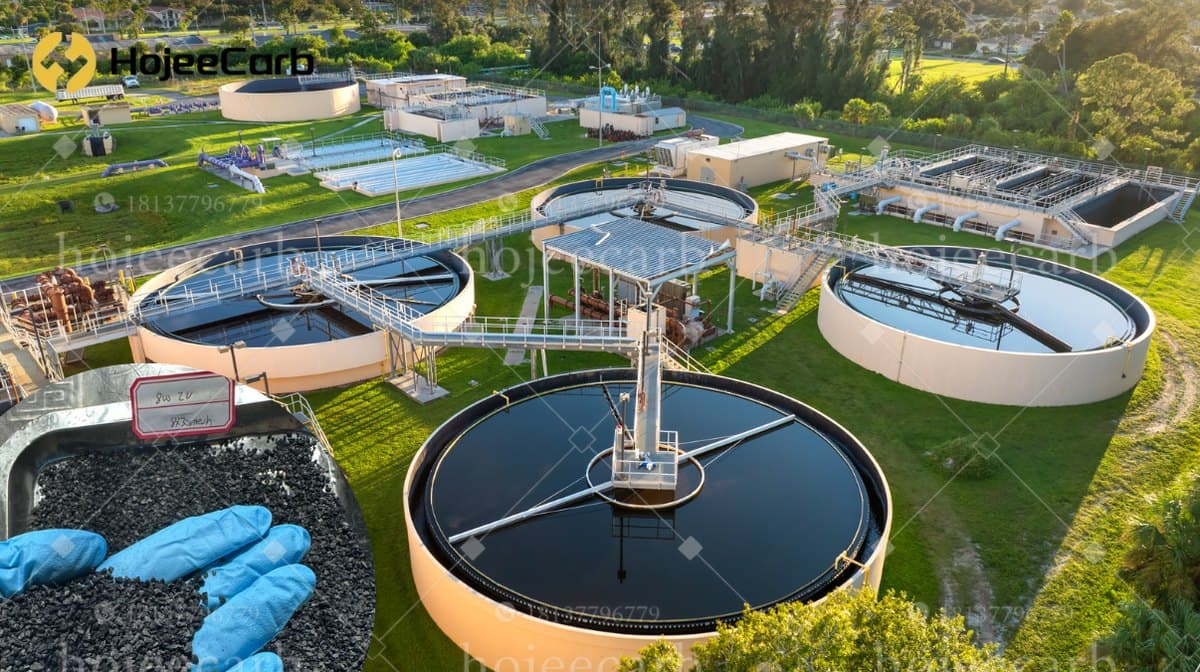
The EU's revised Urban Wastewater Treatment Directive (2024/3019) entered into force on 1 January 2025, requiring a fourth treatment stage to remove organic micropollutants from wastewater. Every plant handling 150,000 p.e. or more must comply — 20% by 2033, 100% by 2045. Activated carbon sits at the centre of that programme.
UWWTD Quaternary Treatment — Quick Reference
| Directive | EU 2024/3019 (UWWTD, recast) — in force 1 Jan 2025; transposition deadline 31 Jul 2027 |
| Performance standard | ≥ 80% average removal across a basket of indicator micropollutants (Annex I, Table 3) |
| Large plants ≥ 150,000 p.e. | 20% → 31 Dec 2033 · 60% → 31 Dec 2039 · 100% → 31 Dec 2045 |
| Risk-area plants ≥ 10,000 p.e. | 10% → 2033 · 30% → 2036 · 60% → 2039 · 100% → 2045 |
| Risk-area list deadline | Member States publish by 31 Dec 2030; review in 2033 and every 6 years |
| Technology options | GAC fixed-bed · Ozonation · PAC dosing · Ozone + GAC combination |
| EPR financing | Pharma & cosmetics producers cover ≥ 80% of quaternary treatment costs from 31 Dec 2028 |
What Is Quaternary Treatment Under the EU UWWTD?
Quaternary treatment is a fourth polishing stage added after conventional tertiary treatment (nutrient removal). Its purpose is the removal of organic micropollutants — pharmaceuticals, hormones, pesticide metabolites, and industrial chemicals — that persist through biological and chemical steps. It sits downstream of the conventional carbon duties covered in activated carbon for wastewater treatment.
Directive 2024/3019/EU defines it as any process achieving the removal of organic micropollutants to the performance standard in Annex I, Part B, Table 3. Compliance is measured against a basket of indicator substances representing different classes of micropollutants.
The 80% removal requirement
Table 3 of Annex I sets a single performance target: minimum 80% average removal of “substances that can pollute water even at low concentrations.” The percentage is the average of individual removal rates across at least six indicator substances drawn from two categories:
- Category 1 (easily treated): amisulpride, carbamazepine, citalopram, clarithromycin, diclofenac, hydrochlorothiazide, metoprolol, venlafaxine
- Category 2 (harder to treat): benzotriazole, candesartan, irbesartan, and a 4-/5-methyl-benzotriazole mixture
Category 1 substances measured must be twice the number of Category 2 substances. Removal is calculated on dry-weather flow. This matters for technology selection: a process must clear the 80% average across both easy and harder-to-treat compounds, not just the easy ones.
Who has to comply, and when
- Article 8(1) — large plants: All UWWTP ≥ 150,000 p.e. — 20% by 31 Dec 2033, 60% by 31 Dec 2039, 100% by 31 Dec 2045
- Article 8(4) — risk areas: Agglomerations ≥ 10,000 p.e. discharging into listed risk areas — 10% by 2033, 30% by 2036, 60% by 2039, 100% by 2045
Member States must publish their risk-area list by 31 December 2030. A 10,000–150,000 p.e. plant upstream of a drinking-water intake or bathing water can be pulled into the mandate well before the 150,000 p.e. threshold would suggest. Any plant added later gets seven years to comply, within the overall deadlines.
The Compliance Routes: GAC, Ozone, and Ozone + GAC
Route A: Ozonation (+ post-filtration)
Ozone is generated on-site and dosed into clarified effluent, typically at 0.5–1.0 g O₃/g DOC. Ozone oxidises micropollutants into smaller fragments. Those fragments are not always fully mineralised, so a downstream step — usually rapid sand filtration or a short GAC contact bed — captures residual ozonation transformation products (OTPs).
- Energy use: roughly 0.05–0.12 kWh/m³ for the ozonation step, plus a small increment for post-filtration. Reference condition: municipal secondary effluent at 0.5–1.0 g O₃/g DOC (Hollender et al., Water Research 2009, doi:10.1016/j.watres.2009.05.035). Site-specific.
- Removal: high for ozone-reactive pharmaceuticals such as diclofenac and carbamazepine; compound-specific and lower for ozone-resistant substances
- Limitation: does not remove PFAS; can form OTPs and, in bromide-rich water, bromate — both need monitoring and control
- Capital: high, for ozone generators and off-gas destruction
Route B: GAC fixed-bed
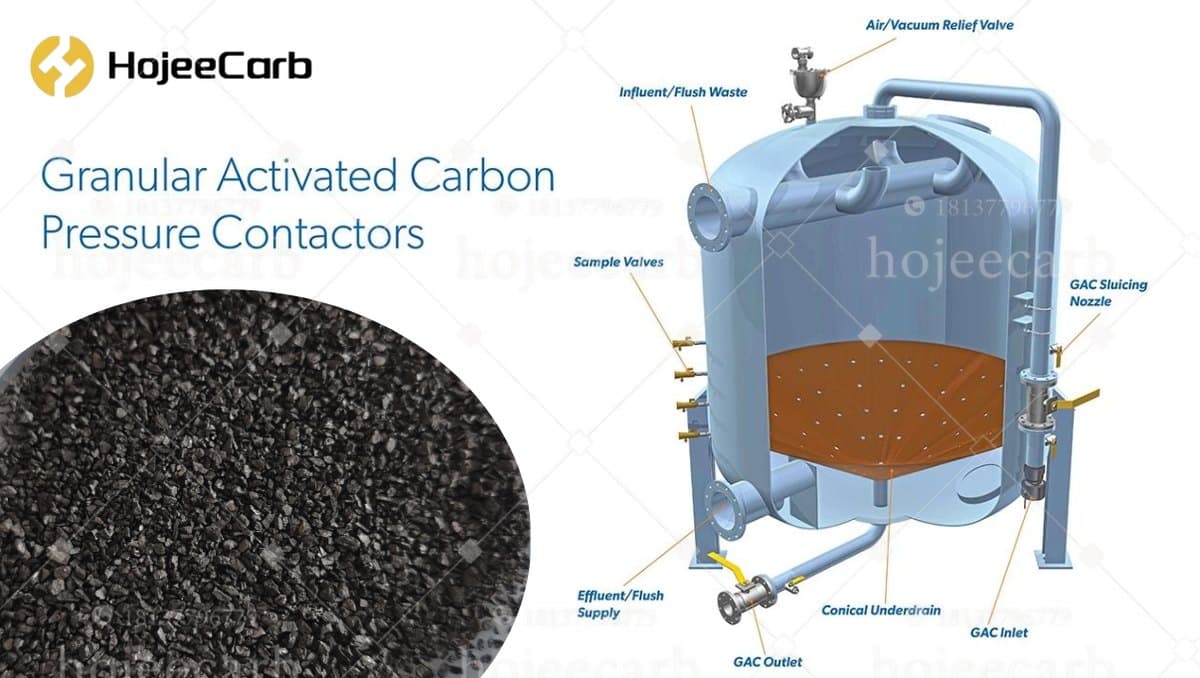
Treated effluent passes through beds of GAC at an Empty Bed Contact Time (EBCT) of 10–30 minutes. The carbon adsorbs a broad spectrum of micropollutants simultaneously without generating by-products. When capacity is exhausted, GAC is replaced with virgin or thermally reactivated carbon. Bed depth, flow rate, and vessel sizing follow standard practice — see our GAC system design guide.
- EBCT: typically 15–20 minutes for municipal micropollutant polishing
- Energy use: roughly 0.01–0.03 kWh/m³. Reference condition: pumping head loss across a fixed bed only, excluding upstream lift. Indicative engineering estimate; varies with bed depth and hydraulic loading rate.
- Bed life: commonly reported in the range of 12–36 months at full-scale municipal plants. Reference condition: municipal secondary effluent, 15–20 min EBCT, breakthrough defined by the required micropollutant removal. Varies widely with influent DOC — confirm by pilot or RSSCT column test.
- Capacity driver: background organic load (TOC/DOC) competes for adsorption sites. Micropollutants are present at trace levels, so bed life is usually set by the bulk organic matrix, not by the indicator substances alone
- Spent carbon: can be thermally reactivated and reused, supporting lifecycle-cost and circular-economy goals. See regeneration methods and the reactivation ROI guide
- Media choice: fixed beds use granular carbon, not powdered. The tradeoff between the two is covered in GAC vs PAC
- Capital: often lower than ozonation at small to mid scale; existing filter shells can sometimes be reused
Route C: Ozone + GAC (the Kalundborg model)
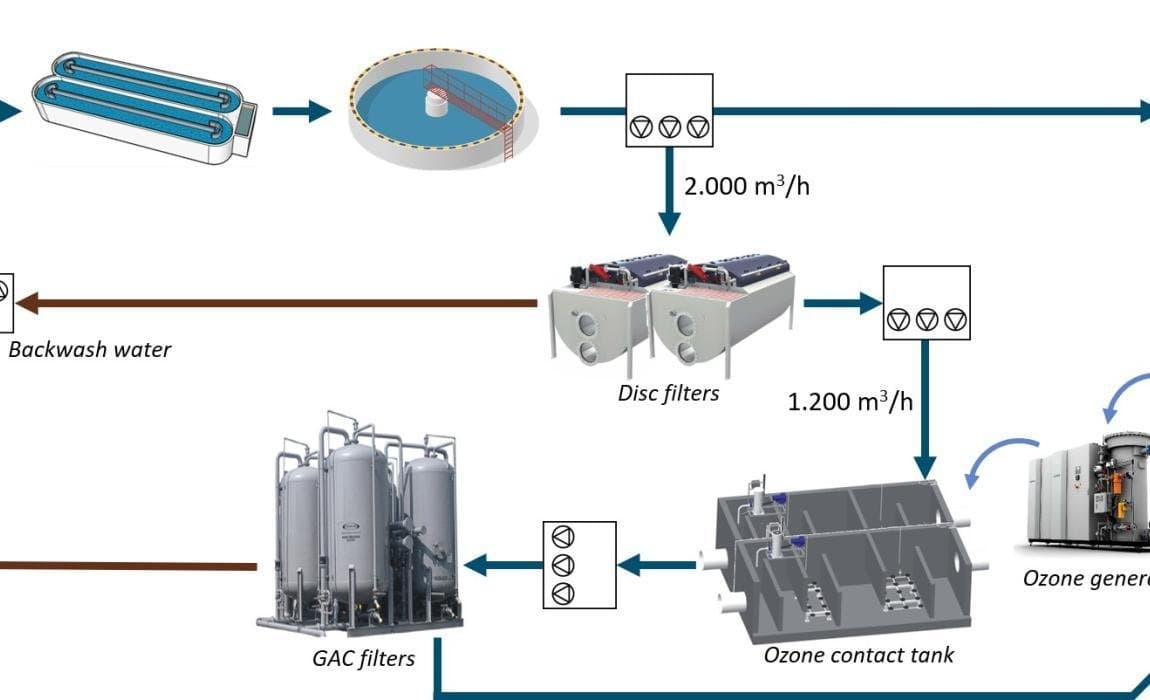
For some large or demanding installations, operators combine both stages: ozone oxidises a broad range of micropollutants and supports downstream biofiltration, while a GAC stage adsorbs residual compounds and transformation products.
SUEZ / Kalundborg — verified reference project. On 13 October 2026, SUEZ announced it had been selected by Kalundborg Forsyning, a Danish public water utility, to design and deliver a new quaternary treatment stage at the Kalundborg Central Wastewater Treatment Plant. Per SUEZ's own press release, the solution combines two ozone injection lines (fed by three ozone generators) with eight granular activated carbon filters, plus digital optimisation. The contract runs three years. It is a useful reference design for how ozone + GAC is configured at scale.
Ozone + GAC is not automatically the best or lowest-risk choice everywhere. It carries the highest capital and footprint, and is justified when influent complexity, discharge sensitivity, or by-product control warrant both barriers.
GAC vs Ozone: Head-to-Head for Quaternary Treatment
| Factor | GAC Fixed-Bed | Ozonation | Ozone + GAC |
|---|---|---|---|
| Micropollutant removal | Broad-spectrum adsorption | Broad oxidation | Two complementary barriers |
| PFAS behaviour | Adsorbs many PFAS; short-chain break through sooner | Does not destroy/remove PFAS | GAC stage handles PFAS adsorption |
| Energy (kWh/m³) | ~0.01–0.03 (pumping) | ~0.05–0.12 (ozonation step) | ~0.06–0.15 (combined) |
| By-product risk | None from the carbon itself | OTPs; bromate in bromide-rich water | Downstream GAC helps manage OTPs |
| Carbon footprint | Lower; especially with reactivated GAC | Higher (power demand) | Moderate to higher |
| Lifecycle cost driver | GAC replacement / reactivation frequency | Ozone generation + maintenance | Both cost drivers combined |
| Footprint | Compact; can reuse existing filter shells | Larger (generator room + off-gas) | Largest |
| Scale suitability | Across all scales | Often better at larger flows | Typically large / sensitive-discharge plants |
Energy figures are order-of-magnitude estimates. GAC pumping: indicative for fixed-bed hydraulics. Ozonation: Hollender et al., Water Research 2009 (doi:10.1016/j.watres.2009.05.035). Actual consumption is site-specific; confirm with engineering design for the specific flow and influent.
The right choice is site-specific. Plants already running sand filters can often convert to GAC contactors at low civil cost. The UWWTD's 80% target is measured against the pharmaceutical/benzotriazole indicator basket in Table 3 — it is not a PFAS standard. PFAS removal is driven by other legislation and is a separate design question.
How Much Activated Carbon Does a Quaternary Treatment Plant Need?
GAC demand is driven by two things: the carbon inventory in the contactors (set by flow and contact time) and how often that inventory needs replacing (set by bed life to breakthrough). The calculation is a two-step estimate.
Step 1 — Carbon inventory in the beds
Bed volume (m³) = Flow (m³/h) × EBCT (h)
Carbon inventory (t) = Bed volume (m³) × bulk density (t/m³)
Step 2 — Annual replacement
Annual GAC use (t/yr) = Carbon inventory (t) ÷ bed life (years)
Worked example — 100,000 m³/day municipal plant
The following is an illustrative estimate only. All assumptions must be confirmed by pilot or RSSCT testing for the specific site; bed life in particular varies widely with influent organic load.
| Assumption | Value used | Note |
|---|---|---|
| Flow | 100,000 m³/day = 4,167 m³/h | Plant design flow |
| EBCT | 15 min (0.25 h) | Mid-range for municipal WWT; may be 10–30 min |
| Bulk density | 450–500 kg/m³ (0.45–0.50 t/m³) | Typical for coal-based granular carbon |
| Bed life | 24 months (illustrative) | Actual life is site-specific; pilot test required |
- Bed volume = 4,167 × 0.25 ≈ 1,042 m³ of GAC
- Carbon inventory = 1,042 × 0.45–0.50 ≈ 470–520 tonnes in the system
- Annual replacement at 24-month bed life ≈ 235–260 tonnes/year
If bed life is 12 months, annual replacement roughly doubles to ~470–520 t/year. If it reaches 36 months, it drops to ~155–175 t/year. Bed life is the single biggest lever on carbon cost, and it is not known precisely until a pilot or RSSCT column study is done.
These figures are order-of-magnitude estimates based on standard GAC engineering relationships. Larger plants scale proportionally into four-figure tonnes/year at short bed life.
At these volumes the carbon grade matters commercially as well as technically. A 100,000 m³/day plant is buying in the hundreds of tonnes per year, so the choice between coal-based granular carbon and coconut shell granular carbon shifts annual spend materially. Coal-based grades are usually the cost-efficient default for bulk municipal duty; coconut grades carry higher iodine value and lower ash where polishing performance is the priority.
What Standards and Test Documents Does GAC Need for EU Wastewater Use?
The UWWTD does not impose a single mandatory product certification for wastewater GAC. The Directive sets a performance target (80% removal across the Table 3 basket) and leaves the material specification to the plant operator and their tender.
A key point on EN standards. EN 12915-1 is written for granular activated carbon used to treat water intended for human consumption — it is a drinking-water material standard, and its proper home is EU drinking water compliance, not wastewater.
What EN 12915-1 actually covers for GAC: material requirements (including limits on leachable impurities such as lead and arsenic), plus normative references to the test methods used to verify them. Several parameters that buyers group under “EN 12915-1 testing” are in fact measured by separate standards — iodine value and CTC activity are commonly determined to ASTM D4607 and ASTM D3467 respectively, ball-pan hardness to ASTM D3802, and BET surface area to ISO 9277. Those are industry test methods referenced alongside EN 12915-1, not clauses of it.
So when a wastewater tender cites EN 12915-1, treat it as the buyer referencing a recognised European material standard by procurement choice. It does not mean the carbon is “certified for wastewater,” and it does not mean every parameter on the datasheet was measured under that one standard. Ask which method applies to which parameter.
The following documents are typically requested in EU quaternary-treatment tenders — not a universal EU legal mandate:
| Document | Why it appears in tenders | Notes |
|---|---|---|
| EN 12915-1 conformance report | Recognised European material standard for GAC in water treatment | A drinking-water standard, cited by procurement choice. Not a UWWTD requirement |
| Adsorption & physical test data | Iodine value, CTC, hardness, BET — the parameters that drive bed performance | Measured to their own methods (ASTM D4607 iodine, ASTM D3467 CTC, ASTM D3802 hardness, ISO 9277 BET), referenced alongside EN 12915-1 |
| REACH compliance statement | EU chemicals regulation applies to substances placed on EU market | Confirms no restricted substances above threshold |
| ISO 9001 QMS | Standard supplier-qualification requirement | Common in public tenders |
| Batch COA — heavy metals | Buyer assurance on As, Pb, Cd, Cr, Hg per batch | Specified per contract, not by the UWWTD |
| NSF/ANSI 61 or drinking-water-contact cert | Only where treated water re-enters a drinking-water catchment | Not required for pure wastewater discharge |
The exact requirement list is set by each utility's tender documents and national transposition. Confirm the specification for the specific project.
Compliance Timeline and Technology Selection
The directive's phased implementation creates three procurement waves. Because GAC or ozone system design, procurement, civil works, and commissioning commonly runs several years, utilities aiming at a 2033 date are already in planning.
Wave 1 — by 31 Dec 2033
20% of ≥ 150,000 p.e. plants, plus 10% of ≥ 10,000 p.e. risk-area agglomerations. These tend to be the largest, highest-visibility plants.
Wave 2 — by 31 Dec 2039
60% of ≥ 150,000 p.e. plants (and 60% of risk-area agglomerations, with 30% by 2036). This is the bulk of the European upgrade market.
Wave 3 — by 31 Dec 2045
100% of qualifying plants and agglomerations. Tail-end compliance across all remaining facilities.
Choosing between PAC, GAC, and ozone
There is no universal winner. The route is chosen per site against the 80% Table 3 target:
- PAC (powdered activated carbon) dosing: lower capital, dosed into existing biology; carbon is wasted with sludge (single-use). Attractive where existing tankage is available and lower upfront cost is prioritised.
- GAC (granular fixed bed): reusable/reactivable, compact, can reuse existing filter shells. Strong where predictable adsorption economics and ozone by-product avoidance are priorities.
- Ozonation: effective broad oxidation at larger flows; needs off-gas destruction, transformation-product monitoring, and bromate control in bromide-rich water.
- Ozone + GAC: two barriers for complex influent or sensitive discharge — justified by site conditions, highest capital and footprint.
Need activated carbon?
Get Factory-Direct Pricing — No Middlemen
20+ years manufacturing. MOQ 1 ton. Free samples. Reply within 2 hours.
Our GAC for Quaternary Treatment: Specifications and Sourcing
We supply coal-based 8×30 GAC and coconut shell 12×40 GAC for municipal wastewater polishing and quaternary treatment. The specifications below reflect our current standard grades. For a tender, the parameters tied to site effluent — EBCT, bed life, and removal across the Table 3 basket — are confirmed by pilot or RSSCT column testing rather than catalogue figures alone.
| Parameter | Coal 8×30 GAC HojeeAqua BG800 | Coconut 12×40 GAC HojeeAqua CG1100 |
|---|---|---|
| Mesh size | 8×30 (0.60–2.36 mm) | 12×40 (0.42–1.70 mm) |
| Raw material | Bituminous coal | Coconut shell |
| Iodine value | ≥ 800 mg/g | ≥ 1,100 mg/g |
| BET surface area | 900–1,000 m²/g | — |
| CTC activity | ≥ 50% | ≥ 60% |
| Hardness (ball-pan) | > 95% | > 98% |
| Ash content | ≤ 12% | ≤ 3% |
| Moisture | < 3% | ≤ 5% |
| Bulk density | 0.45–0.55 g/cm³ | 0.48–0.52 g/cm³ |
| MOQ | 1 tonne | 1 tonne |
| Packaging | 25 kg bags · 500 kg super sacks · 1 t bulk bags | 25 kg bags · 500 kg super sacks · 1 t bulk bags |
Specifications from production standard grades. BET not routinely tested for coconut 12×40 under standard COA; available on request. Acid-washed and impregnated grades are available for applications where lower ash or tighter pH is specified.
A coarser coconut shell 8×30 grade is also available where lower head loss across a deep bed matters more than the finer mesh. Full parameter detail for the coconut grade is in the 12×40 specification breakdown.
Available test and compliance documentation
- Batch Certificate of Analysis (iodine value, CTC, hardness, moisture, ash, heavy metals) with each shipment
- EN 12915-1 conformance data on request, with adsorption and physical parameters measured to their own methods (ASTM D4607 iodine, ASTM D3467 CTC, ASTM D3802 hardness, ISO 9277 BET)
- REACH compliance statement
- ISO 9001 quality management documentation
- Samples for pilot or RSSCT column testing available on request
For PFAS-impacted effluent, bromate risk, or a strict Table 3 demonstration, treat carbon selection as a pilot-driven engineering decision. We are happy to supply test material and specifications to support that work.
Working With Us on Quaternary Treatment Supply
We are a coal-based and coconut shell activated carbon manufacturer supplying GAC for water and wastewater applications. For European quaternary-treatment projects we can provide:
- Product specifications and samples so your engineering team can run pilot or RSSCT column tests on your actual effluent
- Batch certificate of analysis with each shipment
- EN 12915-1 conformance data on request
- Quotes for staged delivery matched to commissioning schedules, including larger recurring contracts
Specific certifications, third-party inspection arrangements, reactivation services, and long-term price terms are confirmed per contract. Request current documentation for your project.
Frequently Asked Questions
What is quaternary treatment under the EU UWWTD?
What is the 80% removal requirement?
Which activated carbon type suits EU quaternary treatment?
GAC or ozone — which is cheaper for quaternary treatment?
Can spent GAC from quaternary treatment be reactivated?
What standards must activated carbon meet for EU wastewater applications?
Related Articles & Products
References
- EU Directive 2024/3019 (UWWTD): eur-lex.europa.eu/eli/dir/2024/3019/oj
- European Commission urban wastewater overview: environment.ec.europa.eu
- SUEZ Kalundborg project (Oct 2026): suez.com press release
- Hollender et al. (2009) — ozone energy for micropollutant removal: Water Research, doi:10.1016/j.watres.2009.05.035
- Snyder et al. (2007) — GAC/ozone micropollutant removal review: Science of the Total Environment, doi:10.1016/j.scitotenv.2006.07.036