
West Africa’s #1 Gold Producer • Factory Direct
Activated Carbon for Ghana Gold Mines — Low Consumption & Reactivation
Ultra-hard coconut shell activated carbon for Ghana’s Ashanti and Western belt CIP/CIL plants — built to cut carbon consumption and survive more reactivation cycles, where g/t carbon cost is a real line item.
- ✓ Hardness >98.5% · A.A.R.L. attrition max 2% · 20–30+ reactivation cycles
- ✓ Lower make-up carbon (g/t) on high-tonnage CIP trains
- ✓ Ships to Tema / Takoradi · 25–30 days sea · 5-ton trials
Recommended Grades for Ghana Mines
The three grades most requested by Ghana’s gold operations. See full specifications, mesh options, and technical data on each product page, then request a quote or TDS for your circuit.
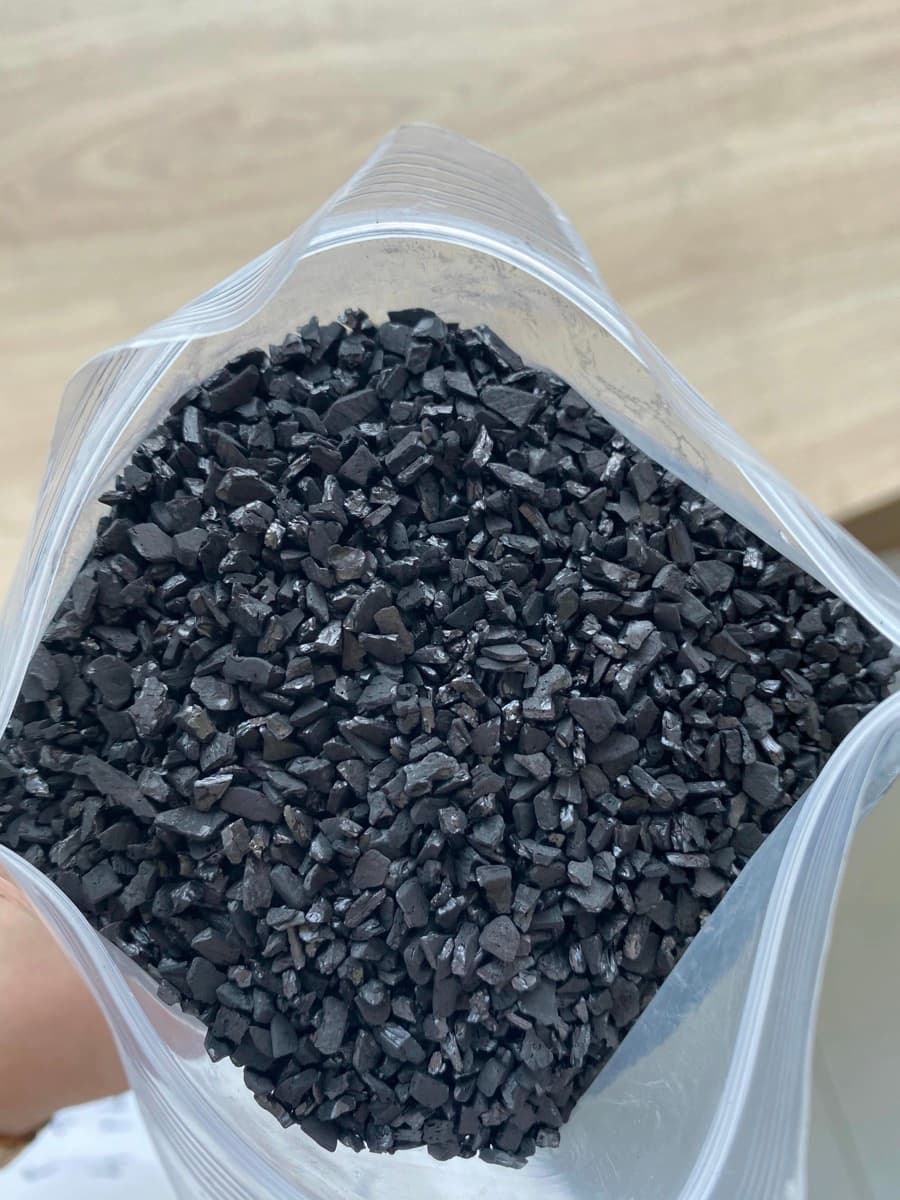
Gold Recovery Activated Carbon
6×12 mesh · hardness >98.5% · gold loading >30 mg/g
The grade that survives the most reactivation cycles. >98.5% hardness means less mass lost to attrition and kiln burn-off each pass — the direct lever on long-run g/t carbon consumption at high-tonnage Ashanti plants.
View product & specs →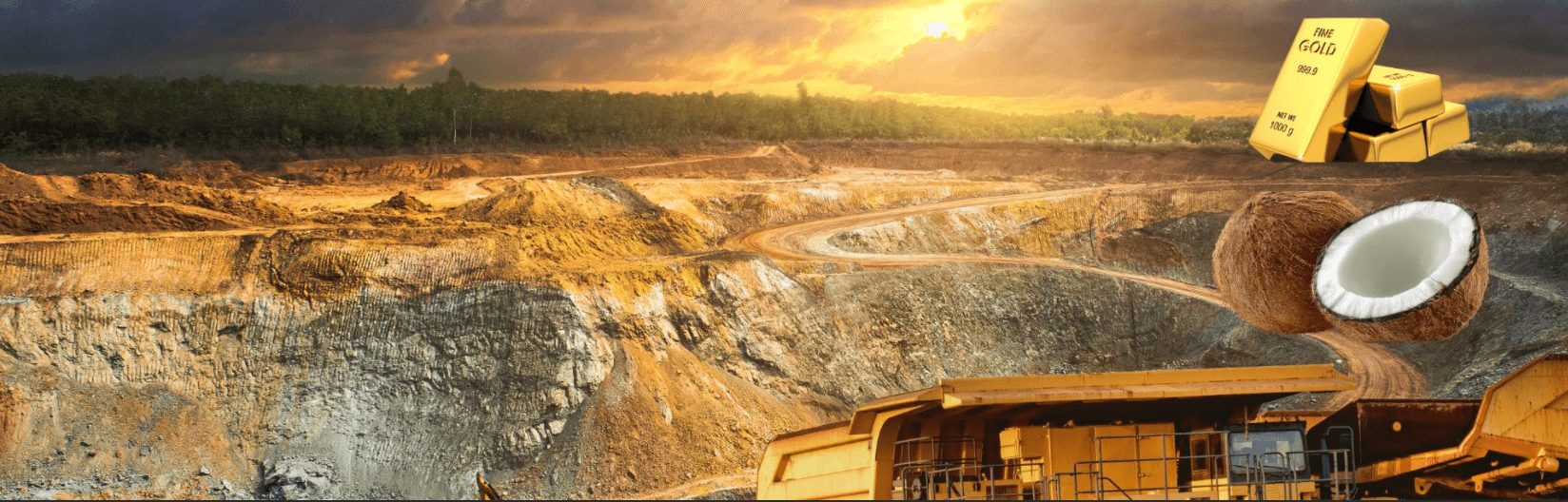
6×12 Coconut Shell — CIP/CIL
6×12 mesh · iodine 1050+ · A.A.R.L. attrition max 2%
Low starting fines (<4%) keep loaded carbon on the screens instead of in the tailings. Full TDS/COA so your metallurgists can benchmark attrition and reactivation yield against your current supplier.
View product & specs →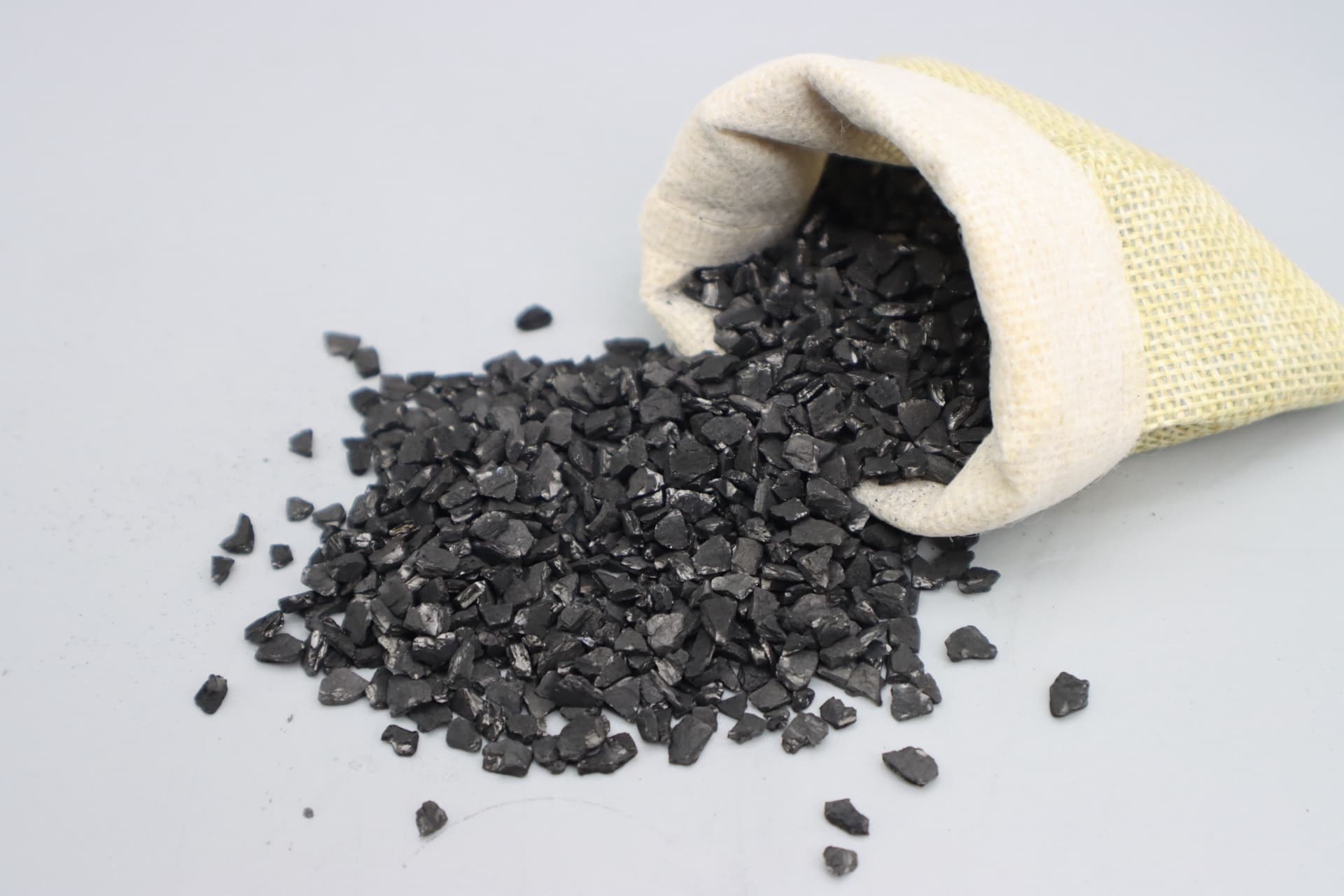
Coconut Granular — Mine Water
8×30 / 12×40 mesh · iodine 1000–1200
For potable and process-water polishing at Ashanti- and Western-belt mine camps — removes organics, turbidity, and residual cyanide before discharge or reuse. A practical add-on to your gold-carbon order.
View product & specs →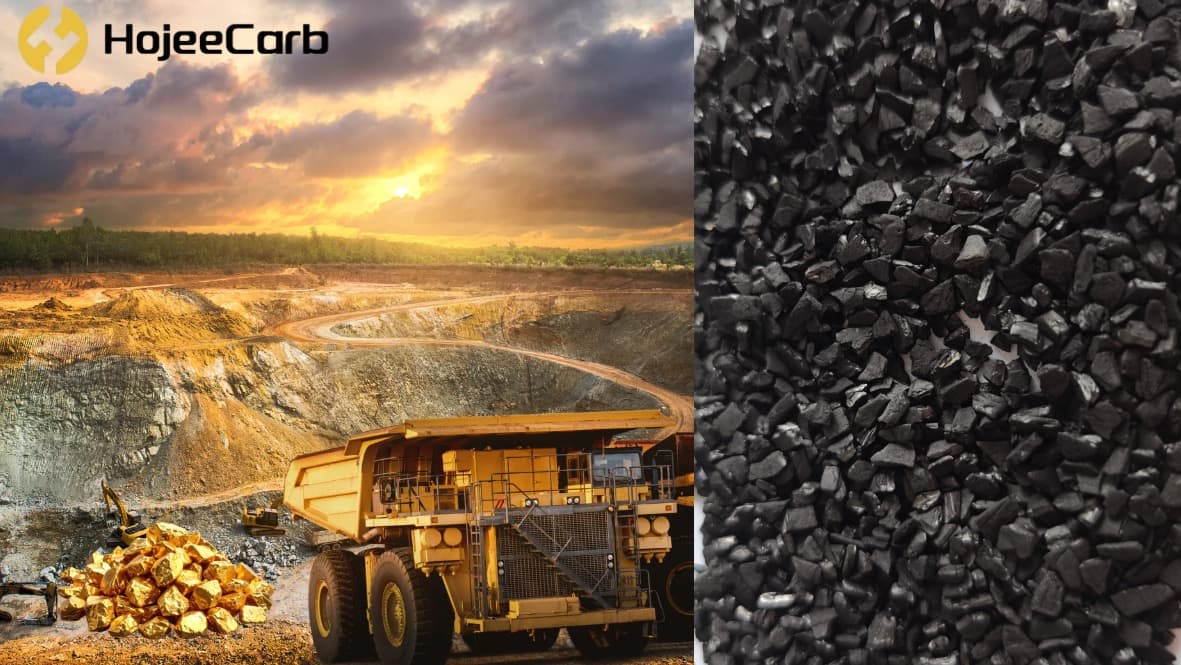
Carbon Specs Built for Low Consumption
Ghana is Africa’s largest gold producer, with world-class CIP/CIL operations across the Ashanti and Western belts. Every spec below is chosen to lower carbon consumption per tonne and extend reactivation life — hardness and attrition first, because they drive the biggest cost buckets.
| Parameter | Value | Why It Matters |
|---|---|---|
| Ball-Pan Hardness | >98.5% | The #1 lever on carbon consumption — less attrition per inter-stage transfer |
| Attrition (A.A.R.L.) | max 2% | The gold-room metallurgist's number — simulates real in-circuit abrasion, keeps mass through 20–30+ elution/reactivation cycles |
| CTC Activity | 45%–60% | Tracks total pore volume — a better predictor of gold-cyanide pickup than iodine alone |
| Platelets / Fines | <4% | Low starting fines keep loaded carbon on the screens, out of tailings |
| Iodine Number | ≥1050 mg/g | High activity restored after each reactivation cycle |
| Gold Loading | >30 mg/g | Fast pickup across 6–8 stage adsorption trains |
| Ash Content | <3% | Less ash build-up in the reactivation kiln, cleaner elution |
Third-Party Verified
SGS Test Report — HojeeCarb Gold Recovery Carbon
Every batch is tested in-house and available for independent SGS or Bureau Veritas verification. Below is a representative SGS report for the same 6×12 grade shipped to Ghana.
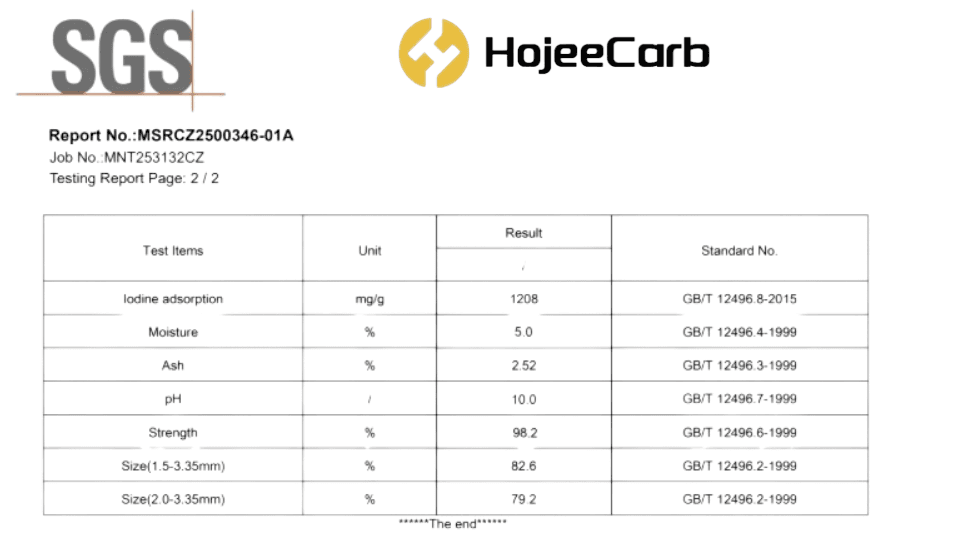
SGS Report No. MSRCZ2500346-01A — Iodine 1208 mg/g · Strength 98.2% · Ash 2.52% · Moisture 5.0%
Real Delivery to Ghana
28 Tons Gold Recovery Carbon — Shipped to Tema Port
A documented shipment of the exact same grade we quote for Ghana’s Ashanti and Western belt CIL/CIP plants — coconut shell 6×12, hardness >98%, A.A.R.L. attrition max 2%, CTC ≥60%. Delivered via Tema in a 40’HQ container (MSC vessel from Tianjin).
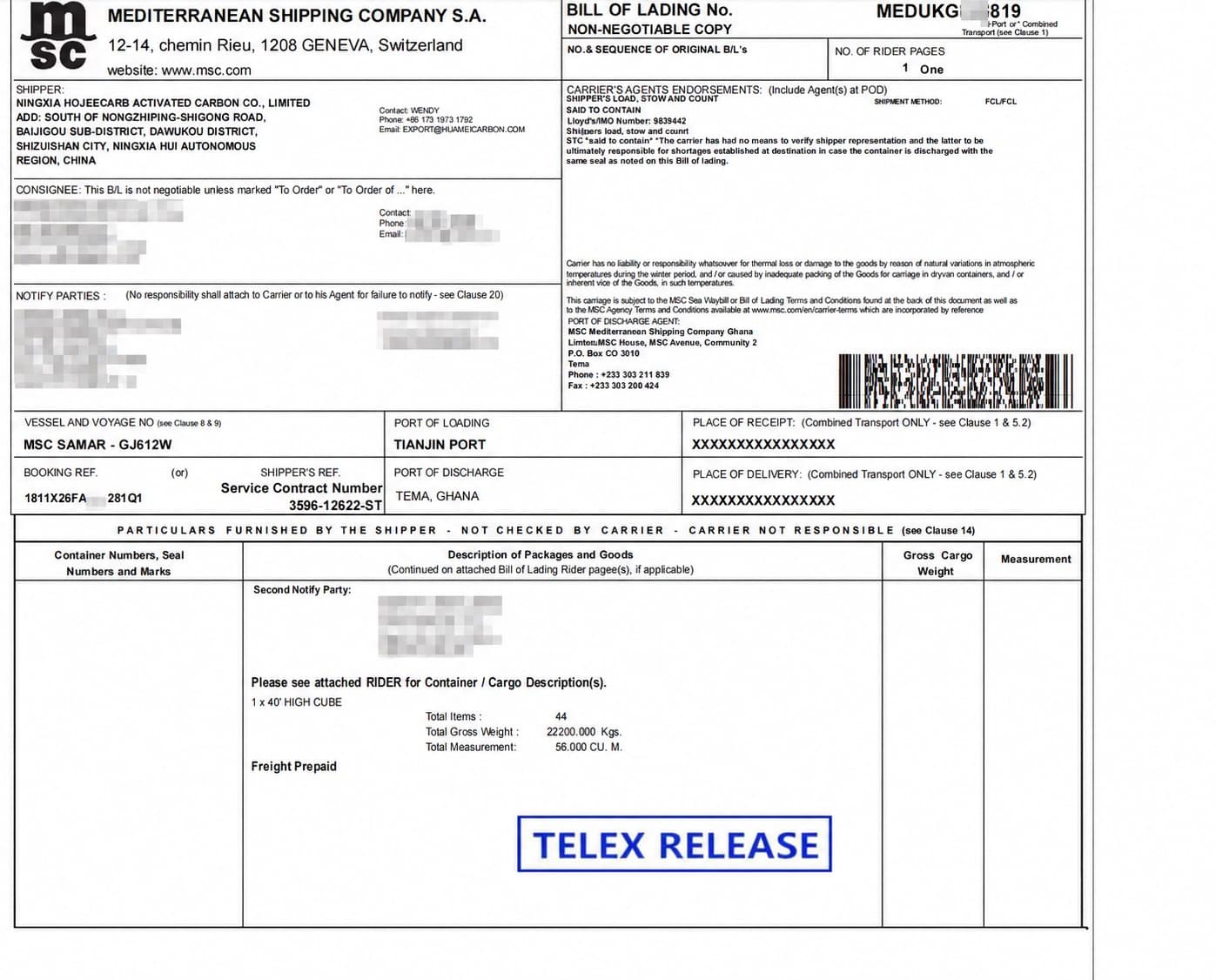
Ocean B/L — MSC SAMAR via Tianjin → Tema, Ghana. 1×40’HQ, 22.2 t gross. Consignee redacted for privacy.
28 t
Ghana
6×12 coconut shell · CTC ≥60% · hardness >98% · A.A.R.L. ≤2%
Shipped from Tianjin to Tema port via MSC vessel. 40’HQ container, 550 kg FIBC jumbo bags, Telex Release. Full COA + SGS batch report included.
Dispatch Video
How a Ghana Order Leaves the Plant Intact
Carbon loss economics start at the bagging line, not at the mine. Over-dropped carbon arrives pre-fractured, and those fines leave with the screen underflow on day one — gold attached. That is why we film the dispatch: this is a real Ghana-bound order being filled, sealed, and stacked, so you can see the handling rather than take our word for it. The cost breakdown further down this page shows what that handling is worth.
- ✓ 550 kg FIBC jumbo bags, PE-lined and heat-sealed — no re-bagging in transit
- ✓ Short drop height at filling to protect ball-pan hardness >98% and hold A.A.R.L. attrition ≤2%
- ✓ Bags block-stacked and lashed in a 40’HQ so the load cannot shift on the Tianjin–Tema leg
- ✓ Batch COA and SGS report issued against the filmed batch, not a reference sample
Gold Recovery Applications in Ghana
Ghana produced over 4 million ounces in 2024 across the Ashanti Gold Belt (Obuasi), the Western Region (Tarkwa, Damang), and emerging Upper East deposits. We match the right carbon grade to each circuit type.
Large-Scale CIP Plants
Ashanti belt giants like Obuasi (AngloGold Ashanti) run 6–8 stage carbon-in-pulp trains with high carbon inventories. Our 6×12 delivers high gold loading with minimal attrition across the whole adsorption train.
Western Belt CIL
Tarkwa and Damang (Gold Fields) process large tonnages of Tarkwaian and Birimian ore. High-activity carbon protects recovery where throughput is high and residence time is tight.
Carbon-in-Column (CIC)
For clarified heap-leach solutions, 6×16 hard coconut carbon keeps head loss low in tall percolation columns while maximising gold pickup.
Mine & Camp Water
Coal-based GAC for potable water and process-water polishing at remote sites — removes organics, turbidity, and residual cyanide.
The Real Cost Driver
Carbon Consumption & Reactivation Economics
On Ghana’s large CIP/CIL plants, activated carbon is not a one-time purchase — it is a circulating inventory that is eluted, reactivated, and topped up cycle after cycle. The number that matters is not the price per tonne of carbon, but the carbon cost per ounce of gold: make-up carbon + reactivation + gold lost in fines. Here is how that cost is built, and where hardness moves the needle.
Where Carbon Loss Comes From
| Loss Source | Share of Total | Main Driver | Lever to Reduce It |
|---|---|---|---|
| Attrition (mechanical) | 40–60% | Inter-stage pumping, screening, airlift transfer in 6–8 stage CIP | Ball-pan hardness >98.5% + A.A.R.L. attrition max 2% |
| Thermal loss in reactivation | 10–20% | Burn-off in the regeneration kiln at 650–750°C | Correct kiln residence time & steam ratio; harder carbon tolerates more cycles |
| Organic fouling / poisoning | 10–20% | Flotation reagents, oils, humics blinding pore mouths | Acid wash + reactivation restores ~90–95% activity |
| Fines below screen aperture | 10–15% | Carbon worn under 0.6 mm reporting to tailings with loaded gold | Low starting platelets/fines <4% |
Indicative ranges for coconut shell carbon in agitated CIP/CIL circuits; your split depends on transfer design, kiln practice, and ore reagent load.
Reactivation Cycle Benchmarks
25–60 g/t ore
Typical carbon consumption
Varies with ore abrasiveness, transfer design, and carbon hardness
88–95%
Reactivation recovery yield
Mass recovered per cycle after attrition + thermal loss
90–95% of virgin
Activity restored per cycle
With acid wash + thermal reactivation at 650–750°C
20–30+
Useful cycles (hard carbon)
>98.5% hardness carbon survives more cycles before dropping below spec
3–5% per cycle
Make-up carbon added
To replace attrition + fines losses and hold inventory activity
Why Hardness Is the Cheapest Lever
Attrition and thermal loss together account for 50–80% of carbon consumption — and both scale with hardness. Carbon that starts at >98.5% ball-pan hardness loses less mass per transfer and per kiln pass, so it stays above spec for 20–30+ cycles instead of dropping out early.
For a plant consuming 40 g/t, cutting make-up carbon by even 15% is a five- to six-figure annual saving before you count the gold that no longer leaves in the fines. That is why we spec hardness first.
Request a Quote
Get Ghana Gold Recovery Carbon Pricing — Factory Direct
Send your current carbon consumption (g/t), reactivation yield, and tonnage. We'll benchmark it against our >98.5% hardness grade and return a factory quote, TDS, and CIF pricing to Tema/Takoradi within 24 hours.
Proven on Africa’s Gold Belts
Gold-Recovery Carbon We’ve Shipped to Africa
We supply the same 6×12 coconut shell gold-recovery grade to CIL/CIP plants across Africa’s gold belts. Recent documented shipments — the exact grade we quote for Ghana’s Ashanti and Western belt mines.
56 t
Ethiopia
6×12 coconut shell · iodine 1100 · CIL/CIP
Passed a strict third-party pre-shipment loading supervision — container dimensions, temperature, and seal integrity documented before the vessel sailed via Djibouti.
Read the case study →28 t
Egypt
6×12 coconut shell · iodine 1100+ · CIL
Repeat-order gold-recovery carbon shipped from Nansha to Alexandria, with full COA and QC packaging for a returning gold-plant client.
Read the case study →Related Resources & Guides
Technical guides and regional references for sourcing gold-recovery carbon across Africa:
Ghana Gold Recovery Carbon FAQ
How much activated carbon does a Ghanaian gold plant consume per tonne of ore?
Typical consumption runs 25–60 g of carbon per tonne of ore, depending on ore abrasiveness, the number of CIP/CIL stages, transfer-pump design, and — critically — carbon hardness. On Ghana's large multi-stage trains, softer carbon can push consumption to the top of that range because it generates more fines per pass. Moving to >98.5% ball-pan hardness typically trims make-up carbon by 10–25%.
How many times can gold recovery carbon be reactivated?
With acid washing and thermal reactivation at 650–750°C, good coconut shell carbon restores 90–95% of virgin activity per cycle and can run 20–30+ useful cycles before it falls below spec. Because our carbon starts at >98.5% hardness, it loses less mass to attrition and thermal burn-off each pass, so it stays in service for more cycles — the single biggest lever on long-run carbon cost.
Where does carbon loss actually come from in a CIP plant?
Roughly 40–60% is mechanical attrition from inter-stage pumping, screening, and airlift transfer; 10–20% is thermal burn-off in the reactivation kiln; 10–20% is organic fouling/poisoning from reagents and humics; and 10–15% is fines worn below the screen aperture that report to tailings carrying loaded gold. Starting hardness and low fines attack the two largest buckets directly.
How do you calculate the true cost of carbon per ounce of gold?
Don't price on $/tonne of carbon alone. The real figure is make-up carbon cost + reactivation cost + gold locked in lost fines, divided by ounces produced. A cheaper, softer carbon that generates more fines and survives fewer reactivation cycles usually costs more per ounce. We help buyers model this with their own consumption and reactivation-yield data.
What spec and testing do you provide for Ghana's mines?
Coconut shell 6×12, iodine ≥1050 mg/g, CTC 45%–60%, ball-pan hardness >98.5%, A.A.R.L. attrition max 2%, gold loading >30 mg/g. FOB Ningbo $3,200–$3,800/ton; MOQ 1 container with 50 kg to 5-ton trials for benchmarking. Every batch ships with a full COA, and SGS or Bureau Veritas third-party testing is available on request. Shipping to Tema/Takoradi runs 25–30 days at sea.
How does Ghana's carbon royalty and export environment affect sourcing carbon?
Ghana is Africa's largest gold producer and its plants run large, capital-intensive CIP/CIL trains at Obuasi, Tarkwa, and Damang — so procurement is metallurgy-led and cost-per-ounce sensitive rather than price-per-tonne. That's why we frame quotes around consumption (g/t) and reactivation yield, not just $/tonne: on a 6-8 stage Ashanti train, a harder carbon that trims make-up by 10–25% and survives more reactivation cycles pays back far more than a cheaper, softer carbon. We ship to Tema and Takoradi, so inland haul to the Ashanti and Western belts is short compared with landlocked neighbours.
Sourcing Carbon for Your Ghana Mine?
Send us your mine, circuit type, and tonnage. We’ll return a detailed quote with CIF pricing to Tema or Takoradi, a full technical data sheet, and a delivery schedule within 24 hours.