Case Study
28 Tons Gold Recovery Carbon Shipped to Ghana for CIL Gold Mining
A gold producer in Ghana needed carbon that stayed hard, held its particle size, adsorbed gold fast, and could be supplied at volume without batch-to-batch drift. We shipped them 28 tons through the port of Tema.
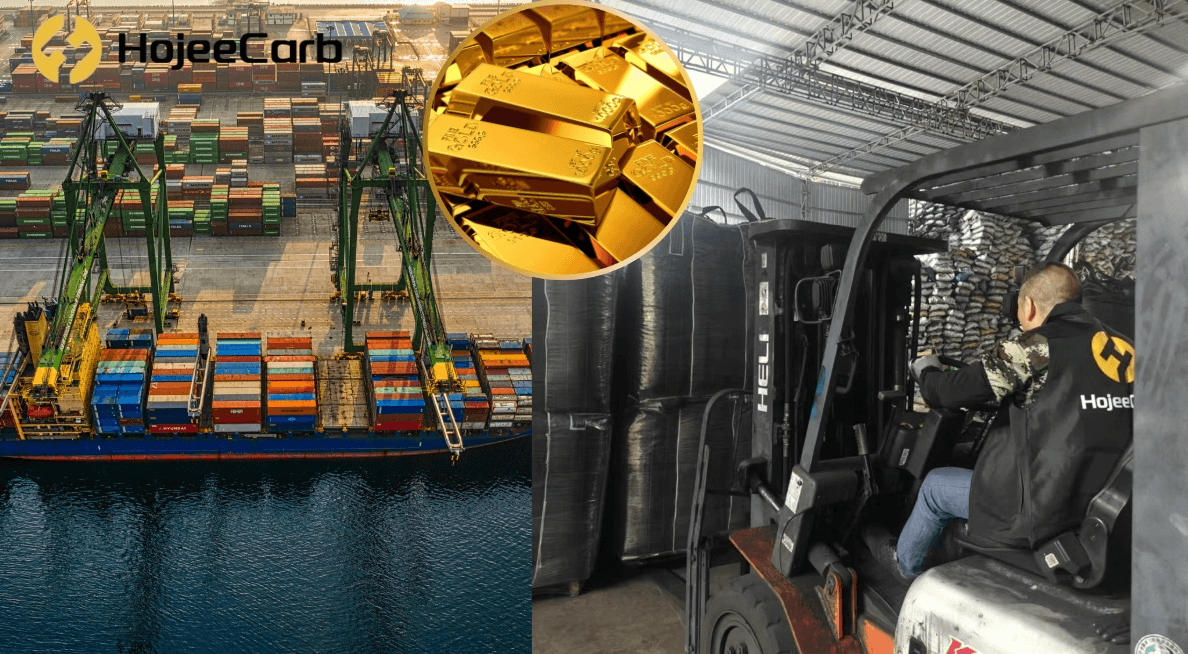
A gold producer in Ghana came to us with a familiar problem. They needed a large, steady volume of activated carbon for their CIL circuit, but their previous carbon was generating too many fines — abrasion in the pumps, screens, and elution steps was quietly carrying gold into tailings. They needed carbon that stayed hard, held its particle size, adsorbed gold fast, and could be supplied at volume without batch-to-batch drift. We shipped them 28 tons, delivered through the port of Tema.
Order Summary
| Item | Details |
|---|---|
| Client Region | Ghana, West Africa |
| Application | Coconut shell GAC for gold CIL/CIP |
| Mesh Size | 6×12 (US mesh, 1.70–3.35 mm) |
| CTC Activity | ≥60% |
| Ball-Pan Hardness | ≥98% |
| Attrition (A.A.R.L.) | ≤2% |
| Ash Content | ≤4% |
| Moisture | ≤5% |
| Apparent Density | 480–510 kg/m³ |
| K Value | 32 kg/tonne |
| R Value | 65 |
| Quantity | 28 tons |
| Packaging | 550 kg FIBC jumbo bags in 40'HQ container |
| Discharge Port | Tema, Ghana |
The Buyer's Real Concerns — and How We Answered Each
Sourcing gold carbon at volume is not about the lowest price per ton. On a CIL circuit the wrong carbon costs you gold every day it runs. Here is what this buyer pushed us on, and what we delivered.
1. Hardness 98% — Because Every Fine Is Lost Gold
Gold carbon takes a beating: pumping between tanks, inter-stage screening, acid washing, elution, and thermal reactivation at 650–750 °C. Soft carbon crumbles into fines, and loaded fines wash straight to tailings. Our carbon runs ball-pan hardness ≥98%, so it survives repeated handling and 5–8 reactivation cycles with minimal breakdown.
2. Attrition (A.A.R.L.) ≤2% — The Wear Number That Predicts Field Loss
Ball-pan hardness is a lab proxy; the AARL attrition test simulates the mechanical abrasion carbon sees inside a real adsorption circuit. We hold AARL attrition at max 2%, verified per batch. That is the number a gold-room metallurgist trusts, and it is why this carbon keeps its mass and its gold on it, cycle after cycle.
3. Particle-Size Stability — Screens Stay Clean, Kinetics Stay High
6×12 mesh (1.70–3.35 mm) is the workhorse size for CIL/CIP: coarse enough to be retained on inter-stage screens without carrying over into tails, fine enough to keep adsorption fast. Because our carbon resists attrition, the size distribution holds over time instead of drifting fine and blinding screens.
4. Gold Adsorption Performance — CTC, K Value, and R Value (Not Iodine)
Gold carbon is judged on CTC activity (total pore volume), K value (loading rate), and R value (equilibrium loading) — not iodine number. This grade delivers CTC ≥60%, K value 32 kg/tonne, and R value 65: a fast, high-capacity carbon that pulls the gold-cyanide complex quickly and holds a strong equilibrium against the barren solution, driving down gold in your tails.
5. Bulk Supply Stability — 28 Tons That All Behave the Same
A single flattering sample means nothing at 28 tons. We draw composite samples across every production lot, so the COA reflects the whole shipment, not one good batch. With our own feedstock and in-house activation, we lock the spec across large volumes and repeat orders — the buyer gets the same carbon next quarter, not a lucky batch.
Need activated carbon?
Get Factory-Direct Pricing — No Middlemen
20+ years manufacturing. MOQ 1 ton. Free samples. Reply within 2 hours.
Quality Control — SGS Tested Before Loading
Every production lot clears our in-house lab before it goes into a container. For this Ghana shipment, the client requested independent SGS inspection. SGS drew samples at our facility and issued Report No. MSRCZ2500346-01A confirming:
- Iodine adsorption: 1208 mg/g (GB/T 12496.8-2015)
- Moisture: 5.0% (GB/T 12496.4-1999)
- Ash: 2.52% (GB/T 12496.3-1999)
- Strength (hardness): 98.2% (GB/T 12496.6-1999)
- Size 1.5–3.35 mm: 82.6% (GB/T 12496.2-1999)
- Size 2.0–3.35 mm: 79.2% (GB/T 12496.2-1999)
The full COA, packing list, and weight certificate were issued and sent to the client before the vessel sailed. We support SGS, Intertek, or Bureau Veritas pre-shipment inspection on every order. The full SGS report for this shipment is shown at the end of this article.
Shipping to Ghana via Tema Port
Ghana's gold belt runs through the Ashanti and Western regions, and Tema is the main eastern gateway serving Accra-area logistics and inland haulage to the mines. We handled ocean freight to Tema with the full export document set — commercial invoice, packing list, COA, certificate of origin, fumigation certificate, and bill of lading.
The 28 tons were packed in 550 kg FIBC jumbo bags and loaded into a 40'HQ container. For mines that prefer smaller handling units, we also supply 25 kg PP woven bags with PE inner liner, palletized and stretch-wrapped.
Need Gold Recovery Carbon for Your Mine?
Tell us your mesh size, CTC/K-value target, and annual volume. We'll send a spec sheet, pricing, and free samples within 24 hours. Delivery to Tema, Takoradi, and inland Ghana arranged.
Frequently Asked Questions
What carbon spec is best for a Ghana CIL plant?
Coconut shell carbon, 6×12 mesh, CTC ≥60%, ball-pan hardness ≥98%, and AARL attrition ≤2%. Ghana's large CIL circuits run high carbon inventories, so hardness and low attrition minimize fines and gold-room losses across the adsorption train.
Why do you use CTC activity and K value instead of iodine number for gold carbon?
Gold recovery depends on how fast and how strongly carbon adsorbs the gold-cyanide complex. CTC activity tracks total pore volume, K value measures loading rate, and R value measures equilibrium loading — all better predictors of gold performance than iodine number alone.
What is AARL attrition and why does it matter?
The AARL attrition test simulates the mechanical wear carbon undergoes inside a real adsorption circuit. At ≤2%, our carbon resists breakdown into fines, which is where loaded gold is lost to tailings.
What is the minimum order and how fast can you ship to Ghana?
MOQ is 1 container (18–20 tons); 5-ton trial orders are available for new buyers. Sea transit to Tema or Takoradi runs 25–30 days, with 35–45 days total including production and documentation.
Can you hold the spec across large, repeat orders?
Yes. We use composite lot sampling and our own feedstock and activation to lock CTC, hardness, and attrition across large volumes, so repeat orders match the original shipment.
SGS Inspection Report