
Technical Deep Dive
Activated Carbon for Gold Cyanide Recovery
A deep technical guide to the chemistry, engineering, and economics of activated carbon in gold cyanidation — from Au(CN)₂⁻ adsorption mechanisms to elution optimization and carbon lifecycle management.
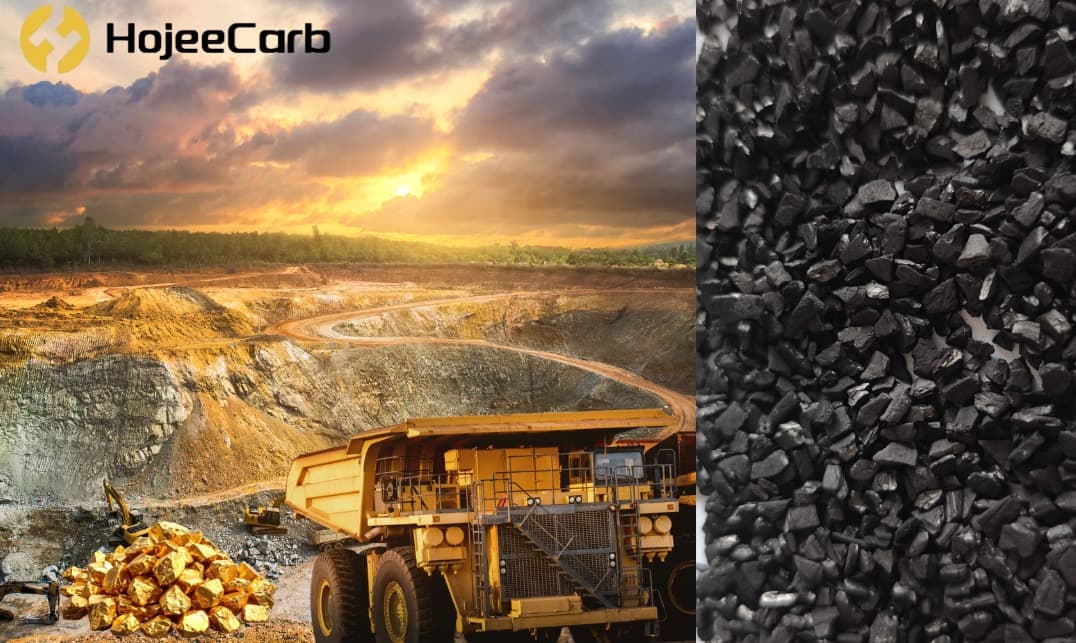
Gold-Cyanide Adsorption Chemistry
In cyanidation, gold dissolves to form the aurocyanide complex [Au(CN)₂]⁻. This complex adsorbs onto activated carbon through a mechanism that is still debated in the literature but is generally understood to involve:
- Ion-pair adsorption: The Au(CN)₂⁻ ion pairs with a cation (Ca²⁺, Na⁺, K⁺) and the neutral ion pair adsorbs into carbon micropores
- Reduction mechanism: Au(CN)₂⁻ may partially reduce to metallic Au⁰ clusters within the carbon pore structure
- Electrostatic attraction: The carbon surface carries a positive charge in alkaline cyanide solutions, attracting the negatively charged aurocyanide complex
The adsorption is selective — gold cyanide is preferentially adsorbed over other metal cyanide complexes, though silver [Ag(CN)₂]⁻, copper [Cu(CN)₃]²⁻, and nickel [Ni(CN)₄]²⁻ are also adsorbed to varying degrees. This selectivity is what makes carbon-based gold recovery viable.
For a comparison of CIP and CIL process configurations, see our gold mining activated carbon guide.
Factors Affecting Gold Adsorption Rate
| Factor | Optimal Range | Effect on Adsorption |
|---|---|---|
| Gold concentration | 1–20 mg/L in solution | Higher concentration → faster kinetics (Freundlich isotherm) |
| Carbon concentration | 10–25 g/L pulp | More carbon → lower equilibrium gold-in-solution |
| Particle size | 6×12 or 6×16 mesh | Smaller particles → faster kinetics but more attrition |
| Temperature | 20–35°C | Higher T → faster kinetics up to ~40°C, then equilibrium decreases |
| Ionic strength | Moderate Ca²⁺ beneficial | Ca²⁺ enhances ion-pair formation; excess Na⁺ can suppress |
| pH | 9.5–11.0 | Optimal for cyanidation; pH >12 reduces adsorption rate |
| Free cyanide | 100–300 mg/L NaCN | High free CN⁻ competes for adsorption sites — balance needed |
| Carbon activity | k-value >3.0 | Fresh/reactivated carbon is 2–5× faster than fouled carbon |
Need activated carbon?
Get Factory-Direct Pricing — No Middlemen
20+ years manufacturing. MOQ 1 ton. Free samples. Reply within 2 hours.
Carbon Specifications for Gold Recovery
Gold mining is the most demanding application for coconut shell activated carbon. Specifications must balance adsorption capacity with mechanical durability:
| Parameter | Minimum Spec | Premium Spec | Why Critical |
|---|---|---|---|
| Hardness (ball-pan) | ≥95% | ≥98% | Each 1% = 5–10% less carbon loss in circuit |
| Iodine Number | ≥1050 mg/g | ≥1100 mg/g | Gold loading capacity correlates with micropore volume |
| Mesh Size | 6×12 | 6×16 | Coarse enough for screening; fine enough for kinetics |
| Moisture | ≤5% | ≤3% | Shipping cost and accurate dosing |
| Ash | ≤3% | ≤2% | Ash blocks pores and reduces gold capacity |
| Apparent Density | 0.48–0.54 g/mL | 0.50–0.54 g/mL | Affects settling in tanks and screening efficiency |
| Gold Adsorption Rate (k) | ≥3.0 (4 hr test) | ≥3.5 | Directly measures gold uptake kinetics |
Recovering Gold from Loaded Carbon (Elution)
Once carbon reaches its target gold loading (typically 5,000–20,000 ppm), gold is stripped off for electrowinning. In practice two methods dominate: Zadra (atmospheric, hot caustic-cyanide recirculation — simpler, slower) and AARL (acid wash + pressurized hot-water elution — faster, more concentrated eluate). The choice mostly comes down to plant throughput and available capital.
Full elution comparison lives on our dedicated guide
Side-by-side Zadra vs AARL parameters (temperatures, cycle times, eluant chemistry, strip efficiency, equipment and capital cost) with operating tips are covered in depth there.
→ Zadra vs AARL Elution: Full Comparison & Operating GuideThermal Reactivation
After elution, carbon must be thermally reactivated to restore adsorption capacity by burning off organic foulants and reopening blocked pores:
Reactivation Parameters
Temperature:
650–750°C (optimal 700°C)
Atmosphere:
Steam + limited O₂ (mildly oxidizing)
Residence time:
15–30 minutes in kiln
Equipment:
Rotary kiln (most common)
Mass loss per cycle:
3–5% (well-controlled) to 10% (poor control)
Capacity recovery:
90–95% of fresh carbon
Critical: Temperature control is everything. Below 600°C — incomplete organic removal. Above 800°C — micropore collapse destroys adsorption capacity permanently. Operators should install continuous temperature monitoring with alarms at ±25°C of setpoint. For more details, see our regeneration methods guide.
Carbon Loss Management
Carbon losses directly translate to gold losses (loaded carbon carries adsorbed gold) and replacement costs. Typical loss points:
| Loss Point | Typical Loss | Mitigation |
|---|---|---|
| Attrition in CIP/CIL tanks | 10–30 g/t ore | Use >97% hardness carbon; optimize agitation speed |
| Screening losses | 5–15 g/t ore | Proper screen maintenance; correct aperture size |
| Reactivation burn-off | 5–20 g/t ore | Temperature control; minimize reactivation time |
| Transfer and handling | 2–5 g/t ore | Minimize pump transfers; use air-lift where possible |
| Elution losses | 1–3 g/t ore | Proper screen on strip column; gentle pumping |
Total target: <50 g carbon loss per ton of ore processed for a well-managed operation. World-class operations achieve <30 g/t. At $3,500/ton for premium carbon, this means $0.105–0.175 carbon cost per ton of ore.
Economic Impact of Carbon Quality
Mining engineers often focus on carbon price per ton. But the real cost metric is total carbon cost per ounce of gold recovered:
Cheap carbon ($800/t, 93% hardness): Higher attrition → 80 g/t loss → $0.064/t ore carbon cost + gold losses from fine carbon in tailings
Premium carbon ($1,400/t, 98% hardness): Lower attrition → 35 g/t loss → $0.049/t ore carbon cost + less gold lost to tailings
For a 5,000 tpd operation, the premium carbon saves $75/day on carbon alone, plus potentially $500–2,000/day in recovered gold that would otherwise be lost in fines.
Frequently Asked Questions
What is the gold loading capacity of activated carbon?
Laboratory equilibrium capacity can reach 50–70 g Au/kg carbon (50,000–70,000 ppm). In practice, CIP/CIL circuits load carbon to 5,000–20,000 ppm (5–20 g/kg) before stripping to maintain fast adsorption kinetics. Loading beyond 20,000 ppm causes slower kinetics and higher gold-in-solution losses. Premium coconut shell carbon with iodine >1050 mg/g achieves 10–15% higher loading than standard grades.
How does activated carbon adsorb gold from cyanide solution?
Dissolved gold forms the aurocyanide complex [Au(CN)₂]⁻, which adsorbs onto activated carbon by three mechanisms: ion-pair adsorption (the complex pairs with Ca²⁺/Na⁺/K⁺ cations and the neutral pair enters carbon micropores), partial reduction to metallic Au⁰ clusters inside the pore structure, and electrostatic attraction to the positively-charged carbon surface in alkaline cyanide. Adsorption is selective for gold over silver, copper and nickel cyanide complexes, which is what makes carbon-based recovery viable.
How many reactivation cycles can gold recovery carbon withstand?
High-quality coconut shell carbon withstands 50–100+ reactivation cycles with proper temperature control (650–750°C). Each cycle typically loses 5–10% of capacity and 3–5% of mass from burn-off. After 50 cycles, cumulative capacity loss is 20–30%. When iodine number drops below 800 mg/g or hardness below 90%, replace with fresh carbon. Make-up rate is typically 30–100 g per ton of ore processed.
Why is hardness the most important specification for gold mining carbon?
Gold recovery circuits subject carbon to extreme mechanical stress: agitated tanks, inter-stage pumping, screening, stripping vessels, and reactivation kilns. Soft carbon breaks into fines that pass through screens, carrying adsorbed gold into tailings — a direct financial loss. Each 1% increase in hardness can reduce carbon losses by 5–10%. Minimum specification: 95% ball-pan hardness; premium operations require >97%.
How does carbon poisoning affect gold recovery?
Carbon poisoning (fouling) reduces gold adsorption capacity and kinetics. Common poisons: calcium carbonate (from alkaline water — reduces capacity 20–40%), organic compounds (oils, flotation reagents, humic acids — block pores), and fine silica/clay (coats carbon surface). Solutions: acid wash before elution (HCl removes CaCO₃), higher reactivation temperature (burns off organics), and pre-screening to remove clay slimes.
Need Gold Recovery Carbon?
We manufacture premium coconut shell activated carbon specifically for gold CIP/CIL operations — 6×12 mesh, iodine ≥1100 mg/g, hardness ≥98%, with gold adsorption rate (k-value) testing on every batch. Samples available for plant-scale trials.
Request Quote →