
Case Study
56 Tons of Gold Recovery Carbon to Ethiopia — Passing a Strict Loading Inspection
Shipping 56 tons of coconut shell activated carbon (6×12 mesh, iodine 1100 mg/g, hardness 98%+) to a gold mine in Ethiopia is not just about making good carbon. The client's freight forwarder required a full loading supervision report — container dimensions, temperature, seals, and weight — before the vessel would accept the cargo.
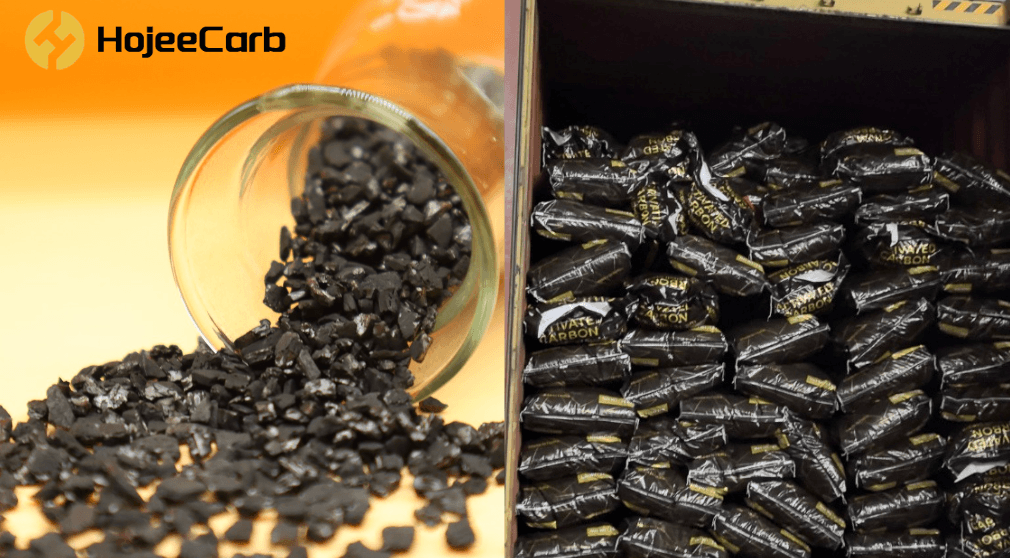
We just closed the books on 56 tons of coconut shell activated carbon bound for a gold mine in Ethiopia. The carbon itself was straightforward for us — 6×12 mesh, iodine 1100 mg/g, ball-pan hardness 98%+, ash below 3%, exactly the spec East African CIL/CIP circuits need. The real test on this order was the loading. Because Ethiopia is landlocked and the cargo faces a long inland journey, the client's freight forwarder enforced a strict pre-shipment loading supervision. Every container had to be inspected and documented before the vessel would sail from Xiamen.
Order Summary
| Item | Details |
|---|---|
| Client Region | Ethiopia, East Africa |
| Application | Coconut shell GAC for gold CIL/CIP |
| Mesh Size | 6×12 (US mesh) |
| Iodine Number | 1100 mg/g (ASTM D4607) |
| Ball-Pan Hardness | ≥98% (ASTM D3802) |
| Moisture | <5% |
| Ash Content | <3% |
| Apparent Density | 0.48–0.52 g/cc (ASTM D2854) |
| Quantity | 56 tons (2 × 40HQ FCL) |
| Loading Port | Xiamen, China |
| Discharge Port | Djibouti Port |
| Final Delivery | Mekelle Dry Port (inland), Ethiopia |
Why Ethiopia-Bound Cargo Faces Strict Pre-Loading Requirements
Ethiopia is landlocked. All sea cargo enters through Djibouti Port on the Red Sea coast, then moves inland by rail and truck — a 5 to 7 day journey to the mining region. If anything goes wrong in transit, there is no quick fix: no nearby port warehouse to swap a damaged container, no local supplier to top up a short shipment.
That is why this client's logistics partner enforced a strict pre-loading inspection. The containers had to be verified before the vessel sailed — not after arrival, not at the discharge port. The loading supervision report had to cover:
- Container internal dimensions — confirming the 40HQ containers meet ISO 668 (internal length ≥12.03 m, width ≥2.33 m, height ≥2.69 m), with no dents or structural damage
- Floor and wall condition — no moisture stains, rust, previous cargo residue, or odor contamination
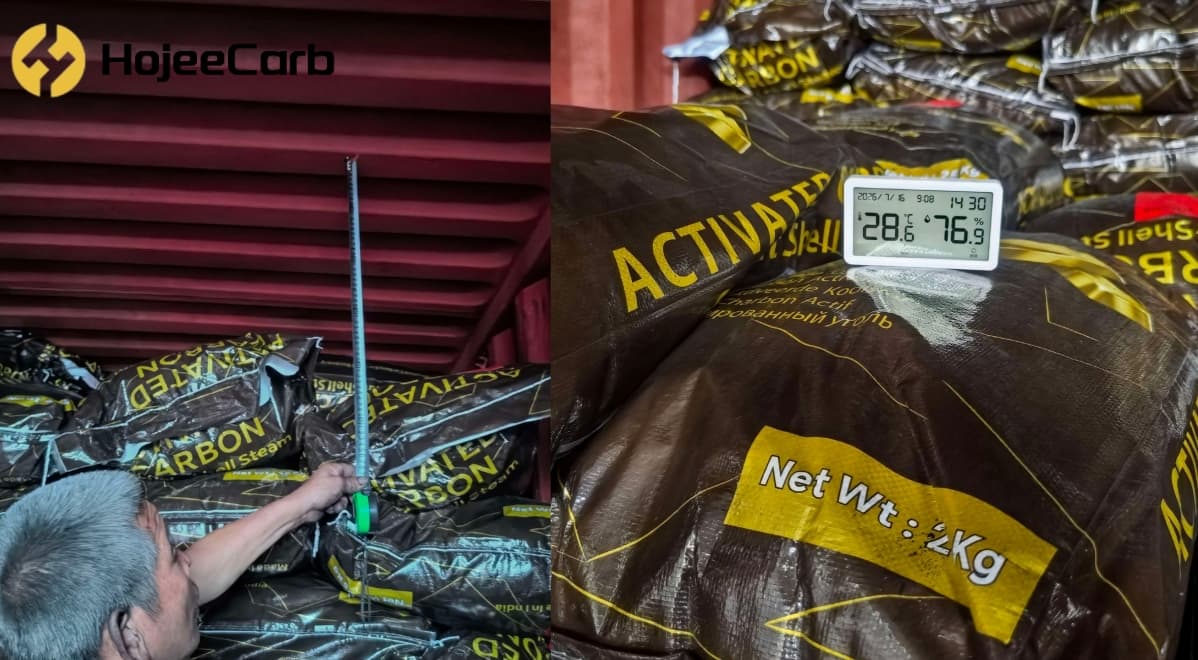
- Temperature reading — internal container temperature recorded at loading; kept below 40°C to prevent condensation during the ocean-to-inland transit
- Seal integrity — door seals and gaskets checked, no light penetration
- Loading pattern and weight distribution — cargo centered, no overhang, weight evenly distributed side to side
- Bag condition and count — every bag checked for tears, moisture, and correct labeling; piece count verified against the packing list
- Photographs — timestamped photos of the empty container, each loading stage, and the sealed doors
Need activated carbon?
Get Factory-Direct Pricing — No Middlemen
20+ years manufacturing. MOQ 1 ton. Free samples. Reply within 2 hours.
Why These Specs Matter for Gold Recovery
6×12 mesh (3.35–1.70 mm) — the workhorse particle size for CIL/CIP. Coarse enough to be retained on inter-stage screens (typically 0.6–0.8 mm aperture) without carrying over into tails, fine enough to keep the gold adsorption rate high. Undersize carbon blinds screens and reports to tailings as loss; oversize carbon slows kinetics.
Iodine 1100 mg/g — a proxy for micropore volume, and micropores are where the gold-cyanide complex ([Au(CN)₂]⁻) adsorbs. At 1100, this carbon reaches a loaded value of 25–30 mg Au/g in a well-run circuit and holds a strong equilibrium (K-value) against the barren solution. See our gold cyanide recovery guide for the adsorption chemistry.
Ball-pan hardness 98%+ — gold carbon is abraded through pumping, screening, acid washing, elution, and thermal reactivation at 650–750°C. Every percent of fines generated is gold walking out the door. At 98%+, this carbon survives 5–8 reactivation cycles with attrition losses typically under 0.5% per cycle.
Ash <3% — coconut shell carbon runs far lower in ash than coal-based grades, which means fewer inorganics (silica, calcium) to foul pores or interfere with elution. Low ash is one reason coconut shell dominates the gold mining carbon market.
Quality Control Before Shipping
At 56 tons across two 40HQ containers, quality can't be assumed lot-to-lot. Every production batch clears our in-house lab before loading:
- Iodine number per ASTM D4607 — composite sample from each production lot
- Ball-pan hardness per ASTM D3802 — minimum 98%, reject below 96%
- Apparent density per ASTM D2854 — target 0.48–0.52 g/cc
- Moisture (ASTM D2867), ash content, and particle size distribution by sieve analysis
- Gold activity test on request — K-value and R-value per standard adsorption isotherm method
Composite samples were drawn across both containers' production lots, so the COA reflects the full shipment, not a single flattering batch. The COA was issued and sent to the client before the vessel sailed from Xiamen, and we support SGS, Intertek, or Bureau Veritas pre-shipment inspection on request. For more on our methods, see our quality testing guide.
How We Handled the Loading Supervision — Step by Step
We've shipped to East Africa many times, so a supervised loading is nothing new to us. But every inspection is taken seriously — one missed checkbox and the cargo gets held at the terminal. Here is exactly how this one ran:
48 hours before loading:
- Requested the shipping line deliver the empty containers to our warehouse one day early
- Pre-inspected both empties ourselves — temperature, cleanliness, internal dimensions, and door seals
- One container had a hairline crack on a floor weld. We rejected it and had a replacement delivered the same day, before the inspector ever arrived
Loading day:
- The inspector arrived at 08:00 to warehouse, cargo, and documents all ready
- Temperature recorded: 27°C in container #1, 26°C in container #2 — well under the 40°C limit (we load early precisely to keep temps down)
- Internal dimensions measured and logged against ISO 668; both containers passed
- Loading took about 6 hours, row by row, with photos documented at each fill stage
- Bag count verified with the inspector: 2,240 bags × 25 kg = 56,000 kg total
- Containers sealed under the inspector's witness; seal numbers recorded on the report
Within 2 hours of loading:
- Supervision report issued with 32 timestamped photographs
- Report, COA, packing list, weight certificate, and fumigation certificate bundled into one PDF for the client
- Client approved; the vessel sailed on schedule
No delays. No re-inspection. No surprises at the port.
What Was Inside the Loading Supervision Report
The final report delivered to the client covered every stage of the loading:
| Section | Contents |
|---|---|
| Container Condition | Internal dimensions, structural check, photos of floor / walls / ceiling / doors |
| Temperature Log | Internal temperature at loading start and end vs. ambient |
| Cargo Verification | Product description, bag count, total weight, packaging condition |
| Loading Sequence | Photos at 25%, 50%, 75%, and 100% fill |
| Seal Record | Seal numbers, photos of sealed doors, tamper indicators |
| Weight Certificate | Gross, tare, and net weight per container |
| Inspector Details | Inspector name, company, certification number, signature |
This level of documentation is not standard from most suppliers. Plenty of Chinese factories can make good carbon — but getting the pre-shipment paperwork right, on time, without delays is where orders break down. Especially for Africa-bound cargo, where one paperwork error can mean weeks of delay at Djibouti.
What Sets Our Delivery Process Apart
- We pre-screen containers before the inspector arrives. If an empty fails, we swap it same-day — not on the inspector's clock
- Temperature and moisture readings are standard on every Africa-bound shipment. We don't wait for clients to ask
- Our warehouse team is trained for supervised loading. They know the checklist and load accordingly — row by row, photo-staged
- Full document package within 2 hours. COA, supervision report, weight certificate, packing list, and fumigation certificate, all bundled
- One point of contact for production, QC, loading, documentation, and shipping — start to finish
Shipping Inland to Mekelle Dry Port
Ethiopia is landlocked, so logistics is the real test on an order like this. Cargo can't just clear a nearby seaport — it lands at Djibouti on the Red Sea coast, then moves inland via the Ethio-Djibouti Railway and road haulage to the mining region. We handled the full chain and delivered directly to Mekelle Dry Port, the inland customs and container station serving northern Ethiopia. One point of contact for ocean freight, Djibouti clearance, and inland transport — instead of stitching together three separate vendors.
The 56 tons were packed in 25 kg PP woven bags with a PE inner liner, palletized and stretch-wrapped for the long inland leg, and loaded across two 40HQ (40-foot high-cube) containers. For mines that prefer bulk handling, we also supply 500 kg and 1,000 kg jumbo bags (FIBC).
We prepare the full export document set: commercial invoice, packing list, COA, fumigation certificate, certificate of origin, and bill of lading. Delivery terms to inland Ethiopian stations are quoted case by case — ask us about CIF Djibouti or delivered-to-dry-port options.
Need Gold Recovery Carbon for Your Mine?
Tell us your mesh size, iodine target, and annual volume. We'll send you a spec sheet, pricing, and free samples within 24 hours. Inland delivery to Africa arranged.
Frequently Asked Questions
What is a loading supervision report for activated carbon?
A loading supervision report is an independent inspection document that verifies container condition, internal dimensions, temperature, cargo quantity, packaging integrity, and seal records before a shipment boards the vessel. It protects buyers against transit damage claims and weight disputes, which matters most on long inland routes like Ethiopia.
What temperature should containers be for activated carbon loading?
Below 40°C internal temperature at the time of loading. For this Ethiopia order we recorded 26–28°C by loading early in the day. High container temperatures combined with humidity cause moisture migration and condensation during the ocean-to-inland transit, which can raise moisture content and trigger weight disputes at destination.
Do you charge extra for pre-loading inspection?
We do not charge for our in-house pre-inspection of empty containers. If you require a third-party inspector (SGS, Intertek, or Bureau Veritas) to witness the loading and issue the supervision report, the inspection fee is paid by the buyer, but we coordinate scheduling and provide full access.
How fast do you issue the supervision report and documents?
Within 2 hours of loading completion. We issue the loading supervision report along with the COA, packing list, weight certificate, and fumigation certificate as a single PDF package so the buyer can approve before the vessel departs.
Can you deliver activated carbon to inland sites in Ethiopia?
Yes. Ethiopia is landlocked, so cargo arrives at Djibouti Port and moves inland by rail or truck. We can handle ocean freight, Djibouti clearance, and inland transport to Mekelle Dry Port or other stations as a single door-to-inland-station service.