
Shipment Case Study
26 Tons of HojeeGold CG33 Gold Recovery Carbon Shipped to a Zimbabwe CIP Mine
A new client on the Zimbabwe Craton greenstone belt came to us on a referral from an existing customer, benchmarked our sample against several other activated carbon manufacturers, and placed a first order of 26 tons — one 40ft container of 500 kg bulk bags, all from a single production batch.
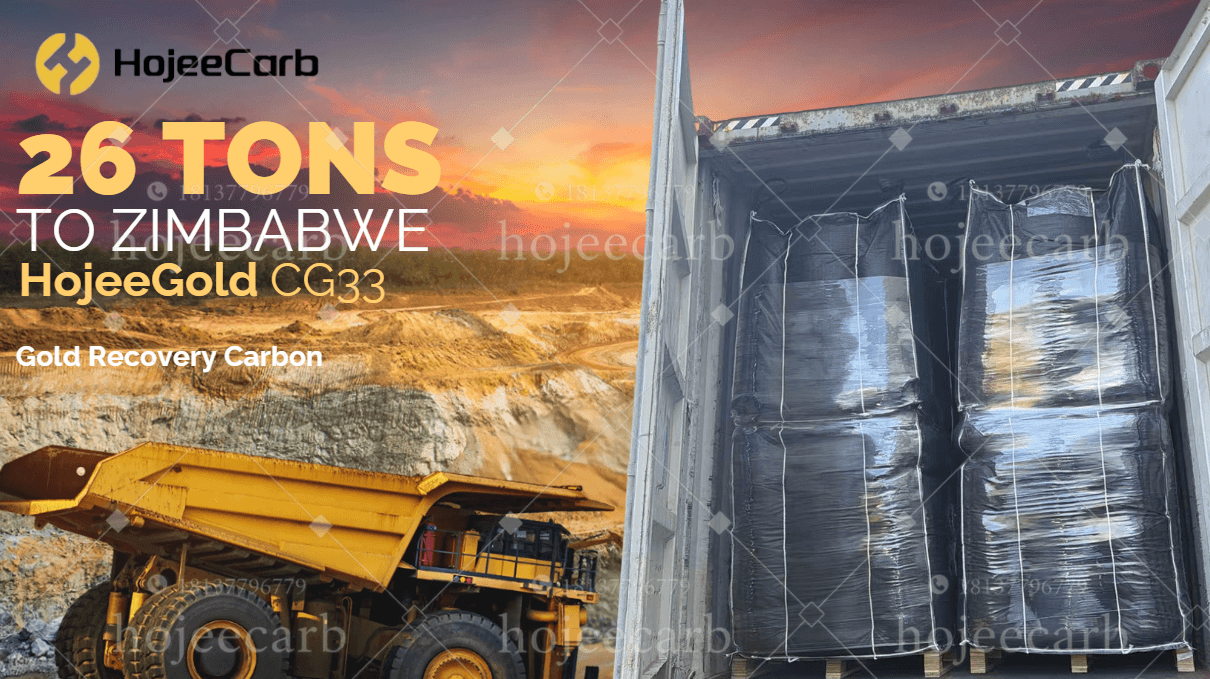
26 tons of HojeeGold CG33 (6×12 mesh, iodine ≥1100 mg/g) in 500 kg bulk bags, loaded into a single 40ft container for the Beira Corridor route to Harare.
We just shipped 26 tons of coconut shell gold recovery carbon to a gold producer in Zimbabwe — a 40-foot container of HojeeGold CG33 bound for a carbon-in-pulp (CIP) circuit on the country’s greenstone gold belt. The spec was the one Zimbabwean mines keep asking us for: 6×12 mesh, iodine ≥1100 mg/g, ball-pan hardness ≥99%, CTC ≥55%, ash under 3%. What makes a 26-ton order worth writing up isn’t the tonnage — it’s how the order was won, and why hardness, not headline iodine, decided the grade.
This was a first-time order from a new client, introduced by one of our existing customers. Before placing it, they did what careful buyers do: they requested samples, then benchmarked us against several other activated carbon manufacturers. They came back and told us our carbon was the one they were satisfied with, and placed the full container. A referral gets you in the door; a sample on the bench is what closes it.
Zimbabwe’s gold sector is booming. The country delivered a record 46.7 tonnes of gold to Fidelity Gold Refinery in 2025, 28% above the previous record of 36.5 tonnes in 2024, with small-scale and artisanal miners contributing 34.87 tonnes — about 74.5% of national output. That structure, a huge base of small and medium mills cycling carbon hard, is exactly why the carbon spec for Zimbabwe differs from a fully mechanised West African CIL plant.
Order Summary
| Client region | Zimbabwe (Craton greenstone gold belt) |
| Order type | First order — new client, referred by an existing customer |
| Circuit type | CIP — Carbon-in-Pulp (cyanide leach) |
| Product | HojeeGold CG33 — Coconut Shell Activated Carbon |
| Iodine value | ≥ 1100 mg/g (ASTM D4607) |
| Hardness | ≥ 99% (ASTM D3802) |
| CTC activity | ≥ 55% |
| Mesh size | 6 × 12 (ASTM D2862) |
| Ash / Moisture | ≤ 3% / ≤ 5% |
| Total volume | 26 tons net weight |
| Containers | 1 × 40ft HQ |
| Packing | 52 × 500 kg FIBC bulk bags, lined |
| Production | Single production batch — one composite COA |
| Routing | Beira, Mozambique → Harare (Beira Corridor) |
| Ship date | October 2026 |
Why Zimbabwe Mines Should Ask for Hardness First
Most carbon buyers lead with iodine number. In Zimbabwe, the number that actually protects gold recovery is ball-pan hardness. Here is the reasoning, not just the claim:
- Zimbabwe Craton ore is largely free-milling. The greenstone belts around Kadoma, Kwekwe, Zvishavane and the Bubi area are not strongly preg-robbing — the gold loads readily. You rarely need a premium 1150+ iodine carbon to pull it. CG33 at iodine ≥1100 mg/g already carries more working micropore volume than the ore demands.
- The circuits cycle carbon aggressively. Many Zimbabwean operations — especially the small and medium mills that make up roughly three-quarters of national production — run pumps, screens, acid wash and elution with less screening discipline than a large automated plant. Every cycle abrades the carbon.
- Every percent of fines is gold walking out. Soft carbon crumbles into fines that pass through inter-stage screens and leave with the tails, loaded with gold. At ≥99% ball-pan hardness, CG33 generates far fewer fines per cycle, which is where recovery is actually won or lost in a hard-cycling circuit.
The honest spec guidance we give Zimbabwe buyers: do not overpay for iodine you cannot use. Put the budget into hardness, because that is what survives your circuit.
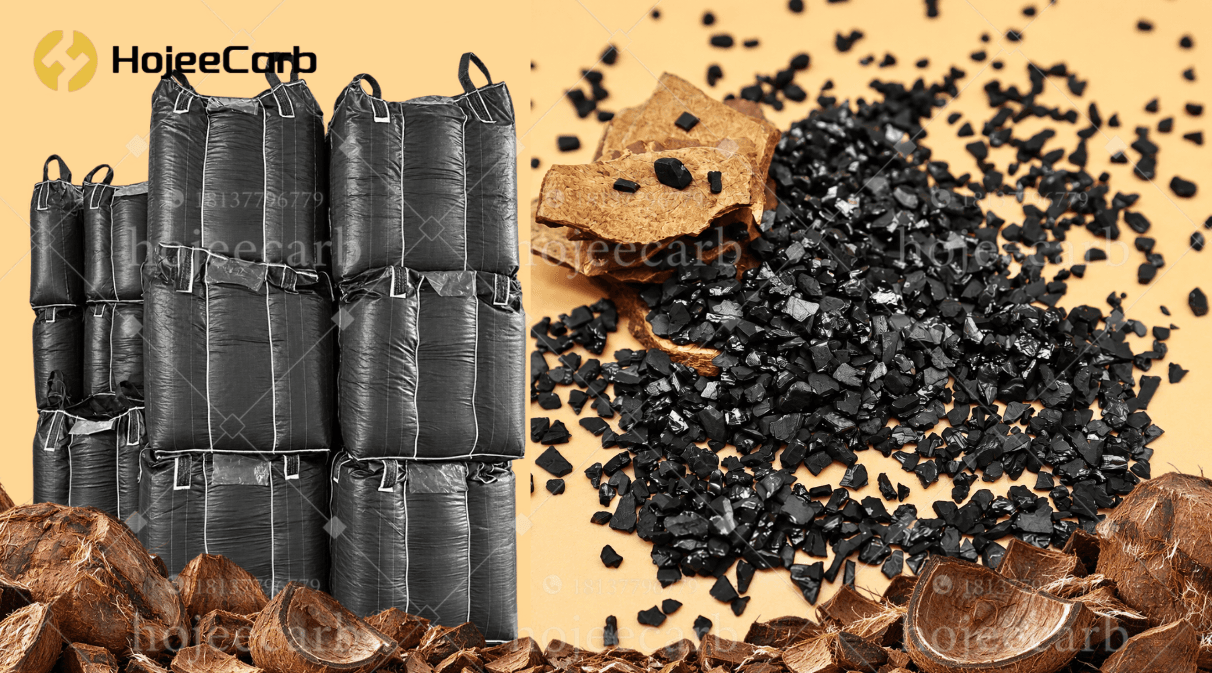
500 kg lined FIBC bulk bags ready for loading, and the carbon itself — 6×12 mesh granules made from coconut shell charcoal, the raw material that gives CG33 its ≥99% hardness.
Why CG33 for This CIP Circuit
This client runs a CIP (carbon-in-pulp) section. In CIP, leaching finishes first and the carbon meets a clarified, high-grade solution with short contact time per tank stage — so gold adsorption kinetics (the K value) matter more than long residence time. A higher iodine value correlates with more available micropore surface and faster loading, which is why CG33 (iodine ≥1100 mg/g) suits a CIP tank better than a lower-iodine CIL grade.
| Parameter | HojeeGold CG33 (this order) |
|---|---|
| Base material | Coconut shell charcoal |
| Mesh size | 6 × 12 (ASTM D2862) |
| Iodine value | ≥ 1100 mg/g (ASTM D4607) |
| CTC activity | ≥ 55% |
| Ball-pan hardness | ≥ 99% (ASTM D3802) |
| Ash | ≤ 3% |
| Moisture | ≤ 5% |
| Apparent density | 480–520 kg/m³ |
| Circuit fit | CIP / CIL — fast adsorption kinetics, high attrition resistance |
Quality Control — One Batch, One COA
26 tons is a single production commitment, not a warehouse pick. All 26 tons came off one production batch — same raw coconut shell charcoal source, same activation furnace run, same screening pass — so one composite COA honestly represents every bag in the container.
This matters more than it sounds. When a supplier blends two or three lots to make up tonnage, bag-to-bag iodine and hardness drift, and a circuit that was tuned on the first lot starts behaving differently halfway through the container. A first-time buyer has no history with a supplier; one batch and one COA is how the first container becomes verifiable instead of a leap of faith.
Before loading, our in-house lab tested:
- Iodine value — composite sample drawn from the production lot (ASTM D4607)
- Ball-pan hardness — minimum 99% (ASTM D3802)
- CTC activity — minimum 55%
- Moisture, ash content and particle size distribution by sieve analysis
- 6×12 mesh confirmed (ASTM D2862)
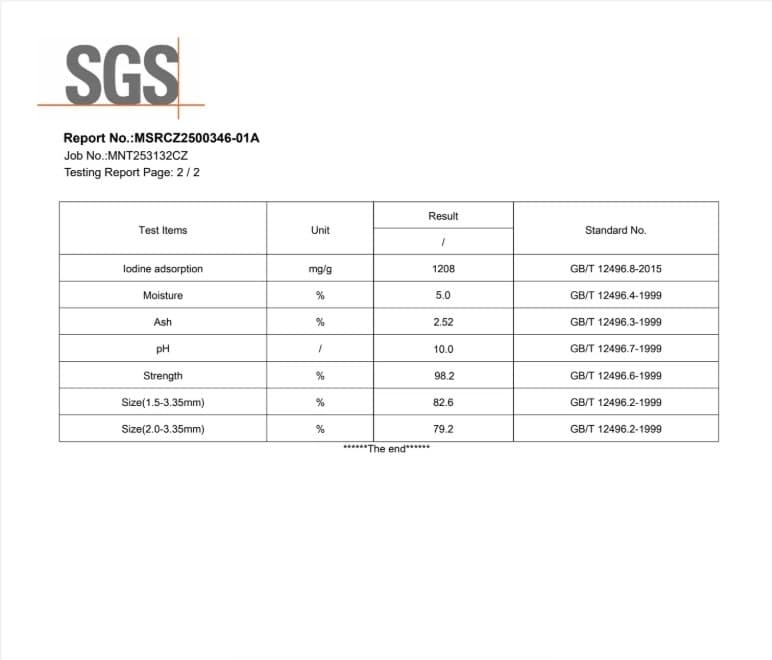
We put our carbon through independent SGS testing, not only our own lab. This SGS report (No. MSRCZ2500346-01A) on our coconut shell activated carbon returned iodine adsorption 1208 mg/g, ash 2.52%, moisture 5.0%, pH 10.0 and strength 98.2%, tested to the GB/T 12496 series. Note that GB/T strength and ASTM D3802 ball-pan hardness are different test methods and the numbers are not directly comparable.
The COA travelled with the shipment alongside the packing list, weight certificate and fumigation certificate. We also support SGS or Bureau Veritas pre-shipment inspection at origin on request — useful for mines and co-ops that report to lenders or donor-funded programmes.
Need activated carbon?
Get Factory-Direct Pricing — No Middlemen
20+ years manufacturing. MOQ 1 ton. Free samples. Reply within 2 hours.
Packaging and Routing — 500 kg Bulk Bags, Landlocked via Beira
Zimbabwe has no seaport, so the entry route drives both landed cost and lead time. For this order we shipped a single 40ft container through the Beira Corridor, Zimbabwe’s standard gateway.
- Packaging: 26 tons in 500 kg bulk bags (FIBC jumbo bags) — 52 bags, four-loop single-trip construction with an inner liner against moisture pickup on the ocean leg. The client’s site has a loader, so bulk bags beat 25 kg sacks here: fewer units to count at the border, far less handling labour per ton, no pallet wrap to dispose of, and carbon goes into the tanks straight from the bag. We also supply 25 kg PP bags for sites without lifting equipment — the choice should follow what your site can actually lift.
- Routing: ocean leg to Beira, Mozambique, then roughly 600 km overland to Harare via the Beira Corridor — the shortest inland leg and usually the lowest landed cost for central Zimbabwe. Durban is the alternative for Bulawayo and the south (about 1,700 km via Beitbridge), but Beira won on cost and transit time here.
- Documented loading: all 52 bulk bags weighed and verified against the packing list, timestamped photos at fill stages, container seal recorded. The full document set — COA, packing list, weight certificate, fumigation certificate, bill of lading — was bundled for the client before the vessel sailed, so customs clearance at Beira and the Zimbabwe border did not stall the cargo.
Why the Client Chose Us Over Several Other Manufacturers
The client told us plainly why they chose us after comparing suppliers:
- The sample performed. They ran our sample alongside carbon from several other manufacturers before committing. That is the right way to buy carbon, and it is the only reason a first container gets placed with a supplier you have never used.
- A customer vouched for us. The introduction came from an existing client already running our gold carbon. In mining procurement, a working reference from a peer operation carries more weight than any brochure.
- The right grade for Zimbabwe Craton ore. 6×12, iodine ≥1100, hardness ≥99% — matched to free-milling, hard-cycling CIP circuits, with budget spent on hardness rather than unusable iodine.
- One batch, one COA. No inter-lot blending to hit tonnage; the paperwork represents what actually goes into the tanks.
- Independent verification. In-house lab results backed by SGS third-party testing, with SGS or BV pre-shipment inspection available on the first container.
- Honest routing advice. Beira versus Durban costed openly instead of a generic “we ship worldwide” line.
- Packaging matched to the site. 500 kg bulk bags because they have a loader — not whatever was cheapest for us to pack.
Get a Quote
Running a CIP or CIL gold circuit in Zimbabwe — Harare, Kadoma, Kwekwe, Zvishavane or the Great Dyke margins — and want carbon that survives hard cycling? Do what this client did: get a sample and bench it against whatever you are running now. Tell us your mesh size, iodine/hardness target and tonnage (we start at 1 ton and consolidate small orders). We will send a spec sheet, a composite-sample COA, pricing and free samples within 24 hours — and quote delivery via Beira or Durban, in 25 kg bags or 500 kg bulk bags, whichever your site can handle.
Related Resources
- Activated Carbon Supplier in Zimbabwe — Gold Mining Supply
- Gold Recovery Carbon Specifications: 6×12 Mesh, Iodine 1050+, Hardness 98%+
- Activated Carbon for Gold Mining: CIP vs CIL Explained
- 84 Tons Gold Recovery Carbon to Sudan — CIP Repeat Order
- Gold Carbon Fouling and Poisoning: Diagnosis and Prevention
- Gold Recovery Applications — Full Guide
- Coconut Shell Activated Carbon — Product Page
FAQ
What activated carbon grade is best for a Zimbabwe CIP gold circuit?
A 6×12 mesh coconut shell carbon with iodine around 1100 mg/g (HojeeGold CG33) and ball-pan hardness ≥99%. Zimbabwe Craton greenstone ore is largely free-milling, so you rarely need a premium 1150+ iodine carbon — but because circuits cycle carbon hard, high hardness is critical to limit fines and protect recovery.
Why does hardness matter more than iodine number in Zimbabwe?
The ore loads gold readily, so extra iodine (surface area) is often unused. But many Zimbabwean circuits, especially small and medium mills, abrade carbon aggressively through pumping, screening, acid wash and elution. Soft carbon breaks into fines that leave with the tails carrying gold. Hardness ≥99% keeps fines low, which is where recovery is actually protected.
Do you ship activated carbon to Zimbabwe, and through which port?
Yes. Zimbabwe is landlocked, so we route via Beira, Mozambique (about 600 km to Harare, usually the cheapest and fastest option for central Zimbabwe) or Durban, South Africa (about 1,700 km via Beitbridge, better for Bulawayo and the south). We quote both so you can compare landed cost.
500 kg bulk bags or 25 kg bags — which should a gold mine order?
It depends on what your site can lift. 500 kg bulk bags (FIBC) are better if you have a loader or forklift: fewer units to count at the border, much less handling labour per ton, and carbon discharges straight into the tanks. 25 kg PP bags suit sites with manual handling only, or when you need to dose carbon stage by stage. This order went out as 52 × 500 kg lined bulk bags because the client has lifting equipment on site.
Can you supply small orders, or only full containers?
We start at 1 ton — no container required. We also consolidate several small Zimbabwe orders into a shared container to cut per-ton freight. This 26-ton order filled a single 40ft container, but many Zimbabwean buyers order 1–5 tons at a time.
How do you prove the carbon is consistent across a 26-ton order?
All 26 tons were produced in one batch — same charcoal source, same activation run, same screening pass — and tested on a composite sample before loading, so one COA honestly represents every bag in the container: iodine, hardness, CTC, moisture, ash and particle size. Ask any supplier whether your tonnage is one batch or several lots blended to make weight; blended lots drift bag to bag.
We have never bought from a Chinese carbon supplier before. How do we de-risk the first order?
Exactly the way this client did. Request a sample and bench it against your current carbon on your own ore. Ask for a reference from an operation already using the carbon. Require one production batch with a composite COA rather than blended lots. Then add third-party pre-shipment inspection (SGS or Bureau Veritas) on the first container. If a supplier resists any of those four, that is your answer.