
Shipment Case Study
84 Tons Gold Recovery Carbon Shipped to Sudan — CIP Repeat Order, 3 × 40ft Containers
A Sudan gold producer who ordered 56 tons from us earlier this year came back with a larger repeat order: 84 tons of coconut shell carbon for their CIP circuit expansion, split across three 40-foot containers. Shipped October 13, 2026.
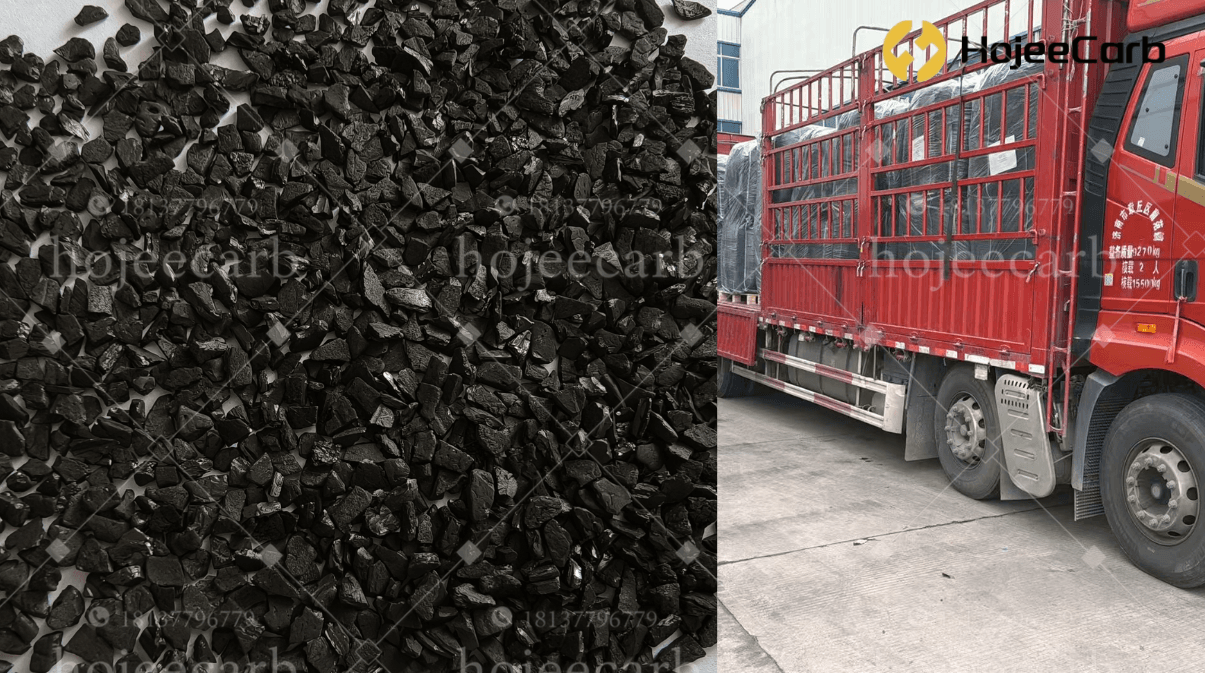
HojeeGold CG33 (6×12 mesh, iodine ≥1100 mg/g) loaded for dispatch — truck departing factory for consolidation before sailing to Port Sudan
Order Summary
| Client region | Sudan (Red Sea Hills gold belt) |
| Order type | Repeat order (returning client) |
| Circuit type | CIP — Carbon-in-Pulp |
| Product | HojeeGold CG33 — Coconut Shell Activated Carbon |
| Iodine value | ≥ 1100 mg/g (ASTM D4607) |
| Hardness | ≥ 99% (ASTM D3802) |
| Mesh size | 6 × 12 (ASTM D2862) |
| Total volume | 84 tons net weight |
| Containers | 3 × 40ft HQ, approx. 28 tons per container |
| Packing | 550 kg FIBC jumbo bags |
| Destination | Port Sudan, Red Sea |
| Ship date | October 13, 2026 |
Background: A Client Who Came Back
Earlier in 2026 this client placed their first order with us — 56 tons of coconut shell gold recovery carbon for a CIL section of their plant. Before that order, they ran a side-by-side comparison of our carbon against a well-known competing brand, testing iodine value, hardness, CTC activity, and K value. The numbers matched. The price was lower. They shipped.
After running our carbon through their CIL circuit for several months, they came back with a second requirement: a CIP expansion. The CIP section needed a higher-kinetics grade — specifically iodine ≥ 1100 mg/g — to match the faster gold adsorption cycle typical of carbon-in-pulp operation. They specified HojeeGold CG33 and ordered 84 tons across three containers.
Repeat orders are a different kind of proof than a first inquiry. The client has already seen the carbon in operation, compared actual recovery data against their baseline, and decided the performance justifies continuing with the same supplier. The increased volume — from 56 to 84 tons — reflects a circuit expansion, not just a restock.
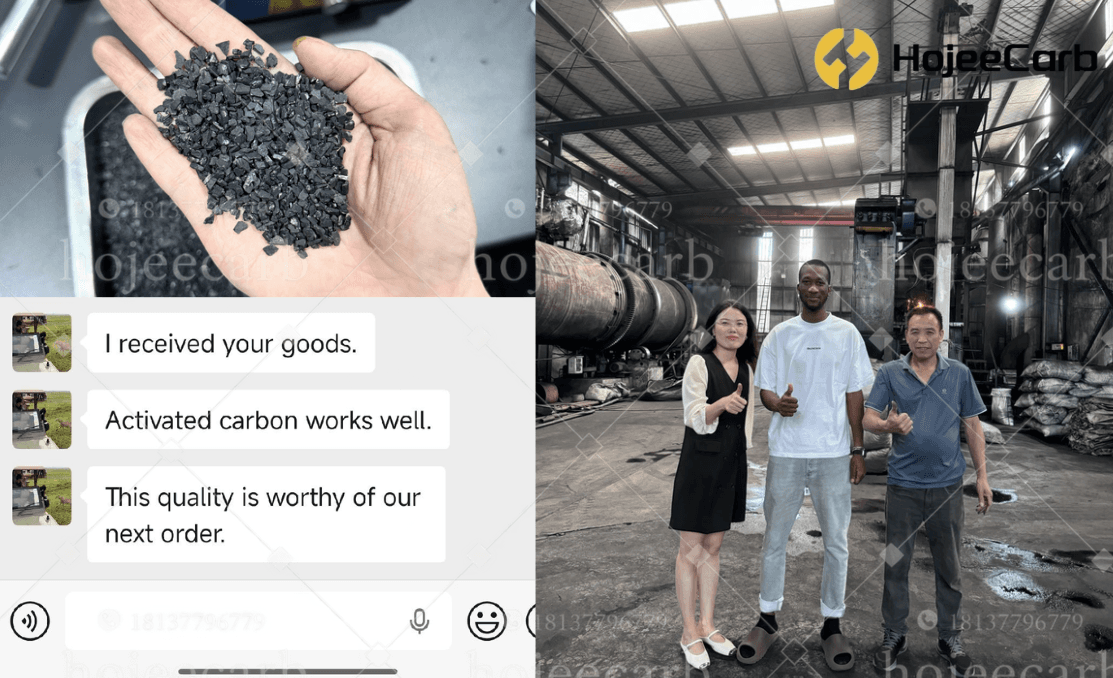
The Sudan client visited our factory before the first order. After receiving the 56-ton shipment, they sent confirmation: “Activated carbon works well. This quality is worthy of our next order.”
CIP vs CIL: Why the Grade Changed
In a CIL (carbon-in-leach) circuit, activated carbon is added directly to the leach tanks. Gold adsorption and cyanide leaching happen simultaneously, so the carbon operates in a slurry with active leaching chemistry. Residence time is longer. The emphasis is on elution compatibility and R value (retentivity).
In a CIP (carbon-in-pulp) circuit, leaching is completed first, and the carbon is introduced afterward to a clarified slurry with high gold-in-solution concentration. The contact time per tank stage is shorter. What matters most here is the K value — the rate at which gold loads onto carbon under AARL test conditions. A higher iodine value correlates with more available micropore surface area and faster adsorption kinetics.
That is why this client stepped up from CG32 (iodine ≥ 1050 mg/g) for CIL to CG33 (iodine ≥ 1100 mg/g) for the CIP section. The difference is not dramatic on paper, but in a CIP circuit running at high throughput, the faster kinetics translate directly to higher gold recovery per ton of carbon.
| Parameter | CIL (first order) | CIP (this order) |
|---|---|---|
| Grade | HojeeGold CG32 | HojeeGold CG33 |
| Iodine value | ≥ 1050 mg/g (D4607) | ≥ 1100 mg/g (D4607) |
| Hardness | ≥ 98% (D3802) | ≥ 99% (D3802) |
| CTC activity | ≥ 55% | ≥ 55% |
| Mesh size | 6 × 12 | 6 × 12 |
| Circuit emphasis | R value, elution compatibility | K value, adsorption kinetics |
Coordinating 3 Containers: What Bulk Delivery Looks Like
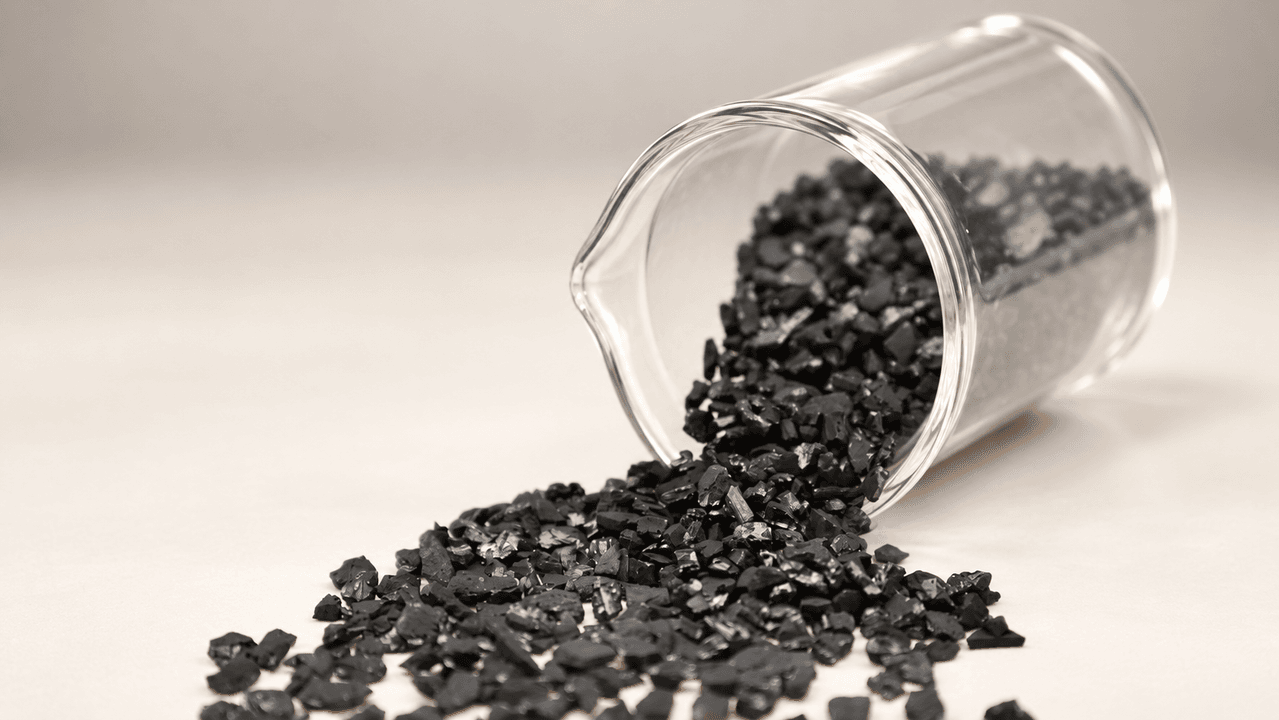
CG33 granules tested in the lab before packing — iodine ≥1100 mg/g, hardness ≥99%, 6×12 mesh. One COA covers all three containers.
An 84-ton order is a bulk production commitment, not a warehouse pick. All three containers come from the same production batch — one batch, one COA, one quality baseline. This matters because inter-container variation is a real risk when suppliers split large orders across different production runs or blend batches to hit volume.
Each container holds approximately 28 tons net weight, packed in 550 kg FIBC jumbo bags. Fifty jumbo bags per container. The bags are labelled with batch number, grade, and test date. The packing list, weight certificate, fumigation certificate, and COA travel with the full Bill of Lading set. Port Sudan is the receiving point, with onward transport to the mine site inland.
From order confirmation to vessel departure was under three weeks. Typical vessel transit from a Chinese port to Port Sudan via the Red Sea runs 18–25 days. The client receives the full document package — COA, B/L, packing list, weight and fumigation certificates — before the vessel arrives, so they can clear customs without waiting at port.
Need activated carbon?
Get Factory-Direct Pricing — No Middlemen
20+ years manufacturing. MOQ 1 ton. Free samples. Reply within 2 hours.
What This Order Tells a Buyer Evaluating Suppliers
If you are sourcing gold recovery carbon for the first time, a case like this answers a specific question: can this supplier deliver at scale, consistently, after the first order?
A first order tells you about initial quality. A repeat order at higher volume tells you about supply reliability, production consistency, and whether the relationship holds when the client has already paid once and has real operating data. This client expanded their order and their circuit with the same supplier. That is the signal.
The scale of 84 tons across 3 containers also demonstrates a specific logistics capability: coordinating a multi-container shipment from a single batch, clearing a Chinese export port, and delivering to a Red Sea destination on schedule. Not every supplier handles that process without introducing quality variation or booking delays between containers.
If your mine runs CIP and you are evaluating whether to trial a new carbon supplier, the relevant question is not just the spec sheet. It is whether the supplier has delivered that spec at bulk volume, to your region, for a client who came back.
Related Resources
- 56 Tons Gold Recovery Carbon Shipped to Sudan — CIL Case Study (First Order)
- Gold Recovery Carbon Specifications: 6×12 Mesh, Iodine 1050+, Hardness 98%+
- Activated Carbon for Gold Mining: CIP vs CIL Explained
- Activated Carbon Supplier for Sudan Gold Mines
- Gold Recovery Applications — Full Guide
- Coconut Shell Activated Carbon — Product Page
FAQ
What does a CIP gold mine need from activated carbon that a CIL mine does not?
In CIP (carbon-in-pulp), carbon is added after leaching into clarified slurry, so it contacts higher gold-in-solution concentrations but has less residence time per stage. This puts a greater premium on fast gold adsorption kinetics — the K value — than on raw surface area. A high-iodine carbon with K ≥ 30 kg/t and hardness ≥ 99% resists the attrition typical in CIP agitation tanks. For CIL, the carbon contacts the leach as it happens, so elution compatibility and R value matter more.
Why did this client switch from 56 tons (CIL) to 84 tons (CIP)?
The client operates two separate circuits. Their first order (56 tons) supplied a CIL section. This repeat order supplies a CIP expansion added since then. The larger volume — 84 tons across 3 containers — reflects the CIP circuit's higher carbon inventory requirements. Both orders used coconut shell carbon; the CIP order specified the higher iodine grade (≥ 1100 mg/g, HojeeGold CG33) to match faster kinetics in the CIP tanks.
How do you ensure quality is consistent across 3 separate containers?
All 84 tons came from a single production batch. One COA covers the entire shipment — iodine value, hardness, moisture, ash, and CTC activity were tested on a composite sample drawn from the batch before packing. Each of the three containers received the same packing lot. The COA, packing list, and weight certificate are issued per shipment, not per container, so the client can verify consistency against a single document set.
What is the lead time for a 3-container bulk order to Sudan?
Production and packing for an 84-ton batch typically takes 7–12 days from order confirmation, assuming the grade is in-schedule production. Booking and loading adds 3–5 days. Vessel transit from a Chinese port to Port Sudan via the Red Sea is approximately 18–25 days, depending on routing and port congestion. Total lead time from PO to arrival is usually 28–40 days.
Can I get a sample of HojeeGold CG33 before placing a bulk order?
Yes. We ship 200–500g lab samples by courier, typically arriving within 5–7 business days. The sample comes with a full COA so you can run your own iodine, hardness, and K-value tests before committing to a full order. Contact us with your target iodine value and circuit type (CIP or CIL) and we will recommend the right grade.