
Shipment Case Study
72.6 Tons of Gold Recovery Activated Carbon Shipped to Mali
A gold mining customer in Mali ordered three 40ft containers — 72.6 tons of coconut shell gold recovery carbon at iodine 1000 mg/g, 3-7 mesh, in palletised bulk bags. He was introduced by a local buyer who already runs our carbon, and ordered three full containers outright — no sample, no trial tonnage.
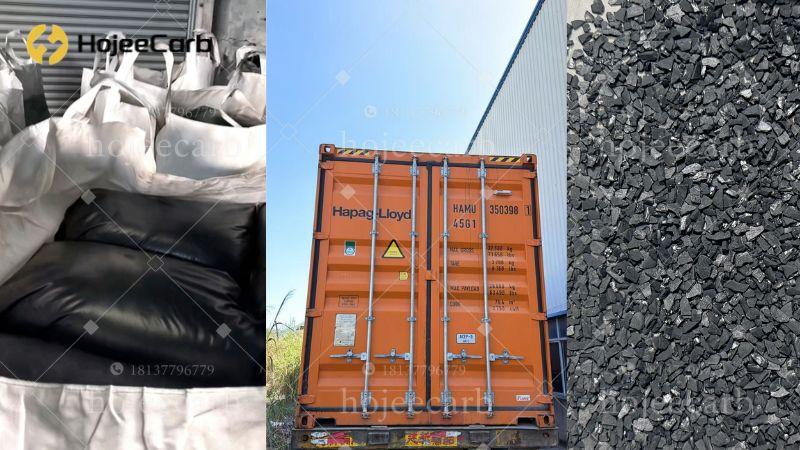
Part of 72.6 tons of coconut shell gold recovery carbon (1000 mg/g iodine, 3-7 mesh) in palletised bulk bags — one of the three 40ft containers leaving our yard for Mali.
We recently shipped 72.6 tons of coconut shell gold recovery activated carbon to a gold mining customer in Mali — three 40ft containers, iodine 1000 mg/g, 3-7 mesh, in palletised bulk bags. Mali is not a new market for us — we have exported gold recovery carbon there repeatedly, and that history is what brought this order in. The buyer was introduced by a local contact who already buys our carbon, and what he kept hearing from others in the trade was the same: the quality holds and the price works. By the time he called us he had effectively already done his evaluation, so he placed a full three-container order without asking for a trial.
Mali is one of West Africa’s largest gold producers and ranks among the top gold-mining nations on the continent, according to USGS mineral statistics. The country is home to more than 15 industrial mines run by majors such as Barrick, B2Gold, Resolute and Endeavour. According to mines ministry data reviewed by Reuters, Mali’s industrial gold production fell about 23% in 2025 to 42.2 tonnes, from 54.8 tonnes in 2024, largely because Barrick’s Loulo-Gounkoto complex was suspended for more than six months in a dispute with the government. Even so, record gold prices lifted the sector’s payments to the state to a record 888.5 billion CFA francs (about $1.57 billion), and with Loulo-Gounkoto back in operation from late 2025 the mines are ramping up again. Most of that output runs through cyanide leaching circuits, which is where our carbon goes to work.
Order Summary
| Destination | Mali (West Africa) |
| Order type | Referral — introduced by an existing Mali buyer |
| Product | Coconut shell gold recovery activated carbon |
| Application | Gold recovery — CIL / CIP circuit |
| Iodine value | 1000 mg/g (ASTM D4607) |
| Mesh size | 3-7 mesh |
| Total volume | 72.6 tons |
| Containers | 3 × 40ft — 24.2 tons per container |
| Packing | Palletised FIBC bulk bags |
Why Three Containers Right Away
Most new mining customers work through a sample, then a trial ton or two, then scale up. This buyer skipped all of it. A local contact already running our carbon vouched for it, and others in the Mali trade told him the same thing — consistent quality batch to batch, and pricing well under what the imported brands quote into West Africa. A reference from someone treating comparable ore in the same country carries more weight than any datasheet we could send him.
Our own side of it was equally settled. We have shipped gold recovery carbon into Mali several times, so the export paperwork, the port routing and the inland leg to site were all known ground rather than something to figure out mid-order. Between the referral and a supply route we had already run, committing to three containers was a short decision for him.
What the Customer Needed
For a gold mine, the carbon is not a generic consumable. It sits directly in the leach circuit and pulls dissolved gold out of the cyanide solution. If the carbon adsorbs slowly, or breaks down into fines under handling, gold escapes into the tailings and the mine loses revenue. So the brief was specific: a hard coconut shell carbon with enough micropore volume to load gold well, in a particle size that suits their screens.
At 72.6 tons the order covers a serious run of circuit inventory rather than a test batch, so consistency across the whole lot mattered more than any single bag. We produced all three containers from the same raw material intake and held the same spec through every batch, because a carbon that drifts between containers forces a plant to re-tune its circuit mid-campaign.
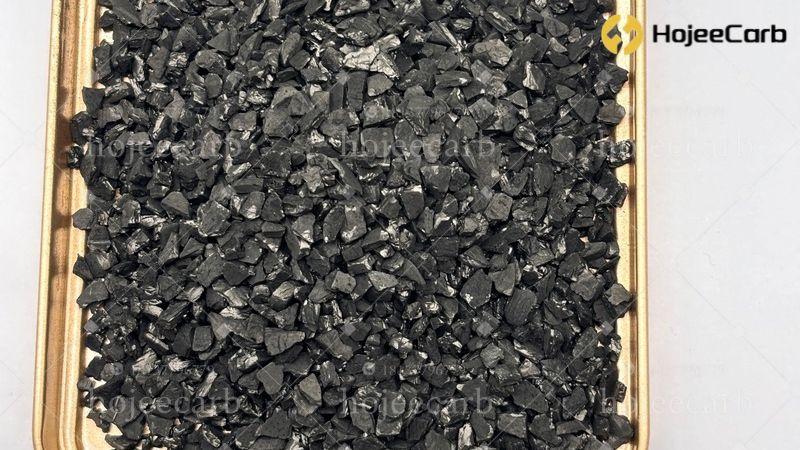
The carbon itself: hard, angular coconut shell granules at 3-7 mesh, iodine 1000 mg/g — the grade this Mali customer specified.
Why This Grade: 1000 Iodine, 3-7 Mesh
- Iodine value 1000 mg/g. The iodine number reflects how much micropore surface the carbon has, and micropores are where the gold-cyanide complex adsorbs. For gold recovery, 1000 mg/g is a solid working level — enough capacity for a CIL or CIP circuit without paying for surface area the application cannot use. Our coconut shell gold recovery carbon starts from thick coconut shell, which gives a harder granule and a cleaner, lower-ash carbon than most coal-based alternatives.
- Mesh 3-7. This is a coarse granular size. Coarser carbon drains and screens more easily in a leach tank and resists being carried out of the circuit as fines. We supplied to the size the customer’s circuit already runs rather than pushing a standard sizing — matching the existing screens avoids channeling and uneven flow through the carbon columns.
- Why coconut shell. Coconut shell activated carbon is the standard raw material for gold adsorption because of its high micropore ratio and high mechanical hardness. Hardness matters because gold carbon is reactivated and recycled many times; a soft carbon crumbles into fines on each cycle, and those fines carry adsorbed gold straight into the tailings. A harder carbon survives more cycles, lowering the real cost per ounce recovered.
Production and Quality Checks
We produced all three containers on our standard gold-carbon line and ran our routine checks before packing, batch by batch:
- Iodine value — confirmed against the 1000 mg/g target, measured per ASTM D4607, the standard test method for the iodine number of activated carbon.
- Particle size — screened to confirm the 3-7 mesh distribution, so the carbon the customer receives matches the size their circuit is built around.
- Moisture and appearance — checked so the bags are not shipping water weight and the granules are clean and uniform.
We do not publish a customer’s own test data, and we are not going to invent numbers. What we can say is that the carbon left our plant verified against the agreed specification before it was loaded.
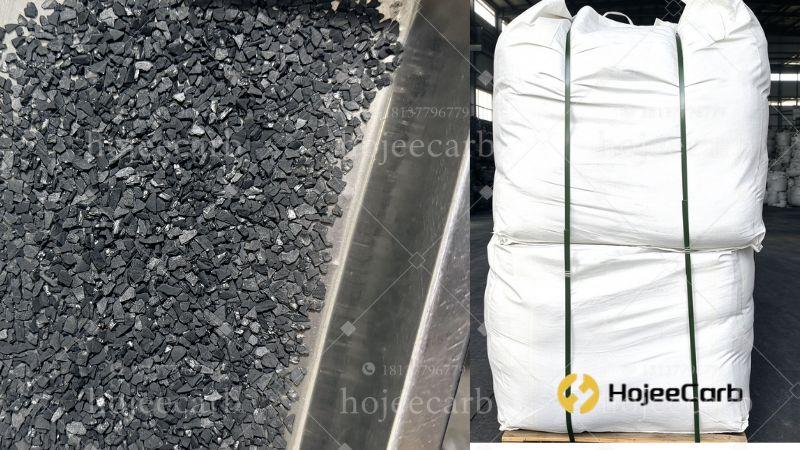
Bulk bags strapped onto pallets — palletising is what lets us fit 24.2 tons into a 40ft container and keeps the bags stable through the ocean and inland legs.
Need activated carbon?
Get Factory-Direct Pricing — No Middlemen
20+ years manufacturing. MOQ 1 ton. Free samples. Reply within 2 hours.
Packaging and Loading
The 72.6 tons went out as palletised bulk bags across three 40ft containers, 24.2 tons per container. Palletising is the detail that decides the load figure: bags sitting on pallets stay square and stack without slumping, so the container fills to its usable cube instead of wasting headroom, and a forklift can pull them straight out at the far end. Loose-stacked bags in the same box would land well under 24 tons.
For a mine, this packing also means no manual handling of thousands of small sacks — the carbon transfers cleanly from the bag into the circuit makeup hopper. Bags were lined and sealed against moisture for the ocean leg to West Africa, then the inland haul to site.
How the Carbon Works in a Gold Circuit
In a CIL or CIP gold recovery process, ore is ground and leached with a dilute cyanide solution that dissolves the gold (a process known as gold cyanidation). Activated carbon is then added to the slurry (carbon-in-leach) or to the leached solution ( carbon-in-pulp). The carbon adsorbs the gold-cyanide complex onto its internal micropore surface. Loaded carbon is screened out, the gold is stripped off in an elution column, and the stripped carbon is thermally reactivated and returned to the circuit.
Three properties decide whether a carbon performs in this loop: adsorption capacity (driven by micropore volume, hence the iodine value), adsorption kinetics (how fast it loads gold before the slurry moves on), and hardness (how many reactivation cycles it survives before breaking down). That is why mines specify carbon carefully, and why a reference from a plant in the same country running comparable ore counts for so much when the order is three full containers rather than a trial pallet.
Get a Quote
Running a CIL or CIP gold circuit in Mali or elsewhere in West Africa and looking at a new carbon supplier? Tell us your mesh size, iodine target and tonnage and we will send a spec sheet, a COA, pricing and free samples. If you want to test before you commit we will quote a trial quantity; if you already know what you need, we load full 40ft containers at 24.2 tons palletised. You can also read more about us or contact us with your current carbon spec and circuit type.
Related Resources
- Coconut Shell Gold Recovery Carbon — Product Page
- Gold Recovery Applications — Full Guide
- Gold Recovery Carbon Specifications: Mesh, Iodine and Hardness
- Activated Carbon for Gold Mining: CIP vs CIL Explained
- 28 Tons Gold Recovery Carbon Shipped to Ghana
FAQ
What iodine value do I need for gold recovery activated carbon?
For most CIL and CIP gold circuits, an iodine value around 1000 mg/g is the working standard. It provides enough micropore surface for good gold loading. Going higher does not automatically help, because gold adsorption also depends on hardness, kinetics and your specific ore chemistry — which is why mines test carbon in their own circuit rather than buying on iodine number alone.
Why is coconut shell carbon preferred over coal-based carbon for gold?
Coconut shell carbon has a higher micropore ratio and greater mechanical hardness. Hardness is critical because gold carbon is reactivated and reused many times; a harder carbon generates fewer fines per cycle, and fewer fines means less adsorbed gold lost to the tailings. Coconut shell also has lower ash, which keeps the micropores open.
What is the minimum order quantity, and can I get a sample first?
Yes. We supply trial quantities for gold mines evaluating a new carbon, and we also load full 40ft containers — this Mali order ran to 72.6 tons across three containers, placed on a local referral without any trial. Samples for laboratory and plant testing are available if you prefer to test first. Tell us your current carbon spec and circuit type, and we will match to it.
How is the carbon packed for export to West Africa?
For gold mining customers we typically use palletised bulk bags, which are faster to unload with a forklift and easier to handle at a mine site than 25 kg sacks. Palletising also lets us load 24.2 tons into a 40ft container. Bags are lined and sealed against moisture for the ocean freight. We can also supply 25 kg bags for sites that dose carbon manually.
Can Chinese activated carbon match the international brands for gold recovery?
When the specification is matched — iodine value, hardness, ash and mesh size — coconut shell carbon from an established manufacturer performs comparably in CIL and CIP circuits. The reliable way to confirm it for your operation is a sample test and a trial order in your own circuit, because performance always depends on your ore chemistry and circuit design.