
Egypt Eastern Desert · Factory Direct
Activated Carbon for Egypt Gold Mines — High-Salinity CIL/CIP
Egypt's gold mines sit deep in the arid Eastern Desert, where water is scarce, evaporation is high, and process water is recycled until it turns saline. That chemistry attacks carbon differently than a high-rainfall belt — so we spec hard, low-ash coconut carbon built to hold gold loading and resist scaling in high-TDS, arid-climate CIL/CIP circuits.
- ✓ 6×12 mesh · CTC ≥60% · hardness ≥98% · A.A.R.L. attrition ≤2%
- ✓ Built for high-salinity recycled process water & scaling resistance
- ✓ Ships to Safaga (Red Sea) & Alexandria · full COA + SGS on request
Egypt's Real Carbon Challenge
Process Water Salinity & Arid-Climate Carbon Management
In the Eastern Desert there is almost no fresh make-up water, so plants recycle process water heavily. Each pass concentrates chlorides, sulphates, and calcium — pushing TDS up and hardening the water. High salinity and dissolved calcium change gold-cyanide adsorption kinetics and promote calcium-carbonate scaling on the carbon surface, which blinds pore mouths and drags down loading capacity between reactivations. This is the differentiator for Egypt: the carbon has to keep working in water that would foul a softer, higher-ash grade.
How Saline, Arid-Climate Water Attacks the Carbon Circuit
| Factor | Effect on the Carbon Circuit | How We Address It |
|---|---|---|
| High TDS / chlorides | Competing ions and higher ionic strength slow gold-cyanide pickup and shift adsorption equilibrium | High CTC (≥60%) and open pore structure keep loading capacity up under competition |
| Dissolved calcium & carbonate | CaCO₃ scale precipitates on carbon, blinding pore mouths and cutting effective surface area | Low ash (<4%) carbon + acid-wash step in reactivation strips scale and restores activity |
| High evaporation / water reuse | Salinity and scaling worsen over each recycle cycle, so fouling accelerates through the season | Hard carbon (≥98%) survives more acid-wash + reactivation cycles before dropping below spec |
| Fine, abrasive desert ore | Extra attrition generates fines that carry loaded gold to tailings | A.A.R.L. attrition ≤2% and low starting fines keep loaded carbon on the screens |
What We Target for High-Salinity CIL
≥60%
CTC Activity
Holds gold-cyanide loading under high-TDS competition
<4%
Ash Content
Less CaCO₃ scaling and cleaner acid-wash regeneration
≥98%
Ball-Pan Hardness
Survives more acid-wash + reactivation cycles in reused water
≤2%
A.A.R.L. Attrition
Keeps fines and gold losses low with abrasive desert ore
Gold Recovery Applications in Egypt
Egypt's modern gold industry is concentrated in the Eastern Desert, from the long-running Sukari operation to the new exploration blocks tendered by the state mineral authority EMRA. We match carbon grade to circuit type across these arid, high-salinity sites.
Large-Scale CIL — Sukari
Sukari (operated by Centamin), Egypt's flagship gold mine near Marsa Alam, runs a large carbon-in-leach circuit. High-tonnage arid-climate CIL needs hard, low-ash carbon that holds loading in recycled saline process water.
Eastern Desert Exploration Blocks
EMRA's international bid rounds have awarded exploration and development blocks across the Eastern Desert (Arabian-Nubian Shield). New CIL/CIP plants coming online will face the same high-salinity, low-water conditions.
Carbon-in-Column (CIC)
For clarified heap-leach solutions in arid operations, hard 6×16 coconut carbon keeps head loss low in tall percolation columns while maximising gold pickup.
Mine & Camp Water
In the desert, potable and process water polishing matters. Coconut and coal-based GAC remove organics, turbidity, and residual cyanide at remote camp sites.
Real Delivery to Egypt
28 t Gold Recovery Carbon — Egypt (Alexandria)
28 t
Egypt (Alexandria)
6×12 coconut shell · iodine 1100+ · hardness 97%+ · CIL
Repeat-order gold-recovery carbon shipped from Nansha to Alexandria for a returning Egyptian gold-plant client, with full COA and QC packaging. A documented delivery of the exact grade we quote for Eastern Desert CIL circuits.

Third-Party Verified
SGS-Tested Coconut Shell Gold Recovery Carbon
The coconut shell gold-recovery carbon we ship to Egypt is verified by SGS third-party testing against the GB/T 12496 method. The report confirms iodine adsorption of 1208 mg/g, low ash and moisture, and controlled particle-size distribution — the same activity and hardness we quote for Eastern Desert high-salinity CIL/CIP circuits. Every shipment ships with a full COA, and SGS or Bureau Veritas testing is available on request.

Shipment Video
Loading Gold Recovery Activated Carbon — Hojeecarb Factory
Watch our team loading jumbo bags of gold recovery activated carbon onto flatbed trucks at the factory yard — the same grade we ship to Egypt’s Eastern Desert CIL operations.
Shipment Documentation
Loading & Bill of Lading — Egypt Delivery
Real shipping documentation from our Egypt gold-recovery carbon deliveries. We share loading photos, packing lists, and B/L copies so buyers can verify the supply chain before placing an order.


Carbon Specs for Egypt Gold Plants
Every spec below is chosen for high-salinity, arid-climate CIL/CIP — hardness, ash, and CTC first, because those drive loading stability and scaling resistance in Egypt's recycled process water.
| Parameter | Value | Why It Matters |
|---|---|---|
| Ball-Pan Hardness | ≥98% | Survives more acid-wash + reactivation cycles in high-TDS water |
| Attrition (A.A.R.L.) | max 2% | The gold-room number — simulates real in-circuit abrasion |
| CTC Activity | ≥60% | Holds gold-cyanide loading under high-salinity competition |
| Iodine Number | ≥1100 mg/g | High activity, restored after each reactivation cycle |
| Ash Content | <4% | Less CaCO₃ scaling; cleaner elution and regeneration |
| Moisture | ≤5% | Stable shipping weight and consistent dosing |
| Mesh Size | 6×12 | Standard CIL/CIP mesh for adsorption trains |
Recommended Grades for Egypt Mines
Gold Recovery Activated Carbon
6×12 mesh · hardness ≥98% · gold loading >30 mg/g
The grade that survives the most reactivation cycles — critical when acid-washing scale off carbon in high-salinity Eastern Desert water.
View product & specs →
6×12 Coconut Shell — CIP/CIL
6×12 mesh · iodine 1100+ · A.A.R.L. attrition max 2%
Low starting fines (<4%) keep loaded carbon on the screens. Full TDS/COA so your metallurgists can benchmark against your current supplier.
View product & specs →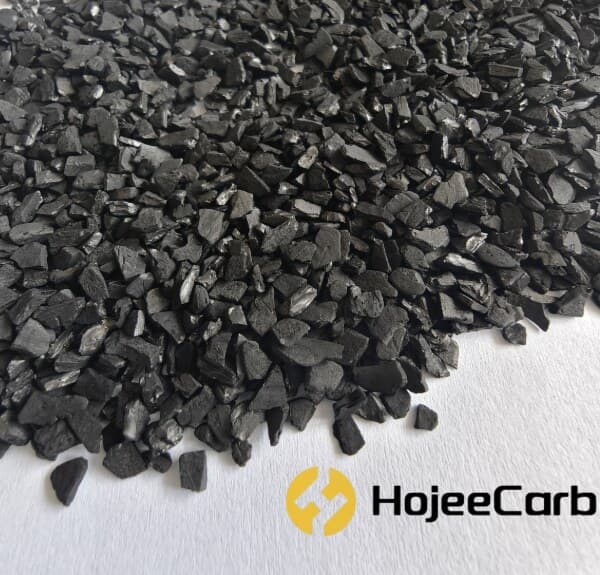
Coconut Shell Granular — Carbon-in-Column
8×30 / 12×40 mesh · iodine 1000–1200 · high hardness
Finer-mesh coconut carbon for carbon-in-column trains and tailings-solution polishing — scavenges residual gold-cyanide and recovers soluble losses downstream of the main CIL/CIP circuit.
View product & specs →Request a Quote
Get Egypt Gold Recovery Carbon Pricing — Factory Direct
Send your mine, circuit type, and tonnage. We'll return a factory quote, TDS, and CIF pricing to Safaga & Alexandria within 24 hours.
Proven on Africa's Gold Belts
Gold-Recovery Carbon We've Shipped
28 t
Egypt
6×12 coconut shell · iodine 1100+ · CIL
Repeat-order gold-recovery carbon shipped from Nansha to Alexandria, full COA and QC packaging for a returning gold-plant client.
Read the case study →56 t
Ethiopia
6×12 coconut shell · iodine 1100 · CIL/CIP
Passed a strict third-party pre-shipment loading supervision — container dimensions, temperature, and seal integrity documented before sailing via Djibouti.
Read the case study →Egypt Gold Recovery Carbon FAQ
Why does process-water salinity matter for gold recovery carbon in Egypt?
Eastern Desert mines have almost no fresh water, so they recycle process water heavily. Each pass concentrates chlorides, sulphates, and calcium, raising TDS. High salinity increases ionic competition that slows gold-cyanide adsorption, and dissolved calcium precipitates as carbonate scale on the carbon, blinding pore mouths. Carbon for Egypt needs high CTC to hold loading under competition and low ash so scale can be acid-washed off cleanly during reactivation.
How do you stop calcium-carbonate scaling on the carbon?
Two levers. First, spec low-ash (<4%) carbon so there is less internal mineral matter to seed scaling. Second, include an acid-wash step (typically dilute HCl) ahead of thermal reactivation to dissolve CaCO₃ scale and restore activity. Because our carbon starts at ≥98% hardness, it tolerates more acid-wash and reactivation cycles before dropping below spec — which matters when scaling forces more frequent regeneration.
Which spec should Egyptian gold plants prioritise?
Hardness, ash, and CTC — in that order for arid, high-salinity circuits. Hardness (≥98%) keeps mass through more acid-wash/reactivation cycles; low ash (<4%) limits scaling and gives cleaner regeneration; CTC (≥60%) holds gold-cyanide loading against ionic competition. Iodine (≥1100 mg/g) confirms baseline activity, but for a saline circuit the loading-under-competition and scaling behaviour matter more than iodine alone.
Which ports do you ship to for Egyptian mines?
For Eastern Desert operations we ship to Safaga on the Red Sea, which is closest to the mining districts around Marsa Alam. We also ship to Alexandria on the Mediterranean for inland or Nile-valley destinations — our documented 28-ton repeat order went into Alexandria. Sea transit from China runs roughly 25–35 days depending on port and routing.
What spec and testing do you provide for Egypt's mines?
Coconut shell 6×12, iodine ≥1100 mg/g, CTC ≥60%, ball-pan hardness ≥98%, A.A.R.L. attrition max 2%, ash <4%, moisture ≤5%. Every batch ships with a full COA, and SGS or Bureau Veritas third-party testing is available on request. MOQ is one container, with 50 kg to 5-ton trials for benchmarking against your current carbon.
Can the same carbon handle both Sukari's hard-rock ore and the new Eastern Desert exploration blocks?
Yes, with the right mesh. Sukari and most Arabian-Nubian Shield ores are milled sulphide/oxide feed run through agitated CIL, which wants 6×12. As EMRA's newer Eastern Desert blocks come online, some will heap-leach oxide caps and recover gold in carbon columns, where 6×16 keeps head loss lower. The core spec — hardness ≥98%, low ash for scale-prone saline water — stays the same; we just match mesh to whether you're agitating pulp or percolating a heap. Tell us the circuit and we quote the correct grade.
Sourcing Carbon for Your Egypt Mine?
Send us your mine, circuit type, and tonnage. We’ll return a detailed quote with CIF pricing to Safaga & Alexandria, a full technical data sheet, and a delivery schedule within 24 hours.