
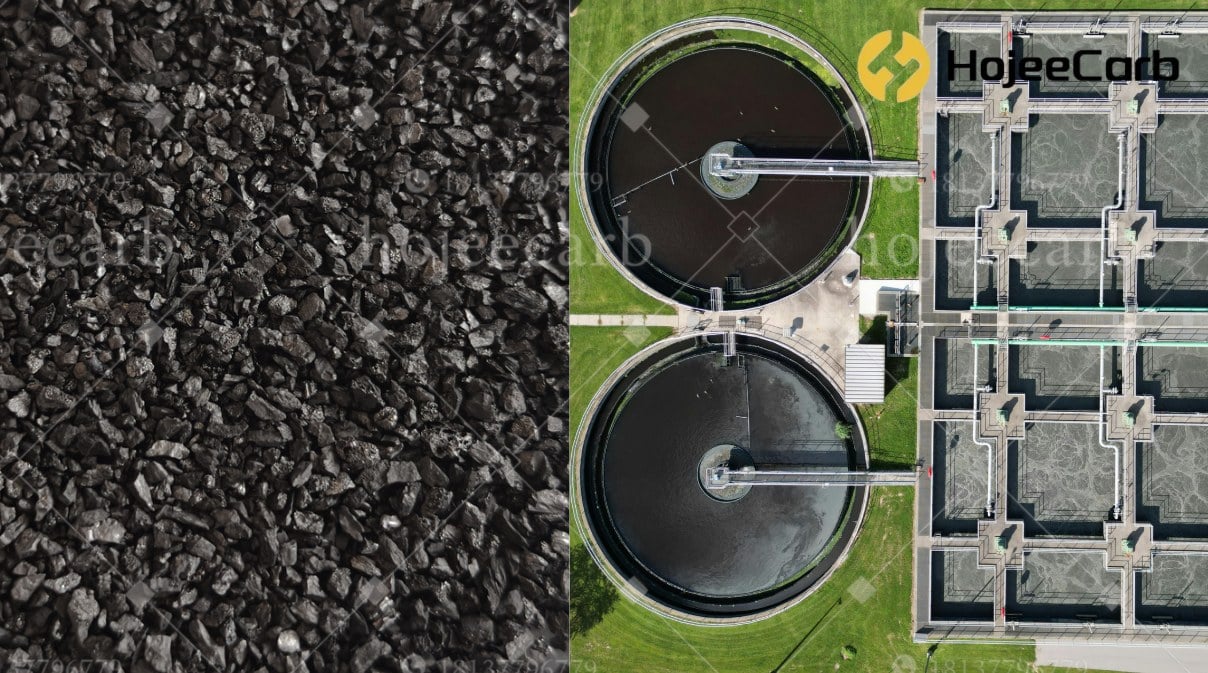
Granular Activated Carbon Supplier
How to spec and source GAC from China: what the numbers on a datasheet actually control, how to match raw material to application, and how to vet a manufacturer before you wire a deposit.
⚡ Quick Answer
Granular activated carbon (GAC) is steam-activated carbon crushed and screened to 4×8–30×60 mesh, with 800–1,200 m²/g of internal surface area. It holds together in a packed bed under continuous flow, which is why it dominates liquid-phase filtration. Hojee supplies coconut-shell, coal-based and wood-based GAC from three production bases with 20,000+ tons annual capacity, MOQ 1 ton, and a batch-specific COA on every lot.
- Iodine Number
- 500 – 1,200 mg/g
- Bulk Density
- 450 – 660 kg/m³
- MOQ
- 1 ton
- Lead Time
- 7 – 15 days
Related: GAC Product Specs · GAC System Design · Price Guide · Mesh Size Guide · Get a Quote
Granular activated carbon is the most widely bought form of activated carbon on the planet, and also the easiest one to buy badly. Two carbons can both be labelled “GAC 8×30, iodine 1000” and behave nothing alike in your vessel — one runs eighteen months, the other channels and breaks through in five.
This page is written for the person who has to place the order. If you want the engineering side — bed depth, EBCT, vessel sizing — that lives in our GAC system design guide. If you want per-ton numbers, see the activated carbon price guide.
What Granular Activated Carbon Is
GAC is activated carbon crushed and screened into irregular granules, typically between 4 and 40 mesh, then steam-activated at 800–1000°C to open up an internal pore network of 800–1,200 m²/g. The granular form exists for one reason: it holds together in a packed bed under continuous flow, so water or gas can pass through at pressure without the media compacting, blinding, or washing out.
That is the dividing line against the other two forms. Powdered carbon is dosed into a tank and removed with the sludge — it works fast, but you can’t run flow through it. Pellet carbon is extruded into uniform cylinders with a lower pressure drop, which matters in gas phase. GAC sits in the middle and dominates liquid-phase filtration: municipal drinking water, industrial wastewater polishing, point-of-use cartridges, gold recovery columns, sugar and sweetener decolorization.
How to Read a GAC Datasheet
Most GAC disputes trace back to a buyer who compared only iodine number. These are the parameters that decide whether the carbon performs, in the order they usually matter.
Iodine number (mg/g)
The standard proxy for total micropore surface area, measured by iodine adsorption. Higher iodine means more capacity for small molecules. Our coal-based HojeeAqua BG series runs BG400 through BG1000 (iodine >500 to >1,000 mg/g); coconut-shell HojeePure CG grades run CG950 to CG1100 (iodine >950 to >1,100 mg/g).
Iodine number is necessary but not sufficient. It tells you nothing about pore size distribution, so it over-predicts performance on large molecules — humic acids, colour bodies, PFAS — which need mesopores the iodine test never sees.
Bulk density (kg/m³)
The parameter buyers forget and then get burned by. GAC is sold by weight and used by volume. A vessel holding 10 m³ of media needs 4,800 kg of a 480 kg/m³ coconut carbon, but 6,600 kg of a 660 kg/m³ coal carbon — a 37% difference in tonnage on the same purchase order.
Typical ranges: coconut-shell GAC 480–520 kg/m³, coal-based GAC 450–660 kg/m³ depending on grade, wood-based lower still. Always confirm the figure before you compare quotes per ton, because a cheap high-density carbon can cost more per cubic metre of bed filled.
Hardness and abrasion
How much of the granule survives handling, backwash and thermal reactivation. Coconut GAC typically tests above 98–99% hardness; our coal-based grades hold above 95%. Soft carbon generates fines, fines cause head loss and turbidity spikes, and if you plan to reactivate, soft carbon means you lose several percent of the bed every cycle. See the hardness and abrasion number guide for the test methods.
Ash and water-soluble content
Ash is the inorganic residue left after the carbon burns off. Coconut shell GAC runs under 3%; coal-based GAC typically under 12%. High ash means more leachable minerals, higher pH drift on start-up, and in gold recovery, more contaminants competing for adsorption sites. For drinking water and food contact, low ash plus low water-soluble content is what keeps you inside the spec.
Mesh size and uniformity
Mesh controls the trade-off between adsorption kinetics and pressure drop. Finer mesh adsorbs faster with more external surface; coarser mesh runs at lower head loss. What matters as much as the nominal size is how tightly the distribution is held — a sloppy 8×30 with 10% oversize and 8% fines will channel. Ask for the actual screen analysis, not just the label. Our mesh size guide maps common cuts to applications.
Moisture
Usually specified at ≤5%. It matters because you pay for it. Carbon shipped at 12% moisture instead of 5% means roughly 7% of every container is water.
GAC at a Glance
| Form | Granular (crushed & screened) |
| Mesh Range | 4×8 – 30×60 mesh |
| Raw Materials | Coconut shell / coal / wood |
| Iodine Number | 500 – 1,200 mg/g |
| Surface Area | 800 – 1,200 m²/g |
| Bulk Density | 450 – 660 kg/m³ |
| Hardness | > 95% (coconut > 98%) |
| Ash | < 3% coconut / < 12% coal |
| Moisture | ≤ 5% |
| MOQ | 1 ton |
| Lead Time | 7 – 15 days (stock grades) |
| Packaging | 25 kg bags / 500–1,000 kg FIBC |
Response within 24 hours
Request TDS / COAGAC by Raw Material
Matching Raw Material to Application
There is no universal GAC. Three raw materials, three pore structures, three price points.
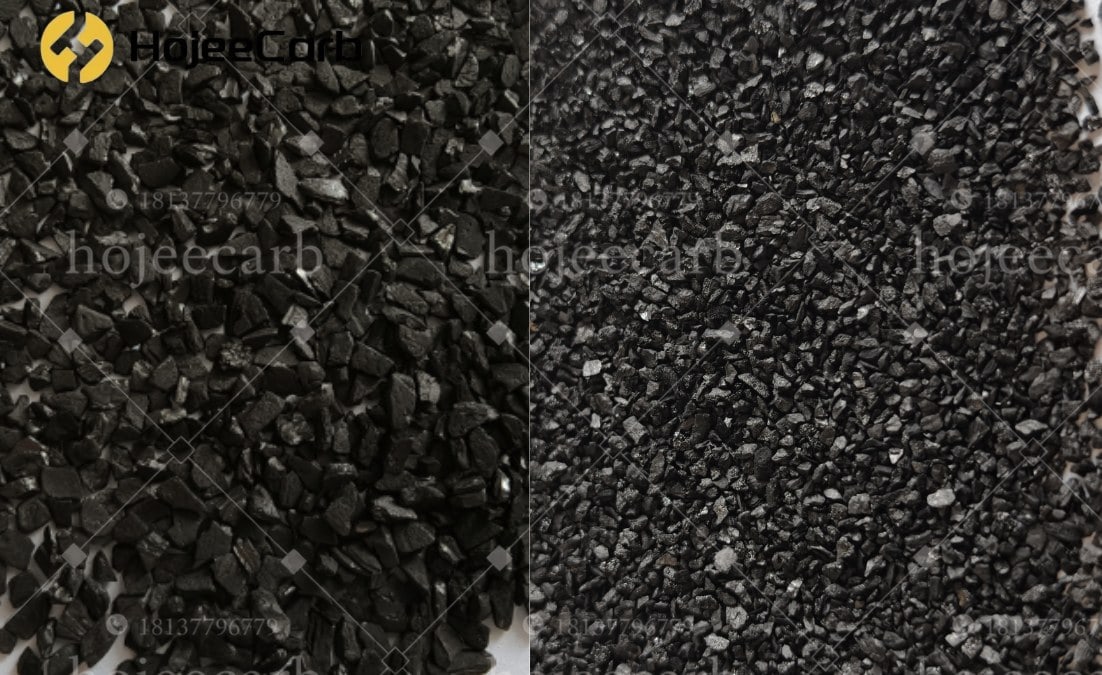
Coconut Shell GAC
Micropore-dominated, hard, low in ash. The default for drinking water, point-of-use cartridges, food and beverage, and gold recovery, where hardness and cleanliness carry the decision. Iodine typically 950–1,200 mg/g.
Coal-Based GAC
A broader pore distribution reaching into the mesopores, which makes it stronger on larger organic molecules, colour, COD and taste-and-odour work in municipal and industrial water. Also meaningfully cheaper per ton. Our coal granular grades cover iodine >500 to >1,000 mg/g across the BG range — the coal-based guide breaks down the sub-grades.
Wood-Based GAC
Macropore-heavy and mostly used where decolorization drives the spec rather than filtration.
A short version: if it goes in a drinking water cartridge or a CIL circuit, start with coconut. If it polishes municipal or industrial water at volume, start with coal and let the pilot data decide. For the full comparison, see coconut shell vs coal-based activated carbon.
Grade Selection by Use Case
| Application | Recommended Grade | Key Spec |
|---|---|---|
| Municipal drinking water | HojeeAqua BG800–BG1000, coal 8×30 | Iodine >800–1,000, ash <12%, low water-soluble |
| Industrial wastewater / COD polishing | HojeeAqua BG600–BG800, coal 8×30 or 12×40 | Iodine >600–800, strength >95% |
| Point-of-use & cartridge filters | HojeePure CG950–CG1100, coconut 12×40 | Iodine >950–1,100, ash <3%, tight screen |
| Food, beverage & sweetener | HojeePure CG1050–CG1100, coconut | Low ash, low water-soluble, food-grade docs |
| Gold recovery (CIL/CIP) | HojeeGold CG31–CG35, coconut 6×12 | Hardness >98.5%, attrition <2%, gold loading |
| Seawater / high-salinity feed | HojeeAqua BG900–BG1000 | Iodine >900, controlled pH |
Standard grades. Custom specifications available; the batch COA governs in every case.
Gold Recovery Is the Exception
Gold recovery is the one case where iodine number is the wrong yardstick. Loading capacity (K value), kinetics (R value), hardness and attrition decide the result — a carbon with a lower iodine number but higher hardness will out-earn a softer high-iodine carbon over repeated acid wash and reactivation cycles.
6×12 gold recovery carbon specifications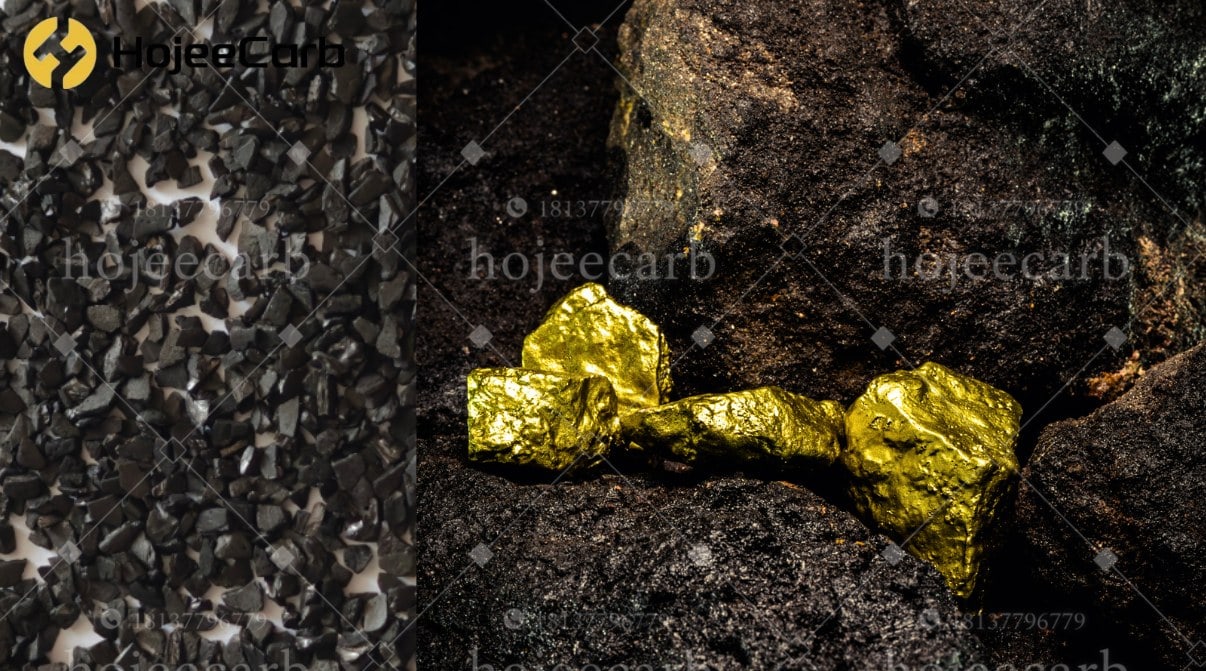
How to Vet a Chinese GAC Manufacturer
China supplies the majority of the world’s granular activated carbon, and the quality spread between the best and worst factories in the same city is wider than most buyers expect. Five checks separate a manufacturer from a trading desk.
Ask whether they own the kiln.
A large share of “manufacturers” on B2B platforms are traders reselling whichever factory quoted lowest that week, which is why batch consistency collapses on the second order. Ask which activation furnaces they run, how many production lines, and annual tonnage. We operate three production bases — Nan’an in Fujian, Shizuishan in Ningxia, and Hami in Xinjiang — with 20,000+ tons of annual capacity, which is what lets us hold one spec across repeat orders.
Demand a batch-specific COA, not a sample COA.
The meaningful document is the certificate of analysis for the lot you are shipping, tested against the parameters in your PO: iodine, bulk density, hardness, ash, moisture, screen analysis. A generic datasheet with round numbers proves nothing. Every batch we ship carries its own COA.
Verify certifications by number.
ISO 9001/14001/45001 certificates carry registration numbers you can check. Ours is ISO 9001:2015 No.00125Q36671R0S, issued by CQC. Food and drinking water work may additionally need Halal, Kosher, or food-grade documentation — ask upfront rather than after production.
Allow third-party pre-shipment inspection.
A factory confident in its carbon will accept SGS or BV inspection of the loaded lot before it sails. A factory that resists is telling you something. We offer SGS/BV pre-shipment inspection on request.
Test the sample against your own water.
Lab numbers are a screen, not a decision. Get 5–25 kg of the actual production grade, run it on your feed, and compare breakthrough against your incumbent carbon. Anyone unwilling to send a real sample from a real batch is not a supply partner.
MOQ, Packaging & Lead Time
MOQ is 1 ton on most GAC grades, deliberately low so you can qualify the carbon before committing to a container. Full-container load — roughly 20+ tons in a 20ft, up to 28 tons in a 40HQ depending on bulk density — gets the best per-ton rate.
Woven bags + PE liner
Palletized — standard for cartridge and small-batch users
FIBC jumbo bags
Lowest cost per ton for bulk vessels and distributors
OEM packaging
Your brand, free design for distributor orders
Lead time runs 7–15 days for stock grades and 15–25 days for custom specifications or OEM packaging. We ship to 50+ countries on FOB, CIF and DDP terms. Recent GAC movements include 78 tons of coal GAC to Myanmar and coal GAC to Saudi Arabia for municipal supply — the case studies carry the loading and documentation detail.
Frequently Asked Questions
What is the typical bulk density of granular activated carbon?
Coconut or coal-based GAC for drinking water?
What is the minimum order quantity for GAC?
Can you match my current supplier's specification?
Do you supply free GAC samples?
How long does production take?
Get a GAC Quote
Send us the application, flow rate or annual tonnage, and the specification you are working to — or just the COA from your current supplier. You’ll get a grade recommendation, sample offer with batch COA, and factory-direct pricing within 24 hours.
Request a Quote