
If you have ever pulled activated carbon out of a filter and found half of it turned to dust, you already understand why hardness matters. Hardness number and abrasion number tell you how well a carbon survives handling, backwashing, and thermal reactivation before it crumbles into fines. While iodine number and CTC value get most of the attention on datasheets, hardness is the spec that decides how long your carbon lasts — and how much of it you lose every cycle.
We manufacture granular, pellet, and gold recovery activated carbon, and hardness is one of the specs we test on every batch. This guide explains what hardness and abrasion numbers actually measure, how they are tested (ASTM D3802, AWWA B604, GB/T 7702.3), typical values by carbon type, and how to use them so you don't overpay — or lose carbon to attrition.
Hardness at a Glance
| Carbon Type | Ball-Pan Hardness | Wet Attrition (AARL) | Reactivation |
|---|---|---|---|
| Coconut shell GAC | 98–99% | ≤2% loss | Well suited to repeated thermal reactivation |
| Coal-based GAC | 90–97% | 3–8% loss | Suitable for reactivation |
| Coal pellet / extruded | 95–98% | 2–5% loss | Suitable for reactivation |
| Wood-based GAC | 60–80% | High | Generally not reactivated |
| Wood-based PAC (powder) | N/A | N/A | Single-use |
Bottom Line
For any application with backwashing, transfer pumping, or thermal reactivation — drinking water, gold recovery (CIP/CIL), gas-phase beds — hardness above 95% helps protect your carbon over its service life. Cheap soft carbon that turns to fines is often the most expensive carbon you can buy.
What Is Hardness Number in Activated Carbon?
Hardness number is a standardized measure of a carbon's mechanical strength — its resistance to breaking down into smaller particles and fines under mechanical stress. It is reported as a percentage, where a higher number means a harder, more durable carbon.
Hardness number (also called ball-pan hardness) measures the percentage of activated carbon that survives a controlled abrasion test without being ground into fines. A hardness of 98% means that after the test, 98% of the carbon remained as intact granules and only 2% was lost as dust and fragments.
This matters because activated carbon takes a beating in real service — pneumatic conveying, slurry pumping, daily backwashing, and, for reusable grades, heating to 650–850°C in a reactivation kiln. Every step abrades the granules. Soft carbon generates fines that clog underdrains, raise pressure drop, escape into treated water, and get lost during transfer. Hard carbon holds its shape.
Key Definition
Hardness number is the weight percentage of an activated carbon sample that remains as intact granules after a standardized mechanical abrasion test. It predicts how well the carbon resists dusting and breakdown during handling, backwashing, and thermal reactivation.
Need activated carbon?
Get Factory-Direct Pricing — No Middlemen
20+ years manufacturing. MOQ 1 ton. Free samples. Reply within 2 hours.
Abrasion Number — And How It Differs From Hardness
Abrasion number measures the reduction in mean particle size after a carbon sample is subjected to mechanical agitation. Where hardness number reports the fraction that stays intact, abrasion number reports how much the particle size distribution shifts downward. The two terms are related but not identical, and datasheets use them inconsistently:
- •Hardness number (ball-pan, ASTM D3802): % of granules that survive intact. Higher = better.
- •Abrasion number: a general term for the change in mean particle size after agitation, expressed as a percentage. Higher = better (less size reduction). Reported methods vary between suppliers, so always confirm which procedure was used.
- •Attrition / wet attrition (AARL, gold recovery): % of carbon lost as fines under wet agitation. Here lower = better (e.g. ≤2% loss).
Buyers often compare a hardness number measured by one method against a competitor's number from a different method. A ball-pan hardness of 98% and a wet-attrition loss of 2% describe durability on different scales and shouldn't be read as directly equivalent. Confirm the test method before comparing suppliers.
How Hardness Is Tested: The Standard Methods
Understanding the test method helps you read a COA (Certificate of Analysis) correctly and spot inconsistent supplier claims. Three references dominate the industry:
1. Ball-Pan Hardness — ASTM D3802
The most widely cited method. A weighed carbon sample is placed on a sieve in a pan with steel or ceramic balls, then mechanically shaken for a fixed time (typically 30 minutes). The balls abrade the carbon; the sample is re-sieved. Hardness number = (weight retained on the sieve ÷ original weight) × 100. This is the number you see quoted as “hardness 98%.”
2. AWWA B604
The American Water Works Association standard for granular activated carbon in water treatment references abrasion resistance as part of GAC acceptance. Municipal water buyers often require compliance with AWWA B604.
3. Wet Attrition (AARL method) — for gold recovery
Gold recovery carbon (CIP/CIL) is agitated wet, because that is how it lives in a leach circuit. The result is reported as % attrition loss, and a common benchmark is ≤2% AARL attrition for premium coconut shell carbon. This is the number gold miners typically focus on.
A Note on Abrasion Methods
You may see suppliers cite ASTM D4058 for an “abrasion number.” That method — Standard Test Method for Attrition and Abrasion of Catalysts and Catalyst Carriers — is written for catalysts and catalyst carriers, not activated carbon. There is no single dedicated ASTM abrasion-number method that is standard across the activated carbon industry, so treat any abrasion number with care and ask which procedure was actually used.
Chinese equivalent: GB/T 7702.3 covers strength/hardness testing and is common on Chinese factory COAs. GB/T strength results and ASTM D3802 ball-pan results are measured differently and should not be presented as identical. For a broader overview, see our guide to activated carbon quality testing methods.
Typical Hardness Values by Carbon Type
Hardness is driven mainly by raw material and, secondarily, by activation method. Here are the ranges we see in production and across the industry:
| Carbon Type | Ball-Pan Hardness | Notes |
|---|---|---|
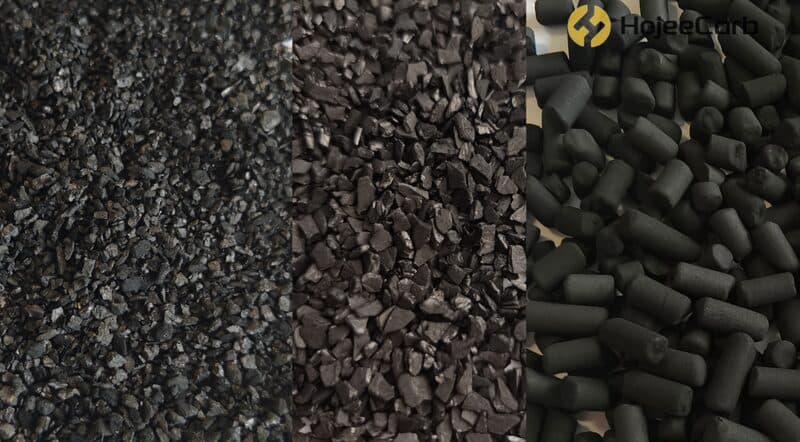
| Coconut shell GAC (steam) | 98–99% | Hardest common carbon; dense shell structure. |
| Coal-based pellet (extruded) | 95–98% | Binder + extrusion gives high strength. |
| Coal-based GAC (steam) | 90–97% | Bituminous harder than sub-bituminous. |
| Anthracite / coal columnar | 95–98% | Very hard; catalytic and gas applications. |
| Wood-based GAC | 60–80% | Soft, friable; not for backwashing / reactivation. |
| Wood-based PAC (powder) | N/A | Powder is dosed once; hardness not applicable. |
| Lignite GAC | 85–92% | Softer than bituminous; lower cost. |
Why coconut shell is prized for hardness: the raw coconut shell has a dense, uniform cellular structure that carbonizes into a mechanically strong char. This is why coconut shell activated carbon is widely used in gold recovery, where carbon is repeatedly pumped, screened, and thermally reactivated over its service life.
Why Hardness Matters — 5 Real Costs of Soft Carbon
Low-hardness carbon costs more over its lifetime because it generates fines that cause carbon loss, higher pressure drop, turbidity, underdrain fouling, and poor reactivation recovery. Here is where the money goes:
- 1Direct carbon loss. Every fine generated is carbon you paid for that washes out. In a CIP/CIL gold circuit, extra attrition means fines carrying loaded gold to tailings — a double loss.
- 2Higher pressure drop. Fines migrate and pack into the bed, increasing head loss. Pumps work harder, energy costs rise, and backwash frequency goes up.
- 3Turbidity and carbon carryover. In drinking water and process water, fines break through into treated water, causing turbidity and black-water complaints — a common trigger for premature change-outs.
- 4Underdrain and nozzle fouling. Fines clog underdrain screens and nozzles, causing channeling and uneven flow that reduces effective bed contact time (EBCT).
- 5Poor reactivation recovery. Reactivation at 650–850°C already burns off a share of the carbon each cycle. Soft carbon that fractures in transport and in the kiln recovers far less usable product. High-hardness coconut shell carbon is well suited to repeated handling and thermal reactivation. The actual number of reuse cycles depends on attrition, kiln conditions, fouling, carbon loss, and the plant's replacement criteria. Soft wood carbon, by contrast, is usually not reactivated economically. See our gold recovery carbon reactivation guide for details.
Hardness Requirements by Application
Not every application needs 99% hardness. Matching hardness to the duty avoids overpaying for strength you won't use — and avoids under-spec'ing where it counts.
| Application | Min. Hardness | Why |
|---|---|---|
| Gold recovery (CIP/CIL/CIC) | 98%+ / ≤2% attrition | Constant pumping, screening, repeated reactivation |
| Municipal drinking water (GAC) | 95%+ | Daily backwashing, multi-year reactivation life |
| Gas-phase / VOC / solvent recovery | 95%+ | Thermal swing regeneration stresses granules |
| Industrial wastewater | 90%+ | Backwashing; moderate reuse |
| Single-use PAC dosing | Not applicable | Powder is filtered out once |
| Point-of-use / cartridge filters | 90%+ | Low mechanical stress; fines cause black water |
Rule of Thumb
If the carbon will be backwashed, transferred as a slurry, or thermally reactivated, specify 95%+ hardness. If it is dosed once and discarded, hardness is irrelevant — don't pay for it.
How to Verify Hardness When Sourcing
Because hardness is easy to misreport and easy to compare wrong, protect yourself with these steps:
- 1Ask for the test method, not just the number. “98% hardness” is meaningless without knowing if it's ASTM D3802 ball-pan, GB/T 7702.3, or a wet-attrition figure.
- 2Request a recent, batch-specific COA — not a generic spec sheet. Hardness varies batch to batch with raw material.
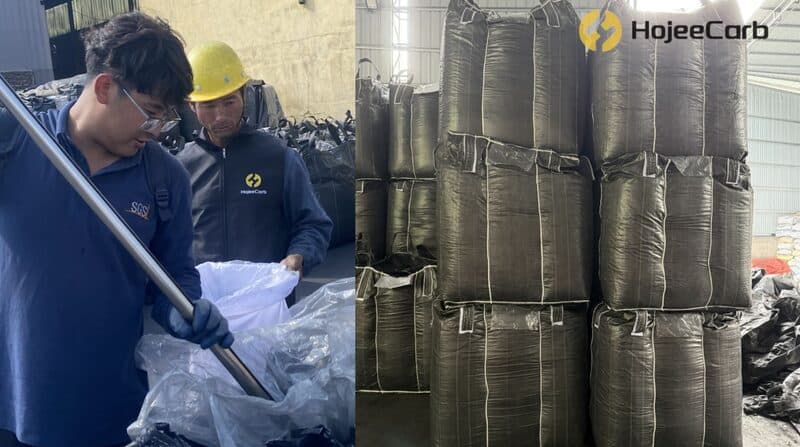
- 3Get third-party verification for large orders. SGS or an equivalent lab can independently confirm hardness and attrition. We provide SGS testing on gold recovery and municipal water shipments as standard.
- 4Run a sample through your actual process. The best hardness test is your own backwash or leach circuit. Sample-first is always cheaper than a full container that turns to fines.
- 5Watch for “strong” claims across different tests. A supplier quoting a GB/T strength figure against a competitor's ball-pan number is comparing apples to oranges — sometimes deliberately.
How We Handle Hardness in Production
Based on 15+ years of manufacturing, we test hardness and attrition on every production batch of granular, pellet, and gold recovery carbon. For gold recovery grades we report AARL wet attrition (≤2% on premium coconut shell 6×12), and for water and gas-phase grades we report ball-pan hardness (ASTM D3802). Every export shipment can be accompanied by a batch COA and, on request, independent SGS verification.
If you're sourcing carbon for a high-attrition duty — gold recovery, reusable water beds, or gas-phase regeneration — we can match a grade to your hardness requirement and send a sample before you commit to a container. Tell us your application and process, and we'll recommend the right hardness spec rather than upselling strength you don't need.
Frequently Asked Questions
What is a good hardness number for activated carbon?
For any application involving backwashing, pumping, or thermal reactivation, a ball-pan hardness of 95% or higher is good, and 98–99% is excellent. Coconut shell activated carbon typically reaches 98–99%. For single-use powdered carbon that is dosed and filtered out, hardness is not a relevant specification.
What is the difference between hardness number and abrasion number?
Hardness number (ball-pan, ASTM D3802) reports the percentage of carbon granules that remain intact after a standardized test — higher is better. Abrasion number is a more general term for the change in mean particle size after mechanical agitation, and reported methods vary by supplier. Wet attrition (AARL method) reports the percentage of carbon lost as fines under wet tumbling, where lower is better. Because they use different scales, these figures should not be read as directly equivalent.
How is activated carbon hardness tested?
The most common method is ASTM D3802 (ball-pan hardness): a carbon sample is agitated with steel or ceramic balls on a sieve for a set time, then re-sieved. The hardness number is the percentage of carbon that survives as intact granules. Gold recovery carbon uses a wet attrition test (AARL method) because the carbon lives in a wet, agitated leach circuit. The Chinese standard GB/T 7702.3 also covers strength testing.
Why is hardness important for gold recovery carbon?
In CIP/CIL/CIC gold recovery, carbon is repeatedly pumped, screened, and thermally reactivated over its service life. Soft carbon breaks into fines that can carry loaded gold to tailings — a loss of both carbon and recovered gold. Premium coconut shell gold recovery carbon typically delivers 98%+ hardness and ≤2% AARL attrition, which is why it is widely specified for this duty.
Does higher hardness mean better adsorption?
No. Hardness measures mechanical strength, not adsorption capacity. Adsorption is measured by iodine number (micropores) and CTC value (gas-phase pore volume). A carbon can be very hard but have modest adsorption, or highly adsorptive but soft. You need to check hardness and adsorption specs separately and match both to your application.
Can soft carbon be reactivated?
Rarely economically. Thermal reactivation burns off a portion of the carbon each cycle and mechanically stresses the granules. Soft wood-based carbon fractures during handling and in the kiln, so recovery of usable product is poor — it is generally treated as single-use. Hard coconut and coal-based carbons withstand repeated reactivation, which is what makes them cost-effective over a multi-year life.
Need Activated Carbon With a Specific Hardness Requirement?
Our technical team can match a grade to your hardness and attrition targets — coconut shell, coal, or pellet — and send a sample with a batch-specific COA before you commit to a full container.