
In This Guide
Overview: The Core Difference
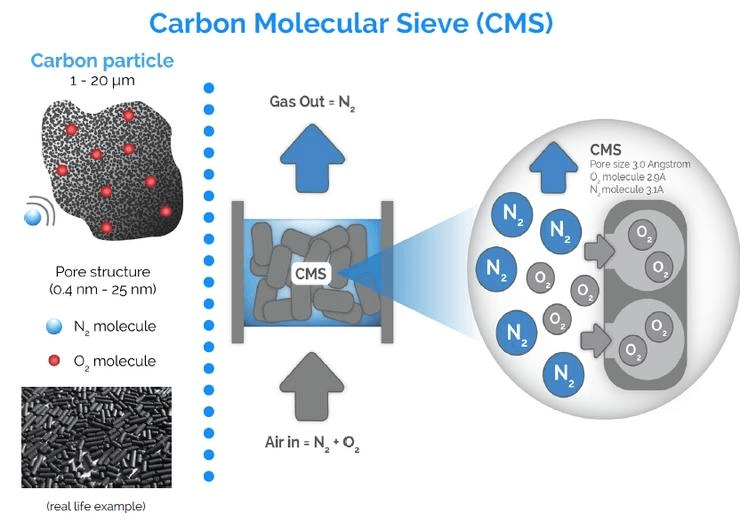
Carbon molecular sieve and activated carbon are both manufactured from carbonaceous raw materials — but the similarities end there. CMS is engineered to a precise pore opening of 0.35–0.42 nm, which is just small enough to admit oxygen (kinetic diameter 0.346 nm) while blocking nitrogen (0.364 nm). This makes it a molecular size separator, not an adsorber.
Activated carbon, by contrast, has a broad pore size distribution from micropores to macropores, giving it an enormous surface area (900–1,200 m²/g) optimized for adsorbing a wide range of organic and inorganic molecules from gas or liquid streams.
| Property | Carbon Molecular Sieve (CMS) | Activated Carbon (GAC/PAC) |
|---|---|---|
| Primary function | Separate gas molecules by kinetic diameter | Adsorb organics, VOCs, chlorine, heavy metals |
| Pore size | 0.35–0.42 nm (precisely controlled) | 0.5–50+ nm (broad distribution) |
| Surface area | 200–400 m²/g | 900–1,200 m²/g |
| Raw material | Coal / coconut shell (precision processed) | Coal / coconut shell / wood |
| Main application | PSA N₂ & O₂ generators | Water treatment, air purification, VOC recovery |
| Price (FOB China) | $8–20/kg | $0.60–2.50/kg |
| Typical form | 1.1–2.0 mm pellets | 4×8 to 12×40 mesh granules or PAC powder |
| Regeneration | Automatic pressure swing (PSA cycle) | Thermal reactivation (500–900°C) |
| Interchangeable? | ❌ No | ❌ No |
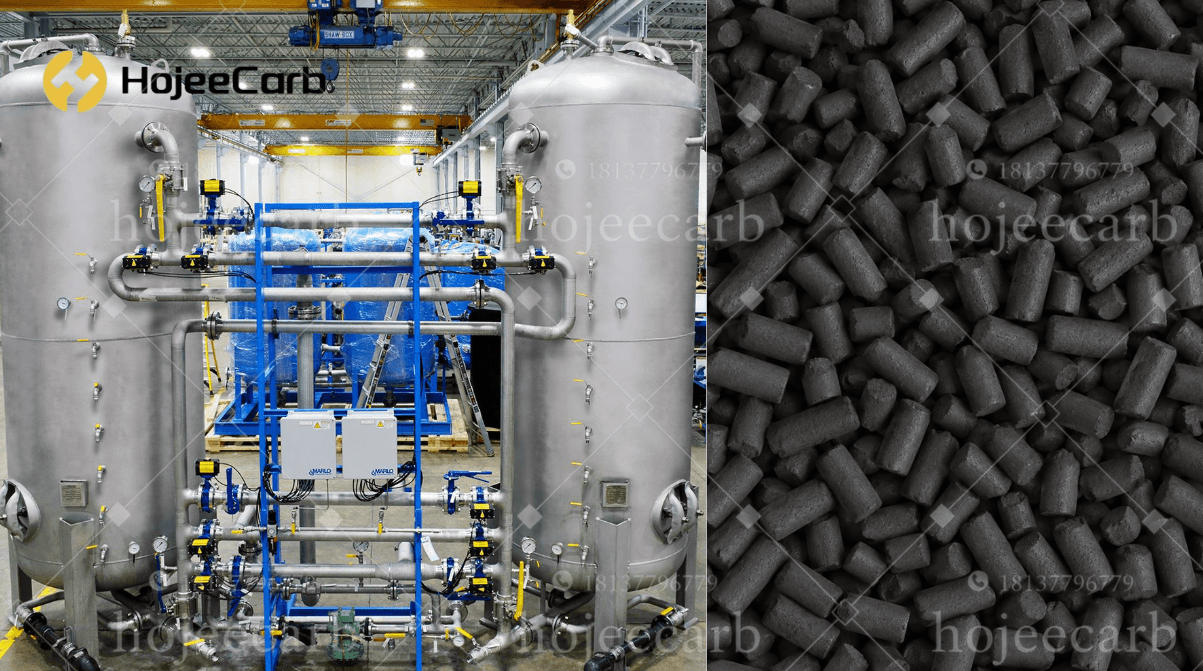
Carbon molecular sieve pellets (1.1–2.0 mm) — the precision pore structure separates O₂ from N₂ by kinetic diameter difference of just 0.018 nm
How Carbon Molecular Sieve Works in a PSA System
A PSA (Pressure Swing Adsorption) nitrogen generator uses two towers filled with CMS. The process runs in a continuous cycle:
- Pressurization (adsorption phase, ~60 seconds): Compressed air is pushed through Tower A. O₂ molecules (0.346 nm) fit into CMS pores and are trapped. N₂ molecules (0.364 nm) are too large — they pass through and exit as product gas.
- Pressure equalization: Towers equalize to recover energy and pre-pressurize the regenerating tower.
- Regeneration (desorption phase): Tower A drops to near-atmospheric pressure. Trapped O₂ molecules desorb and are vented to atmosphere. Tower A is ready for the next cycle.
- Tower B takes over: While Tower A regenerates, Tower B adsorbs. This alternating cycle produces a continuous nitrogen stream.
A well-designed PSA system with quality CMS achieves nitrogen purity of 99.5–99.999% at flow rates from 1 Nm³/h to 3,000+ Nm³/h. The purity/flow tradeoff is adjustable by changing cycle time — slower cycles give higher purity but lower output.
PSA nitrogen generator — CMS towers alternate between adsorption and regeneration cycles to produce continuous 99.5–99.999% N₂
Key CMS Specifications to Evaluate
How Activated Carbon Works
Activated carbon works through physical adsorption — Van der Waals forces attract contaminant molecules to the vast internal surface area of the carbon structure. Unlike CMS, it does not separate by molecular size; it adsorbs any molecule that has sufficient affinity for the carbon surface.
The activation process (steam or chemical) creates a highly porous structure with surface areas of 900–1,200 m²/g — a single gram of activated carbon has more internal surface area than a tennis court. This massive surface area is what makes it effective at removing trace contaminants at ppb levels.
What Activated Carbon Can and Cannot Remove
- • Chlorine & chloramines (water)
- • VOCs: benzene, toluene, xylene
- • Pesticides & herbicides
- • H₂S, mercaptans (odor)
- • PFAS (with specific GAC)
- • Color & taste compounds
- • Mercury vapor (impregnated)
- • Solvents: acetone, MEK, ethanol
- • Nitrogen gas (cannot separate N₂)
- • Oxygen gas (cannot produce pure N₂)
- • Fluoride (requires bone char)
- • Nitrates / nitrites
- • Hardness (Ca²⁺, Mg²⁺)
- • Bacteria & viruses (only some)
- • Total dissolved solids (TDS)
Need activated carbon?
Get Factory-Direct Pricing — No Middlemen
20+ years manufacturing. MOQ 1 ton. Free samples. Reply within 2 hours.
Application Decision Guide: Which One Do You Need?
The decision is usually straightforward once you identify your process goal:
Using Carbon Molecular Sieve and Activated Carbon Together
In many industrial gas systems, CMS and activated carbon are used in sequence — not as alternatives, but as complementary stages.
Typical PSA Nitrogen Generator Pre-Treatment Train
The activated carbon filter at step 3 is critical — compressor oil will permanently poison CMS pores, destroying nitrogen purity. A 2–5 kg activated carbon cartridge upstream protects a $3,000–15,000 CMS bed.
Sourcing CMS and Activated Carbon from China
China dominates global production of both materials. Understanding the supply chain helps you avoid common pitfalls.
Carbon Molecular Sieve
- Production hub: Hunan, Shanxi provinces
- Price range: $8–20/kg FOB China
- MOQ: 50–100 kg (sample), 500 kg (commercial)
- Key test: Request O₂ dynamic adsorption data and N₂/O₂ separation factor, not just appearance
- HS code: 3802.90 (carbon, activated, NES)
- Lead time: 15–25 days
Activated Carbon (HojeeCarb)
- Production hub: Ningxia, Fujian (coconut shell)
- Price range: $600–2,500/ton FOB China
- MOQ: 1 FCL (≈15–20 tons), LCL from 1 ton
- Key test: Iodine value (GB/T 12496.8), hardness, mesh size
- HS code: 3802.10 (activated carbon)
- Lead time: 10–18 days
⚠️ Sourcing Warning: CMS Quality Varies Widely
Unlike activated carbon where iodine value is a standardized test, CMS quality testing requires specialized equipment. Low-grade CMS may look identical to high-grade material but produce nitrogen at only 95% purity instead of 99.5%. Always request a third-party dynamic adsorption test report, not just a manufacturer datasheet. We recommend SGS or Intertek verification for first orders over $5,000.
Frequently Asked Questions
What is the difference between carbon molecular sieve and activated carbon?
Carbon molecular sieve (CMS) has a precisely controlled, narrow pore size distribution (0.35–0.42 nm) designed to separate gas molecules by size — most commonly used in PSA nitrogen generators to block oxygen while allowing nitrogen to pass. Activated carbon has a much broader pore distribution (0.5–50 nm) optimized for high surface area and adsorption capacity, used to remove liquids, organics, chlorine, odors, and dissolved contaminants. They share a carbon base but serve completely different functions.
Can activated carbon replace carbon molecular sieve in a PSA nitrogen generator?
No. Activated carbon cannot replace CMS in a PSA nitrogen generator. CMS achieves nitrogen purity of 95–99.9% because its pore size preferentially adsorbs oxygen (0.346 nm kinetic diameter) over nitrogen (0.364 nm). Standard activated carbon lacks this molecular sieving selectivity — it would adsorb both gases without separation, producing impure output. Using activated carbon in a PSA nitrogen system will damage your generator and fail to produce usable gas.
What purity nitrogen can carbon molecular sieve produce?
High-quality CMS (such as Shirasagi MSC-3R 172 or equivalent) achieves nitrogen purity of 99.5–99.999% in a well-designed PSA system. Lower-cost CMS grades produce 95–99% purity, which is sufficient for most industrial blanketing, purging, and food packaging applications. Purity depends on CMS quality, bed size, cycle time, and feed air quality.
How long does carbon molecular sieve last in a PSA system?
Quality CMS has a service life of 8–15 years in a properly maintained PSA system. Key factors affecting lifespan include feed air moisture (pre-drying is essential), oil contamination from compressors (use oil-free compressors or activated carbon pre-filters), and cycle frequency. CMS degrades gradually — purity output drops before complete failure, giving early warning.
Can I use activated carbon as a pre-filter before carbon molecular sieve?
Yes — and it is strongly recommended. An activated carbon pre-filter before the CMS bed removes compressor oil, VOCs, and residual moisture that would poison the molecular sieve. This is standard practice in PSA nitrogen and oxygen generator design. Typical activated carbon specification for this duty: coconut shell GAC 4×8 mesh, iodine value ≥900 mg/g, moisture ≤5%.
What is the price difference between carbon molecular sieve and activated carbon?
Carbon molecular sieve is significantly more expensive: $8–20/kg FOB China for industrial-grade CMS, versus $0.60–2.50/kg for standard activated carbon. The higher cost reflects the precision manufacturing process required to control pore size distribution. For a typical 50 Nm³/h nitrogen generator, CMS fill volume is 80–150 kg, making the initial fill cost $800–3,000.
Where is carbon molecular sieve manufactured?
Over 80% of global carbon molecular sieve production is concentrated in China, particularly in Hunan, Shanxi, and Henan provinces. Major Chinese producers include Changsha Research Institute of Mining and Metallurgy (CRIMM) and several Hunan-based manufacturers. Japan's Kuraray and Takeda were early pioneers but most volume production has shifted to China. Quality varies significantly — request oxygen/nitrogen purity test reports and dynamic adsorption data before purchasing.
Need Activated Carbon for Your Process?
We supply granular, pelletized, and coconut shell activated carbon factory-direct from China. ISO 9001 certified. SGS tested. MOQ from 1 ton.
Request a Free Quote