
PSA Activated Carbon — Key Specs at a Glance
| Parameter | Standard Grade | High-Performance Grade | Why It Matters |
|---|---|---|---|
| Form | Pellet 4 mm | Pellet 3 mm | Pellets minimize pressure drop in columns |
| CTC Value | ≥ 60% | ≥ 70% | Measures adsorption capacity for organic impurities |
| Surface Area (BET) | 900–1,100 m²/g | 1,100–1,300 m²/g | Higher = more adsorption sites |
| Hardness (Ball-Pan) | ≥ 95% | ≥ 97% | Pellets must survive pressure cycles without crumbling |
| Ash Content | < 8% | < 6% | High ash reduces active surface area |
| Moisture | < 5% | < 3% | Excess moisture competes with impurity adsorption |
| Bulk Density | 400–500 g/L | 420–480 g/L | Affects vessel sizing and carbon load per unit |
| Price Range (2026) | Contact supplier | Contact supplier | Prices vary by volume, grade, and market conditions |
How Hydrogen PSA Uses Activated Carbon
PSA hydrogen purification works on a simple principle: impurities (CO, CO₂, CH₄, N₂, H₂O) adsorb onto activated carbon under high pressure, letting purified hydrogen pass through. When the column reaches saturation, it depressurizes to release the captured impurities — then cycles back to adsorption mode.
A standard industrial PSA unit runs 4–12 columns in parallel, cycling continuously so hydrogen output is uninterrupted. The activated carbon bed handles the bulk of impurity removal. In high-purity applications (99.999%+ for fuel cells or semiconductor gas), a molecular sieve layer is added downstream of the carbon bed.
Why activated carbon, not zeolite?
Activated carbon outperforms zeolite for removing organic impurities (CH₄, light hydrocarbons) and CO₂ at moderate pressures. Zeolite is better at N₂/O₂ separation. Most industrial hydrogen PSA units use activated carbon as the primary adsorbent bed, with zeolite (5A molecular sieve) as a secondary polishing layer. Using carbon for the bulk removal job reduces overall system cost significantly.
Hydrogen Sources and Feed Gas Composition
The type of activated carbon you need depends on your hydrogen source, because different production methods generate different impurity profiles:
| H₂ Source | Main Impurities | Carbon Requirement |
|---|---|---|
| SMR (Steam Methane Reforming) | CO, CO₂, CH₄, H₂O | High CTC, high hardness — heaviest duty |
| Coal Gasification | CO, CO₂, H₂S, COS, tar | Acid-resistant carbon + pre-treatment for sulfur |
| Chlor-Alkali Electrolysis | Cl₂, O₂, H₂O, brine vapor | Specific grade for chlorinated compounds |
| Green H₂ (Electrolysis) | O₂, H₂O vapor | Standard grade sufficient — cleanest feed |
| Coke Oven Gas | CO, CH₄, light HC, BTX | High CTC, larger bed volume needed |
The 4 Specs That Actually Matter for PSA Carbon
CTC Value (Carbon Tetrachloride Activity)
CTC is the single most important adsorption capacity metric for PSA carbon. It measures how much CCl₄ vapor a unit weight of carbon can adsorb under standard conditions — a direct proxy for overall capacity. For hydrogen PSA, CTC ≥ 60% is the minimum; high-load SMR applications should specify ≥ 70%. Low CTC means more carbon needed per unit of hydrogen output, which directly raises capital and operating costs.
Pellet Hardness (Ball-Pan Method)
PSA columns pressurize and depressurize thousands of times per year. Carbon pellets that crack under this mechanical stress generate fines, which block distributor plates and spike pressure drop. Hardness ≥ 95% (ball-pan method) is the industry minimum; specify ≥ 97% for plants cycling more than 4 times per hour. Always request an attrition test report, not just the hardness number.
Pellet Size: 4 mm vs 3 mm
4 mm pellets are the standard for most industrial PSA units. They offer a good balance between pressure drop and mass transfer rate. 3 mm pellets increase surface contact and adsorption kinetics, which matters in fast-cycling PSA designs (cycle time < 3 minutes), but they also raise pressure drop by 20–30%. Match pellet size to your PSA vendor's column design specifications — using the wrong size voids most equipment warranties.
Ash Content
Ash is inert mineral matter that takes up space without contributing to adsorption. High-ash carbon has fewer pores per gram, meaning lower effective capacity despite acceptable CTC numbers. Ash < 8% is standard; < 6% is preferred for high-performance applications. Coal-based carbons inherently have higher ash than coconut shell, which is why the spec matters more here than in water treatment applications.
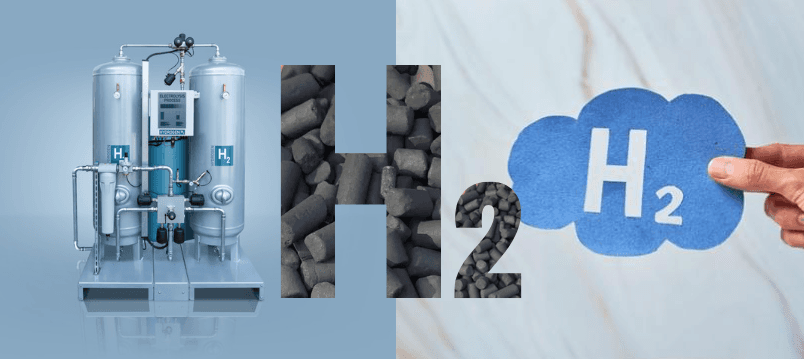
PSA hydrogen purification system with coal-based activated carbon pellets
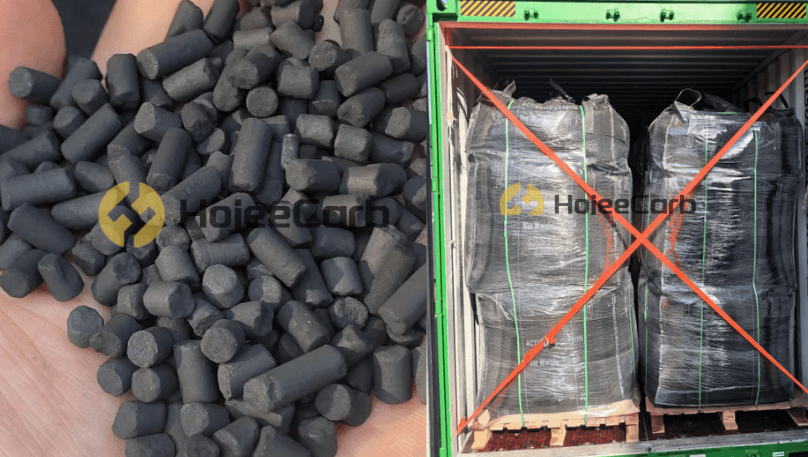
Coal-based activated carbon pellets (left) and container loading for export (right) — HojeeCarb factory direct
Supplier Comparison: Where to Source PSA Carbon in 2026
The global PSA carbon market is dominated by a handful of Western producers and a growing number of Chinese manufacturers. Here is a straightforward comparison for procurement teams evaluating options:
| Supplier | Origin | CTC Range | MOQ | Lead Time | Strengths |
|---|---|---|---|---|---|
| Norit / Cabot | Netherlands / USA | 60–80% | 20+ tons | 6–10 weeks | Premium consistency; pharma/semiconductor track record |
| Kuraray | Japan | 65–80% | 20+ tons | 6–8 weeks | High purity grades; strong R&D support |
| Jacobi Carbons | Sweden (global) | 60–75% | 15+ tons | 4–8 weeks | Global distribution; multiple production sites |
| Shanxi Xinhua | China | 60–72% | 10+ tons | 2–4 weeks | State-owned; stable supply; large capacity |
| HojeeCarb (us) | China | 60–75% | 5 tons | 2–3 weeks | Factory direct; custom pellet size; full COA; fast samples |
* Prices vary significantly by volume, grade, and market conditions. Contact suppliers directly for current quotations. Chinese manufacturers typically offer 50–70% cost savings over Western brands for equivalent specifications.
How Much Carbon Does Your PSA Unit Need?
Carbon loading is determined by your PSA system designer, but the following benchmarks help procurement teams budget correctly:
| H₂ Capacity | Typical Carbon Load | Replacement Cycle | Feed Source |
|---|---|---|---|
| 500 Nm³/h | 5–10 tons | 3–5 years | SMR or electrolysis |
| 1,000 Nm³/h | 8–20 tons | 3–5 years | SMR |
| 5,000 Nm³/h | 35–80 tons | 3–4 years | SMR or coal gasification |
| 20,000 Nm³/h | 120–250 tons | 3–4 years | Large-scale SMR / refinery |
Replacement cycle: Under normal SMR feed conditions (no sulfur contamination), activated carbon beds in hydrogen PSA last 3–5 years. Budget for one full replacement cycle in your 5-year CAPEX plan. If your feed contains H₂S above 1 ppm, plan for annual replacement or add a desulfurization guard bed upstream.
Procurement Checklist: What to Verify Before Ordering
Technical Documents
- ✓Certificate of Analysis (COA) with CTC, hardness, ash, moisture
- ✓BET surface area test report
- ✓Pellet size distribution (sieve analysis)
- ✓Attrition / abrasion resistance test
Compliance & Safety
- ✓Safety Data Sheet (SDS/MSDS)
- ✓Packing list and shipping marks
- ✓HS code for import customs (HS 3802.10)
- ✓Country of origin certificate
Logistics
- ✓Packaging: 25 kg bags or 500 kg super sacks
- ✓Moisture protection during sea freight (silica gel desiccant)
- ✓Lead time: 15–25 days from China factories
- ✓Minimum order: confirm volume matches production schedule
Supplier Qualification
- ✓ISO 9001 certification
- ✓Production capacity and factory audit option
- ✓References from other PSA or gas treatment customers
- ✓Willingness to provide pre-shipment samples
Frequently Asked Questions
What type of activated carbon is used in hydrogen PSA units?
Coal-based pelletized activated carbon (4 mm or 3 mm pellets) is the standard choice for hydrogen PSA. It needs CTC ≥ 60%, hardness ≥ 95%, and ash < 8%. The pellet form is critical — granular carbon causes excessive pressure drop in pressurized columns.
How long does activated carbon last in a hydrogen PSA unit?
Typically 3–5 years under normal operating conditions (pressure 10–30 bar, temperature 25–40°C). Lifespan shortens if feed gas contains high levels of CO, CO₂, or sulfur compounds, which compete with impurities for adsorption sites.
Can I use coconut shell activated carbon for hydrogen purification?
Not recommended. Coconut shell carbon has higher surface area but lower hardness and is more expensive. For PSA hydrogen applications, coal-based pellets offer better crush resistance under pressurization cycles and lower cost per ton. Coconut shell is preferred for water treatment and gold recovery.
What purity level can PSA activated carbon achieve for hydrogen?
PSA with activated carbon as the primary adsorbent typically achieves 99.5–99.9% H₂ purity. For higher purity (99.999%+), a molecular sieve layer is stacked after the activated carbon bed. The two-layer system is standard in fuel cell and electronics-grade hydrogen production.
How much activated carbon does a hydrogen PSA unit need?
A typical 1,000 Nm³/h PSA hydrogen plant uses 8–20 tons of activated carbon depending on feed gas composition and desired purity. Plants processing SMR (steam methane reforming) off-gas use more carbon because the feed contains higher levels of CH₄, CO, and CO₂.
Need Coal-Based Pellet Carbon for Your Hydrogen PSA Project?
We manufacture coal-based activated carbon pellets (3 mm and 4 mm) with CTC 60–75%, hardness ≥ 95%, and full COA documentation. MOQ 5 tons, factory-direct pricing, 15–20 day lead time from our production facilities in China.
Free pre-shipment samples available · ISO 9001 certified · Export to 50+ countries