
Case Study
48 Tons KOH Carbon for WWTP Biogas H₂S Removal
We recently shipped 48 tons of KOH-impregnated columnar activated carbon for hydrogen sulfide (H₂S) removal from municipal wastewater biogas. The order went out in jumbo bags (FIBC) on wooden pallets, loaded into 2×40HC high-cube containers.
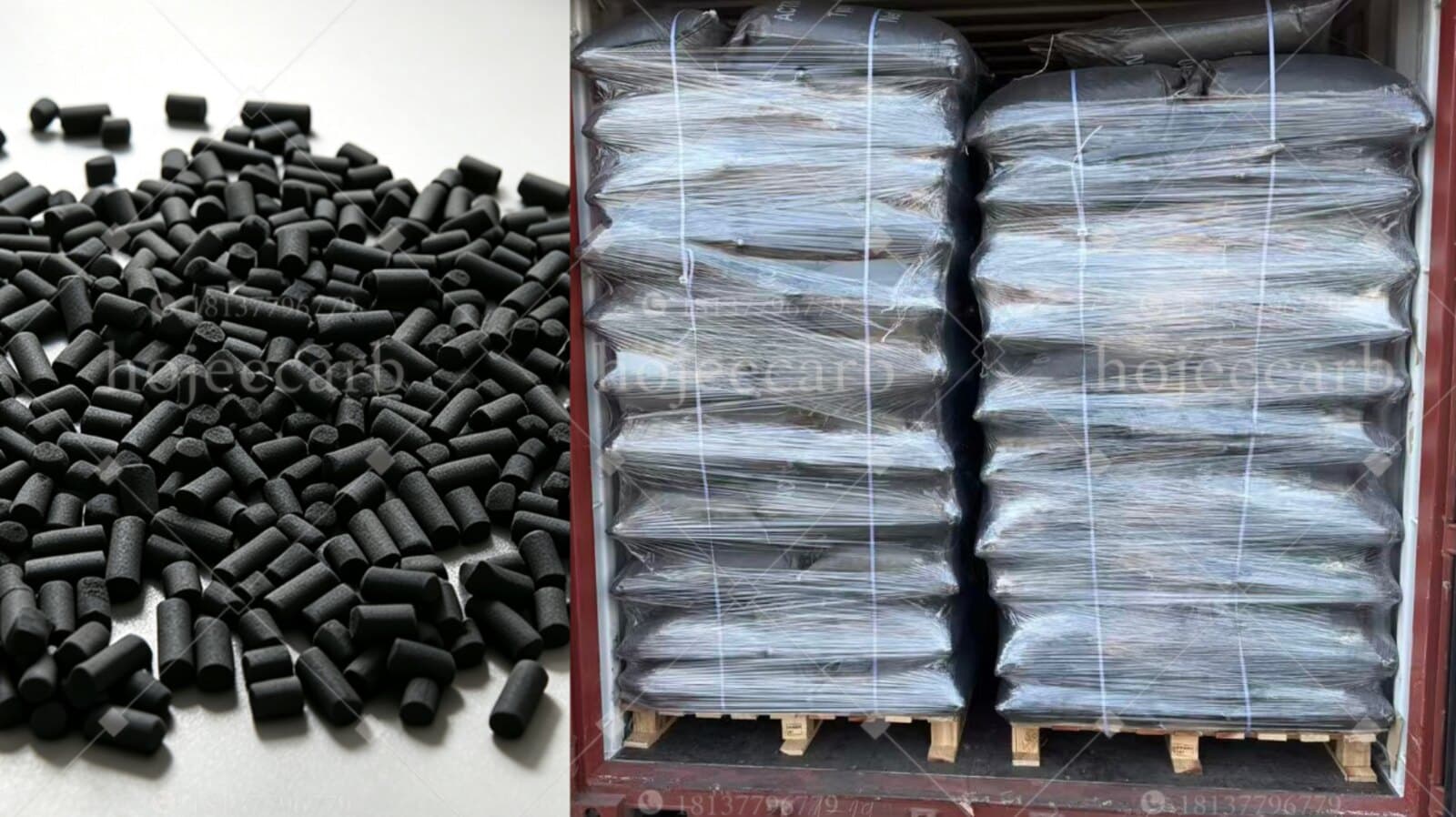
If you run an anaerobic digester and your gas engine supplier keeps warning you about H₂S, this is the media that solves it. Below is what we shipped, why this grade, and the field numbers behind it.
Shipment Summary
| Product | KOH-impregnated columnar activated carbon (extruded pellet) |
| Quantity | 48 tons |
| Packaging | Jumbo bags (FIBC), palletized, heat-sealed PE inner liner |
| Containers | 2 × 40HC (40 ft high-cube) |
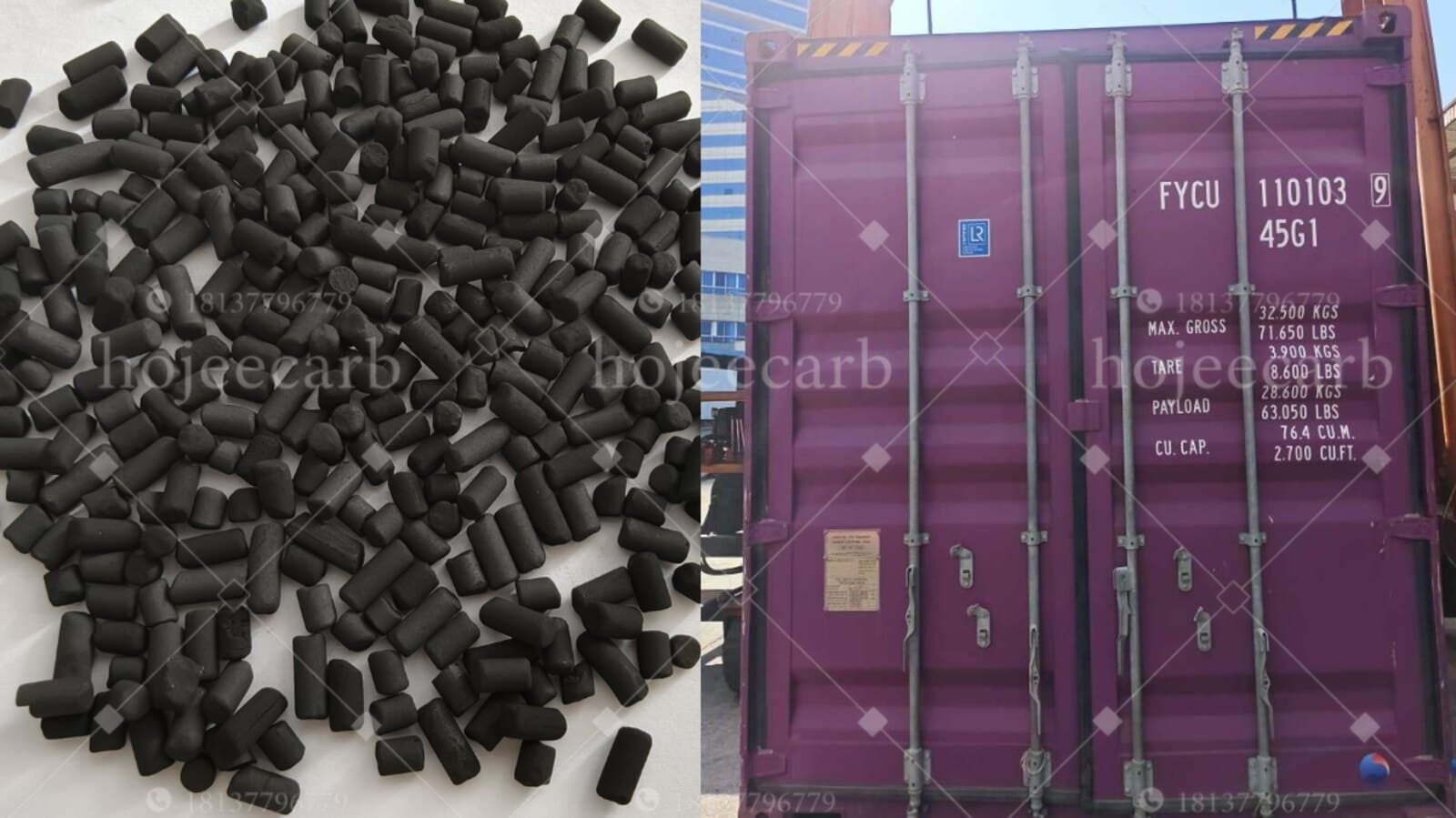
| Container type code | 45G1 |
| Payload per container | 28,600 kg |
| Cubic capacity | 76.4 m³ per container |
| Application | Municipal WWTP biogas H₂S desulfurization |
Why 2 Containers for 48 Tons
A 40HC is rated at 28,600 kg payload. But 48 tons of pelletized carbon at a bulk density of 0.45–0.55 g/cm³ hits the volume limit long before the weight limit — about 24 tons per container is the practical load for jumbo bags on pallets. So 48 tons ships as 2×40HC, not one. Anyone quoting you 48 tons in a single container is either mis-stating the packaging or shipping loose bulk.
Why Jumbo Bags for KOH Carbon
KOH is hygroscopic. It pulls moisture straight out of the air, and moisture taken up in a warehouse is capacity you no longer have in the vessel. That is the whole reason our jumbo bags carry a heat-sealed PE inner liner rather than a plain woven bag.
- Jumbo bags (FIBC) — one bag per vessel charge on most 600 L to 2 m³ systems, so the operator opens one liner and loads it. Less exposure than tipping twenty 25 kg sacks.
- Palletized and stretch-wrapped — pallets keep bags off the container floor away from condensation, and wrapping plus strapping stops shifting on a 30-day ocean leg.
- Keep bags sealed until load-in. This is the single most common field mistake we see. A bag opened and left standing for a week loses working capacity before it ever meets a gas stream.
For buyers comparing packaging options across grades, our packaging and storage guide covers 25 kg sacks versus FIBC and the moisture-barrier reasoning in more detail.
Field Performance: 500 m³/hr WWTP Biogas
This grade is in service on municipal digester gas. A representative installation at a plant treating 50,000 m³/day of sewage produces roughly 500 m³/hr of biogas carrying 2,000–4,500 ppm H₂S.
| Sewage treated | 50,000 m³/day |
| Biogas flow | 500 m³/hr |
| H₂S inlet | 2,000–4,500 ppm |
| H₂S outlet | < 5 ppm |
| Vessels | 2 × 600 L |
| Media | 8% KOH-impregnated, 4 mm pellet |
| Service life to first change-out | 14 months |
| TCO vs previous method | 40% lower per year |
Two 600-litre vessels filled with 8% KOH-impregnated 4 mm pellets held the outlet below 5 ppm continuously for 14 months before the first media change-out.
What makes that number worth reading twice is what it replaced. The same operator previously ran a liquid scrubber, which meant daily chemical dosing, a dosing pump to maintain, and caustic to store and handle on site. Switching to a dry carbon bed cut total cost of ownership by 40% per year — not because the media is cheap, but because nobody has to touch it for a year at a time.
Need activated carbon?
Get Factory-Direct Pricing — No Middlemen
20+ years manufacturing. MOQ 1 ton. Free samples. Reply within 2 hours.
Recommended Product & Specifications
KOH Impregnated Activated Carbon — HojeeDesulf K-Series
| Impregnant | KOH (potassium hydroxide) |
| Impregnation rate | 8 – 15% by weight |
| Base carbon | Coal-based extruded pellet |
| Diameter | Φ 3.0 / 4.0 mm (standard) |
| H₂S working capacity | 0.15 – 0.30 g/cm³ |
| Iodine number | 400 – 700 mg/g |
| pH | 10 – 12 |
| Hardness | > 90% |
| Moisture | < 5% |
| Bulk density | 0.45 – 0.55 g/cm³ |
| Bed pressure drop | Low (uniform pellet geometry) |
Three of those lines do the real work in a digester-gas application:
- H₂S working capacity 0.15–0.30 g/cm³ — this is the number that sets your change-out interval, and it is volumetric, so it maps directly onto vessel size. Capacity quoted per kilogram instead of per cubic centimetre tells you nothing about how long a fixed bed lasts.
- Impregnation rate 8–15% — the WWTP case above runs the 8% grade. Higher loading buys more capacity but costs some base-carbon pore volume, so we match the rate to your inlet concentration rather than defaulting to the highest number.
- Hardness > 90% — extruded pellets that crumble create fines, fines create pressure drop, and pressure drop shows up as a blower cost you did not budget for. This matters more on tall beds.
Bulk density also feeds straight back into logistics: at 0.45–0.55 g/cm³ your container is volume-limited, which is exactly why 48 tons became 2×40HC.
Need KOH Carbon for Your Digester?
Send us your gas flow, H₂S inlet concentration, and target outlet, and we will return a bed-sizing calculation with the recommended impregnation rate and pellet diameter — not just a price per ton.
Where This Grade Fits
KOH-impregnated pellets are a chemisorption media, not a general-purpose adsorbent. They are the right call when:
- Digester and landfill gas — H₂S in the hundreds-to-thousands ppm range ahead of a CHP engine or upgrading skid.
- WWTP odour and pump-station ventilation — same chemistry, lower concentration, larger air volume.
- Acid-gas polishing — where an alkaline surface is needed rather than plain physical adsorption.
They are the wrong call for pure hydrocarbon or solvent capture, where you want unimpregnated carbon selected on CTC activity instead. The selection logic across both, including siloxane removal, is laid out in our biogas purification guide.
One point we state plainly because it affects your budget: KOH carbon is not regenerable. Once the impregnant reacts with H₂S it forms elemental sulfur and potassium salts that plug the pore structure, so thermal reactivation is neither practical nor economical. Spent media is replaced. That is normal for chemisorption desulfurization and it is why we design for maximum single-pass working capacity rather than selling you a regeneration story. If your stream is a candidate for reuse, reactivated carbon is a different conversation and a different product.
Working capacity on this grade is assessed against ASTM D6646, the standard test method for alkaline adsorptive capacity of activated carbon against H₂S. Ask any supplier which protocol their capacity figure comes from — if there is no method behind the number, the number is decoration.
Frequently Asked Questions
How many containers do 48 tons of pelletized carbon need?
Two 40HC containers. A 40HC is rated at 28,600 kg payload, but pelletized carbon at 0.45–0.55 g/cm³ bulk density fills 76.4 m³ of cube before it reaches that weight, so jumbo bags on pallets load out at roughly 24 tons per container.
Why jumbo bags instead of 25 kg sacks?
FIBC suits vessel-charge quantities — one bag per charge on typical 600 L to 2 m³ systems, with a single sealed liner to open instead of twenty. For smaller or intermittent change-outs, 25 kg sacks with the same PE liner are available.
What H₂S inlet concentration can this grade handle?
It treats H₂S from 10 ppm to over 10,000 ppm. Above roughly 3,000 ppm we recommend a two-stage arrangement or a larger bed volume. The installation described here runs 2,000–4,500 ppm on a single stage of 8% impregnation.
How long will a KOH carbon bed last before change-out?
It depends on inlet concentration, gas flow, and moisture. At around 2,000 ppm inlet a properly sized bed typically runs 6–18 months; the 500 m³/hr installation described here reached 14 months to first change-out. We provide the sizing calculation so you can budget the interval rather than guess it.
Is spent KOH impregnated carbon regenerable?
No. Reaction products plug the pore structure and thermal regeneration is not economical. Plan on replacement — that is standard for this media class.
Related Reading
- Impregnated Activated Carbon Guide — how to pick the right impregnant
- 112 Tons Pellet Carbon Shipped to Norway for Biogas — larger KOH order, European delivery