
Whether you're a water treatment company, a distributor building inventory, or an industrial user going through tons of carbon per year, buying in bulk directly from a manufacturer is the most cost-effective approach. But bulk purchasing has its own logistics — MOQ requirements, container optimization, packaging choices, and customs procedures that can trip up first-time buyers.
Minimum Order Quantities (MOQ)
MOQ varies by supplier type and product. Here's what to expect:
| Supplier Type | Typical MOQ | Price Level | Best For |
|---|---|---|---|
| Factory direct | 1 FCL (20–26 MT) | Lowest | Regular users, distributors |
| Factory (flexible) | 5–10 MT | 5–10% above FCL price | Trial orders, smaller operations |
| Trading company | 1–5 MT | 15–30% above factory | Small buyers, mixed orders |
| Domestic distributor | 25 kg – 1 MT | 2–3× factory price | Spot purchases, emergencies |
Our standard MOQ is one 20-foot container (~20 MT for dense products like coconut shell GAC, ~22–26 MT for lighter coal-based carbons). For first-time buyers, we accept trial orders as small as 5 MT to let you validate quality before committing to a full container.
💡 Pro Tip: Consolidate Orders
If you need less than a full container, consider consolidating multiple products into one shipment. For example: 10 MT of 8×30 coconut shell GAC + 5 MT of 12×40 coal-based GAC + 5 MT of PAC = one full 20' container at factory-direct pricing for all three products.
Need activated carbon?
Get Factory-Direct Pricing — No Middlemen
20+ years manufacturing. MOQ 1 ton. Free samples. Reply within 2 hours.
Container Loading Optimization
Maximizing container utilization directly reduces your per-ton shipping cost. Here's how different products and packaging affect loading:
| Product | Bulk Density | 20' FCL Capacity | Limiting Factor |
|---|---|---|---|
| Coconut shell GAC (8×30) | 500–550 kg/m³ | 20–22 MT | Weight (dense product) |
| Coal-based GAC (8×30) | 450–500 kg/m³ | 22–25 MT | Weight |
| Coal pellet (4mm) | 400–450 kg/m³ | 24–26 MT | Volume (lighter, fills space) |
| Wood-based PAC | 350–400 kg/m³ | 18–20 MT | Volume (very light powder) |
| Coconut shell PAC | 450–500 kg/m³ | 20–22 MT | Weight |
Packaging Options for Bulk Orders
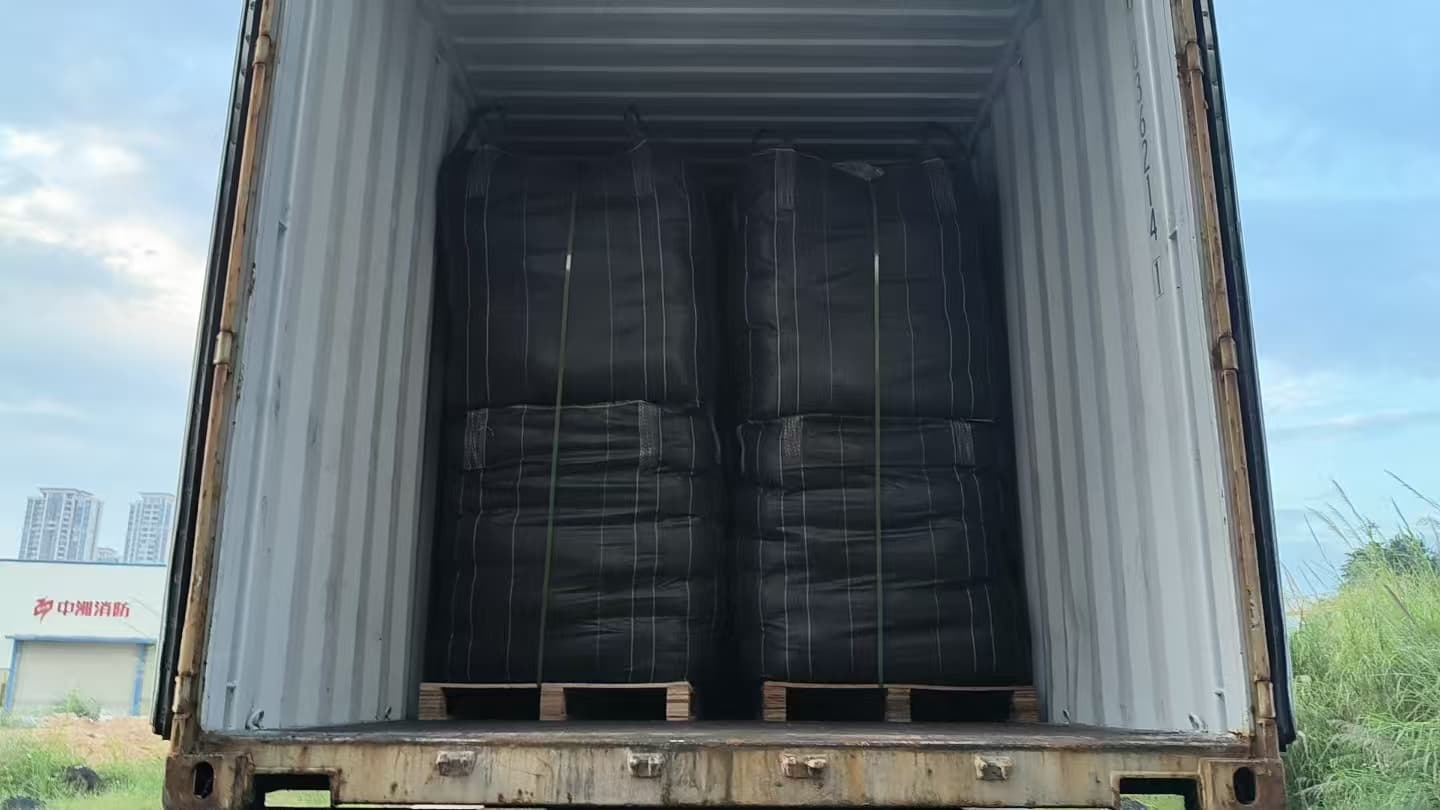
25 kg PP Woven Bags with PE Liner
The most common packaging. PP woven outer for strength, PE inner liner for moisture protection. Can be palletized (20 bags per pallet, ~50 pallets per 20' container) or floor-loaded (higher capacity but harder to unload). Cost: $0.50–$1.00 per bag.
500 kg / 1,000 kg Jumbo Bags (FIBC)
Flexible Intermediate Bulk Containers. Most efficient for bulk buyers with forklift access. Single-layer or double-layer construction. Top-fill, bottom-discharge options available. Cost: $5–$15 per bag depending on specifications.
Custom Branded Bags
For distributors and resellers, we print your logo, product name, specifications, and contact information on bags. Minimum: 2,000 bags (50 MT). Lead time: 2 weeks for bag production + standard production time.
Bulk (Loose) in Flexitank
Not common for activated carbon due to dustiness and handling challenges, but occasionally used for very large volume buyers with pneumatic unloading capability. Maximizes container utilization — no packaging waste.
True Cost Breakdown: What You Actually Pay
The FOB or CIF price is just the starting point. Here's a realistic breakdown of your total landed cost for a 20-ton container of coconut shell GAC (8×30, iodine 1050) shipped from China to a US port:
⚠️ Anti-Dumping Duty Warning (US Buyers)
The US anti-dumping duty on Chinese activated carbon can dramatically change your cost calculation. The “China-wide” rate is 228.11%. Some exporters have individual rates as low as 0%. Before ordering, verify your supplier's specific duty rate with US Customs or a trade attorney. For buyers in the EU, Canada, Australia, and most other countries, no anti-dumping duties apply to Chinese activated carbon as of 2026.
The Bulk Ordering Process: Step by Step
Sample & Specification Review
Request samples (50–500g, shipped by courier). Test in your application. Confirm the product specification matches your requirements.
Quotation & PI
Receive detailed quotation (FOB/CIF/DDP), negotiate if needed. Once agreed, supplier issues a Proforma Invoice (PI) with product specs, quantity, price, payment terms, and delivery timeline.
Deposit Payment
Pay 30% deposit via T/T (bank wire). Supplier starts production or reserves stock.
Production & QC
Standard products: 7–10 days. Custom specs: 15–30 days. Supplier sends production photos and COA for approval before shipping.
Balance Payment & Shipping
Pay remaining 70% against B/L copy or loading photos. Container is loaded and shipped. Supplier provides full document set (B/L, CI, PL, COA, CO, MSDS).
Customs & Delivery
Your customs broker clears the shipment using provided documents. Container delivered to your warehouse. Inspect goods against COA and PI specs.
7 Ways to Reduce Your Bulk Purchase Cost
Buy direct from manufacturer
Skip trading companies. Factory-direct saves 10–25% on the product price alone.
Order full containers
LCL (less-than-container) shipping costs $80–$150/CBM. A full 20' container costs $1,500–$3,500 total. Per-ton shipping cost drops 50–70% with FCL.
Use jumbo bags instead of 25kg bags
Jumbo bags cost ~$10 each vs. ~$0.80 × 40 bags = $32 for the same 1 MT in 25kg bags. Plus you fit more product per container with less packaging waste.
Negotiate annual contracts
Commit to 3–4 containers per year and negotiate a fixed price or volume discount. Most manufacturers offer 3–8% off for annual commitments.
Choose FOB and arrange your own freight
Supplier-arranged CIF freight often includes a markup. Getting your own freight quotes from 2–3 forwarders typically saves $200–$500 per container.
Time your purchases
Raw material prices fluctuate seasonally. Coconut shell prices typically dip in Q2 (post-harvest season in Philippines/Indonesia). Coal-based carbon prices are lowest in Q2–Q3 (lower heating demand in China).
Don't over-specify
Iodine 1050 costs 15–25% more than iodine 900. If your application works fine at 900, don't pay for 1050. Test with samples to find the minimum spec that meets your performance requirements.
Storing Bulk Activated Carbon
Proper storage preserves adsorption capacity and prevents quality degradation:
Frequently Asked Questions
Can I mix different products in one container?
Yes. We regularly ship mixed containers — for example, 10 MT of coconut GAC + 5 MT of coal GAC + 5 MT of PAC. Each product is separately bagged and labeled. The MOQ applies to the total container weight, not individual products (minimum 2 MT per product).
What if I need less than your MOQ?
For orders under 5 MT, we recommend LCL (Less than Container Load) shipping. Cost per ton is higher, but total investment is lower. We can also connect you with our distribution partners in your region who hold local stock.
Can you hold safety stock for us?
Yes. For annual contract customers, we can hold 1–2 containers of your spec at the factory, ready to ship within 7 days of order. This reduces your lead time from 6–8 weeks to 3–4 weeks (shipping only).
Do you offer free samples?
Samples (50–500g) are free. You pay only courier shipping (typically $30–$50 via DHL/FedEx, 3–5 day delivery). For larger test quantities (5–25 kg), we charge product cost but credit it against your first order.
Bottom Line
Buying activated carbon in bulk is straightforward: start with a sample order to validate quality, then commit to a full container for the best economics. Full container loads (20' FCL) offer the lowest per-ton cost for both product and freight. Choose jumbo bags if you have forklift capability, or 25kg bags for manual handling. Time your purchases to raw material price cycles and negotiate annual contracts for volume discounts.
Frequently Asked Questions
What is the minimum order quantity for importing from China?
Most manufacturers set MOQs at 1 FCL: ~20–26 MT for a 20' container or 24–28 MT for a 40' container. Some accept LCL orders of 1–5 tons at a premium. For first orders, many factories accommodate 5–10 ton trial orders to verify quality.
What is the HS code for activated carbon imports?
The primary HS code is 3802.10 (activated carbon). Import duty rates range from 0% to 6% depending on destination and trade agreements. Check your country's tariff schedule for exact rates and any anti-dumping duties that may apply.
How long does shipping take from China?
Ocean freight from Chinese ports: US West Coast 14–18 days, US East Coast 28–35 days, Europe 25–35 days, Southeast Asia 5–10 days, Middle East 15–20 days, Australia 14–21 days. Add 5–7 days for customs clearance. Total door-to-door: 30–50 days.
What documents are needed to import activated carbon?
Essential: commercial invoice, packing list, bill of lading, certificate of origin, COA, MSDS/SDS, and applicable certifications (NSF, food-grade). Some countries require phytosanitary certificates, fumigation certificates, or import licenses.
How should I handle quality verification for imports?
Request pre-shipment samples, specify testing standards in contracts, arrange third-party inspection (SGS, Bureau Veritas) before shipping, request independent lab COA, test incoming shipments, and retain samples 12+ months. Start with a trial order before committing to volume.
Ready to Order in Bulk?
Tell us what you need — product type, quantity, packaging preference, and destination. We'll provide a detailed quotation within 24 hours.
Request Bulk Quotation