
Comparison Guide
Jacobi PICAGOLD G210 Ultima vs HojeeGold CG33: An Objective Gold Recovery Carbon Comparison
In gold extraction (CIP and CIL) and high-end water treatment, the grade of coconut shell activated carbon has a direct impact on gold recovery rate and total running cost. Jacobi Carbons, part of Osaka Gas Chemicals, is a benchmark name in the global market — its flagship gold grade, PICAGOLD G210 Ultima (K 30 kg/t, R 60%), is the reference standard many mine metallurgists specify. HojeeGold CG33, HojeeCarb's premium 6×12 coconut shell gold carbon made from Davao (Philippines) shell, is built as a drop-in alternative to PICAGOLD G210 Ultima — match the K/R performance, hold the spec, cut the price. This guide compares the two across the things you can actually see and measure — no bias, just facts.
The Comparison at a Glance
| Dimension | What It Tells You | Good Gold Carbon Looks Like |
|---|---|---|
| Size uniformity | Packing density, flow resistance, fines | Tight particle size, few fines |
| Water clarity | Dust, washing process | Clear water, short backwash |
| Float rate | True density, activation maturity | Sinks fast, little floating |
| Bubbling | Pore development | Dense, sustained bubbles |
| Iodine / CTC | Micropore & total capacity | High values, fully activated |
| Ash / moisture | Effective surface, water cost | The lower the better |
| Hardness / attrition | Wear resistance, carbon loss | High hardness, low attrition |
| Raw material | Shell maturity & process | Premium shell + mature activation |
| Gold loading | K value, R value, regeneration | High load, fast kinetics, regenerable |
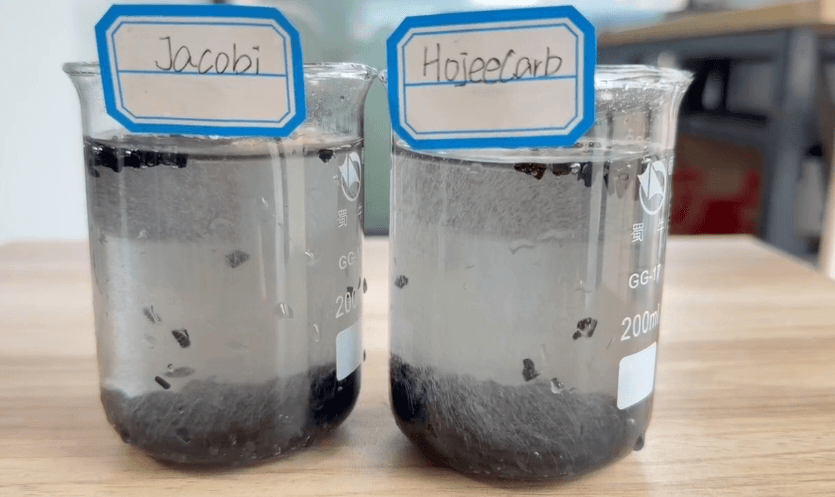
The short video below shows the same hands-on checks — water clarity, float rate, and bubbling — that we describe throughout this guide.
1. Size Uniformity
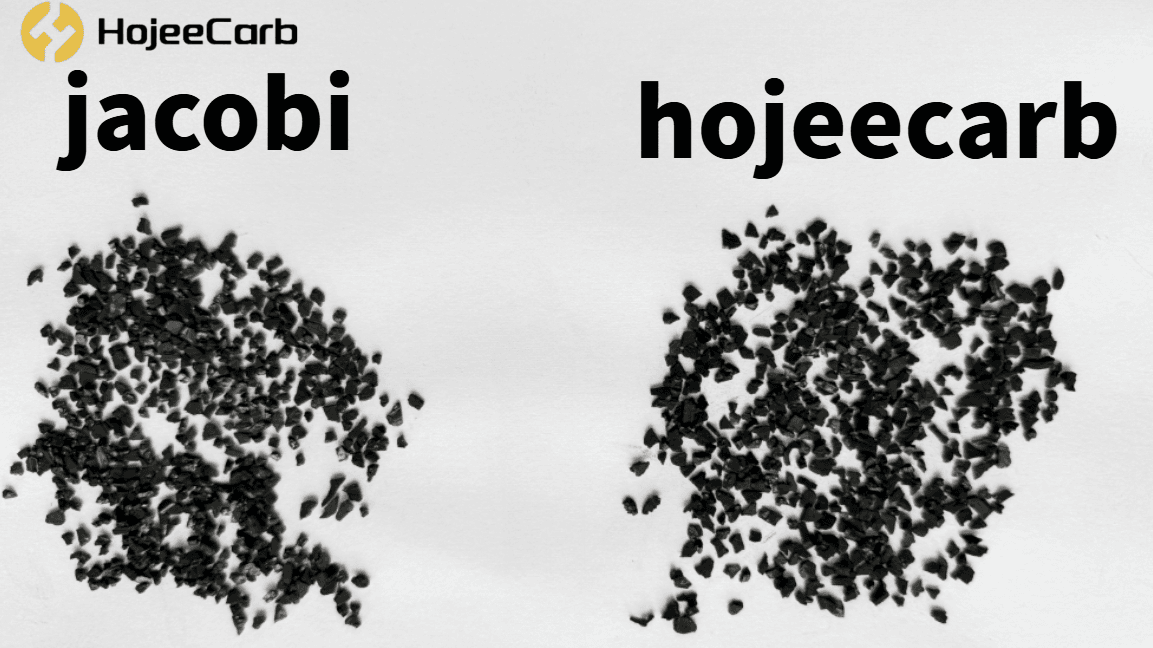
Size uniformity controls packing density, flow resistance, and how many fines a carbon bed generates. The more uniform the granules, the more stable the bed, the fewer fines escape with the overflow, and the lower your carbon loss — which in gold recovery translates directly into money. Per ASTM D2862, gold-grade carbon is typically screened to 6×12 or 8×16 mesh, and a tight spread within that range matters.
- Jacobi PICAGOLD G210 Ultima: Screened from coconut shell to 6×12 and 8×16 mesh. Per Jacobi's published data, PICAGOLD grades hold a mean particle diameter of ≥2.48 mm (6×12) and ≥1.55 mm (8×16), with platelets (flat, off-shape grains) controlled to <1.5% on the flagship G210 Ultima (<4% on standard grades).
- HojeeGold CG33: A multi-stage screening process keeps each batch within a narrow size window, with a low share of off-spec grains and fines. Screening QC runs before packing, so what arrives at the destination port matches the COA.
A simple site check: spread a handful from each supplier on white paper and look at grain evenness and dust. Uniform carbon looks consistent to the eye — that quick check catches most batch issues before loading.
2. Water Clarity After Immersion
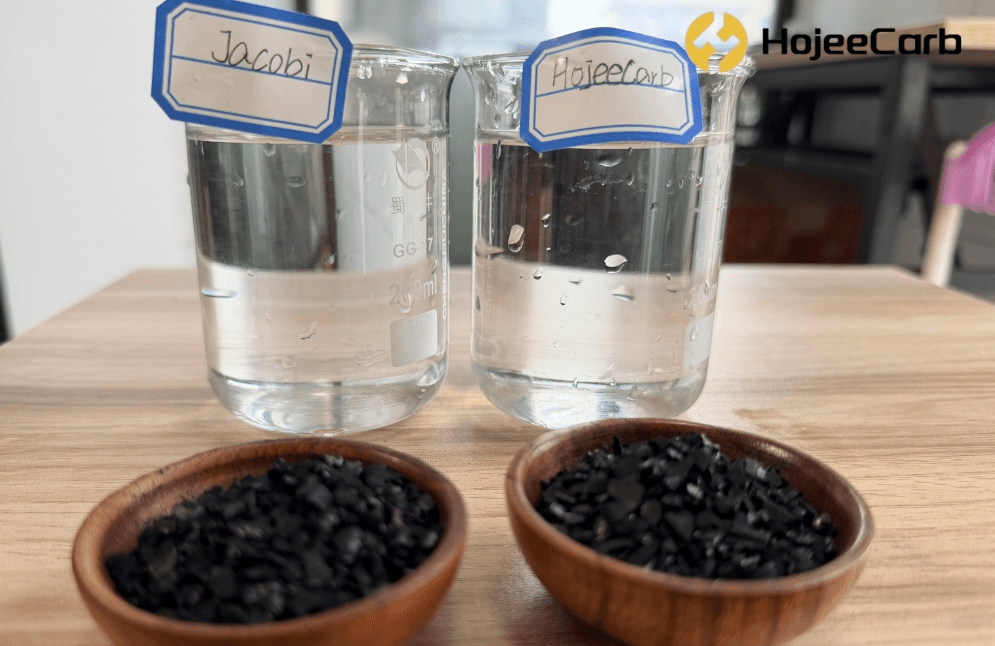
This is the most intuitive on-site test. Well-washed coconut shell activated carbon with little residual dust leaves the water clear after immersion. Dusty carbon turns the water grey and needs longer backwash before going online — that means downtime and wasted water. Drop an equal weight into two identical glasses of clean water and compare after 2–3 minutes.
- Jacobi PICAGOLD G210 Ultima: A mature washing and de-dusting process — water typically stays clear after immersion.
- HojeeGold CG33: Dedicated water-washing and de-dusting at the finishing stage — the water is equally clear, a detail invested in specifically because African and Central Asian mine buyers test this on arrival.
Good clarity means shorter pre-loading backwash, fewer fines entering your CIL circuit early on, and lower precious-metal loss during startup.
3. Float Rate in Water
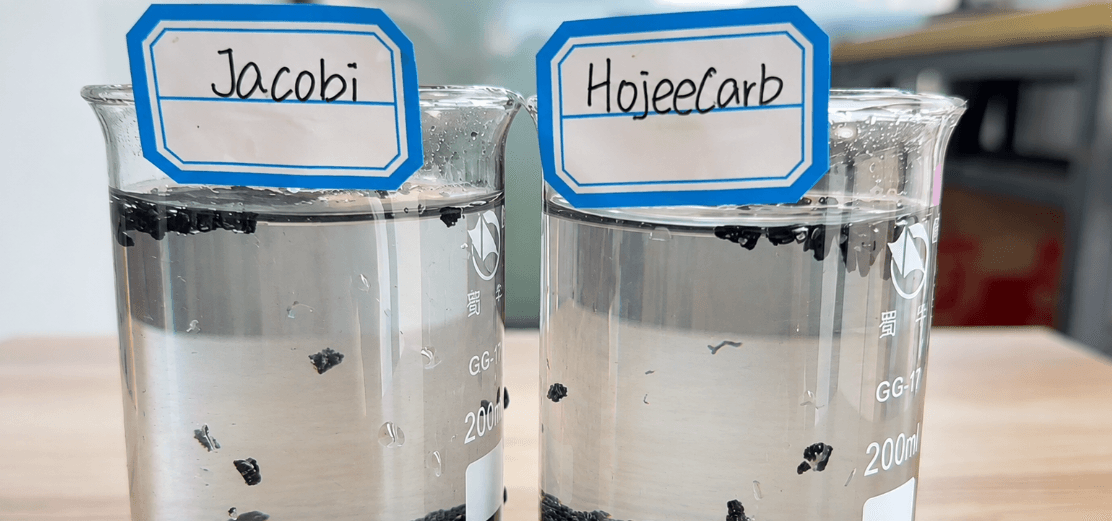
Float rate reflects true density and how mature the pore structure is. Gold carbon needs to sink fast and float little. Floating grains escape with the overflow during CIP/CIL operation, causing carbon loss and wasting adsorption area — every gram that floats away is a gram that never touches the gold-cyanide solution. To test, drop an equal amount into water and watch the share of grains still floating after 1–3 minutes.
- Jacobi PICAGOLD G210 Ultima: PICAGOLD is known for low float rates; consistent activation at its Sri Lanka facility helps keep density even.
- HojeeGold CG33: Float rate is tightly controlled — the carbon sinks fast with very few floaters, a result of dense, mature Davao coconut shell and a complete activation cycle.
4. Bubbling (Wetting and Air Release)
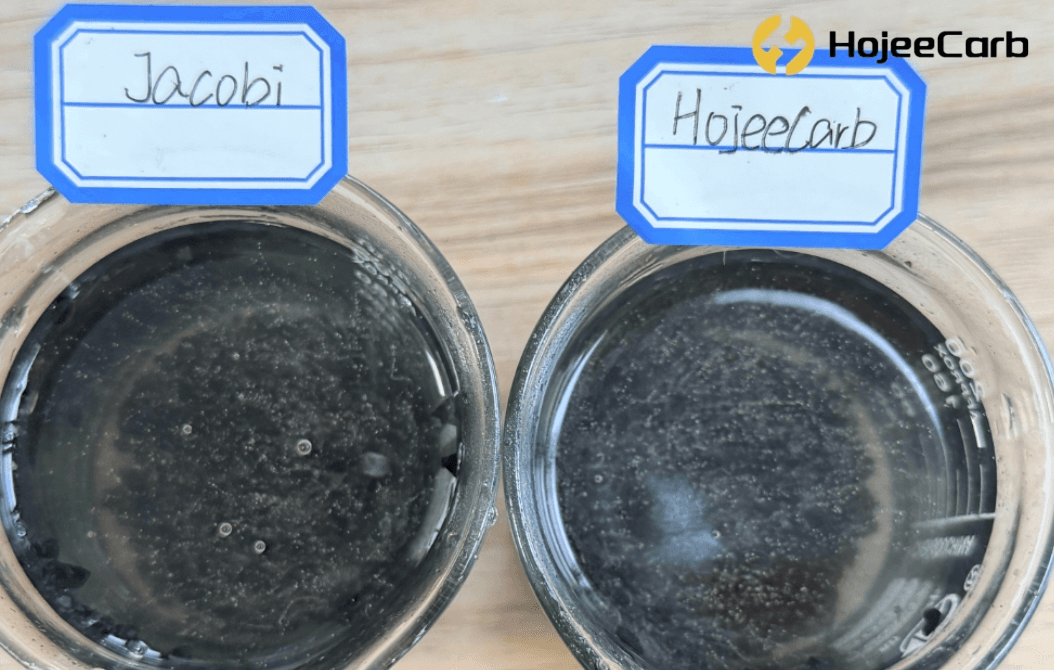
The moment activated carbon hits water, air trapped in the pores escapes as bubbles — direct visual evidence of pore development. Dense, sustained, even bubbling means rich porosity, large internal surface area, and full activation. Sparse bubbling that stops quickly can mean incomplete activation or pores partly blocked by ash.
- Jacobi PICAGOLD G210 Ultima: Noticeable bubbling when immersed, consistent with a well-activated product.
- HojeeGold CG33: Dense, sustained bubbling — the micropore structure developed during activation releases air steadily for 30+ seconds.
Watching how dense and how long the bubbling lasts is an indirect read on micropore development, which ties directly back to adsorption capacity and gold-loading potential.
Need gold recovery carbon?
Get Factory-Direct Pricing — No Middlemen
20+ years manufacturing. MOQ 1 ton. Free samples. Reply within 2 hours.
5. Ash, Moisture, Hardness, and Attrition Rate
These are the hard numbers that decide tender acceptance. Every gold mine buyer has spec sheets, and these four indicators are always on them.
| Indicator | What It Means | Direction | Typical Gold Spec |
|---|---|---|---|
| Ash | Occupies pores, cuts surface area, adds impurities | Lower better | ≤3% |
| Moisture | Freight paid for water; slows initial adsorption | Lower better | ≤5% |
| Ball-pan hardness | Wear resistance in agitated CIL tanks | Higher better | ≥97% |
| Attrition | Rate of fines generation — fines carry gold out | Lower better | ≤2% |
- Jacobi PICAGOLD G210 Ultima: Ash typically 2–3%, moisture within spec, and very low attrition — Jacobi's published data shows rolling-bottle attrition <0.7% on the flagship G210 Ultima (<1.0% on standard grades), backed by Osaka Gas Chemicals quality systems.
- HojeeGold CG33: Ash consistently below 3%, moisture ≤5%, ball-pan hardness ≥98%, attrition ≤2%. Every batch ships with a full COA and welcomes third-party SGS / Intertek verification — the numbers match the paperwork.
These are the numbers that protect your gold. Low ash means more effective surface for adsorption. High hardness and low attrition mean less carbon loss, fewer fines, and less gold escaping with the tailings. Based on our 15+ years of manufacturing experience, the single most common reason mines switch carbon suppliers is unexpectedly high attrition loss — because every percent of extra fines is gold walking out the back door.
6. Iodine Number and CTC Value
Iodine number measures micropore development; CTC value reflects total pore volume including meso- and macropores. Together they tell you how much adsorption capacity the carbon actually has. For CIP/CIL, coconut shell carbon typically needs an iodine number of 1000–1100+ mg/g and a CTC confirming full activation.
- Jacobi PICAGOLD G210 Ultima: Specifies its gold grades primarily by K value and R value (see below) rather than headline iodine numbers. Its coconut shell base delivers the fully developed micropore structure gold-cyanide adsorption requires.
- HojeeGold CG33: Iodine 1100 mg/g, CTC fully in range, reflecting a complete activation cycle with premium Davao coconut shell. At a matching micropore profile, CG33 delivers equivalent adsorption kinetics at a more competitive price.
Key point for buyers: iodine alone does not tell the whole story. Two carbons with the same iodine number can have very different gold-loading performance if their pore size distribution differs. Always request both iodine and CTC, and ideally a gold-loading test (K and R values).
7. Raw Material
Coconut shell is the premium feedstock for activated carbon used in gold mining — more developed micropores, higher natural hardness, and lower ash than coal- or wood-based alternatives. But not all coconut shells are equal; maturity, region, and post-harvest handling set the natural baseline.
- Jacobi: Produces its PICAGOLD gold carbon, including the flagship G210 Ultima, at its Sri Lanka facility. Sri Lankan shell is well-regarded for density and maturity, and long supply relationships give feedstock stability.
- HojeeGold CG33: Uses premium coconut shell exclusively from the Davao region of the Philippines. Davao sits in the tropics at the right latitude, where coconuts are highly mature and the shell is dense — a widely recognized source of top coconut carbon feedstock. That origin contributes to CG33's consistently strong hardness and micropore numbers.
The key is not only which country the shell comes from, but shell maturity combined with the carbonization and activation process. Premium Davao shell plus a mature process delivers dependable iodine, hardness, and gold-loading performance batch after batch.
8. Gold Loading Performance
For gold carbon, every earlier indicator ultimately serves one thing: gold-loading capacity and adsorption kinetics.
- Load capacity (K value): grams of gold per unit of carbon at equilibrium (often kg/t) — higher means less carbon consumed per ounce recovered.
- Adsorption rate (R value): how fast the carbon reaches loading equilibrium — faster means a more efficient CIL circuit.
- Elution & regeneration: how cleanly gold strips, and how many reactivation cycles the carbon survives — driving total cost of ownership.
Per Jacobi's published PICAGOLD data, the range runs from K 26 kg/t / R 50% up to K 30 kg/t / R 60% on the flagship G210 Ultima — the grade HojeeGold CG33 is built to replace:
| PICAGOLD Grade | K Value | R Value | Platelets | Attrition |
|---|---|---|---|---|
| G208AS | 26 kg/t | 50% | <4% | <1.0% |
| G209AS | 28 kg/t | 55% | <4% | <1.0% |
| G210AS | 28 kg/t | 60% | <4% | <1.0% |
| G210 Ultima | 30 kg/t | 60% | <1.5% | <0.7% |
- Jacobi PICAGOLD G210 Ultima: A mature export brand with well-documented K/R loading data and a graded line, from workhorse G208AS to the flagship G210 Ultima (K 30 kg/t, R 60%). Many mine metallurgists use PICAGOLD as their reference standard.
- HojeeGold CG33: At a matching K value and R value, CG33's gold-loading performance is on par with G210 Ultima and other leading international grades. Gold plants in Ghana, Tanzania, Sudan, and Ethiopia already run HojeeCarb carbon in their CIL circuits — comparable performance, better price.
HojeeCarb is confident in its coconut shell activated carbon. The right way to settle any comparison is a side-by-side loading test on your own pulp — request matched samples and run them under identical conditions.
Why Global Customers Choose HojeeCarb
- A cheaper drop-in alternative to PICAGOLD G210 Ultima. HojeeGold CG33 is specced to match Jacobi's flagship gold grade head-on — at a matching K value and R value, its gold loading is on par with PICAGOLD G210 Ultima and other leading brands, while the quote stays more competitive. For a mine running 100+ tons per year, that difference adds up fast.
- Stable Davao feedstock and consistent batches. A fixed supply of premium Davao coconut shell plus a mature activation process keeps performance steady across a long relationship, with no swings from switching raw materials.
- Full COA and third-party testing. Every batch ships with complete quality parameters. HojeeCarb welcomes SGS, Intertek, or any third-party lab verification — the numbers match.
- Proven export track record. HojeeCarb already supplies gold plants across Africa — including Ghana, Tanzania, Sudan, and Ethiopia — handling shipping, documentation, and destination-port delivery with responsive technical support.
Summary Comparison
| Dimension | Jacobi PICAGOLD G210 Ultima | HojeeGold CG33 (Davao Feedstock) |
|---|---|---|
| Size uniformity | 6×12 ≥2.48mm, 8×16 ≥1.55mm | Multi-stage screening, high consistency |
| Water clarity | Clear | Clear |
| Float rate | Low | Low, sinks fast |
| Bubbling | Noticeable | Dense, sustained |
| Ash | 2–3% | <3% |
| Moisture | ≤5% | ≤5% |
| Hardness | ≥97% | ≥98% |
| Attrition | <0.7% | ≤2% |
| K value | 30 kg/t | Matched to grade |
| R value | 60% | Matched to grade |
| Raw material | Sri Lanka coconut shell | Premium Davao coconut shell |
| Gold loading | Benchmark brand, proven | On par at matched K/R, better price |
| Export / service | Global network (Osaka Gas) | Africa export track record, responsive |
Jacobi PICAGOLD G210 Ultima is a proven, premium choice — no question, and it sits at the top of Jacobi's graded K/R line (K 30 kg/t, R 60%) as the benchmark many mines specify. HojeeGold CG33 is built to sit right alongside it as a cheaper drop-in alternative: matched 6×12 mesh, iodine 1100 mg/g, ≥98% hardness, on-par gold loading at a matched K value and R value — at a more competitive price with responsive technical support. If you weigh gold-loading performance, spec parity, and total running cost, HojeeGold CG33 deserves a spot on your shortlist. Request matched samples and run a side-by-side test on your own pulp — that is the only definitive comparison.
Ready to Compare for Your Mine?
Tell us your mesh size, target K/R and iodine, and annual volume. We'll send a spec sheet and pricing within 24 hours, and help match the right grade to your pulp conditions.
Frequently Asked Questions
What is the difference between Jacobi and HojeeCarb coconut shell activated carbon?
Both are coconut-shell-based and widely used in gold recovery (CIP/CIL). Jacobi is a global brand under Osaka Gas Chemicals, and its flagship gold grade is PICAGOLD G210 Ultima (K 30 kg/t, R 60%) produced in Sri Lanka. HojeeCarb's gold grade, HojeeGold CG33, uses premium Davao (Philippines) coconut shell and is built as a drop-in alternative to PICAGOLD G210 Ultima — delivering comparable K/R gold-loading performance at a more competitive price, with a proven export track record in Africa.
What iodine number and CTC should gold recovery carbon have?
For CIP/CIL gold extraction, coconut shell activated carbon typically needs an iodine number of 1000–1100 mg/g or above and a CTC value confirming full activation. Higher values indicate more developed micropores and stronger adsorption of the gold-cyanide complex. Per ASTM D4607, iodine number is tested by the standard iodine adsorption method.
Why does raw material origin matter for gold carbon?
Coconut shell maturity and density directly affect the hardness, ash content, and pore structure of the finished carbon. Shells from tropical regions like Davao, Philippines tend to be highly mature and dense, giving the carbon naturally high hardness and low ash — both critical for surviving the intense agitation inside CIL tanks.
How do I compare two gold carbons objectively?
Focus on measurable indicators: iodine number, CTC, ash content, moisture, ball-pan hardness, abrasion/attrition rate, and gold-loading performance (K and R values). Visual tests like water clarity, float rate, and bubbling after immersion provide useful quick checks on washing quality and pore development. A side-by-side loading test on your own pulp settles any comparison.
Does HojeeCarb ship activated carbon to Africa?
Yes. HojeeCarb supplies coconut shell activated carbon for gold extraction to mining operations across Africa, including Ghana, Tanzania, Sudan, and Ethiopia. We handle international shipping, documentation, and destination-port delivery with full technical support.