
Gold Recovery Guide
Coconut Shell Activated Carbon for Gold Extraction: The Complete Guide
Why coconut shell carbon dominates CIP, CIL, and CIC gold recovery — with real specs, not marketing fluff.
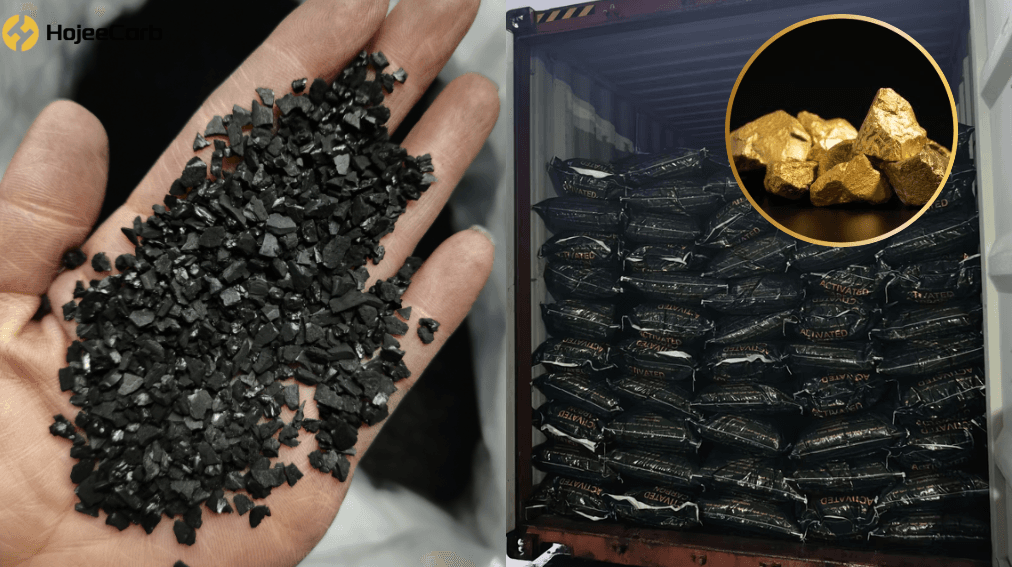
Today I'm going to walk you through why coconut shell activated carbon is the gold standard (literally) for gold extraction in CIP, CIL, and CIC processes. After 15+ years supplying gold mines across Africa, Southeast Asia, and South America, we've learned what works and what doesn't.
Gold Extraction Carbon Specifications: 3 Grades Compared
| Parameter | Standard Grade | Mid Grade | Premium Grade |
|---|---|---|---|
| CTC Activity | min. 45% | min. 55% | min. 60% |
| Surface Area | 1000 m²/g | 1100 m²/g | 1150 m²/g |
| K Value (adsorption rate) | 26 kg/tonne | 28 kg/tonne | 32 kg/tonne |
| R Value (equilibrium loading) | 50 | 60 | 65 |
| Hardness (Ball-Pan) | min. 99% | min. 99% | min. 98.5% |
| Attrition (A.A.R.L.) | max. 2% | max. 1.5% | max. 2% |
| Ash Content | max. 4% | max. 4% | max. 4% |
| Moisture | max. 5% | max. 5% | max. 4% |
| Apparent Density | 480–550 kg/m³ | 480–530 kg/m³ | 480–510 kg/m³ |
| Mean Particle (6×12) | min. 2.48 mm | min. 2.48 mm | min. 2.48 mm |
| Platelets (A.A.R.L.) | max. 7% | max. 7% | max. 7% |
Available Mesh Sizes
- • 6×12 mesh (1.70–3.35 mm) — most common for CIP/CIL
- • 6×16 mesh (1.18–3.35 mm) — better kinetics for high-silver ores
- • 8×16 mesh (1.18–2.36 mm) — column operations
- • 12×30 mesh (0.60–1.70 mm) — specialty applications
Why Coconut Shell, Not Coal-Based?
For gold recovery, coconut shell activated carbon outperforms coal-based carbon in 3 key ways:
1. Hardness
Coconut shell carbon scores 98.5–99% on ball-pan hardness. Coal-based? Usually 85–92%. In a CIP circuit where carbon gets pumped between 6–8 tanks, low hardness means you lose 2–5% carbon per cycle to attrition. Gold-grade carbon costs $3,200–3,800/ton — that adds up fast.
2. Micropore Structure
Gold-cyanide complex [Au(CN)₂]⁻ has a molecular diameter around 6 Å. Coconut shell carbon achieves 1000–1150 m²/g surface area with a higher proportion of micropores (< 20 Å). More micropores = more adsorption sites for gold. This is why K values reach 26–32 kg/tonne.
3. Reactivation Performance
After thermal reactivation at 700–850°C, coconut shell carbon retains 95%+ of its original activity for 15–20 cycles. Coal-based degrades faster, typically lasting 8–12 cycles before replacement.
How Gold Extraction Works: CIP vs CIL vs CIC
| Process | Full Name | How It Works | When to Use |
|---|---|---|---|
| CIP | Carbon-in-Pulp | Carbon added after leaching is complete | Most common, ores with <5 g/t Au |
| CIL | Carbon-in-Leach | Carbon added during leaching | Higher-grade ores, reduces preg-robbing |
| CIC | Carbon-in-Column | Carbon in fixed columns, solution passes through | Heap leach operations |
In all three, activated carbon adsorbs the gold-cyanide complex from solution. Then you strip (elute) the gold off the carbon using hot caustic cyanide solution (Zadra or AARL method), electrowin it, and smelt into doré bars.
Our carbon is also used for silver recovery from photographic wastes and reworking of ore spoil tips.
Need activated carbon?
Get Factory-Direct Pricing — No Middlemen
20+ years manufacturing. MOQ 1 ton. Free samples. Reply within 2 hours.
9 Factors for Choosing the Right Gold Recovery Carbon
1. CTC Activity
This is the primary activity indicator for gold carbon — not iodine number. CTC (Carbon Tetrachloride) activity measures total pore volume. Minimum 45% for standard operations, 55%+ for demanding circuits, 60%+ for maximum recovery.
2. K Value (Gold Adsorption Rate)
The most direct performance indicator. K value measures how fast your carbon grabs gold from solution. Standard grade: 26 kg/tonne. Premium: 32 kg/tonne. Higher K value = faster loading = fewer stages needed.
3. R Value (Equilibrium Loading)
R value tells you the maximum gold the carbon can hold at equilibrium. Standard: 50. Premium: 65. Higher R value = more gold per ton of carbon before you need to elute.
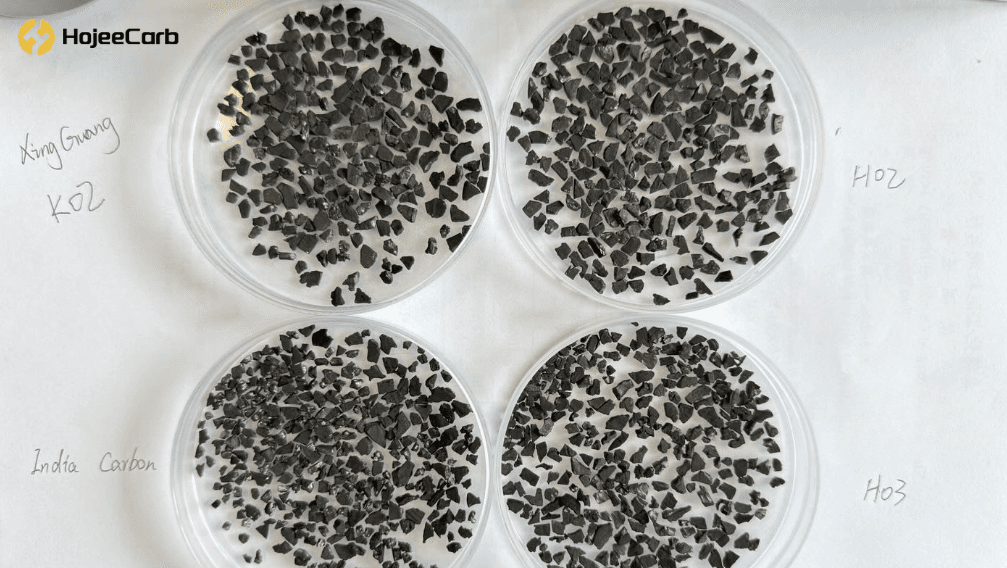
4. Particle Size Distribution
Standard is 6×12 mesh with mean particle diameter ≥2.48 mm. Finer than 12 mesh passes through inter-stage screens and gets lost with tailings. Coarser than 6 mesh is too slow on adsorption kinetics.
5. Ball-Pan Hardness
Must be ≥98.5%, our standard grade achieves ≥99%. Soft carbon generates fines that block screens, get lost to tailings (= gold loss), and reduce elution efficiency.
6. Attrition (A.A.R.L. Method)
Different from ball-pan hardness. A.A.R.L. attrition test simulates real CIP conditions. Max 2% for standard, max 1.5% for mid grade. Lower is better.
7. Ash Content
Max 4% across all grades. Low ash means cleaner elution and less contamination of your gold product. High-ash carbon releases calcium and iron into solution, causing fouling.
8. Apparent Density
480–550 kg/m³ is the working range. Too light, carbon floats and distributes unevenly. Too heavy, carbon settles and doesn't flow between stages. Premium grade is tighter: 480–510 kg/m³.
9. Platelets (A.A.R.L.)
Max 7%. Platelets are flat, thin fragments that pass through screens even if they're technically "on size." High platelet content means screen losses even with good hardness numbers.
Common Problems and Solutions
| Problem | Likely Cause | Fix |
|---|---|---|
| Slow gold loading | Low CTC activity or K value | Check CTC; reactivate or upgrade grade |
| High carbon losses | Low hardness, high attrition | Switch to ≥99% hardness grade; inspect screens |
| Poor elution recovery | Organic fouling, high ash | Acid wash before elution; use max 4% ash carbon |
| Uneven carbon distribution | Density out of spec | Verify 480–550 kg/m³ range; adjust flow rates |
| Gold in tailings | Insufficient carbon inventory | Increase carbon concentration (15–25 g/L typical) |
| Screen blinding | High platelets content | Demand ≤7% platelets from supplier |
What Our Customers Ask
How much carbon do I need per ton of ore?
Typical carbon concentration is 15–25 g/L of pulp. For a 3,000 t/day CIP plant with 6 stages and 40% pulp density, you're looking at roughly 20–30 tons of carbon inventory, with makeup of 50–100 g per ton of ore processed.
How often should I reactivate?
When gold loading approaches R value capacity, or when K value drops below 80% of fresh carbon performance. Most operations run on a 5–7 day cycle.
What's the difference between CTC activity and iodine number?
CTC measures total pore volume (macro + micro). Iodine number only measures micropores. For gold recovery, CTC is the better indicator because it reflects overall adsorption capacity. A carbon with high iodine but low CTC may have plenty of micropores but limited total capacity.
What's the price range?
Gold-grade coconut shell activated carbon runs $3,200–3,800/ton FOB China (2026), depending on grade and order quantity. Standard water treatment carbon is $1,450–1,950/ton — you get what you pay for.
Testing standards referenced: ASTM D3802 Ball-Pan Hardness for hardness measurement; A.A.R.L. (Anglo American Research Laboratories) method for attrition and platelet testing.
Frequently Asked Questions
What is the K value for gold recovery activated carbon?
K value measures gold adsorption rate in kg/tonne. Standard grade: 26 kg/t, mid grade: 28 kg/t, premium: 32 kg/t. Higher K value means faster gold loading from cyanide solution.
Why is CTC activity used instead of iodine number for gold carbon?
CTC (Carbon Tetrachloride) activity measures total pore volume including macro and micropores. Iodine number only measures micropores. For gold recovery, CTC better predicts overall adsorption capacity in CIP/CIL circuits.
How many reactivation cycles can gold recovery carbon withstand?
High-quality coconut shell gold carbon survives 15–20 thermal reactivation cycles at 700–850°C with less than 5% activity loss per cycle. Coal-based carbon typically lasts only 8–12 cycles.
What mesh size is standard for gold extraction carbon?
6×12 mesh (1.70–3.35 mm) is the industry standard for CIP/CIL operations. Mean particle diameter should be ≥2.48 mm. Other options include 6×16 mesh for high-silver ores and 8×16 for column operations.
What is the price of gold-grade coconut shell activated carbon?
Gold-grade coconut shell activated carbon ranges from $3,200–3,800/ton FOB China (2026), depending on CTC activity level and order quantity. Standard water treatment carbon costs $1,450–1,950/ton for comparison.
Related Articles
- Activated Carbon for Gold Mining: CIP vs CIL Guide →
- Gold Carbon Specs: 6×12 Mesh Complete Guide →
- Zadra vs AARL Elution: Full Comparison →
- 28-Ton Gold Recovery Carbon Egypt Shipment →
- Activated Carbon for Mining in Africa →
- Gold Recovery Activated Carbon in Ghana →
- Gold Recovery Activated Carbon in Tanzania →
- Gold Recovery Activated Carbon in Sudan →