
Gas-Phase Activated Carbon Filtration for AI Data Centers: Risk Assessment, Media Selection and Sizing

Air-cooled data center white space and the extruded columnar activated carbon used to protect it from corrosive gases
Short answer: Gas-phase activated carbon filtration in a data center is needed when the cooling design brings outdoor air into the building and that air carries corrosive gases — most commonly hydrogen sulfide (H₂S) and sulfur dioxide (SO₂) — which attack the copper and silver on circuit boards. Particulate filters (MERV/ePM) do not remove gases; only an adsorbent does. The usual design target is to hold the white space at ANSI/ISA-71.04 severity level G1, and activated carbon for data centers is the medium used to get there. Whether you need it at all depends on your cooling architecture and on a measurement, not on rack density.
This guide is written for the mechanical engineer and the procurement specialist who need to answer four questions: do I have a problem, which carbon fixes it, how much do I buy, and how do I prove it worked.
Rack density does not determine your risk — cooling architecture does
Higher rack power does not automatically mean more outdoor air. It depends entirely on how the heat leaves the building.
| Cooling architecture | Outdoor air volume | Gas-phase filtration usually needed? |
|---|---|---|
| Air-cooled + air-side economizer (free cooling) | High | Yes, if measurement confirms G2 or worse |
| Liquid cooling (DLC/immersion) + residual air cooling | Low to moderate | Only for the remaining air-handling duty |
| Sealed/recirculating air cooling, no economizer | Minimal | Usually no — verify by coupon test first |
Air-cooled with an air-side economizer is where the risk concentrates. To cut compressor energy, the site runs on outdoor air for much of the year, so it imports whatever the local airshed contains. Here, more cooling demand does mean more contaminant mass reaching the hardware even when outdoor concentration is unchanged. Central cooling and air movement dominate data center non-IT load, which is exactly why operators lean on outside air in the first place (DOE — Data Centers and Servers).
Liquid cooling moves heat out in water or dielectric fluid, so airflow across the boards drops sharply. The high-density rack itself needs less air, not more. Liquid cooling rarely covers the entire heat load, so the air-cooled remainder, the power and network rooms, and any economizer on the remaining loop still see outdoor air. The gas risk shrinks; it does not automatically vanish.
Sealed or recirculating cooling admits little outdoor air by design. This is the case where a carbon stage is often genuinely unnecessary, provided intake position and envelope infiltration are controlled.
The driver is how much outdoor air your design pulls in, not rack wattage. Answer the architecture question first, then measure.
Which gases matter, and where they come from
| Gas | Typical local source | What it attacks | Media that addresses it |
|---|---|---|---|
| H₂S | Sewer vents, pump stations, wastewater plants, landfill, pulp mills | Copper and silver; forms creep corrosion | KOH/NaOH-impregnated carbon |
| SO₂ | Fossil-fuel combustion, heavy industry, ports, dense traffic | Copper traces, connectors (with moisture) | KOH/NaOH-impregnated carbon |
| HCl / Cl₂ | Coastal air, water treatment, some industrial processes | Metal pitting | KOH/NaOH or K₂CO₃ impregnated |
| NOₓ | Combustion, generator exhaust, traffic | Acid attack in the presence of moisture | Blended or catalytic media — not caustic alone |
| Ozone (O₃) | Photochemical smog | Polymers, elastomers | Catalytic carbon |
| VOCs / organic odours | Construction, off-gassing, solvents | Surface films; mostly nuisance | Virgin columnar carbon |
On impregnant specificity. KOH and NaOH are the workhorse chemistry for acidic gases and are well matched to H₂S, SO₂ and HCl. They are not a universal answer: oxidised nitrogen species and ozone respond poorly to caustic impregnation and need a different chemistry. If your gas survey returns a mixed list, the correct answer is usually a layered or blended bed, not one impregnant.
On how common these gases are. H₂S and SO₂ are not present at problematic levels everywhere. SO₂ concentrations have fallen substantially in many regions under emissions regulation (EPA — SO₂ Pollution), and a site in clean suburban air may measure G1 with no chemical filtration at all. H₂S is highly localised: it is generated by anaerobic decomposition and concentrates near its source. OSHA notes it is heavier than air and collects in low-lying enclosed spaces (OSHA — Hydrogen Sulfide Hazards), which is why intake height and proximity to drain runs matter more than regional averages. Do not assume you have a gas problem. Measure.
Step 1: Do I actually have a corrosion risk?
Screen the site
Start with the architecture table above. If you run economizers for a meaningful share of the year, or bring in outdoor make-up air with no chemical filtration, you have an exposure pathway worth measuring. If you are fully liquid-cooled with no economizer, your exposure is low — but still screen for local sources.
Walk the area around the air intake and look for sewer vents and pump stations, wastewater treatment plants, landfill, pulp or paper mills, petrochemical or refinery operations, ports with heavy diesel traffic, or coal-fired generation. Note the intake height: a ground-level or basement intake near a drain run is the worst case for H₂S.
Measure with reactivity coupons
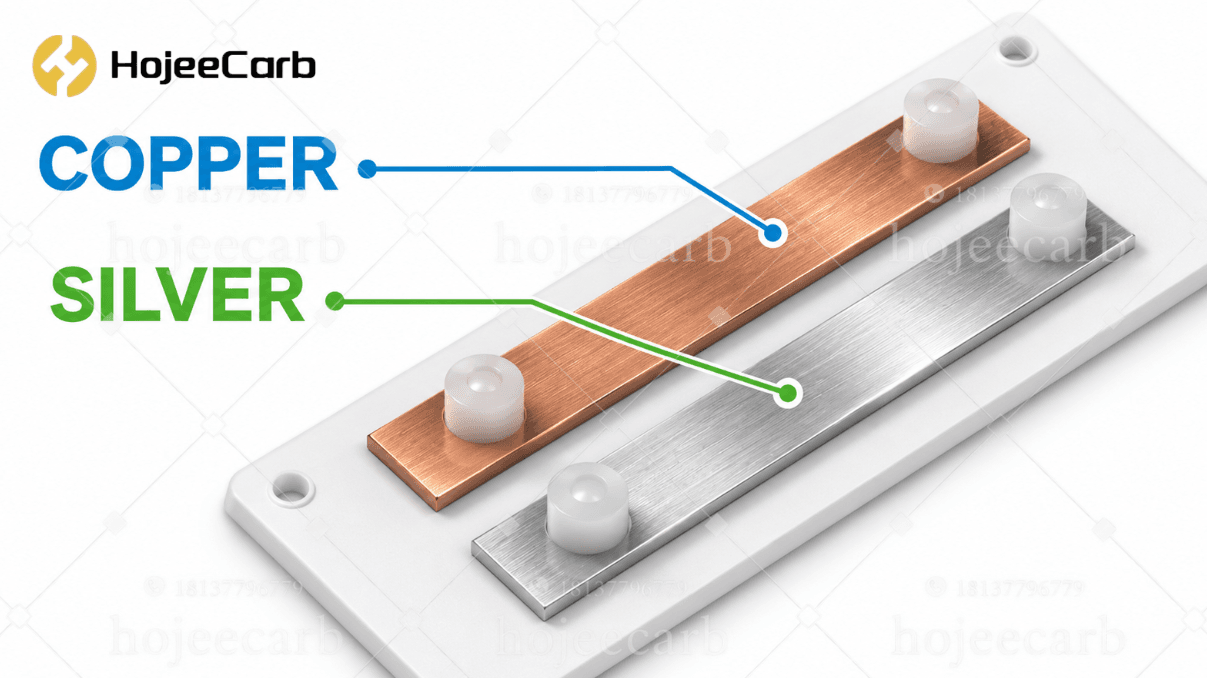
Copper and silver coupons are the standard tool for classifying an environment under ANSI/ISA-71.04 — the film that grows on them maps to a G1–GX severity level
This is the method behind ANSI/ISA-71.04, “Environmental Conditions for Process Measurement and Control Systems: Airborne Contaminants.” It classifies an environment by how fast copper and silver coupons corrode, and sorts the result into severity levels G1 through GX (ISA71 committee).
Procedure: hang certified copper and silver coupons at representative points in the white space — near the supply air stream and near equipment exhaust — for a 30-day exposure, then send them to an accredited laboratory. The result comes back as a corrosion film thickness in angstroms per month, which maps to a severity level.
| ISA 71.04 level | Interpretation | Design implication |
|---|---|---|
| G1 — Mild | Corrosion not a factor in equipment reliability | The target. Hardware vendors commonly write G1 into environmental warranty conditions |
| G2 — Moderate | Corrosion measurable and may become a reliability factor | Action trigger. A carbon stage belongs in the design |
| G3 — Harsh | High probability of corrosive attack | Filtration required; review intake position too |
| GX — Severe | Corrosion expected to be severe | Redesign intake and filtration together |
Exact angstrom thresholds for each level are defined in the standard itself; cite the measured value from your laboratory report rather than a number from an article, and ask the lab to state the level against the current edition of ISA-71.04.
G2 is the action trigger. At G1 with no nearby sources identified, chemical filtration may not be justified. At G2 or above it is.
Add a gas survey when a source is suspected
Coupons give you severity; they do not tell you which gas caused it. A gas survey does. For data center duty you need ppb-range detection — electrochemical cells or photoionisation instruments, depending on the target. Include H₂S, SO₂, NO₂, Cl₂ and total VOC as a baseline. Sample at the outdoor intake and inside the white space on the same day, so you can separate what comes in with the air from what is generated inside.
Write the target into the specification
G1 is the normal hardware-warranty target. Put it in the air-handling specification before anything is designed, and make the post-commissioning coupon result the acceptance criterion — not a supplier datasheet, not an estimated service life.
Why gas corrosion is a reliability problem, not a cosmetic one
Airborne molecular contamination (AMC) is the collective term for gas-phase pollutants that pass straight through a particulate filter. A MERV 13 or ePM1 filter stops dust; an H₂S molecule passes through it unimpeded. That is the entire reason a separate carbon stage exists.
Two changes made modern electronics more vulnerable than boards of twenty years ago. Lead-free (RoHS) solder and thinner board geometries left more exposed copper and silver surface. Component spacing shrank, so a corrosion product needs to bridge only a very short gap to create a fault.
Creep corrosion is the migration of a corrosion product — typically silver sulfide or copper sulfide — across a board surface until it bridges two conductors and creates an unintended electrical path. It produces intermittent faults that are difficult to trace back to air quality, which is what makes gas contamination a hardware-availability issue.
Among the gases commonly measured in data center air, H₂S is the one most often implicated in creep corrosion failures, because it reacts readily with both copper and silver and its reaction products are conductive. SO₂ acts differently: it converts to sulfurous and sulfuric acid in the presence of humidity and attacks copper traces. Which gas dominates at your site is a question for your coupon and survey data, not a general rule.
Need activated carbon?
Get Factory-Direct Pricing — No Middlemen
20+ years manufacturing. MOQ 1 ton. Free samples. Reply within 2 hours.
Step 2: Which configuration suits my cooling architecture?
Configuration A — Air-side economizer, air-cooled white space
The highest-exposure case, and the one that most often justifies a carbon stage.
Treat the outdoor-air / make-up air stream before it reaches the AHU. The carbon bed sits downstream of a particulate pre-filter (typically MERV 8–13) and upstream of the final filter (ePM1), so only the air actually drawn from outside is treated. This is the most economical position because the make-up volume is smaller than the full recirculation stream.
Carbon fines generated in the bed must not reach the room, which is why the final particulate filter goes downstream of the carbon, not upstream.
Media: in industrial or mixed urban air with H₂S or SO₂ confirmed, use a layered bed — virgin columnar carbon upstream to take the VOC load, KOH-impregnated columnar carbon downstream for the acid gases. Specify bed depth and face velocity as a pair, because that pair sets residence time; a deep bed at high velocity performs no better than a shallow one. If the AHU cross-section cannot hold the depth your residence-time target requires at design flow, add bed area with a V-bank rather than accepting a thinner panel.
In clean suburban or rural air with no identified H₂S source and a G1 coupon result, virgin carbon for odour and VOC duty may be all that is warranted — or no carbon stage at all.
Configuration B — Liquid-cooled racks with residual air cooling
Exposure is reduced, not eliminated. Liquid cooling carries the GPU and CPU thermal load; air still moves through the room for infrastructure equipment, occupants and residual heat. Make-up air volume is lower, which reduces both the duty and the cost.
Treat the make-up/outdoor-air stream as in Configuration A but at lower face area, since airflow is lower. Where liquid cooling carries most of the rack heat, a single carbon stage on the AHU is often sufficient and a separate recirculation unit is not needed.
One adjacent issue worth naming: in DLC facilities, any point where chilled water lines pass through unconditioned space can accumulate surface condensation that accelerates localised corrosion. That is a mechanical hygiene problem and carbon filtration does not address it.
Configuration C — Sealed/recirculating cooling, no economizer
Lowest exposure. No outdoor air enters by design, so chemical filtration is driven only by:
- Infiltration through loading docks, cable penetrations, or loss of positive pressurisation
- Internal sources: battery off-gassing, cleaning chemicals, generator test exhaust re-entrained at an intake
If coupons confirm G1 and no local source is identified, no carbon stage is required and installing one is money spent without a measurable return. If infiltration is suspected, fix the building envelope and pressurisation first. Positive pressurisation of the white space against adjacent spaces costs nothing in media and is routinely overlooked. A carbon recirculation unit inside the white space is a second-line measure for pulling a measured G2 room down to G1 without reworking the central plant — not a substitute for a sealed building.
Step 3: Virgin or impregnated carbon?
The two mechanisms
Physical adsorption (physisorption): molecules are held on the pore wall by van der Waals forces. Effective on larger, heavier, less volatile molecules — most VOCs and organic odours. It is reversible, which is the catch: rising temperature or a falling inlet concentration can drive adsorbed molecules back off the carbon.
Chemisorption: the pollutant reacts with an impregnant deposited on the carbon surface, producing a stable salt that stays put. This is the mechanism needed for small, light, acidic gases — H₂S, SO₂, HCl — which virgin carbon holds only weakly.
For data centers the gases of concern are mostly the ones virgin carbon handles worst. That is why media selection for this application is largely a discussion about impregnation.
Side-by-side
| Virgin columnar carbon | KOH/NaOH-impregnated columnar carbon | |
|---|---|---|
| Mechanism | Physical adsorption | Chemisorption |
| Target gases | VOCs, solvents, organic odours | H₂S, SO₂, HCl and other acid gases |
| Desorption risk | Yes — reversible with heat or falling inlet concentration | No — pollutant converted to a stable salt |
| H₂S capacity | Low | Substantially higher; quantify per ASTM D6646 |
| End of life | Saturation | Chemically consumed — weight and appearance do not indicate exhaustion |
| Regeneration | Possible in some industrial settings | Not practical; replace at breakthrough |
| Relative cost | Lower | Higher |
Choose virgin carbon when the measured problem is organic: solvent vapour from a nearby process, construction off-gassing, fuel-storage odour. Also the right choice when you have no measurement yet and the site is in clean air — do not buy impregnated media for a problem you have not confirmed.
Choose impregnated carbon when coupons or a gas survey put H₂S, SO₂ or HCl on the list. Caustic impregnation converts the acid gas to a sulfide or sulfite salt on contact, so capacity does not leak back out when the plenum warms up.
Most real data center beds end up layered, because real outdoor air contains both organic and acidic contaminants.
Hojee columnar grades for this duty
The base carbon is HojeeVapor BP60, a coal-based extruded columnar carbon from anthracite/bituminous coal. The air-handling rationale for the columnar shape is covered in our pelletized activated carbon for air treatment guide.
| Parameter | Virgin columnar (BP60) | KOH/NaOH-impregnated columnar |
|---|---|---|
| Base material | Anthracite/bituminous coal | Same coal-pellet base |
| Diameter | Φ1.5 / 2.0 / 3.0 / 4.0 mm | Φ1.5 / 2.0 / 3.0 / 4.0 mm |
| Iodine number | 400–1,000 mg/g | 400–900 mg/g |
| Impregnant | None | KOH / NaOH, 5–20% by weight |
| H₂S capacity (published) | — | 0.15–0.30 g H₂S / cm³ carbon |
| pH | — | 9–12 |
| Hardness | > 95% | > 90% |
| Bulk density | 0.35–0.55 g/cm³ | 0.40–0.60 g/cm³ |
The impregnated grade is available in several chemistries; the selection logic is broken down in the impregnated activated carbon guide, and the sulfide case specifically under H₂S removal.
A note on H₂S capacity units. H₂S capacity is quoted in two different ways and they are not interchangeable. ASTM D6646 reports capacity per unit volume of carbon — grams of H₂S per cm³ of carbon — because the test measures a packed bed. Some datasheets quote per unit mass (g H₂S per g carbon). To convert between them you need the bulk density. Always confirm which basis a figure uses before comparing two products, and ask for the D6646 result in its native g/cm³ form.
Does D6646 apply to 3 mm columnar carbon?
Not directly, and this matters for how you read a test report. ASTM D6646 as written applies only to carbons with a mean particle diameter below 2.5 mm. A 3 mm pellet is above that limit. The standard's paragraph 5.3 explains how to test larger pellets anyway: use a larger-diameter column (column-ID-to-particle-diameter ratio above 10 to avoid wall effects) while holding the standard's superficial velocity and contact time. Data obtained this way can be reported but falls outside the standard's strict scope.
Practical consequence: if your design uses 3 mm or 4 mm pellets, ask the supplier whether the D6646 figure was generated on the actual pellet size in a correctly scaled column, or on a smaller grade. For pressure-drop-sensitive make-up air duty you often want the larger pellet, so the test basis needs to match the product you will install.
Step 4: How much carbon do I need? A worked example
Gas-phase filter media sizing starts with arithmetic: media volume follows directly from face area and bed depth. The harder questions are residence time and service life. Work through it in this order.
The six inputs
- Contaminant identity — from your gas survey. You cannot pick an impregnant without it.
- Concentration — data center inlet levels are in the ppb range, not the ppm range of an industrial scrubber. At ppb, first-pass capture efficiency matters more than raw bed capacity.
- Temperature and humidity — physisorption weakens as temperature rises; caustic chemisorption needs some moisture because the reaction runs in the adsorbed water film, while very humid air lets water compete for pore space. State your design conditions and ask for test data near them.
- Airflow — treating make-up air only is a far smaller duty than full recirculation. Decide which before sizing.
- Residence time = bed depth ÷ face velocity. Too short and the bed under-performs regardless of its capacity.
- Pressure drop — every pascal of ΔP is fan energy for the life of the install, a real PUE cost. Ask for a ΔP-versus-face-velocity curve, not a single number.
Worked example: sizing the bed volume and media mass
Design conditions (illustrative — substitute your own):
- Make-up airflow: 10,000 m³/h
- Target face velocity: 0.5 m/s (a common upper bound for adequate residence time)
- Chosen bed depth: 0.3 m (deep-bed V-cell)
- Media bulk density: 0.50 g/cm³ = 500 kg/m³
Step A — required face area. Convert airflow to m³/s: 10,000 ÷ 3,600 = 2.78 m³/s. Face area = volumetric flow ÷ face velocity = 2.78 ÷ 0.5 = 5.56 m².
Step B — residence time check. Residence time = bed depth ÷ face velocity = 0.3 ÷ 0.5 = 0.6 s. Whether 0.6 s is adequate depends on the target gas and concentration; confirm against D5160 dynamic-capacity data for the specific carbon. If it is short, either deepen the bed or lower the face velocity (which raises face area).
Step C — media volume. Bed volume = face area × bed depth = 5.56 × 0.3 = 1.67 m³.
Step D — media mass. Mass = volume × bulk density = 1.67 × 500 = 835 kg of carbon for the stage.
Step E — what this does not tell you. Steps A–D size the bed. They do not give you service life. Service life depends on inlet concentration, airflow, bed mass and the carbon's working capacity at your actual (ppb-level) conditions — which is a separate calculation that needs real breakthrough data, discussed next.
This worked example is a method, not a recommendation for your site. Send your real airflow, target gases and concentrations, humidity, available depth and ΔP ceiling, and the sizing can be done against test data for the specific grade.
Why you cannot read service life off an accelerated test
ASTM D6646 is an accelerated test. It challenges the bed with 1% (10,000 ppm) H₂S and runs to 50 ppm breakthrough — conditions chosen to rank carbons quickly, not to mimic a data center. Real data center inlet H₂S is in the single-digit-to-tens-of-ppb range, three to four orders of magnitude lower.
You therefore cannot divide a D6646 capacity by a ppb inlet rate and call the answer “service life.” The accelerated test drives a large temperature rise in the bed and favours fast kinetics in ways that do not represent low-concentration service. The standard itself states the figure is for comparing carbons under its defined laboratory conditions.
What D6646 is good for: comparing two candidate carbons on the same basis, and confirming a delivered batch matches the grade you specified. For an actual service-life estimate at your concentrations, you need either dynamic-capacity data generated near your real conditions (closer to the D5160 approach, where the user sets the adsorbate and conditions) or an empirical figure from monitoring an installed bed. Treat any service-life number offered without your site concentrations as a guess.
Step 5: How do I verify it works? Three distinct tests
These three are often conflated. They answer different questions and happen at different points in the project.
1. Laboratory breakthrough testing (before purchase). Done on the media, in a lab, before you buy. It ranks carbons and confirms a batch. Reference ASTM D6646 for H₂S capacity and ASTM D5160 for user-defined dynamic adsorption capacity and critical bed depth. Ask for the conditions on the report: inlet concentration and carrier gas, relative humidity, temperature, bed depth, face velocity, breakthrough threshold, and — for pellets above 2.5 mm — the column scaling used. This proves the media's potential.
2. On-site copper/silver coupon testing (after commissioning). The same ISA-71.04 method you used to size the problem, repeated after the filtration is running. It measures the outcome in the actual room: did the installed system bring the white space to G1? This is the end-to-end acceptance test and the only one that reflects your real air, your real bed, and your real infiltration. Re-run it periodically and after any change to intake, nearby construction, or economizer strategy.
3. Outlet gas monitoring (continuous or periodic). Real-time or spot measurement of target gas downstream of the carbon. It tells you when the bed is approaching breakthrough so you can schedule replacement on evidence rather than a calendar. Most useful on high-risk (G3/GX) sites or where an unplanned failure is expensive.
| Test | When | What it proves | Standard |
|---|---|---|---|
| Lab breakthrough | Before purchase | Media capacity and batch conformance | ASTM D6646 / D5160 |
| Coupon re-test | After commissioning, then periodically | The room actually reaches G1 | ANSI/ISA-71.04 |
| Outlet monitoring | Ongoing | Approaching breakthrough; replacement timing | Site instrumentation |
A replacement trigger should be defined against test 2 or 3 — not a fixed date and not the bed's weight, because caustic-impregnated carbon is chemically consumed and looks much the same whether fresh or spent.
Standards referenced in this guide
Naming these in a purchase specification is the cheapest quality control available. Cite the current edition and let the supplier confirm the version used.
- ASTM D6646 — Standard Test Method for Determination of the Accelerated Hydrogen Sulfide Breakthrough Capacity of Granular and Pelletized Activated Carbon. Current edition D6646-03(2022). Applies to mean particle diameters below 2.5 mm unless the larger-column procedure in §5.3 is used. (standard)
- ASTM D5160 — Standard Guide for Gas-Phase Adsorption Testing of Activated Carbon. User sets the adsorbate and operating conditions; yields dynamic capacity and critical bed depth. Current edition D5160-95(2025). (standard)
- ANSI/ISA-71.04 — Environmental Conditions for Process Measurement and Control Systems: Airborne Contaminants. Defines the G1–GX severity classification. (committee)
- ISO 10121-2:2013 — Test methods for assessing gas-phase air-cleaning devices for general ventilation (device-level, assembled module). (standard)
Supporting references:
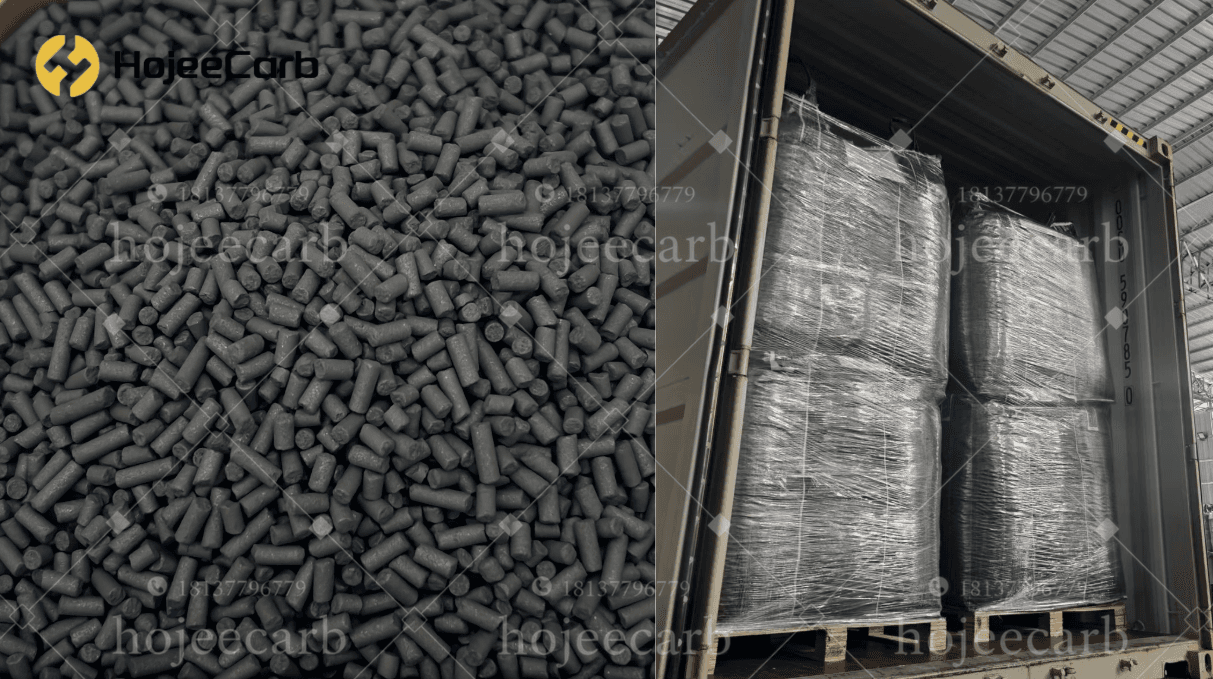
Extruded columnar activated carbon in bulk, loaded for container shipment — the media supplied against a batch certificate of analysis
Get a media recommendation
To size and specify carbon for a data center, Hojee works from your measured data rather than a product code. Send:
- Target gases (H₂S, SO₂, VOC, other — from your gas survey)
- Concentrations (ppb/ppm, measured or best estimate)
- Design airflow (m³/h or CFM; make-up vs recirculation)
- Relative humidity and temperature at the filter face
- Available bed depth (mm) and duct/AHU cross-section
- Pressure-drop ceiling (Pa)
We return a media recommendation (virgin, impregnated, or layered), a sizing calculation against that data, and the matching breakthrough test basis with batch COA. If you are still at the measurement stage, say so — we would rather point you to a coupon-test protocol first than sell you impregnated carbon for a problem that turns out to be organic, or none at all.
Submit your parameters for a recommendation →FAQ
How do I know if I even have a gas problem?
Run a 30-day ANSI/ISA-71.04 copper/silver coupon test in the white space. It is the only reliable way to quantify the risk for your specific building and intake. Regional air-quality data can flag whether H₂S or SO₂ is elevated nearby, but it does not measure what reaches your hardware.
Is gas-phase filtration always necessary for an AI data center?
No. It is necessary when your cooling design brings in outdoor air and measurement shows G2 or worse. A sealed, recirculating, or fully liquid-cooled facility in clean air may measure G1 and need no carbon stage. Architecture plus measurement decides it, not rack density.
Virgin or impregnated carbon?
Virgin carbon for VOCs and organic odours. KOH/NaOH-impregnated carbon when H₂S, SO₂ or HCl are measured, because virgin carbon holds those weakly and can release them as temperature rises. Most data center beds are layered to cover both.
What particle size should I specify?
Extruded columnar (pelletized) carbon for air-handling duty, because uniform cylinders give predictable, lower pressure drop than irregular granules. Note that ASTM D6646 strictly covers pellets below 2.5 mm; if you specify 3 mm or 4 mm for lower ΔP, confirm the breakthrough data was generated on that pellet size in a correctly scaled column. Give the supplier bed depth, face velocity and ΔP ceiling and let them work back the diameter.
How much carbon do I need?
Face area = airflow ÷ face velocity; media volume = face area × bed depth; media mass = volume × bulk density. The harder number — service life — needs breakthrough data at your real conditions, not an accelerated-test figure.
How long will the carbon last?
It depends on inlet concentration, airflow, bed mass and the carbon's working capacity at your conditions, so the same media can last very different lengths of time at two sites. Because data center concentrations are far below accelerated-test levels, published test numbers do not translate to a service interval. Determine replacement by coupon re-test or outlet monitoring.
Does gas-phase filtration replace particulate filtration?
No — they are independent problems. Particulate filters do not remove gases; carbon does not remove dust. The carbon stage sits between a particulate pre-filter and a final particulate filter.
How do I verify what I received matches what I ordered?
Ask for a batch certificate of analysis with the test methods named, and breakthrough data on the specific grade near your conditions — not a generic datasheet. For H₂S, reference ASTM D6646 explicitly and confirm the units (g/cm³ vs g/g) and the pellet size tested.
Reviewed for technical accuracy by the Hojee applications engineering team. Hojee manufactures coal-based and coconut-shell activated carbon — virgin and impregnated columnar, granular and powdered grades — with per-batch COA and third-party (SGS/BV) testing, ISO 9001 certified. For corrections or technical questions on this article, contact the applications team via the link above.