
Case Study
Why Activated Carbon Turns Filtered Water Yellow — and How We Fixed It for a Turkish Customer
A water filter manufacturer in Turkey came to us after his previous supplier's coal-based GAC kept turning the filtered water yellow. Most suppliers blame iron and ash — and stop there. We ran the trials, found the real cause, and changed the production process. He now buys 3 × 40HQ per month, CIF Mersin.
Quick Answer
Activated carbon turns filtered water yellow for three commonly known reasons — high iron content, high ash content, and dust — plus a fourth that most suppliers miss: coal gas and coal tar residues left in the raw coal during carbonisation. Screening better coal and de-dusting improves the problem but does not eliminate it. HojeeCarb solved it by changing the production process: extracting coal gas and coal tar before carbonisation, then spraying with clean tap water afterwards. The same change lowered bulk density, so the customer fills the same filter with less carbon by weight. That Turkish customer now buys 3 × 40HQ per month on a 15-day cycle, shipped CIF from Tianjin to Mersin.
Order Summary
| Product | Coal-based granular activated carbon, water treatment filter grade |
| Application | Water treatment filters — colour, odour and organics removal |
| Container load | 28 tons per 40HQ |
| Current volume | 3 × 40HQ per month |
| Production cycle | One batch every 15 days |
| Loading port | Tianjin, China |
| Destination | Mersin, Turkey (transit 12–18 days) |
| Terms | CIF Mersin, freight arranged by Hojee |
1. The Problem: What the Customer Told Us
A water filter manufacturer in Turkey had been sourcing coal-based granular activated carbon from another supplier. He came to us with three complaints that were costing him money at every stage.
Bulk density was too high. A filter vessel is sized by volume, not by weight. When the carbon packs heavier per litre, filling the same vessel takes more tons. He was paying for extra tonnage on every changeout without gaining any treatment capacity. In Turkey's competitive water filter market, that margin leakage adds up fast across dozens of filter builds per month.
The filtered water came out yellow and black, with a bad odour. For a manufacturer whose product is the filter, yellow outlet water is a commercial failure. It comes back to him. His end customers blame the filter, and he cannot argue otherwise when the media is the problem.
Quality was unstable. One batch ran clean, the next did not. Unstable quality means a buyer cannot standardise a changeout interval, cannot plan inventory, and cannot trust any single COA to represent the next container.
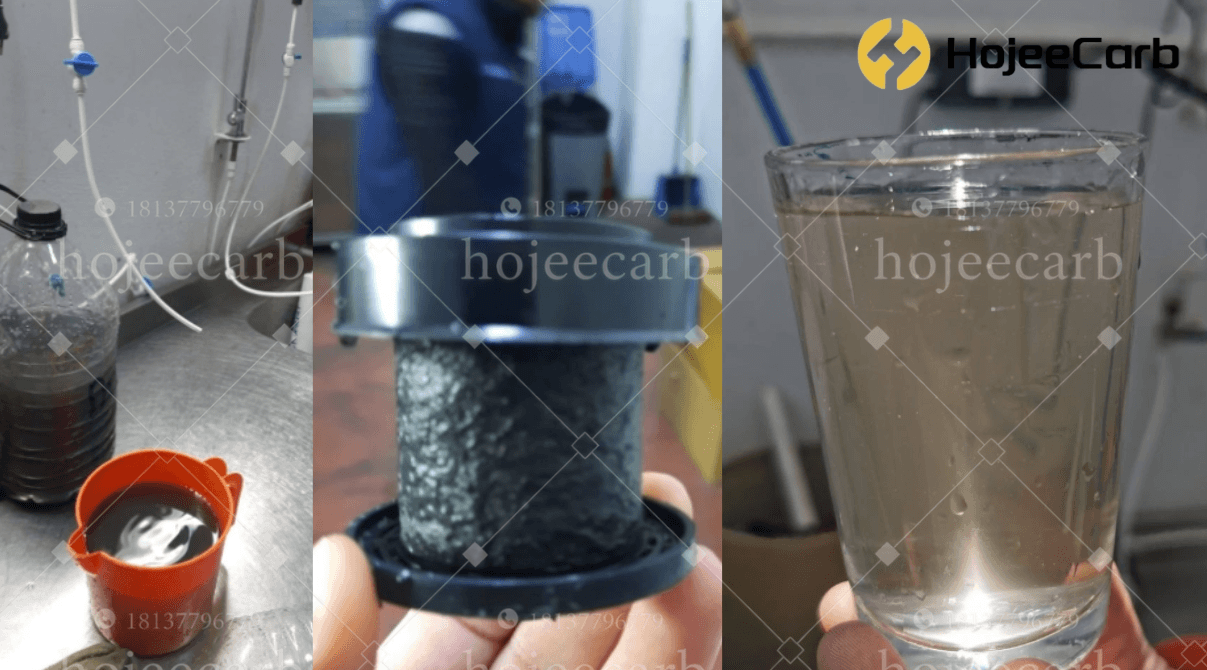
Coal tar residue (left), coal-based GAC filter cartridge (centre), clean outlet water after the process change (right)
2. The Analysis: Why Activated Carbon Turns Water Yellow
Ask around the industry and you get the standard answer: iron content too high, ash content too high. That is correct as far as it goes — iron compounds in raw coal carry through activation and leach into the water, causing a yellow-brown tint. High ash means more soluble inorganics available to bleed out. According to the WHO Guidelines for Drinking-water Quality, iron concentrations above 0.3 mg/L are noticeable in taste and colour — a standard any water treatment carbon needs to stay well below.
Fines and dust make the first hours after a changeout look dirty even when the carbon itself is sound. So on the first shipment to this Turkish customer we controlled three things:
- Raw coal screening — selecting low-ash, low-sulphur, low-volatile-matter coal instead of taking whatever was cheapest that month.
- Iron reduction — bringing iron content down through raw material selection and process control. For applications where even tighter iron limits are needed, acid washed activated carbon is the right grade.
- Dust removal — de-dusting the finished carbon so fines were not washing into the water on start-up.
The First Container Was Better, But Not Right
Those three controls were not enough. On the first container the customer reported an improvement, but the water still yellowed. The average had moved; the consistency had not. For a manufacturer running filter builds every day, intermittent yellow water is still a failed product. We kept the conversation open rather than closing the file, and in the process learned how large his ongoing demand was — at that volume, the case for going back into the production process itself rather than just tightening incoming inspection is straightforward.
3. The Solution: Changing the Production Process, Not Just the Spec
Hojee took the problem into the lab and ran repeated trials. The conclusion: for coal-based granular activated carbon going into water treatment filters, iron, ash and dust are only part of the story. The production process itself has to change.
The residues that cause the colour and the odour are coal gas and coal tar. Left in the raw coal through carbonisation, they carry into the pore structure and bleed out in service. No amount of downstream screening removes them reliably — which is exactly why the first container was still inconsistent.
What We Changed
- Extract the coal gas and coal tar from the raw coal first, before carbonisation, rather than trying to clean up afterwards.
- Spray with clean tap water after carbonisation, then continue through drying, activation, crushing and the remaining steps.
Need activated carbon?
Get Factory-Direct Pricing — No Middlemen
20+ years manufacturing. MOQ 1 ton. Free samples. Reply within 2 hours.
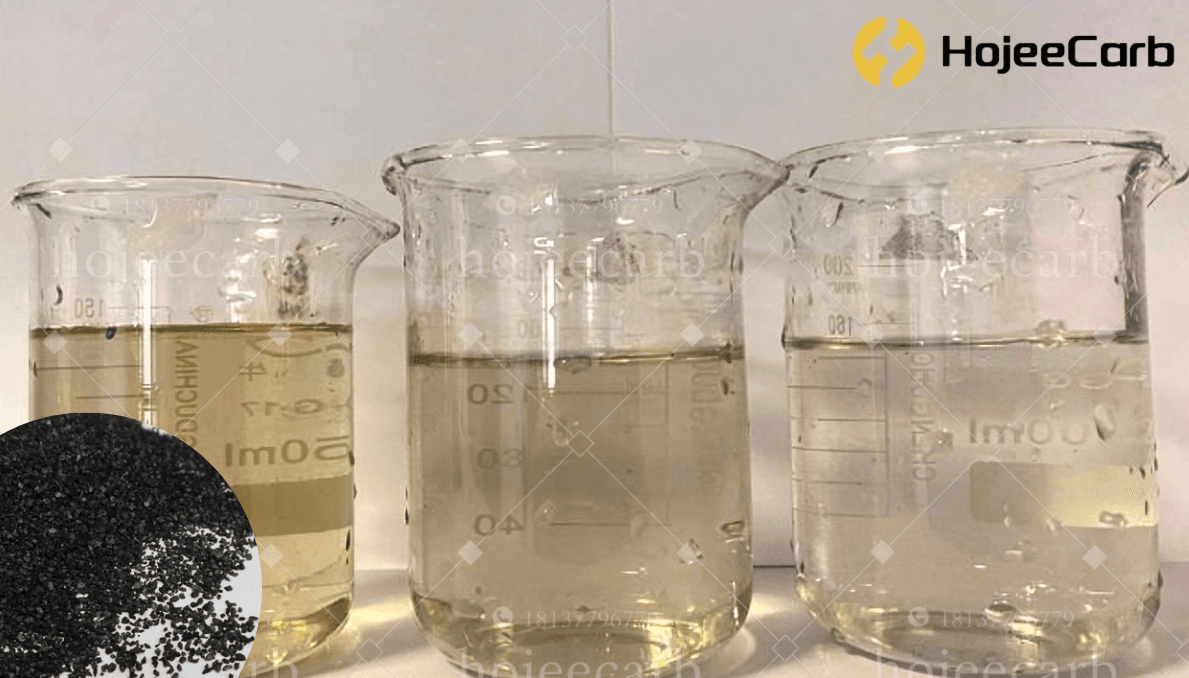
Jar test — yellow water from the previous carbon (left) vs. clean outlet water from HojeeCarb coal GAC after the process change (right)
4. The Result and Customer Feedback
| Problem | Before | After the process change |
|---|---|---|
| Bulk density | High — more tons to fill the same vessel | Lower — less carbon by weight per fill |
| Water colour | Yellow to black | No yellowing, no blackening |
| Odour | Bad odour in the outlet | Clean |
| Batch consistency | Unstable container to container | Stable, consistent |
One point worth making explicit: removing the tar and gas ahead of carbonisation leaves a cleaner, more open pore structure. That structure weighs less per unit volume and has nothing left in it to leach. Lower bulk density and clean water are the same result from the same cause — one process change, both problems fixed.
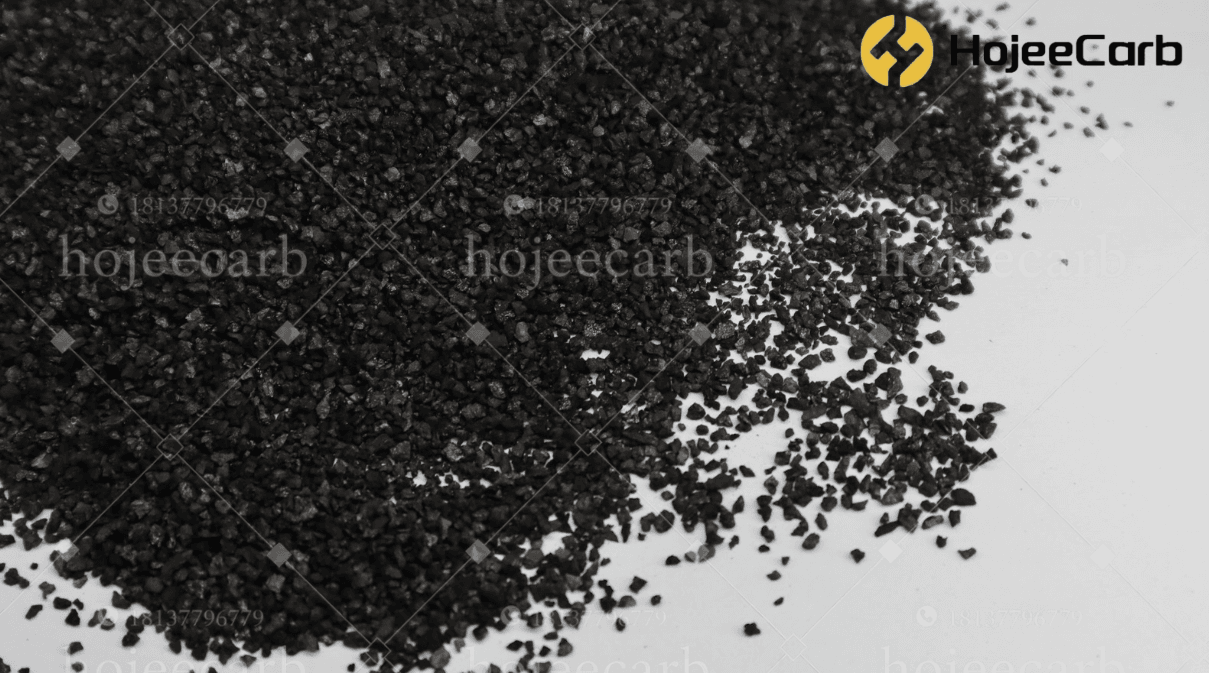
HojeeCarb coal-based GAC for water treatment filters — low bulk density, de-dusted, produced on a 15-day cycle
Three Months On: 3 × 40HQ per Month to Mersin
Three months of running the new carbon, and the Turkish customer is on repeat purchase. Current volume is 3 × 40HQ per month, produced at 15-day intervals, shipped CIF to Mersin so containers arrive on a predictable rhythm. A 40HQ holds 28 tons of this grade — at three containers per month that is 84 tons moving through Tianjin every 30 days, each batch with its own COA, each arriving at Mersin in 12–18 days. For how container loading, MOQ and payment terms work at this volume, see our bulk ordering guide.
“We would like to order 3 more containers. We request that production be carried out at 15-day intervals. Is it possible?”
HojeeCarb: No problem.
“Can you also arrange the freight so that it arrives on time? Can you give a CIF price?”
HojeeCarb: Yes — CIF Mersin, shipped immediately at 15-day intervals.
He asked for scheduled production rather than a bulk order, and CIF terms so arrival timing sits with us rather than him. Both requests are about removing uncertainty from his supply chain. For a similar large coal GAC shipment on a fixed programme, see the 78-ton coal GAC shipment to Myanmar for water treatment.
5. What to Ask a Supplier If Your Filtered Water Is Yellow
If your outlet water is discolouring or your carbon consumption per changeout looks too high, the useful questions for a supplier are not all on the datasheet. We cover the full selection process in our guide to activated carbon for industrial water treatment, but for yellow water specifically:
- Ask for bulk density in the quotation, not just iodine value. Filters are filled by volume but carbon is sold by weight. Bulk density decides how many tons that volume costs you.
- Ask about iron and ash, and ask to see the test. Low iron and low ash are the baseline for any water treatment grade.
- Ask how coal gas and coal tar are handled in production. This is the question that separates a producer from a trading desk. If they cannot answer it, they do not control the process.
- Ask whether the carbon is de-dusted. Fines make sound carbon look dirty on start-up and add to filter pressure drop early in the service cycle.
- Ask what holds quality from container to container, in writing. One good COA proves one batch. Ask what keeps the next twenty containers to the same standard.
Hojee supplies this grade as a standing programme: coal-based granular activated carbon for water treatment filters, low bulk density, low iron, de-dusted, produced on a fixed schedule with a COA per batch, CIF to your port from Tianjin. Send us your filter dimensions, flow rate, inlet water quality and target outlet spec — we will recommend a grade, send samples, and give you a real CIF number.
Yellow water from your carbon? Let's diagnose it.
Tell us your filter dimensions, flow rate and current carbon supplier. We will tell you honestly whether the problem is iron, ash, fines — or coal tar residues in the production process.
Frequently Asked Questions
Why does activated carbon turn filtered water yellow?
High iron content, high ash content and residual dust are the commonly cited causes. There is a fourth that most suppliers miss: coal gas and coal tar residues left in the raw coal during carbonisation. Those residues sit in the pore structure and bleed into the water in service. Fixing it requires extracting the gas and tar from the raw coal before carbonisation — screening the finished product afterwards is not enough.
Can better raw coal selection alone stop yellow water?
No. HojeeCarb controlled raw coal screening, iron content and dust on the first shipment to this Turkish customer, and the water still yellowed. Consistent results only came after changing the production process itself — specifically, extracting coal gas and coal tar before carbonisation.
Why does bulk density matter when buying activated carbon for filters?
Filters are sized by volume, but carbon is sold by weight. Higher bulk density means more tons to fill the same vessel, so cost per changeout rises with no gain in treatment capacity. Always ask for bulk density in the quotation alongside iodine value.
Why did lower bulk density and clear water arrive from the same fix?
They share a cause. Extracting coal gas and coal tar before carbonisation leaves a cleaner, more open pore structure — which weighs less per unit volume and has nothing left to leach into the water. One process change, two problems fixed.
How much coal-based activated carbon fits in a 40HQ container?
This Turkish customer loads 28 tons per 40HQ shipped to Mersin. Actual tonnage depends on bulk density and packaging — another reason to confirm bulk density before comparing prices per ton.
Can HojeeCarb produce on a fixed schedule instead of one large order?
Yes. This customer runs 3 × 40HQ per month produced at 15-day intervals, shipped CIF Mersin. Scheduled production keeps a buyer's cash flow and warehouse steady, and it only works if quality holds across every run.
What is the transit time from Tianjin to Mersin, Turkey?
Typically 12–18 days by sea from Tianjin to Mersin on the Mediterranean coast of Turkey. HojeeCarb arranges the freight on CIF terms so arrival timing sits with us.
What questions should I ask a supplier if my filtered water is turning yellow?
Ask for bulk density (not just iodine value), iron and ash test results, how coal gas and coal tar are handled in production, whether the carbon is de-dusted, and what process controls hold quality from container to container.