
Catalytic activated carbon is standard activated carbon whose surface has been modified through high-temperature gas-phase treatment to break down chloramines and H₂S by chemical reaction, not just physical adsorption. It looks identical to regular GAC, costs 40–80% more per ton, and solves a narrow but critical set of problems that standard carbon handles poorly. If your application is not chloramine or H₂S, you probably do not need catalytic carbon — regular granular activated carbon will outperform it dollar-for-dollar.
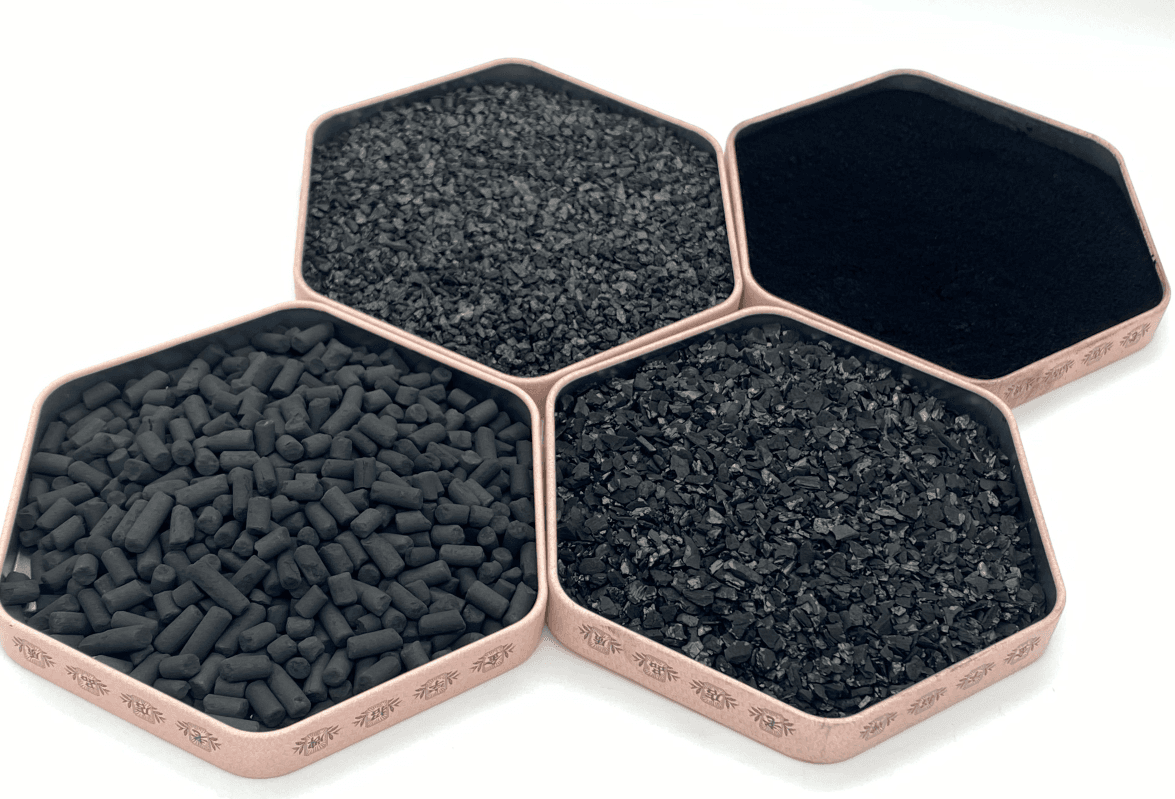
We manufacture catalytic activated carbon at our Ningxia facility using bituminous coal feedstock. The catalytic activation step runs in our dedicated rotary kiln at 850–1,000 °C under controlled atmosphere — the same kiln that produces our standard coal-based GAC, but with a modified gas recipe. Based on our 20+ years of production data, the difference between a good catalytic carbon and an average one comes down to process control during that final activation stage.
This guide covers what catalytic carbon is, how it works, what specs to look for, where it outperforms standard and impregnated carbon, and how to source it. For the comparison page focused on catalytic vs standard vs impregnated, see our catalytic carbon vs activated carbon comparison.
Key Specifications: What to Request
The single biggest mistake buyers make with catalytic carbon is evaluating it on iodine number alone. Iodine measures adsorption capacity, not catalytic activity. Here are the specs that actually matter:
| Specification | Target Value | Why It Matters | Test Method |
|---|---|---|---|
| H₂O₂ Decomposition | ≥50% in 60 min | Directly measures catalytic activity — the spec that defines catalytic carbon | In-house / Calgon method |
| Iodine Number | ≥900 mg/g | Adsorption capacity for organics and taste/odor | ASTM D4607 |
| BET Surface Area | ≥850 m²/g | Overall porosity indicator | ASTM D6556 |
| Abrasion Number | ≥85 | Mechanical durability — withstands backwash without excess fines | ASTM D3802 |
| Mesh Size | 8×30 or 12×40 | Must match vessel design — 12×40 for residential, 8×30 for municipal | ASTM D2862 |
| Moisture | ≤5% | Excess moisture = you're paying for water, not carbon | ASTM D2867 |
Our catalytic GAC (model HJ-CAT series) tests at 55–65% H₂O₂ decomposition, iodine 950–1,050, BET 900–1,050 m²/g. Every batch ships with a full COA. For detailed testing methodology, see our quality testing guide.
Need catalytic activated carbon?
Get Factory-Direct Pricing — No Middlemen
20+ years manufacturing. MOQ 1 ton. Free samples. Reply within 2 hours.
How Catalytic Carbon Works: The Chemistry
Standard activated carbon removes chloramines slowly by adsorption — catalytic carbon destroys them fast by chemical reaction at the carbon surface. The distinction is everything. At 2 mg/L combined chlorine (monochloramine), a standard GAC bed needs 20–30 minutes empty bed contact time (EBCT) to achieve even partial chloramine reduction. Catalytic carbon does the same in 2–5 minutes EBCT. The mechanism: the basic surface oxygen complexes on catalytic carbon act as electron donors, driving the decomposition of chloramines into chloride, nitrogen, and water.
For H₂S, the mechanism is catalytic oxidation. In the presence of dissolved oxygen (typical in aerated well water), catalytic carbon accelerates the oxidation of H₂S to elemental sulfur, which deposits in the pores. This works at lower dissolved oxygen levels than standard manganese dioxide media and does not require backwash chemicals. According to AWWA Technical Division data, catalytic carbon beds run at 5 min EBCT remove 90%+ of H₂S from well water at 0.5–3.0 mg/L influent with a typical 12–18 month run length before H₂S breakthrough.
One important nuance: the catalytic activity does not significantly improve chlorine (free chlorine) removal. Standard carbon removes free chlorine efficiently through both adsorption and chemical reduction. If your only concern is free chlorine taste/odor, standard coal or coconut shell GAC is the more economical choice.
Where Catalytic Carbon Is the Right Choice
Based on the problems we see buyers bring to us, catalytic carbon earns its premium in four specific scenarios:
- Chloramine-treated municipal water. Over 30% of US municipalities use chloramines (not free chlorine) as a secondary disinfectant. Standard GAC passes chloramines with minimal removal at practical EBCT values. Catalytic carbon solves this. Common in whole-house filters, POE systems, and small municipal plant polishing stages.
- H₂S in well water or groundwater. “Rotten egg” odor from dissolved hydrogen sulfide is a frequent complaint in areas with reducing groundwater conditions. Catalytic carbon in a vented or aerated contact vessel achieves effective H₂S removal without chemicals. Typical loading: 0.5–3.0 mg/L H₂S, 8×30 mesh, 5–7 min EBCT.
- Trihalomethane (THM) and HAA5 precursor control. When natural organic matter (NOM) reacts with chloramines, it produces haloacetic acids. Catalytic carbon removes both the chloramine and the NOM, attacking the precursor issue at its source. Relevant for utilities running high-NOM source water.
- Ozonation and advanced oxidation processes (AOP). Ozone generates hydroxyl radicals that can be quenched with a downstream GAC bed. Catalytic carbon decomposes residual ozone and hydrogen peroxide more rapidly than standard carbon, reducing the risk of oxidant breakthrough.
For industrial VOC removal, pharmaceutical decolorization, gold recovery, or food-grade applications — standard activated carbon is the correct product. Catalytic carbon's premium brings no benefit in those applications.
Catalytic vs Impregnated Carbon: The Key Difference
Buyers sometimes conflate catalytic and impregnated carbon. They are manufactured differently, have different performance profiles, and serve different markets.
| Factor | Catalytic Carbon | Impregnated Carbon |
|---|---|---|
| Modification method | High-temperature gas-phase (no additives) | Chemical loading (KI, KMnO₄, Ag, KOH, etc.) |
| Target contaminants | Chloramines, H₂S, ozone/H₂O₂ | Mercury, HCN, acid gases, H₂S (KOH), bacteria (Ag) |
| Leaching risk | None — no added chemicals | Possible — impregnant can desorb under adverse conditions |
| Drinking water compliance | NSF/ANSI 61 certifiable | Depends on impregnant — Ag grades can comply |
| Reactivation | Yes — catalytic activity largely restored | Difficult — chemical loading depleted, hard to restore |
| Cost premium over standard GAC | 40–80% | 80–300%+ depending on impregnant |
Sourcing Catalytic Carbon: What to Watch Out For
Catalytic carbon is one of the most spec-abused products in the activated carbon market. We regularly see suppliers selling standard bituminous GAC with a “catalytic” label and no H₂O₂ test data to back it up. Three things to do before placing an order:
- Ask for the H₂O₂ decomposition test result from the actual production batch. Not a generic spec sheet — the lot-specific COA. If a supplier cannot provide this, the product is almost certainly standard GAC.
- Confirm NSF/ANSI 61 compliance if used in drinking water. The certification must list the specific grade at the intended dose/contact conditions. A blanket “our factory is certified” does not meet this requirement.
- Request a free sample and run a chloramine or H₂O₂ bench test before committing to a container. A 50 kg sample costs almost nothing at the supplier level. The test takes one day. It eliminates all ambiguity.
For sourcing logistics, mesh size availability, and current factory-direct pricing, see our catalytic activated carbon product page. We supply 8×30 and 12×40 mesh grades in 25 kg bags, 1,000 kg super sacks, and 20-foot container bulk. MOQ 3 tons, sample available before order. For the full types overview, see our activated carbon types guide.
China is the dominant source of catalytic activated carbon globally (producing >70% of world supply). Quality ranges from excellent to non-existent. The factories that have invested in controlled-atmosphere kilns and rigorous H₂O₂ testing produce genuine catalytic carbon. Those running standard kilns with a different label do not. We have been manufacturing catalytic grades for 12+ years and welcome third-party verification of every batch.
Frequently Asked Questions
What is catalytic activated carbon?
Catalytic activated carbon is standard activated carbon whose surface chemistry has been altered through a high-temperature gas-phase treatment (typically 800–1,000 °C in nitrogen or steam with controlled oxygen exposure). This process increases the density of basic surface functional groups, giving the carbon the ability to catalyze chemical reactions — primarily the decomposition of chloramines and the oxidation of hydrogen sulfide (H₂S) — rather than relying solely on physical adsorption.
How is catalytic carbon different from impregnated carbon?
Catalytic carbon is modified by altering the carbon surface itself — no chemicals are added. Impregnated carbon has chemicals (KOH, KI, KMnO₄, silver, etc.) physically deposited onto the surface. Catalytic carbon does not leach additives, maintains consistent performance over its service life, and is preferred for drinking water where regulatory compliance (NSF/ANSI 61) is required. Impregnated carbon excels at specific gas-phase targets (mercury, acid gases) but has a finite chemical loading that depletes independently of adsorption capacity.
What specifications should I request when buying catalytic carbon?
Request these five specs: (1) H₂O₂ decomposition rate — the definitive measure of catalytic activity; (2) iodine number (≥900 mg/g); (3) BET surface area (≥850 m²/g); (4) abrasion/hardness number (≥85 for longevity); (5) mesh size distribution matching your vessel. Iodine number alone does not predict catalytic performance — always ask for the H₂O₂ test result.
Can catalytic carbon remove PFAS?
Catalytic carbon removes PFAS through the same adsorption mechanism as standard GAC — the catalytic modification does not significantly improve PFAS uptake. For PFAS-specific applications, select carbon based on iodine number, BET surface area, and pore-size distribution rather than catalytic activity. Standard bituminous coal GAC with iodine ≥1,000 is typically more cost-effective for PFAS than catalytic grades.
How long does catalytic carbon last?
Service life depends on the application. For chloramine removal in municipal water (1–2 mg/L combined chlorine), catalytic carbon typically lasts 3–5 years in a properly sized vessel with 5+ minutes EBCT. For H₂S removal in well water, life varies with H₂S concentration and pH — 1–3 years is common for residential systems. Catalytic carbon can be thermally reactivated, restoring both adsorption capacity and catalytic activity.
Related Resources
Catalytic Activated Carbon
HJ-CAT grades, mesh sizes, H₂O₂ spec, MOQ
Comparison →Catalytic vs Standard vs Impregnated
Three-way performance comparison
Application →Air Purification with Activated Carbon
VOC, odor, and gas-phase applications
Get Started →Request a Quote
Free sample + H₂O₂ test data with every inquiry