
Anthracite filter media is one of the most widely used materials in water treatment filtration, yet it's often overshadowed by activated carbon in purchasing conversations. If you're designing or sourcing for a multi-media filter system, understanding how anthracite performs — and what specifications actually matter — will save you from costly under-performance or over-specification.
This guide covers the complete picture: what anthracite is, why it works in water filtration, the specifications that matter (AWWA B100, effective size, uniformity coefficient), multi-media filter design principles, and how to evaluate suppliers. We supply anthracite filter media alongside activated carbon to water treatment plants across Southeast Asia, the Middle East, and Africa.
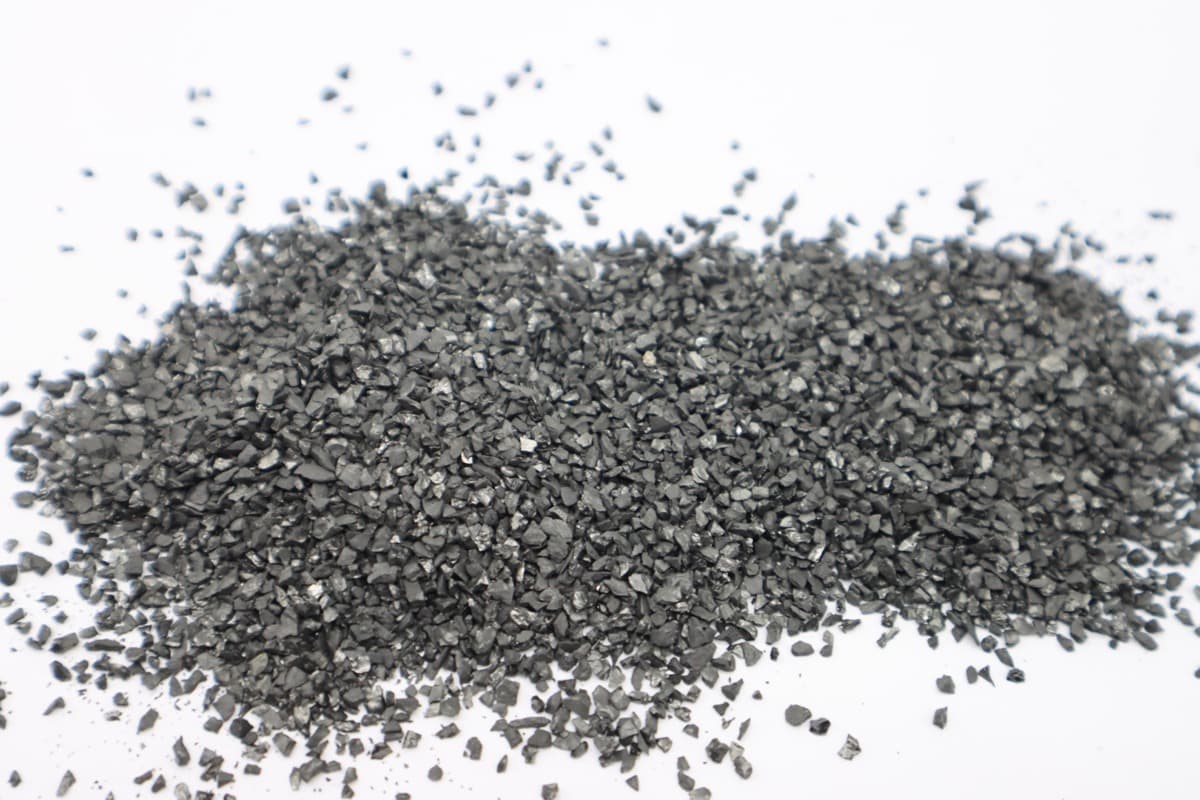
What Is Anthracite Filter Media?
Anthracite coal is the hardest, densest form of coal — with a carbon content of 86–98% and very low volatile matter. When processed into filter media, anthracite is crushed and sized to specific particle ranges, then cleaned to remove fines and surface impurities. The result is an angular, durable granule with a specific gravity of approximately 1.4–1.7 g/cm³.
What makes anthracite valuable as filter media is a combination of three properties: its angularity creates pore spaces between particles that trap suspended solids effectively; its low specific gravity (compared to silica sand at ~2.65 g/cm³) allows it to remain stratified above sand after backwashing; and its hardness means it resists attrition and lasts for years in service.
Key Distinction
Anthracite filter media works by mechanical filtration — physically trapping suspended particles. It does not adsorb dissolved contaminants. For dissolved organics, taste, odor, chlorine, or PFAS removal, you need activated carbon. The two media are complementary, not interchangeable.
Why Use Anthracite in Multi-Media Filtration?
In a conventional single-media sand filter, backwashing stratifies the bed from fine particles at the top to coarse at the bottom. This means filtration happens top-down through an increasingly fine bed — which sounds logical, but it means the finest sand at the top captures most of the solids, and the filter clogs quickly.
A dual-media filter (anthracite + sand) solves this by exploiting the density difference between the two materials. After backwashing, the lighter anthracite (SG ~1.5) settles above the heavier sand (SG ~2.65), creating a coarse-to-fine gradient in the direction of flow. Water passes first through the larger anthracite pores — capturing larger floc particles — then through the finer sand layer for polishing. This produces:
- Longer filter runs before backwashing is needed (typically 2–4× longer than sand alone)
- Lower effluent turbidity (target <0.1 NTU achievable with good coagulation)
- More uniform solid loading across the bed depth
- Higher allowable filtration rates (5–10 m/h vs 3–5 m/h for sand only)
Triple-media filters add a dense garnet layer below the sand, providing an even finer polishing step. These are used in high-purity applications such as pre-treatment for reverse osmosis systems or ultrafiltration.
Get Factory-Direct Pricing
Request a quote from our team — coal-based, coconut shell, or specialty activated carbon delivered worldwide.
AWWA B100 Specifications: What to Require from a Supplier
The American Water Works Association standard AWWA B100 is the most widely referenced specification for granular filter media, including anthracite. Even if your project doesn't explicitly require AWWA compliance, using B100 as a benchmark ensures you're sourcing a product that will perform reliably.
| Parameter | AWWA B100 Requirement | HojeeCarb AG Spec |
|---|---|---|
| Effective Size (d10) | 0.45 – 1.6 mm (per grade) | 0.8 – 2.0 mm (as specified) |
| Uniformity Coefficient | ≤ 1.75 | < 1.5 |
| Acid Solubility | ≤ 5% | < 1% |
| Specific Gravity | > 1.4 | > 1.5 |
| Hardness (Mohs) | > 2.7 | 3 – 4 |
| Carbon Content | ≥ 85% | > 80% |
The two most critical parameters are effective size and uniformity coefficient. Effective size (d10) is the sieve opening through which 10% of the media will pass — it controls the finest fraction that determines filtration efficiency. Uniformity coefficient is the ratio of d60 to d10; a lower UC means a narrower particle size distribution, which produces more predictable hydraulic behavior and avoids premature clogging from fine particles concentrated at the bed surface.
Selecting Particle Size for Your Application
Anthracite filter media is available in multiple particle size grades. The right choice depends on your filtration rate, raw water turbidity, and whether you're using single-media or multi-media configuration.
| Grade | Effective Size | Typical Application | Notes |
|---|---|---|---|
| Fine | 0.8 – 1.0 mm | Drinking water polishing, RO pre-treatment | Low turbidity raw water (<20 NTU) |
| Standard | 1.0 – 1.2 mm | Municipal water treatment, dual-media filters | Most common specification |
| Coarse | 1.2 – 1.6 mm | Industrial pre-treatment, high-flow systems | Higher turbidity (20–100 NTU) |
| Extra Coarse | 1.6 – 2.0 mm | Wastewater pre-treatment, high-solids | Turbidity >100 NTU applications |
For dual-media systems, the anthracite effective size should typically be 2–3× larger than the sand effective size. If your sand has an effective size of 0.45–0.5 mm, specify anthracite at 0.9–1.2 mm. This ratio ensures proper stratification after backwashing and maintains the coarse-to-fine gradient that makes dual-media filtration effective.
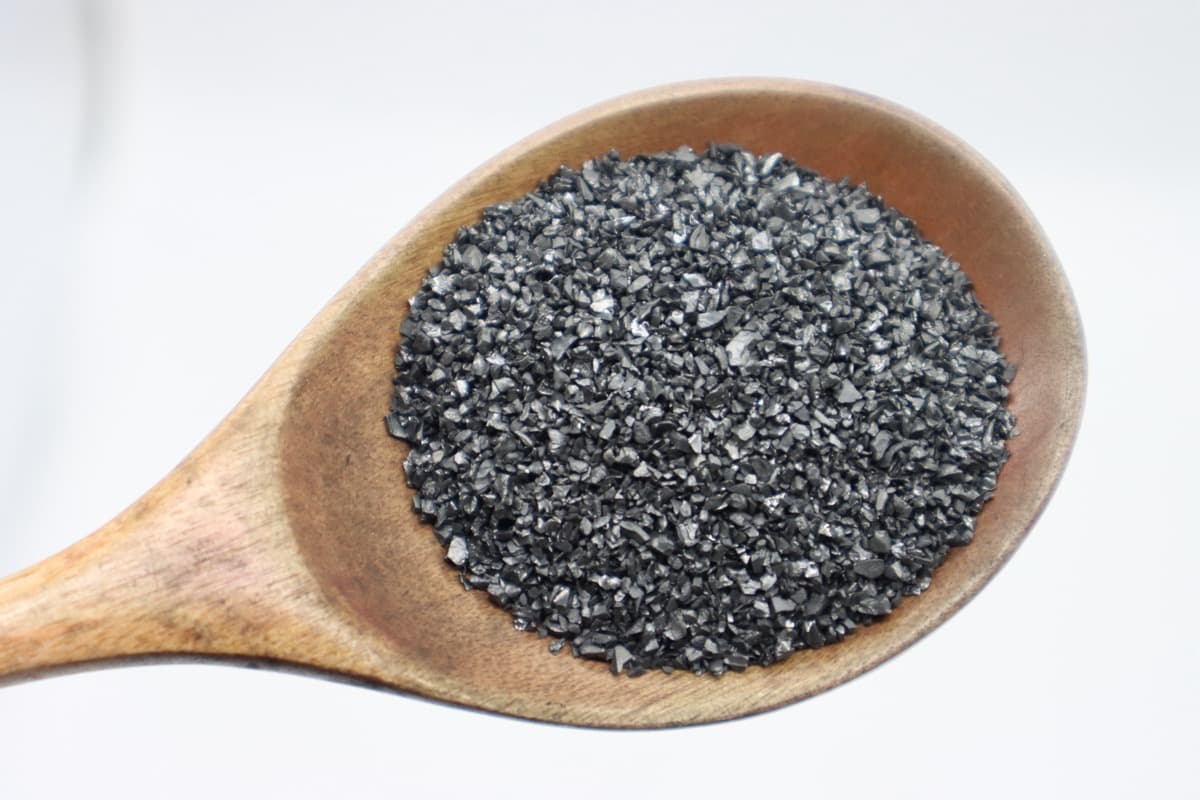
Anthracite vs Activated Carbon: Different Jobs, Often Used Together
Buyers new to water treatment filtration often ask whether to use anthracite or activated carbon. The answer is that they serve fundamentally different functions and are routinely used in sequence within the same treatment train.
| Property | Anthracite Filter Media | Granular Activated Carbon (GAC) |
|---|---|---|
| Primary function | Mechanical particle removal | Chemical adsorption |
| Removes | Suspended solids, turbidity, floc | Chlorine, VOCs, THMs, taste/odor, PFAS |
| Lifespan | 5–10+ years with proper backwashing | 1–5 years (depletes, needs replacement or reactivation) |
| Specific gravity | ~1.5 g/cm³ | ~0.45–0.55 g/cm³ (bulk) |
| Typical position in train | Before activated carbon (upstream) | After particle removal (downstream) |
| Cost per ton | Lower | Higher |
Placing an anthracite filter upstream of a GAC filter protects the activated carbon from fouling by particulates — extending the GAC service life significantly. This combination is standard in municipal drinking water treatment plants and industrial process water systems.
Get Factory-Direct Pricing
Request a quote from our team — coal-based, coconut shell, or specialty activated carbon delivered worldwide.
Backwashing: The Key to Long Anthracite Filter Life
Anthracite filters require periodic backwashing to remove captured solids and restore hydraulic capacity. Unlike activated carbon, which depletes chemically over time, anthracite can last for years if backwashing is properly managed. In practice, beds are replaced every 5–10 years due to gradual attrition — particle breakdown that produces fines and reduces usable media volume.
Key backwash design parameters for anthracite:
- Backwash rate: 12–18 m/h upflow — enough to fluidize the bed without washing media out of the filter
- Bed expansion: 30–50% above settled depth — confirms adequate fluidization
- Duration: 5–15 minutes, until backwash effluent turbidity drops below 5 NTU
- Air scour: Simultaneous air/water backwash improves cleaning when solids loading is heavy
Under-backwashing allows fine particles and biological growth to compact in the bed, increasing head loss and eventually causing channeling. Over-backwashing causes media loss and, in dual-media beds, can disrupt the anthracite/sand interface — mixing the two layers and destroying the coarse-to-fine gradient you paid for.
Where Anthracite Filter Media Is Used
Anthracite filtration appears across a wide range of water treatment settings. Understanding the specific duty helps you specify the right grade and bed configuration.
- Municipal drinking water: Dual-media anthracite/sand filters are the workhorse of conventional treatment plants, polishing coagulated and settled water down to below 0.3 NTU before disinfection. Standard effective size here is 1.0–1.2 mm.
- Industrial process water: Factories that need low-turbidity water for boilers, cooling towers, or product rinsing use anthracite filters as a cost-effective first stage. Coarser grades (1.2–1.6 mm) handle higher flow rates.
- Reverse osmosis pre-treatment: RO membranes foul rapidly on suspended solids. A fine anthracite/sand filter upstream of the RO train removes particulates and reduces the silt density index (SDI), protecting the membranes.
- Wastewater tertiary filtration: After secondary biological treatment, anthracite filters remove residual suspended solids before discharge or reuse. Coarse grades manage the higher solids loading.
- Swimming pool and recreational water: Anthracite is increasingly used in place of sand in high-rate pool filters, offering longer runs between backwashes and lower water consumption.
In every one of these settings, anthracite handles the particle load so that any downstream adsorption media — typically granular activated carbon — can focus on dissolved contaminants without being prematurely blinded by silt.
Common Mistakes When Specifying Anthracite
After supplying filter media to water treatment projects for over 15 years, we see the same specification errors repeatedly. Avoiding them saves money and prevents performance problems that are expensive to diagnose after commissioning.
- Specifying only effective size, ignoring UC: A tight effective size spec means little if the uniformity coefficient is high. A UC of 1.8 vs 1.4 changes head loss and backwash behavior dramatically. Always specify both and request the full sieve analysis.
- Mismatching anthracite and sand sizes: If the anthracite is too fine relative to the sand, the two layers intermix after backwashing and you lose the dual-media benefit entirely. Keep the 2–3× effective size ratio.
- Over-specifying hardness for the duty: Premium high-hardness anthracite costs more. For a low-turbidity municipal duty, standard AWWA-grade hardness is sufficient. Match the spec to the service, not to the datasheet with the biggest numbers.
- Skipping the acid solubility test: High acid solubility means the anthracite contains clay and carbonate impurities that dissolve over time, generating fines and shortening bed life. Confirm <1–2% acid solubility on the COA.
- Ordering without a particle size distribution curve: A single "1.0–1.2 mm" number tells you nothing about the fines fraction. Always require the full PSD curve so you can verify the effective size and UC independently.
Lifecycle Cost: Why Anthracite Is Economical
On a per-ton basis, anthracite filter media costs more than silica sand but far less than activated carbon. Where it earns its keep is service life. Because anthracite removes particles mechanically rather than adsorbing contaminants chemically, it does not deplete. With disciplined backwashing, a properly specified anthracite bed delivers 5–10 years of service before top-up or replacement is needed, and the only recurring cost is a small annual make-up to compensate for attrition losses — typically 2–5% of bed volume per year.
This durability is why operators who switch from single-media sand to dual-media anthracite/sand usually recover the upgrade cost within the first two years through longer filter runs, lower backwash water consumption, and higher throughput per filter. For a plant running multiple filter cells, a modest increase in filtration rate across the board can defer capital spending on an additional filter entirely.
When budgeting, treat anthracite as a long-life capital item, not a consumable. The right question is not "what does a ton cost" but "what is the delivered cost per year of reliable service" — and on that basis, quality anthracite from a factory-direct source is consistently the lower-cost option.
Frequently Asked Questions
What effective size of anthracite should I specify?
For municipal drinking water filtration, 0.8–1.2 mm effective size is the standard range. Industrial and pre-treatment applications often use 1.2–2.0 mm for higher flow rates and longer filter runs. Match particle size to your design flow rate and the turbidity of the raw water.
What is the uniformity coefficient for anthracite filter media?
AWWA B100 requires a uniformity coefficient (UC) of ≤1.75 for anthracite filter media. Most quality suppliers target ≤1.5 UC. A lower UC means more uniform particle distribution, which reduces channeling and improves filter performance. Always request a particle size distribution curve, not just a single UC value.
Can anthracite replace sand entirely in a filter?
Anthracite is typically used as the top layer in dual-media (anthracite + sand) or multi-media (anthracite + sand + garnet) systems, not as a complete sand replacement. Its low specific gravity allows it to stratify above sand after backwashing, creating a coarse-to-fine filtration gradient that improves turbidity removal and extends filter runs.
What depth of anthracite bed is typically used?
In a dual-media filter, the anthracite layer is typically 300–600 mm deep, sitting above a sand layer of similar depth. For single-media anthracite filters, bed depths of 600–900 mm are common. Actual depth depends on design flow rate, target effluent quality, and backwash hydraulics.
How does anthracite perform compared to activated carbon in water filtration?
Anthracite and activated carbon serve different purposes. Anthracite is a mechanical filtration media that removes suspended solids and turbidity. Activated carbon is an adsorption media that removes dissolved contaminants like chlorine, THMs, VOCs, and taste/odor compounds. Many water treatment plants use both in sequence: anthracite for particle removal, followed by a GAC filter for chemical removal.
Sourcing Anthracite Filter Media from China
China is a major export source for anthracite filter media, with production concentrated in Shanxi and Inner Mongolia — provinces holding large high-grade anthracite reserves. Factory-direct pricing from Chinese suppliers typically runs well below Western distributor pricing for the same AWWA B100 specification, and the cost gap widens on full-container orders.
We supply HojeeCarb AG anthracite filter media in 25 kg woven bags or 500 kg / 1,000 kg FIBC jumbo bags, loaded into 20GP or 40HQ containers. Minimum order is one full container. A COA with the full particle size distribution curve, acid solubility, specific gravity, and Mohs hardness ships with every order.
HojeeCarb AG — Anthracite Filter Media
Effective Size
0.8–2.0 mm
Uniformity Coefficient
< 1.5
Acid Solubility
< 1%
Specific Gravity
> 1.5 g/cm³
Hardness (Mohs)
3 – 4
Packaging
25 kg / 500 kg / 1 t
If your treatment train also calls for an adsorption stage, we supply activated carbon and anthracite from the same facility and can consolidate both into one shipment to cut freight cost. Send us your filter design — bed area, flow rate, raw water turbidity — and we will quote the matching grade.