
Category: Buyer's Guide · Published 2026-10-10
Activated Charcoal Odor Absorber: How It Works & How to Source Bulk Supply
Quick Answer
Activated charcoal removes odors by adsorbing odor-causing molecules — H₂S, ammonia, mercaptans, and VOCs — into its micropore structure. It does not mask smells; it captures them chemically and physically. For industrial and commercial applications, granular coconut shell or coal-based carbon (iodine ≥800 mg/g, 8×30 or 4×8 mesh) is the standard form. Bulk pricing from China starts around $600–900/MT FOB, MOQ 5 MT.
Why Activated Charcoal Actually Removes Odors
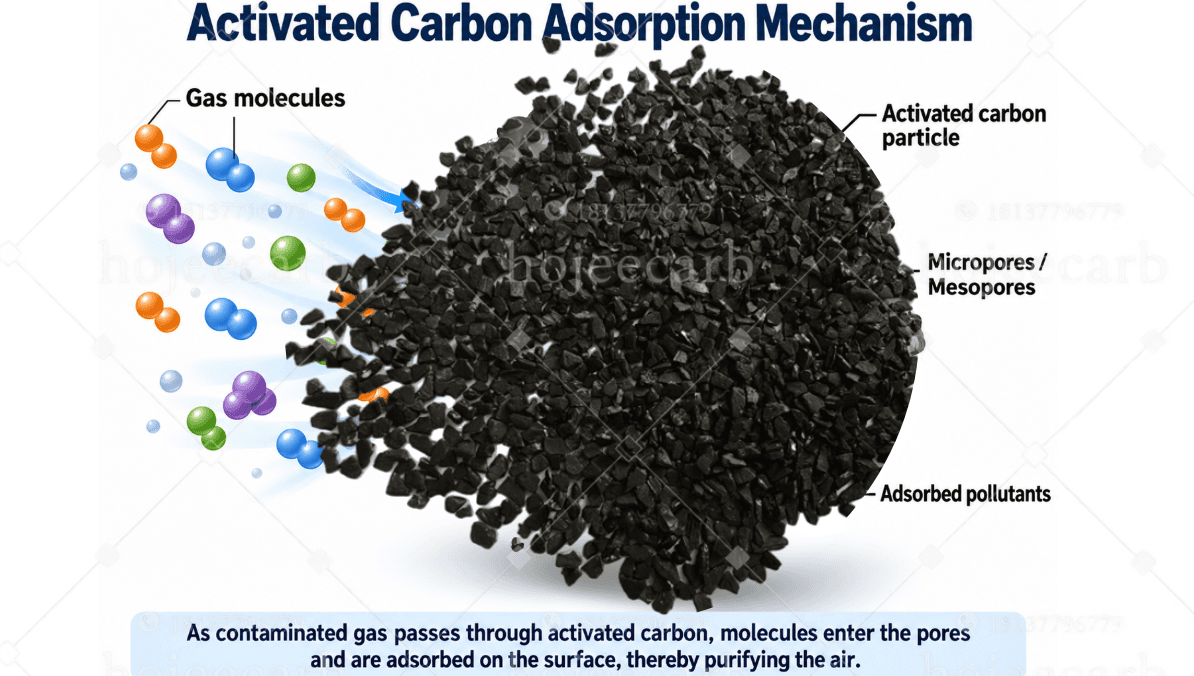
Most odor-masking products cover smells with fragrance. Activated charcoal works differently — it captures the molecules causing the smell through adsorption, a process where gas-phase contaminants bind to the carbon's internal pore surfaces and stay there.
The numbers make this concrete: one gram of activated charcoal has a surface area of 800–1,200 m² — roughly the size of a tennis court. That surface is riddled with micropores (under 2 nm) and mesopores (2–50 nm) that trap odor molecules by Van der Waals forces and, in impregnated carbons, by chemical reaction.
Common odor compounds it removes: hydrogen sulfide (H₂S), ammonia (NH₃), mercaptans (thiols), dimethyl sulfide, acetaldehyde, formaldehyde, and VOCs from solvents, adhesives, and coatings.
Where Activated Charcoal Odor Absorbers Are Used Commercially
| Application | Odor Source | Recommended Form |
|---|---|---|
| Cold storage / refrigerated warehouses | Ethylene, ammonia, food decay | Coconut GAC 8×30, passive trays |
| HVAC air handling units | VOCs, formaldehyde, general mustiness | Pellet 3mm or GAC 4×8 in filter cassettes |
| Industrial packaging lines | Solvent fumes, adhesive off-gassing | Coal pellet 4mm, fixed-bed adsorber |
| Wastewater pump stations / WWTP | H₂S, mercaptans, amines | KOH or KI impregnated carbon |
| Livestock / agricultural facilities | Ammonia, hydrogen sulfide | Coal GAC 4×8 bulk bins |
| Shoe / apparel / furniture manufacturing | Solvent VOCs (toluene, xylene) | Coal pellet BP60, regenerable |
Granular vs Pellet vs Powdered Activated Charcoal for Odor — Which Form?
| Form | Best For | Pressure Drop | Regenerable? |
|---|---|---|---|
| Granular (GAC) 4×8 or 8×30 | Fixed-bed adsorbers, filter cassettes, passive bags | Medium | Yes (steam) |
| Pellet 3mm or 4mm | HVAC, high-flow air treatment, packed towers | Low | Yes (steam) |
| Powdered (PAC) | Liquid-phase, slurry dosing — not for air odor | N/A | No |
For most bulk odor-absorption applications — warehouses, air scrubbers, filter panels — granular 4×8 coal-based or 8×30 coconut shell carbon is the practical choice. Pellets are preferred when pressure drop is a constraint (large HVAC units, high-CFM systems).
Coconut Shell vs Coal Activated Charcoal for Odor Removal
Both work. The difference is pore structure and cost.
Coconut shell carbon is micropore-dominant. It excels at capturing small molecules — VOCs, H₂S, chlorinated solvents, and most food-industry odors. Iodine number typically 1,000–1,100 mg/g. Harder, less dusty, cleaner. Higher cost (~$900–1,200/MT).
Coal-based carbon has a broader pore distribution that handles both small and mid-size molecules including amines, mercaptans, and larger VOCs. Iodine number 800–1,000 mg/g. Lower cost (~$600–900/MT). Better choice when odor sources are mixed or unknown.
For a deeper comparison of raw material types, see our coconut shell vs coal activated carbon guide.
Need activated carbon?
Get Factory-Direct Pricing — No Middlemen
20+ years manufacturing. MOQ 1 ton. Free samples. Reply within 2 hours.
How Much Activated Charcoal Do You Need — Dosage Guide
Dosage depends on whether you're doing passive absorption (open-air placement) or active filtration (fan-driven airflow through a bed).
| Setup | Dosage Rule | Example |
|---|---|---|
| Passive (warehouse tray) | 50–150 g per m³ of space | 500 m³ warehouse = 25–75 kg |
| Active fixed-bed (light load) | 1 kg per 4 m³/hr airflow | 1,000 m³/hr = 250 kg bed |
| Active fixed-bed (heavy H₂S load) | 1 kg per 1–2 m³/hr airflow | Use impregnated carbon (KOH/KI) |
Contact time matters more than carbon quantity. A 0.2–0.5 second empty bed contact time (EBCT) is the minimum for VOC removal. For H₂S to outlet <1 ppm, EBCT of 2+ seconds with impregnated carbon is typical.
How to Source Bulk Activated Charcoal Odor Absorber from China
China produces over 60% of the world's activated carbon. For buyers sourcing an odor absorber at scale, factory-direct procurement from China typically delivers the same performance as Western-branded equivalents at 40–60% lower cost.
Key sourcing parameters to specify:
- Raw material: coconut shell (microporous, food-grade odor) or coal (general industrial)
- Mesh size: 4×8 or 8×30 for granular; 3mm or 4mm for pellet
- Iodine number: ≥800 mg/g (general); ≥1,000 mg/g (high-performance)
- Moisture: ≤5% (critical for air-phase applications)
- Ash content: ≤10% (lower = cleaner, less dust)
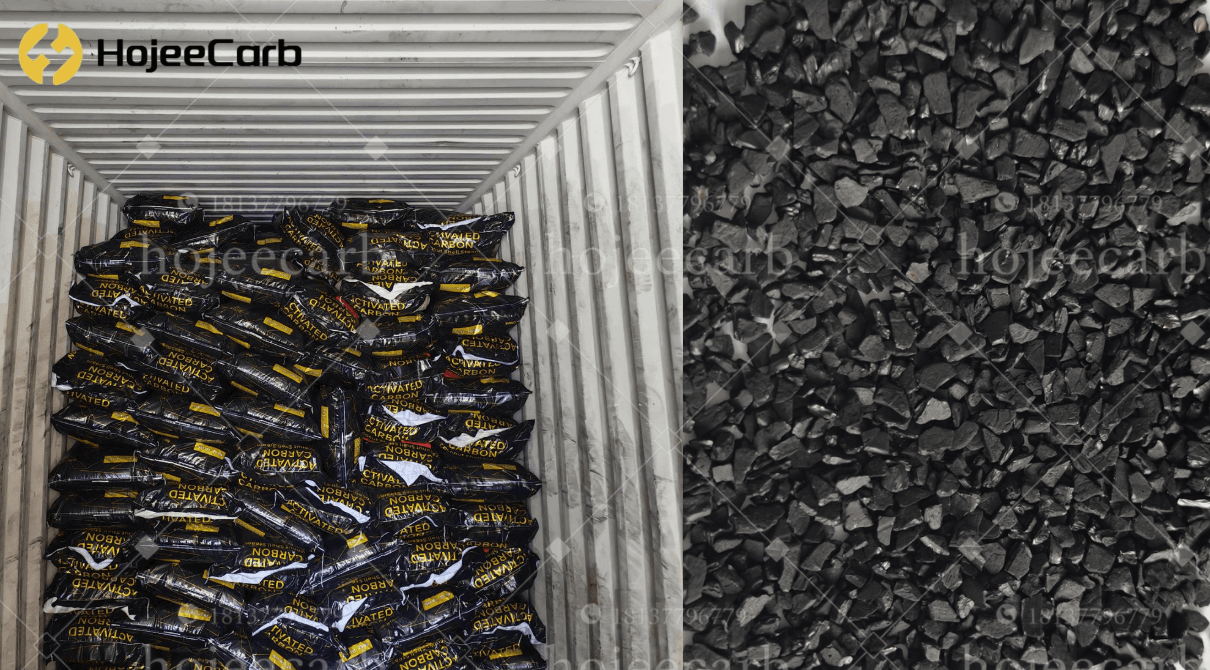
- Packaging: 25 kg woven bags or 500 kg jumbo bags (jumbo preferred for MOQ 5+ MT)
Standard MOQ is 5 MT for production orders. A 20GP container fits approximately 8–10 MT depending on bulk density. Lead time is typically 15–25 days from order confirmation.
For a full overview of packaging and storage requirements, see our activated carbon packaging & storage guide.
FAQ
Does activated charcoal actually absorb odors?
Yes. Activated charcoal adsorbs odor-causing molecules — H₂S, ammonia, mercaptans, VOCs — into its pore structure through physical and chemical adsorption. With iodine number ≥800 mg/g and surface area 800–1,200 m²/g, a single gram holds more than a tennis court's worth of adsorption surface.
How much activated charcoal do I need per square meter for odor control?
For passive warehouse odor control, 50–150 g/m³ of space. For active HVAC filtration, size by airflow: 1 kg per 2–4 m³/hr at 0.2–0.5 second contact time for moderate odor loads.
Coconut shell vs coal activated charcoal for odors — which is better?
Coconut shell carbon is micropore-dominant — best for small odor molecules like VOCs and H₂S. Coal carbon has a broader pore distribution for amines and mercaptans. For general-purpose odor control, coconut shell 8×30 is the most versatile.
Can activated charcoal be regenerated after odor absorption?
Steam regeneration at 800–900°C restores 80–90% of original capacity. Economical at scale (>5 MT). For smaller quantities, replacement is usually more cost-effective. Chemically impregnated carbon (KOH/KI) cannot be thermally regenerated.
What is the MOQ for bulk activated charcoal odor absorber from China?
Standard MOQ is 1 MT for samples and 5–10 MT for production orders. A 20GP container holds approximately 8–10 MT depending on bulk density and packaging format.
Related guides
Need bulk activated charcoal for odor control?
Tell us your application, airflow, and odor compounds — we'll spec the right grade and send a quotation within 24 hours.
Request a Quote