
Technical Guide
Activated Carbon Dosage Calculator: How to Size GAC & PAC for Water Treatment
Step-by-step formulas, dosage tables, and a practical sizing workflow for granular and powdered activated carbon systems — from a manufacturer with 20+ years of application engineering experience.
Why Dosage Calculation Matters
Undersizing an activated carbon system means contaminant breakthrough and failed compliance. Oversizing wastes capital and carbon. With activated carbon prices ranging from $800–$2,500 per metric ton depending on grade, getting the dosage right directly impacts your project economics.
As a manufacturer supplying activated carbon to water treatment plants across 50+ countries, we see the same sizing mistakes repeatedly. This guide gives you the exact formulas, tables, and workflow our application engineers use when helping clients design their systems.
Whether you're designing a new GAC filtration system, optimizing PAC dosing at an existing plant, or evaluating carbon consumption for budgeting — this guide covers it all.
GAC System Sizing: The EBCT Method
For granular activated carbon (GAC) systems, sizing revolves around one key parameter: Empty Bed Contact Time (EBCT). EBCT is the theoretical time water spends in contact with the carbon bed, assuming the bed is empty of carbon.
Core EBCT Formula
EBCT (min) = Bed Volume (m³) ÷ Flow Rate (m³/min)
Bed Volume (m³) = Flow Rate (m³/h) × EBCT (h)
Carbon Mass (kg) = Bed Volume (m³) × Apparent Density (kg/m³)
Typical apparent density: coconut shell GAC 480–520 kg/m³, coal-based GAC 400–500 kg/m³
Recommended EBCT by Application
| Application | EBCT (min) | Recommended Carbon | Key Spec |
|---|---|---|---|
| Municipal Drinking Water | 10–20 | Coconut Shell GAC 12×40 | Iodine ≥1050 mg/g |
| PFAS Removal | 15–30 | Coconut Shell GAC 12×40 or 8×30 | Iodine ≥1100, high micropore |
| Taste & Odor Control | 7.5–15 | Coal-Based GAC 8×30 | Iodine ≥900, CTC ≥55% |
| Industrial Wastewater Polish | 15–30 | Coal-Based GAC 8×30 | Iodine ≥850, hardness ≥85% |
| Groundwater Remediation | 10–20 | Coconut Shell or Coal GAC 12×40 | Iodine ≥1000, low ash |
| Swimming Pool / Aquarium | 3–5 | Coconut Shell GAC 8×30 | Iodine ≥1000, NSF 61 |
Worked Example: Municipal Drinking Water Plant
Given:
- • Design flow rate: 500 m³/h
- • Target EBCT: 15 minutes (0.25 hours)
- • Carbon type: Coconut shell GAC 12×40 (apparent density: 500 kg/m³)
Calculation:
- • Bed Volume = 500 m³/h × 0.25 h = 125 m³
- • Carbon Mass = 125 m³ × 500 kg/m³ = 62,500 kg (62.5 MT)
- • With 2 vessels in lead-lag: 31.25 MT per vessel
- • Vessel diameter (at 10 m/h loading rate): ~4.0 m each
Budget Estimate:
- • Carbon cost (FOB China): 62.5 MT × $1,400/MT = $87,500
- • Annual replacement (18-month life): ~$58,300/year
- • Cost per m³ treated: ~$0.013/m³
Need activated carbon?
Get Factory-Direct Pricing — No Middlemen
20+ years manufacturing. MOQ 1 ton. Free samples. Reply within 2 hours.
GAC Loading Rate & Vessel Sizing
Beyond EBCT, the hydraulic loading rate determines vessel diameter. Too high a loading rate causes channeling and poor contact; too low wastes capital on oversized vessels.
| Parameter | Gravity Filter | Pressure Vessel |
|---|---|---|
| Loading Rate | 5–15 m/h (2–6 gpm/ft²) | 8–20 m/h (3–8 gpm/ft²) |
| Bed Depth | 1.0–2.5 m (3–8 ft) | 1.0–3.0 m (3–10 ft) |
| Backwash Rate | 30–50 m/h | 25–40 m/h |
| Bed Expansion | 20–30% | 20–30% |
Vessel Diameter Formula
Cross-Section Area (m²) = Flow Rate (m³/h) ÷ Loading Rate (m/h)
Diameter (m) = √(4 × Area ÷ π)
Example: 250 m³/h ÷ 12 m/h = 20.8 m² → Diameter = 5.15 m → Use 2 vessels at 3.65 m
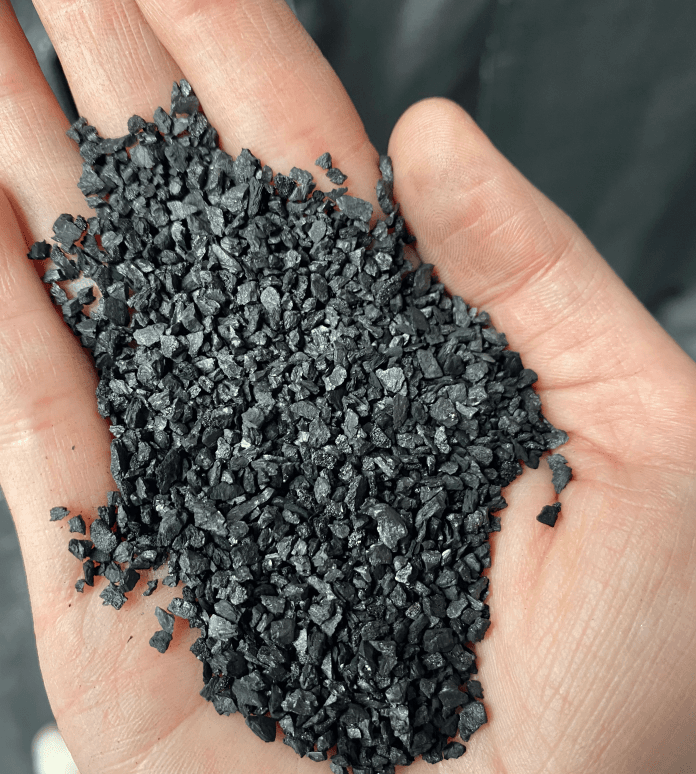
GAC 8×30 mesh granules — the particle size most commonly specified for pressure vessel and gravity filter applications.
PAC Dosage Calculation
Powdered activated carbon (PAC) dosing is simpler in concept but requires jar testing for optimization. PAC is added directly to the water, mixed for a contact time, then removed by sedimentation or filtration.
PAC Consumption Formula
Daily PAC (kg/day) = Flow Rate (m³/day) × Dosage (mg/L) ÷ 1,000
Annual PAC (MT/year) = Daily PAC × 365 ÷ 1,000
Example: 10,000 m³/day × 20 mg/L ÷ 1,000 = 200 kg/day = 73 MT/year
PAC Dosage Ranges by Application
| Application | Dosage (mg/L) | Contact Time | Recommended Carbon |
|---|---|---|---|
| Taste & Odor (MIB/Geosmin) | 5–25 | ≥15 min | Wood-based PAC |
| NOM / DBP Precursor Removal | 10–30 | ≥30 min | Wood or coconut PAC |
| Algal Toxins (Microcystin) | 20–50 | ≥4 hours | Wood-based PAC, iodine ≥800 |
| Industrial Wastewater COD | 50–500 | 30–60 min | Wood-based PAC, MB ≥180 |
| Emergency Spill Response | 50–200 | As available | Any available PAC |
Jar Test Protocol for PAC Optimization
Never specify PAC dosage without jar testing. Here's the standard protocol our lab uses:
- 1. Prepare stock solution: Mix 1 g PAC in 1 L distilled water (1,000 mg/L stock). Stir vigorously for 30 minutes.
- 2. Set up 6 jars: Fill each with 1 L of your raw water. Add PAC stock to achieve doses of 5, 10, 20, 30, 50, and 100 mg/L.
- 3. Rapid mix: 200 RPM for 1 minute to disperse PAC uniformly.
- 4. Slow mix: 40 RPM for 30 minutes (simulates contact time).
- 5. Settle: 30 minutes quiescent settling.
- 6. Filter & analyze: Filter supernatant through 0.45 μm membrane. Measure target parameters (TOC, UV254, specific contaminants).
- 7. Plot isotherm: Graph removal % vs. dosage. The optimal dose is where the curve flattens — adding more carbon gives diminishing returns.
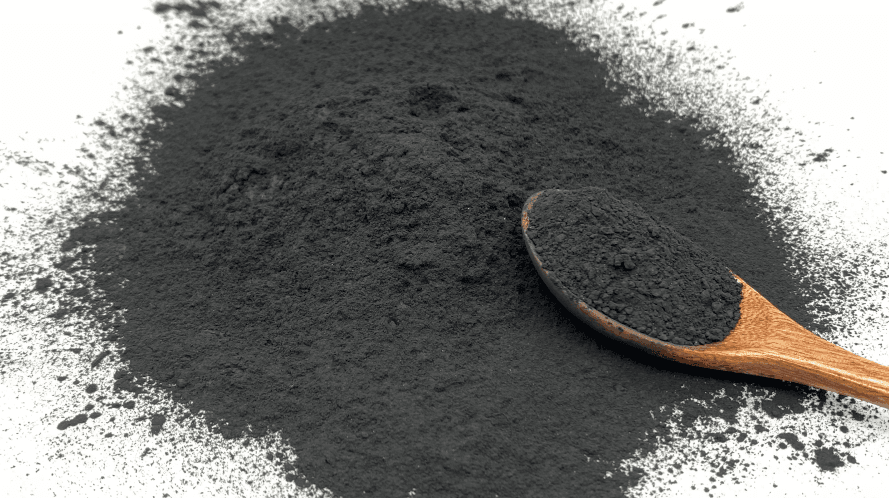
Wood-based powdered activated carbon (PAC) — 200 mesh particle size for rapid adsorption in jar test and full-scale dosing applications.
Carbon Usage Rate: Predicting Replacement Costs
For GAC systems, the carbon usage rate (CUR) tells you how much carbon is consumed per volume of water treated. This is the single most important number for budgeting.
Carbon Usage Rate Formula
CUR (g/m³) = Carbon Mass in Bed (g) ÷ Volume Treated to Breakthrough (m³)
Annual Cost = CUR × Annual Volume × Price per gram
Typical Carbon Usage Rates
| Application | CUR (g/m³) | Bed Life | Cost/m³ |
|---|---|---|---|
| Drinking Water (T&O) | 5–15 | 24–36 months | $0.005–0.02 |
| Drinking Water (NOM/DBP) | 15–40 | 12–24 months | $0.02–0.05 |
| PFAS Removal | 30–100 | 6–18 months | $0.04–0.15 |
| Industrial Wastewater | 50–200 | 6–12 months | $0.07–0.30 |
PFAS-Specific Sizing Considerations
With the EPA's 2024 PFAS rule setting limits at 4 ppt for PFOA and PFOS, GAC system sizing for PFAS requires special attention. The 2026 market is seeing massive demand — Jacobi recently announced 15–20% price increases on coconut shell grades partly driven by PFAS compliance demand.
PFAS GAC Sizing Rules of Thumb
- • EBCT: Minimum 10 min, recommended 15–20 min for long-chain PFAS, 20–30 min if short-chain PFAS present
- • Configuration: Lead-lag series is mandatory — allows lead vessel to exhaust while lag provides backup
- • Carbon type: Bituminous coal-based GAC 8×30 often outperforms coconut shell for PFAS due to broader pore distribution
- • Bed life: 6–18 months depending on PFAS concentration, NOM competition, and water temperature
- • Monitoring: Monthly PFAS sampling of lead vessel effluent; replace when any regulated PFAS reaches 50% of MCL
Cost Optimization: 7 Proven Strategies
After 20+ years of supplying activated carbon to treatment plants worldwide, these strategies consistently reduce costs without compromising performance:
- 1. Use lead-lag configuration: 30–50% better carbon utilization vs. parallel. Saves $20,000–50,000/year on a mid-size plant.
- 2. Right-size your EBCT: If targeting taste and odor, 10 min EBCT is sufficient — you don't need 20 min.
- 3. Pre-treat to reduce NOM: Coagulation/flocculation upstream removes 30–50% of NOM. This can double bed life.
- 4. Consider reactivated carbon: For non-PFAS applications, reactivated GAC costs 40–60% less with 85–95% performance.
- 5. Buy direct from manufacturer: Eliminate 20–40% distributor markups. See our bulk ordering guide.
- 6. Match carbon grade to application: Don't use premium coconut shell ($2,900–4,500/MT) for wastewater when coal-based ($450–1,550/MT) works equally well.
- 7. Monitor and predict replacement: Online TOC or UV254 monitors avoid premature changeouts and compliance violations.
Common Sizing Mistakes to Avoid
- Ignoring NOM competition: High-NOM water (TOC >4 mg/L) can reduce GAC bed life by 50–70%. Always factor NOM into sizing.
- Using iodine number as the only spec: Iodine number measures micropore volume but doesn't predict performance for large molecules. For dyes and humic acids, methylene blue value matters more. See our iodine number guide.
- Designing for average flow: Size vessels for peak hourly flow, not average daily flow. Under-sizing causes early breakthrough during peak demand.
- Skipping pilot testing: Bench-scale tests cost $2,000–5,000 but can save $50,000+ in avoided over/under-design.
- Not accounting for temperature: Adsorption capacity decreases at higher temperatures. Summer can reduce bed life by 20–30% vs. winter.
Get a Custom Dosage Recommendation
Every water source is different. Our application engineering team can review your water analysis, recommend the right carbon grade, calculate bed sizing, provide jar test samples, and estimate annual consumption and budget.
Need Help Sizing Your Carbon System?
Send us your water analysis and flow data. Our engineers will provide a free dosage recommendation and budget estimate within 24 hours.
Request Free Dosage Consultation →Frequently Asked Questions
How do I calculate the amount of activated carbon needed for water treatment?
For GAC systems, calculate bed volume using EBCT (Empty Bed Contact Time): Bed Volume (m³) = Flow Rate (m³/h) × EBCT (hours). Typical EBCT ranges from 5–30 minutes depending on the application. For PAC, dosage is determined by jar testing, typically 5–50 mg/L for drinking water and 50–500 mg/L for wastewater.
What is EBCT and why does it matter for activated carbon sizing?
EBCT (Empty Bed Contact Time) is the time water spends in contact with the carbon bed, calculated as bed volume divided by flow rate. Longer EBCT means better contaminant removal but requires more carbon and larger vessels. For drinking water, 10–20 minutes is standard; for PFAS removal, 15–30 minutes is recommended by the EPA.
How much PAC should I add per liter of water?
PAC dosage varies by application: taste and odor control requires 5–15 mg/L, general organic removal 10–30 mg/L, seasonal algal toxin events 20–50 mg/L, industrial wastewater COD removal 50–500 mg/L, and emergency contamination response up to 100–200 mg/L. Always conduct jar tests with your specific water to determine the optimal dose.
How often should I replace GAC in a water treatment filter?
GAC replacement frequency depends on water quality and contaminant loading. For municipal drinking water, GAC typically lasts 12–36 months. For PFAS removal, 6–18 months. For industrial wastewater polishing, 6–12 months. Monitor effluent quality regularly — when contaminant breakthrough reaches 70–80% of your target limit, schedule replacement or regeneration.
What is the cost per cubic meter of water treated with activated carbon?
Treatment costs vary widely: municipal drinking water GAC filtration costs $0.01–0.05/m³, PFAS removal with premium coconut shell GAC costs $0.05–0.15/m³, industrial wastewater PAC treatment costs $0.10–0.50/m³, and emergency PAC dosing can reach $1.00+/m³. Carbon cost is typically 40–60% of total operating cost, with the remainder being vessel amortization, labor, and disposal.
Related Resources
- → EBCT & Carbon Bed Sizing Calculator
- → Carbon Bed Life & Change-Out Estimator
- → Granular Activated Carbon Filter: Complete Buying Guide
- → Powdered Activated Carbon (PAC): Applications & Buying Guide
- → PFAS Removal with Activated Carbon: Complete Treatment Guide
- → GAC vs PAC: Which Is Right for Your Application?
- → Activated Carbon Price Per Ton: 2026 Pricing Guide