
Need activated carbon?
Get Factory-Direct Pricing — No Middlemen
20+ years manufacturing. MOQ 1 ton. Free samples. Reply within 2 hours.
In This Guide
Key Takeaways
- Modern vehicles use activated carbon in two separate systems: the cabin air filter (removes odors, VOCs, and exhaust gases from incoming air) and the EVAP carbon canister (traps fuel vapor before it escapes to the atmosphere).
- Cabin filter carbon is a fine, low-dust grade — often coconut shell — bonded onto pleated media, sometimes impregnated to neutralize ozone, NOx, and SO2.
- EVAP canister carbon is a durable granular or pellet grade rated by Butane Working Capacity (BWC), typically 9–15+ g/100 mL, engineered to survive thousands of adsorption/purge cycles.
- The two are not interchangeable. Spec each by its own metric: adsorption capacity and low dust for cabin filters, BWC and hardness for canisters.
Where Carbon Sits in a Car
A modern vehicle relies on activated carbon in two distinct systems, each with completely different demands. The cabin air filter cleans incoming air, while the EVAP canister controls fuel vapor emissions.
| System | Job | Carbon type | Key spec |
|---|---|---|---|
| Cabin air filter | Remove odors, VOCs, exhaust gases from incoming air | Fine GAC or powder on filter media | Adsorption capacity, low pressure drop, low dust |
| EVAP carbon canister | Trap fuel tank vapors, release to engine on purge | High-BWC granular or pellet | Butane Working Capacity (BWC), hardness |
The mistake buyers make is treating "automotive carbon" as one product. It isn't. Let's take each system.
Cabin Air Filter Carbon
Cabin air filter carbon is a fine, low-dust adsorbent bonded onto the pleated filter media that removes odors, VOCs, and exhaust gases from air entering the vehicle interior. It sits behind the glovebox, and is also called an activated charcoal cabin filter.
- What it removes — Road-level pollutants that a plain particulate filter cannot touch: exhaust gases (NOx, SO2), ground-level ozone, fuel odors, and volatile organic compounds. Only activated carbon adsorbs these gases.
- Form factor — Carbon is bonded as a fine granular or powdered layer onto the pleated filter media, not packed as loose granules. Low pressure drop is critical so the HVAC blower is not choked.
- Impregnation — For specific gases like ozone and acidic exhaust components, carbon is often impregnated with chemical additives that neutralize SO2 and NOx on contact. This is the same principle used in impregnated activated carbon for industrial gas treatment, scaled down to a thin filter layer.
Coconut shell activated carbon is favored here for its high microporosity (1,000+ m²/g surface area) and low dust generation — you do not want carbon fines blowing into the cabin.
EVAP Carbon Canister: Fuel Vapor Control
The EVAP carbon canister uses activated carbon to trap fuel vapors from the gas tank and release them to the engine when it runs. This is the emissions side of automotive carbon, governed by regulation — the evaporative emission control (EVAP) system stops fuel vapors from venting to the atmosphere.
- How it works — When the car is parked, fuel vaporizes in the tank. Those vapors flow into a canister packed with activated carbon, which adsorbs them. When the engine runs, it "purges" the canister — fresh air pulls the vapor off the carbon and into the intake manifold to be burned.
- The critical spec: BWC — Because the carbon adsorbs and desorbs thousands of times over the vehicle's life, it is rated by Butane Working Capacity (g/100 mL), not iodine value. Higher BWC means more vapor stored per canister volume. Typical automotive canister carbon ranges from 9 to 15+ g/100 mL.
- Regulation drives demand — Standards from the U.S. EPA evaporative emission regulations and equivalents worldwide set how little vapor a vehicle may leak. Tighter limits — and hybrid vehicles' longer park times — keep pushing canister carbon volumes up.
- Durability — Canister carbon must resist attrition through thousands of adsorption/purge cycles. Hardness and a stable pore structure matter as much as capacity.
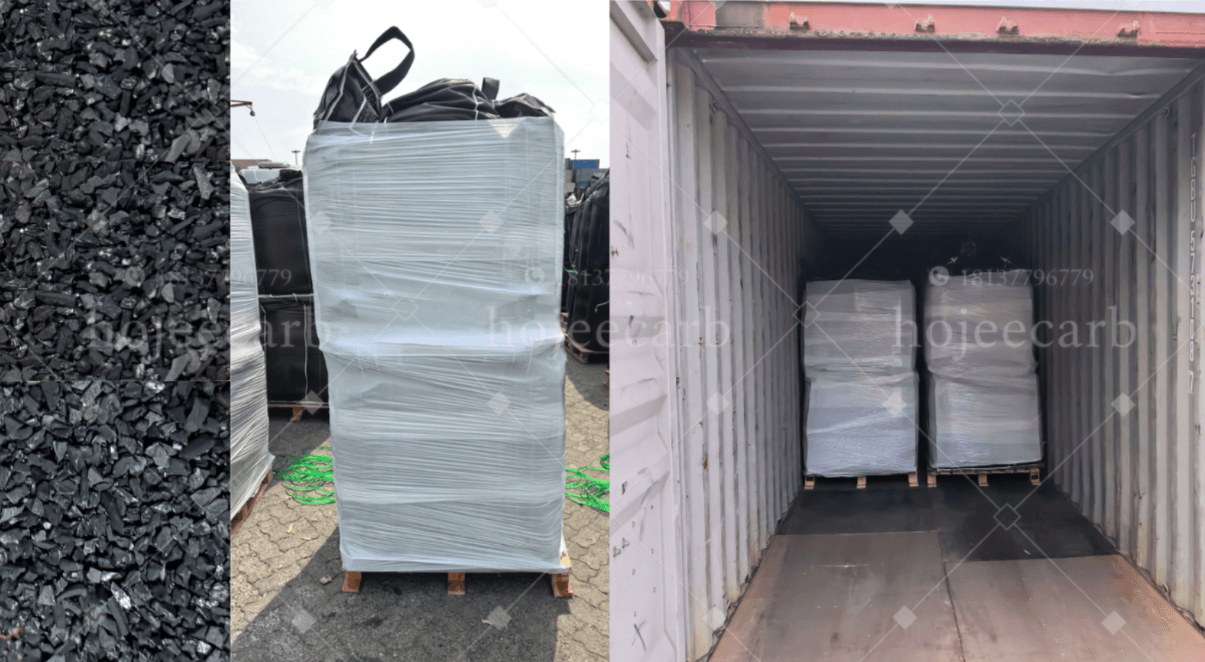
Coconut shell granular activated carbon packed in jumbo bags and loaded for container shipment — ready for automotive OEM supply chains.
Key Specs for Automotive Carbon
Automotive carbon is specified differently for each system: cabin filter carbon by adsorption capacity and low dust, EVAP canister carbon by Butane Working Capacity and hardness. Here is what belongs on your spec sheet, side by side:
| Parameter | Cabin filter carbon | EVAP canister carbon |
|---|---|---|
| Mesh / form | Fine granular or powder on media | Granular 4×10, 6×16 or pellet |
| Surface area | 1,000+ m²/g | Application-specific |
| Primary rating | Adsorption capacity (toluene, butane) | BWC 9–15+ g/100 mL |
| Hardness | Not critical (bonded to media) | High — must survive 000s of cycles |
| Dust / fines | Ultra-low (cabin safety) | Low (system integrity) |
| Impregnation | Optional (ozone, NOx, SO₂) | Not typical |
Both systems require low ash and consistent batch-to-batch quality. Automotive supply chains do not tolerate variability.
Coconut Shell vs Coal for Automotive Use
For cabin air filters, coconut shell activated carbon is the better raw material thanks to its high microporosity and low dust. For EVAP canisters, the choice is application-specific and driven by BWC target rather than raw material alone.
- Cabin filters → coconut shell wins on microporosity and low dust. Ideal for adsorbing low-concentration gases and odors in a thin filter layer. For a full breakdown, see our coconut shell vs coal comparison.
- EVAP canisters → application-specific. Grade is chosen by BWC target and cycle durability rather than raw material alone. Both wood-based and specialized engineered carbons are used, optimized for working capacity over adsorption cycles.
Match the raw material to the spec the system demands, not to a blanket "automotive grade."
Why Buy From Us
We supply activated carbon for both automotive uses — fine grades for cabin filtration and durable high-capacity granular for EVAP canisters.
- Right grade per system — We spec to your BWC or adsorption target, not a one-size product.
- Consistent QC — Every batch tested for capacity, hardness, ash, moisture, and particle size before shipment.
- OEM-ready supply — Bulk volumes, consistent sizing, and the documentation automotive supply chains require.
Frequently Asked Questions
What type of activated carbon is used in car cabin air filters?
Car cabin air filters use fine granular or powdered activated carbon bonded onto the pleated filter media, not loose granules. Coconut shell carbon is preferred for its high microporosity and low dust, which prevents carbon fines from entering the cabin. For gases like ozone and acidic exhaust components (NOx, SO2), the carbon is often impregnated with additives that chemically neutralize them.
What is BWC in EVAP carbon canister carbon?
BWC stands for Butane Working Capacity, measured in grams per 100 mL. It is the key spec for EVAP canister carbon because the carbon adsorbs and desorbs fuel vapor thousands of times over a vehicle's life. Higher BWC means more fuel vapor stored per canister volume. Automotive canister carbon typically ranges from 9 to 15+ g/100mL.
Can I use the same activated carbon for cabin filters and EVAP canisters?
No. Cabin filter carbon is a fine, low-dust, single-pass adsorbent optimized for odors and gases at low pressure drop. EVAP canister carbon is a durable granular or pellet grade engineered for repeated adsorption/desorption cycles, rated by butane working capacity and hardness. Using one in place of the other will fail the application.
Why is coconut shell activated carbon good for automotive cabin filters?
Coconut shell activated carbon has a high microporous surface area (typically 1,000+ m²/g) ideal for adsorbing low-concentration gases and odors, and it produces very little dust. Low dust matters in a cabin filter because you do not want carbon fines blowing into the vehicle interior.
What drives demand for EVAP carbon canister carbon?
Evaporative emission regulations set how little fuel vapor a vehicle may release. As standards from the U.S. EPA and equivalents worldwide tighten, and as hybrid vehicles sit parked for longer periods with fuel evaporating, canister carbon volumes and performance requirements rise.
Source Automotive-Grade Activated Carbon Directly
Tell us the system (cabin filter or EVAP canister), your target spec (BWC, adsorption capacity, or impregnation requirement), and order volume. We'll recommend the right grade and send a firm quote — not a vague range.
Related Articles & Products
- Activated Carbon for VOC Removal: Industrial Air Treatment Guide →
- Activated Carbon Air Purification Applications →
- BET Surface Area Explained: What It Means for Adsorption Performance →
- Impregnated Activated Carbon: Types, Applications & Selection →
- Coconut Shell vs Coal-Based Activated Carbon: Full Comparison →
- Browse All Activated Carbon Products →