
Activated Carbon for Textile Wastewater & Dye Removal
Many dye molecules are large and poorly held by the micropores that dominate most activated carbon, so decolorizing textile effluent usually leans on a carbon with more mesopore structure. The right grade and dose for your stream come from a jar test on your own effluent, not from a datasheet. Factory-direct carbon, with published research and a test protocol to back the selection.
Reviewed by HojeeCarb application engineers · Updated November 2026 · Technical claims referenced to published research (see sources below)
Why It's Hard
Why Textile Dyeing Effluent Resists Conventional Treatment
Textile effluent is not just loaded — it is awkward. Reactive dyes are engineered to resist fading, which is the same property that makes them resist biodegradation. Biological treatment knocks down the easy organic load and leaves the colour behind. The stream also arrives strongly alkaline from the dyebath, carries trace metals from pigment complexes, and swings hard in concentration between batches. Adsorption is the step that handles what biology cannot, but only if the carbon's pore structure actually fits the dye molecule.
Stream Profile
Four Characteristics That Drive Carbon Selection
High, Persistent Colour
Visible colour at 400–1,500 Pt-Co even after secondary treatment. Reactive and disperse dyes survive biological stages almost intact, so colour — not organic load — is usually the limiting discharge parameter.
Large, Varied Dye Molecules
Dye molecules are generally larger than the small adsorbates (chlorine, solvents) that fill micropores, and their size varies widely by dye class. Much of a carbon's surface area can sit in micropores the dye cannot enter, so a high iodine number alone does not predict decolorization — adsorption capacity has to be confirmed on the actual dye.
Strongly Alkaline, pH 10–13
Dyebath and scouring liquor push pH high. Carbon tolerates this, and the common assumption that you must neutralise first does not always hold: in one study on Reactive Black 5, PAC removed 98.4% of colour at pH 2.0 and 95.6% at pH 10.0, but only 77–78% in the pH 4–8 range. The best operating pH is dye- and carbon-specific, so test your own stream before adding acid.
Trace Metals and Surfactants
Copper, chromium and zinc arrive with pigment complexes; sizing agents and surfactants foul the carbon surface. Pre-treatment protects bed life more than any grade upgrade will.
How It Works
Dye Adsorption Is Decided by Pore Size, Then by Contact Time
A dye molecule has to physically enter a pore before it can adsorb. That single fact explains many disappointing decolorization trials: the carbon had plenty of surface area, but the surface sat inside micropores the larger dye molecules could not easily reach. Mesopores in the 2–50 nm range help capture dye and colour bodies, and the methylene blue (MB) value is a useful reference for a grade's capacity toward larger molecules — though it is a single-molecule index and does not directly equal mesopore volume. Once the pore structure fits, the second lever is contact time: dye diffuses into the pore network slowly, so beds sized for taste and odour at short contact times can break through on colour.
| Pore Class | Width | Adsorbs | Dominant In |
|---|---|---|---|
| Micropore | < 2 nm | Small molecules, chlorine, VOC | Coconut shell carbon |
| Mesopore | 2 – 50 nm | Larger dye molecules, colour bodies, humics | Wood-based and selected coal grades |
| Macropore | > 50 nm | Transport channels only | All granular carbon |
This is why a micropore-dominant coconut shell carbon, despite its high iodine number, is often not the first choice for dye decolorization — much of its pore volume lies below 2 nm. It still has a clear role for odour, taste and VOC/small-molecule duty; the right grade depends on the pollutant and should be confirmed by testing.
Two Ways to Dose
PAC Dosing or GAC Polishing — Pick by Load Pattern, Not by Price
Both routes work on textile effluent. They fail in different ways, and they cost money at different points in the plant.
| Dimension | PAC Dosing | GAC Polishing Bed |
|---|---|---|
| Where it sits | Dosed before the secondary clarifier | Fixed bed after clarification and filtration |
| Capital cost | Low — a dosing skid and a mixer | Higher — vessels, pumps, backwash |
| Flexibility | High — change dose batch to batch | Low — bed sized for design flow |
| Sludge impact | Adds carbon to the sludge, raises disposal volume | No sludge contribution |
| Spent carbon | Usually leaves and is handled with the sludge | Reactivation can be evaluated case by case after exhaustion |
| Best suited to | Batch dyehouses, colour spikes, seasonal shade changes | Steady flow, tight permanent discharge limit |
Grade Selection
Which Carbon We Recommend for Textile Effluent
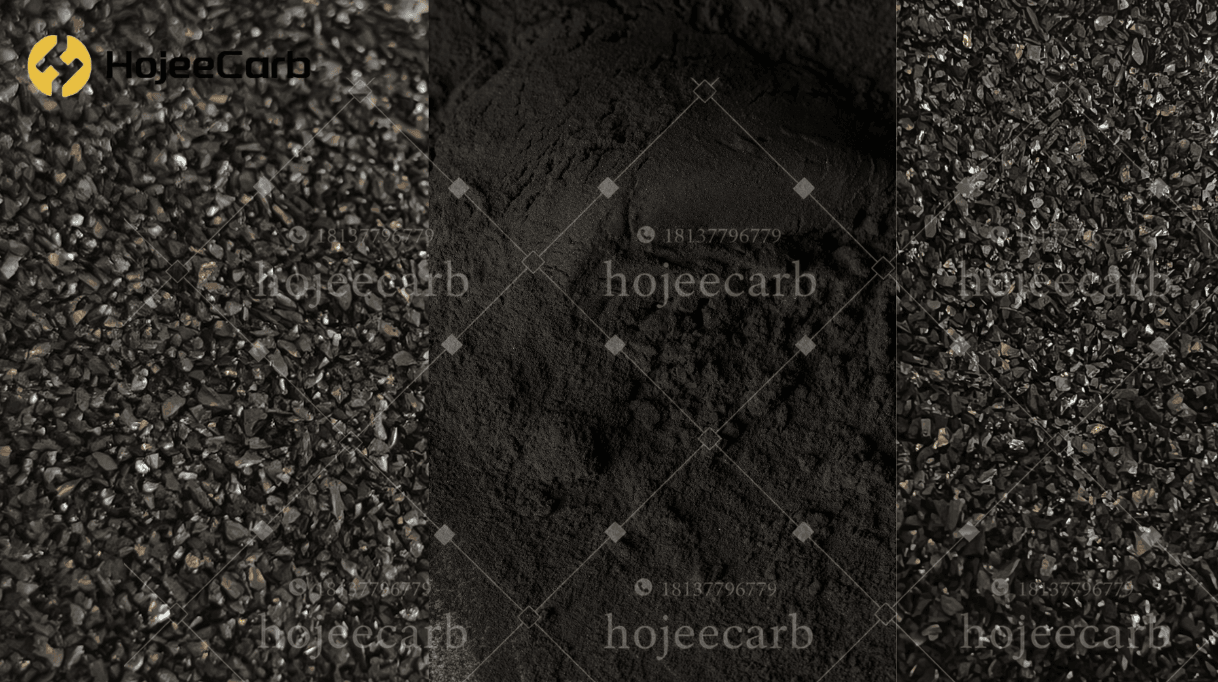
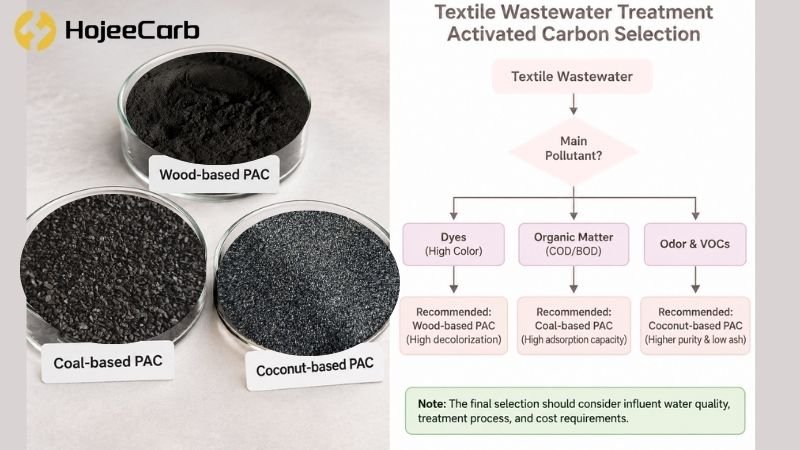
Grade selection follows the dominant pollutant. Colour points to a mesopore-rich wood-based grade; organic load (COD) points to coal; odour and VOC/small-molecule duty points to coconut shell. The figures below are indicative grade ranges for orientation only — the binding specification for any order is our current Technical Data Sheet and the batch Certificate of Analysis (COA), which we send on request. Ask for the methylene blue value alongside iodine number when colour is your target, since iodine number alone does not predict decolorization.
| Grade | Indicative spec (confirm via TDS/COA) | Role in the ETP | Notes |
|---|---|---|---|
| Coal-based GAC (e.g. 8×30) | High iodine number, high hardness, moderate ash — exact values per TDS/COA | Continuous filtration and deep polishing in a fixed bed, lead-lag | The workhorse for continuous polishing. High hardness helps it survive backwash and any reactivation cycles. |
| Wood-based decolorizing PAC | High methylene blue value, low iron — exact values per TDS/COA | Dosing where colour is the binding limit | Mesopore-rich; generally the strongest decolorizer of the four, at a higher unit price. Best for dye/colour removal. |
| Coal-based PAC (fine mesh) | Moderate–high iodine number, moderate MB — exact values per TDS/COA | Dosing where COD / organic load, not colour, is the binding limit | Fast kinetics and lowest-capital route for adsorbing organic pollutants ahead of clarification. |
| Coconut shell carbon | Micropore-dominant, high iodine, low ash — exact values per TDS/COA | Micropore-suited duty: odour, taste, residual small-molecule / VOC polishing | High iodine number; pore structure favours small molecules. Confirm suitability for a given dye by testing. |
Before You Buy
Run a Jar Test — the Only Way to Set Your Dose
A jar test on your own effluent settles the dose and pH questions that no supplier datasheet can answer. Published studies use very different conditions and report very different optimum doses, so their numbers guide the design of the test — they are not a dose you can copy. The ladder below is a suggested screening grid, not a fixed engineering standard.
Sample the Real Stream
Take the effluent at the exact point the carbon will enter — after the clarifier for a GAC bed, after the equalisation tank for PAC dosing. Record pH, COD and colour as the baseline.
Test a Range of pH — Including As-Is
Do not assume neutralisation helps. Published work on Reactive Black 5 found higher removal at both pH 2.0 and pH 10.0 than in the pH 4–8 band, so include your untreated alkaline effluent as one of the set-points alongside mildly acidic and neutral jars. If the as-is pH performs, you save the acid dosing entirely.
Set a Dose Ladder
Suggested PAC screening doses: 0, 100, 200, 400, 800 and 1,500 mg/L of the candidate carbon. Keep the 0 mg/L jar as the untreated control. Treat this as a screening grid to bracket your stream, not a design dose.
Sample Across Contact Times
Draw samples at 15, 30, 60, 120 and 180 minutes under gentle mixing. This captures both kinetics and the approach to equilibrium, which differ between fine PAC and granular carbon.
Filter and Measure
Filter at 0.45 μm, then read colour (Pt-Co or ADMI), COD and pH on every jar. Plot removal against dose and against contact time.
Read the Knee of the Curve
Removal climbs steeply, then flattens. The dose just past the knee is your working design dose — everything beyond it is carbon you pay for and do not use. Confirm it holds across your pH range.
Carbon Cost per Cubic Metre
Carbon Cost (USD/m³) = Dose (mg/L) × Carbon Price (USD/MT) ÷ 1,000,000
Worked example: a dose of 100 mg/L with carbon priced at 2,000 USD/MT gives 100 × 2,000 ÷ 1,000,000 = 0.20 USD/m³.
The number that matters is not the price per tonne — it is the carbon cost per cubic metre at your tested dose. A cheaper carbon that needs a high dose can cost more to run than a premium grade at a low one. Use the formula below with your own jar-test dose.
This is the activated-carbon material cost only. It does not include other chemicals, energy, sludge handling and disposal, labour, or equipment and maintenance. Use the dose from your own jar test.
Process Placement
Where Carbon Can Sit in a Textile ETP
Textile effluent plants vary widely between mills, so there is no single universal flowsheet. Activated carbon is usually added in one of two ways, shown as separate options below. Which fits your plant depends on your existing stages, discharge limit and load pattern — confirm the actual injection point for your site.
Option A — PAC dosing
Powdered carbon dosed into the treatment stream (commonly around the biological / clarification stage). Adsorbed dye leaves with the sludge. Flexible batch-to-batch; adds to sludge volume.
- 1
Screening & Equalisation
Removes lint and fibre, buffers batch-to-batch swings in colour and pH.
- 2
Biological Oxidation
Removes the bulk of BOD and readily degradable COD. Colour largely survives.
- ●
PAC Dosing
Carbon inCandidate carbon dosed at the jar-test dose; adsorbed dye settles out with the sludge.
- 4
Coagulation & Clarification
Removes suspended solids and spent PAC.
- 5
Discharge or Reuse
Compliant effluent to sewer, surface water, or back to the dyehouse for reuse.
Option B — GAC fixed-bed polishing
Granular carbon in a fixed bed after clarification and filtration, for continuous deep polishing to a tight limit. No sludge contribution; spent carbon can be assessed for reactivation.
- 1
Screening & Equalisation
Removes lint and fibre, buffers swings in colour and pH.
- 2
Biological Oxidation
Removes the bulk of BOD and readily degradable COD.
- 3
Coagulation & Clarification
Removes suspended solids before the bed.
- 4
Filtration / Pre-treatment
Removes residual solids and surfactants that would otherwise foul the bed.
- ●
GAC Fixed-Bed Polishing
Carbon inCoal-based GAC in a fixed bed (often lead-lag), trimming residual colour and refractory COD. Size the EBCT from your water quality, flow, bed height and breakthrough testing.
- 6
Discharge or Reuse
Compliant effluent to sewer, surface water, or reuse.
Procurement
Five Mistakes That Waste a Carbon Budget
Specifying iodine number only
Iodine number mainly reflects micropore volume. For dye removal it is a weak predictor on its own — ask for the methylene blue value and ash content alongside it, and confirm capacity on your actual dye.
Skipping the jar test
Dose is site-specific and varies widely between studies and streams. Buying a full container on a generic dose figure routinely overshoots — or falls short of the discharge limit.
Dosing acid on the assumption that neutral pH adsorbs best
Published Reactive Black 5 data shows higher removal at pH 2.0 and pH 10.0 than at pH 4–8. Screen a pH range — including your untreated alkaline effluent — before committing to acid dosing you may not need.
Putting a bed in without pre-filtration
Suspended solids and surfactants blind the bed, cause channelling and pressure drop, and can sharply shorten bed life regardless of carbon quality.
Comparing quotations on price per tonne
Two grades at the same price can differ widely in required dose. Normalise every quotation to carbon cost per cubic metre at your tested dose before deciding.
Textile Wastewater & Dye Removal — Frequently Asked Questions
Does activated carbon remove colour from textile wastewater?
Yes. Adsorption studies on dye and textile effluent commonly report high colour removal (often in the 70–95% range) on clarified streams when the carbon has enough mesopore structure and the dose and contact time are adequate. Because dye molecules are relatively large, a mesopore-rich carbon with a good methylene blue value usually outperforms a micropore-dominant grade of the same surface area. The actual removal and dose for your effluent should be confirmed by a jar test.
Which activated carbon is best for dye removal?
It depends on which pollutant is binding. Where colour is the limit, wood-based decolorizing PAC with a high methylene blue value adsorbs large dye molecules best. Where COD / organic load is the limit, coal-based PAC is often more cost-effective. For continuous polishing, coal-based granular carbon in a fixed bed. Coconut shell carbon is micropore-dominant and suits odour, taste and small-molecule duty; whether it helps on a particular dye should be confirmed by testing. Exact specifications come from our current TDS and batch COA.
What PAC dose does textile effluent need?
There is no universal figure — reported optimum doses vary widely with the dye, the carbon and the test conditions. Published work spans a broad range (for example, bench studies have used carbon doses on the order of ~100 mg/L up to ~2 g/L depending on dye concentration and target), so those numbers should guide the design of a jar test rather than be copied as a dose. Run a dose ladder on your own effluent and design at the point where the removal curve flattens.
Why is methylene blue value useful here, not just iodine number?
Iodine number mainly reflects micropore volume, which suits small molecules such as chlorine and solvents. Methylene blue value is a single-molecule index that reflects a carbon's capacity toward larger molecules; it is a useful reference for decolorization duty but does not directly equal mesopore volume. For colour work it is a better guide than iodine number alone, which is why we quote it on decolorizing grades — with actual values confirmed on the batch COA.
Do I need to neutralise textile effluent to pH 6–8 before activated carbon?
Not necessarily, and the assumption is worth testing before you budget for acid dosing. In a study on Reactive Black 5, powdered activated carbon removed 98.4% of colour at pH 2.0 and 95.6% at pH 10.0, but only about 77–78% across the pH 4–8 range — the opposite of the conventional 'neutralise first' rule. The effect depends on the dye's charge and the carbon's point of zero charge, so run your jar test with your untreated alkaline effluent as one of the set-points. If it performs, you avoid the acid cost altogether.
Can exhausted carbon from a textile plant be reused or reactivated?
It depends on the form and the fouling. Powdered carbon (PAC) typically leaves with the sludge and is handled as part of sludge disposal. Granular carbon (GAC) from a fixed bed can, in many cases, be thermally reactivated — but whether that is worthwhile has to be evaluated case by case from the contaminant loading and the economics of your site. We do not promise a fixed recovery figure.
Evidence
Published Research Behind This Page
The statements above are drawn from peer-reviewed studies on dye adsorption onto activated carbon. Product specifications are governed by our Technical Data Sheets and batch Certificates of Analysis, not by these studies.
- Vojnović et al. (2022) — Influence of initial pH on adsorption of Reactive Black 5 dye on powdered activated carbon: decolouration efficiency 98.4% at pH 2.0 and 95.6% at pH 10.0, versus ~77–78% at pH 4–8, confirming strong pH dependence. Molecules 27(4), 1349. View source →
- Yalili Kılıç (2020) — Comparative treatability study for textile wastewater (Bursa, Turkey): coagulation plus adsorption, with adsorbent column design and operating-cost calculation. Pol. J. Environ. Stud. 29(6), 4131–4137. View source →
- Khellouf et al. (2020) — A new activated carbon from cypress cones for COD reduction and colour removal from industrial textile effluent. Environment, Development and Sustainability. View source →
Send Us Your Effluent Analysis
Share your flow rate, influent colour (Pt-Co or ADMI), COD, pH and discharge limit. We will come back within 24 hours with a grade shortlist, a suggested jar-test plan, and a factory-direct quotation normalised to carbon cost per cubic metre.