
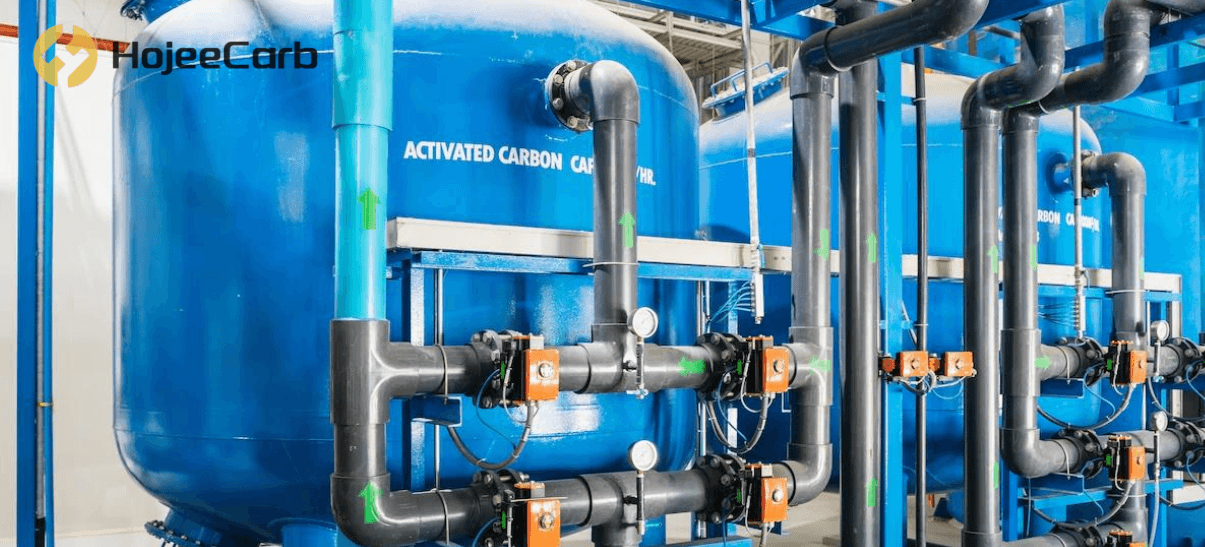
Activated Carbon for Taste & Odor Removal (Geosmin & 2-MIB)
Earthy, musty tap water is almost always geosmin and 2-MIB — algal metabolites detectable at nanogram levels. Powdered activated carbon (PAC) handles seasonal bloom spikes; coconut-shell GAC beds carry the continuous load. Factory-direct supply, ISO 9001 certified.
The Problem
Why Tap Water Smells Earthy and Musty
Reviewed by HojeeCarb application engineers · Updated September 2026
The classic earthy/musty taste-and-odor complaint in drinking water is caused by two compounds: geosmin and 2-methylisoborneol (2-MIB). Both are secondary metabolites released by cyanobacteria (blue-green algae) and actinomycetes, especially during warm-weather algal blooms in reservoirs and slow-moving rivers. The human nose detects them at astonishingly low concentrations — often 5–10 nanograms per litre — so even trace amounts trigger customer complaints. They are not a direct health hazard, but they drive the largest volume of aesthetic complaints utilities receive, and conventional coagulation, sedimentation and chlorination do little to remove them. Chlorine can even worsen the perceived odor. Activated carbon is the proven barrier: powdered activated carbon (PAC) dosed during bloom season, or granular activated carbon (GAC) beds for plants facing recurring or year-round taste-and-odor loads.
Source: US EPA Drinking Water Contaminants · WHO Guidelines for Drinking-water Quality
Key Takeaways
- Geosmin and 2-MIB cause the earthy/musty taste & odor in most drinking-water complaints — detectable at 5–10 ng/L.
- PAC (powdered activated carbon) is the go-to for seasonal algal-bloom spikes — dosed upstream, no permanent infrastructure.
- Coconut-shell GAC — high iodine, microporous — is well matched to small T&O molecules for continuous-duty beds.
- Wood-based PAC (HojeePure WPW1200, iodine ≥1200 mg/g) offers the fastest adsorption kinetics for severe bloom events.
- Factory-direct from China: batch COA, ISO 9001, NSF/ANSI 61-compatible grades, flexible MOQ.
How It Works
How Activated Carbon Removes Geosmin and 2-MIB
Powdered activated carbon is slurried into raw water upstream of coagulation during algal-bloom events. High surface area and small particle size give rapid kinetics — geosmin and 2-MIB adsorb within minutes. PAC is removed with the sludge, so no permanent carbon infrastructure is needed. Typical dose: 5–20 mg/L depending on T&O load and competing NOM.
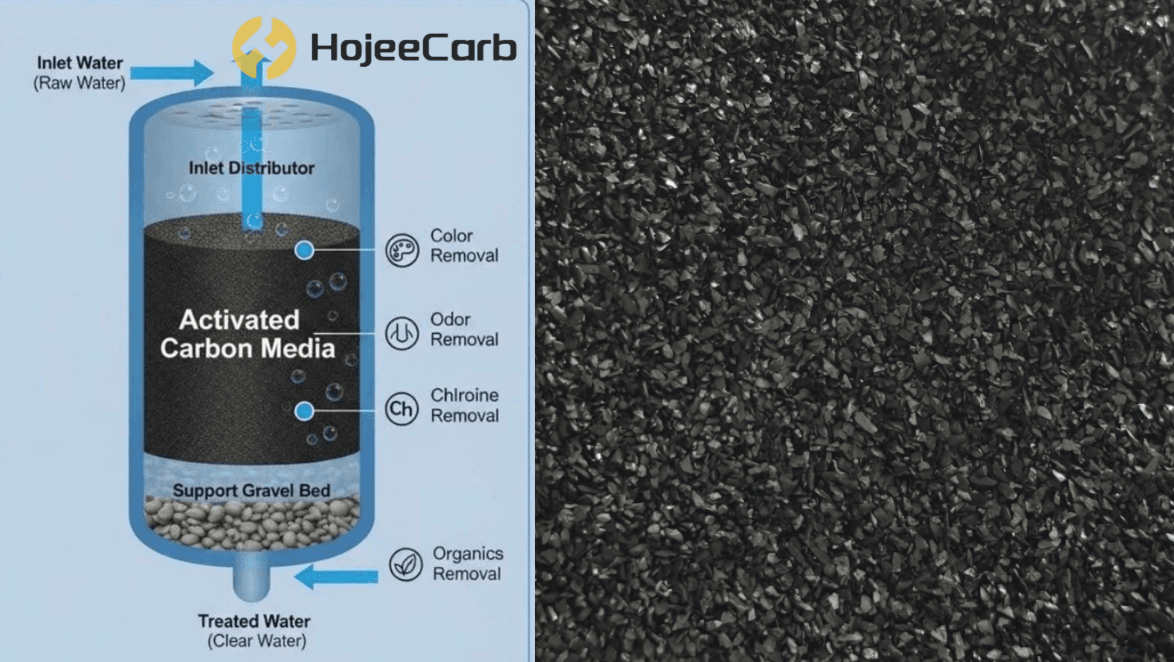
Granular activated carbon beds — gravity or pressure — adsorb geosmin and 2-MIB continuously as water percolates through. Coconut-shell GAC is preferred: its predominantly microporous structure is well matched to these small, low-molecular-weight molecules (MW ~182 for geosmin, ~168 for 2-MIB). EBCT of 5–10 minutes is typical for T&O polishing.
Pre-oxidation with ozone or permanganate can break down some geosmin/MIB before the carbon stage, extending GAC bed life. However, oxidation alone rarely achieves the sub-10 ng/L levels needed to eliminate complaints — carbon remains the final polishing barrier.
Carbon Selection
Which Carbon We Recommend for Taste & Odor
The right choice depends on whether you need seasonal emergency dosing (PAC) or continuous polishing (GAC), and the background NOM level of your source water.
| Duty | Recommended Carbon | Model | Iodine No. | Mesh | Notes |
|---|---|---|---|---|---|
| Seasonal bloom (PAC dosing) | Wood-based PAC | HojeePure WPW1200 | ≥1200 mg/g | 200+ mesh | Highest iodine, fastest kinetics — best PAC for severe events |
| Seasonal bloom (PAC dosing) | Coconut-shell PAC | — | ≥1000 mg/g | 200+ mesh | Good micropore capacity; slightly lower dose than wood PAC for same removal |
| Continuous GAC bed | Coconut-shell GAC 8×30 | HojeeAqua CG1050 | ≥1050 mg/g | 8×30 | Hard, low-dust, microporous — ideal for municipal GAC contactors |
| Continuous GAC bed (fine) | Coconut-shell GAC 12×40 | HojeeAqua CG1100 | ≥1100 mg/g | 12×40 | Finer mesh for deeper beds or POU systems; faster kinetics |
| High-NOM water (mixed duty) | Coal-based GAC 8×30 | HojeeAqua BG900 | ≥900 mg/g | 8×30 | Wider pore distribution for NOM + T&O; preferred when TOC > 4 mg/L |
Not sure whether PAC or GAC fits your plant? Send us your T&O data and treatment layout.
Send Us Your Water Data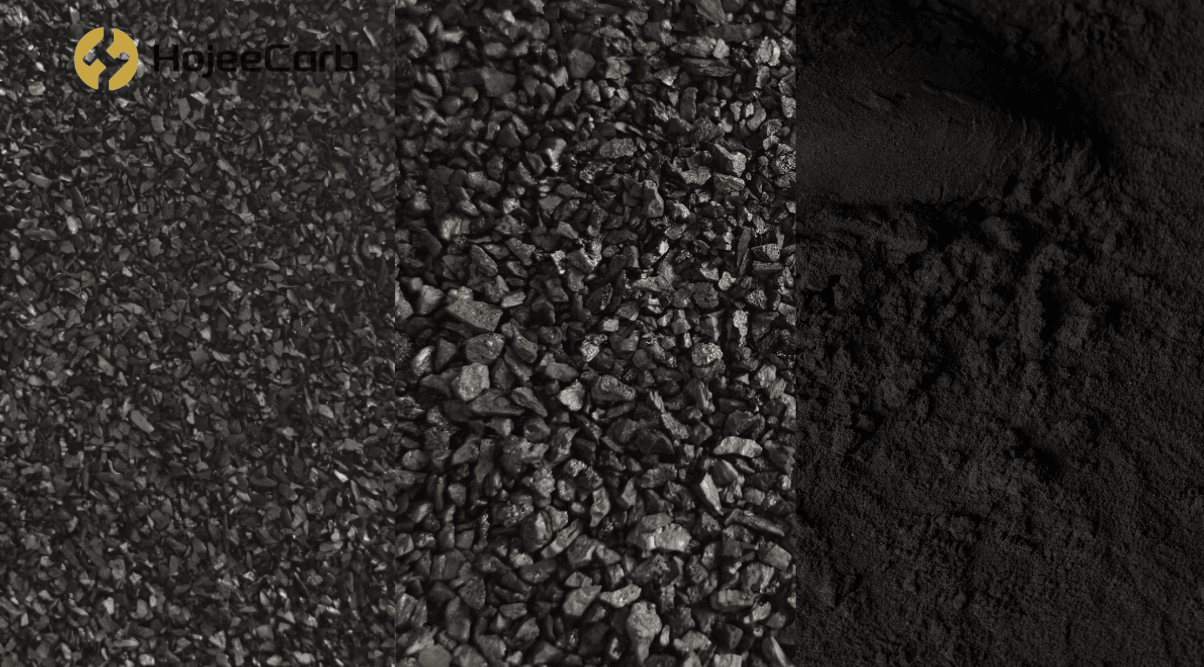
Recommended products: Wood-based PAC (HojeePure WPW1200) · Coconut GAC 8×30 (HojeeAqua CG1050) · Coconut GAC 12×40 (HojeeAqua CG1100) · For high-NOM water: Coal GAC 8×30 (HojeeAqua BG900)
What We Target
Taste & Odor Compounds and Carbon Performance
Geosmin and 2-MIB are the dominant culprits. Both are small, non-ionic organic molecules readily adsorbed by activated carbon — but competing NOM in the source water affects capacity.
| Compound | MW (g/mol) | Odor Threshold | Source | Carbon Removability |
|---|---|---|---|---|
| Geosmin | 182 | ~5–10 ng/L (earthy) | Cyanobacteria, actinomycetes | Excellent — well adsorbed by GAC and PAC |
| 2-Methylisoborneol (2-MIB) | 168 | ~5–15 ng/L (musty) | Cyanobacteria, actinomycetes | Good–Excellent — slightly harder than geosmin; higher PAC dose or EBCT may be needed |
| Dimethyl trisulfide (DMTS) | 126 | ~1 ng/L (septic/swampy) | Anaerobic decomposition | Good — higher doses needed at very low concentrations |
| 2,4,6-Trichloroanisole (TCA) | 211 | ~2 ng/L (musty/moldy) | Chlorination of anisole precursors | Good — responds to GAC adsorption |
System Design
Designing a Carbon System for T&O Control
PAC Dose & Contact Time
PAC is most effective with 15–30 minutes of contact time before coagulant addition. Dose 5–10 mg/L for moderate episodes, 10–20 mg/L for severe blooms. Jar testing with your raw water is the fastest way to dial in the right dose — we supply sample quantities for bench trials.
GAC EBCT 5–10 Minutes
For T&O polishing, 5–10 minutes of empty-bed contact time is standard. Geosmin adsorbs somewhat faster than 2-MIB, so if MIB is your primary compound, design toward the higher end. Post-filter contactors or GAC-capped dual-media filters are common configurations.
Pre-oxidation to Extend Bed Life
Ozone (0.5–2 mg/L) or potassium permanganate upstream of the GAC bed can partially oxidize geosmin/MIB, reducing the adsorption load and extending change-out intervals. Some plants report 30–50% longer GAC life with pre-ozonation.
Monitor Influent T&O
Geosmin/MIB analysis (EPA Method 528 or equivalent) at least weekly during bloom season catches spikes before customer complaints. Sensory panels (flavor profile analysis) provide a practical cross-check.
Use our EBCT calculator and carbon bed life calculator to estimate contact time and change-out intervals for your specific flow and T&O load.
Performance
Trusted by Water Utilities
Taste & Odor Removal — Frequently Asked Questions
What causes the earthy/musty smell in tap water?
Almost always geosmin and 2-methylisoborneol (2-MIB). These are natural metabolites from cyanobacteria and actinomycetes — not a health hazard, but detectable by the human nose at concentrations as low as 5–10 nanograms per litre. They spike during warm-weather algal blooms in source-water reservoirs.
Can PAC remove geosmin during an algal bloom?
Yes. Powdered activated carbon dosed at 5–20 mg/L upstream of coagulation is the standard emergency response for seasonal T&O events. It adsorbs geosmin and MIB within minutes and is removed with the sludge. No permanent carbon infrastructure is needed — ideal for utilities that only face taste-and-odor problems a few weeks per year.
Coconut shell or coal-based GAC for taste and odor?
Coconut-shell GAC is generally preferred for T&O duty. Geosmin (MW 182) and 2-MIB (MW 168) are small molecules that fit well in the microporous structure of coconut-shell carbon. However, if your source water has high NOM (TOC > 4 mg/L), coal-based GAC with its wider pore distribution may perform better because it handles the competing organics that would otherwise foul coconut-shell micropores.
What EBCT do I need for taste and odor removal?
5–10 minutes is typical. Geosmin generally adsorbs faster than 2-MIB, so if MIB is your primary concern, design toward 10 minutes. The exact EBCT depends on influent T&O concentration, NOM competition, and your residual target. Pilot testing with your source water gives the most reliable answer.
How much PAC should I dose for geosmin/MIB?
Start with 5 mg/L and increase based on jar-test results. Moderate episodes typically need 5–10 mg/L; severe blooms may require 15–20 mg/L. Competing NOM in the raw water increases the dose requirement because NOM occupies adsorption sites. We supply sample quantities for bench testing.
What is the MOQ and lead time?
Minimum order is 1 ton for both PAC and GAC grades. Standard water-treatment grades ship in 7–15 days FOB China with batch COA. Free samples for jar testing are available before you commit to a bulk order.
Taste & Odor Episode Coming? Let's Get Ahead of It.
Send us your source-water geosmin/MIB data and current treatment layout. Our technical team responds within 24 hours with a PAC dosing recommendation or GAC system design and factory-direct quotation.
Request a T&O Carbon Quote