
Potassium Carbonate (K₂CO₃) Impregnated Activated Carbon
K₂CO₃-impregnated activated carbon for acid-gas scrubbing — hydrogen sulfide (H₂S) and sulfur dioxide (SO₂) removal from biogas, natural gas and industrial exhaust. The mildly alkaline carbonate neutralizes acid gases with far lower corrosivity and handling risk than caustic KOH or NaOH impregnation.
⚡ Quick Answer
K₂CO₃ impregnated activated carbon is coal-pellet carbon loaded with 5–15% potassium carbonate that neutralizes acid gases — hydrogen sulfide (H₂S) and sulfur dioxide (SO₂) — with far lower corrosivity than KOH or NaOH impregnation. It is the preferred media for biogas desulfurization, WWTP odour control and acid-gas polishing where carbon-steel equipment, worker safety or waste classification matters.
- K₂CO₃ Loading
- 5 – 15% by weight
- H₂S Removal
- > 95% efficiency
- Base Carbon
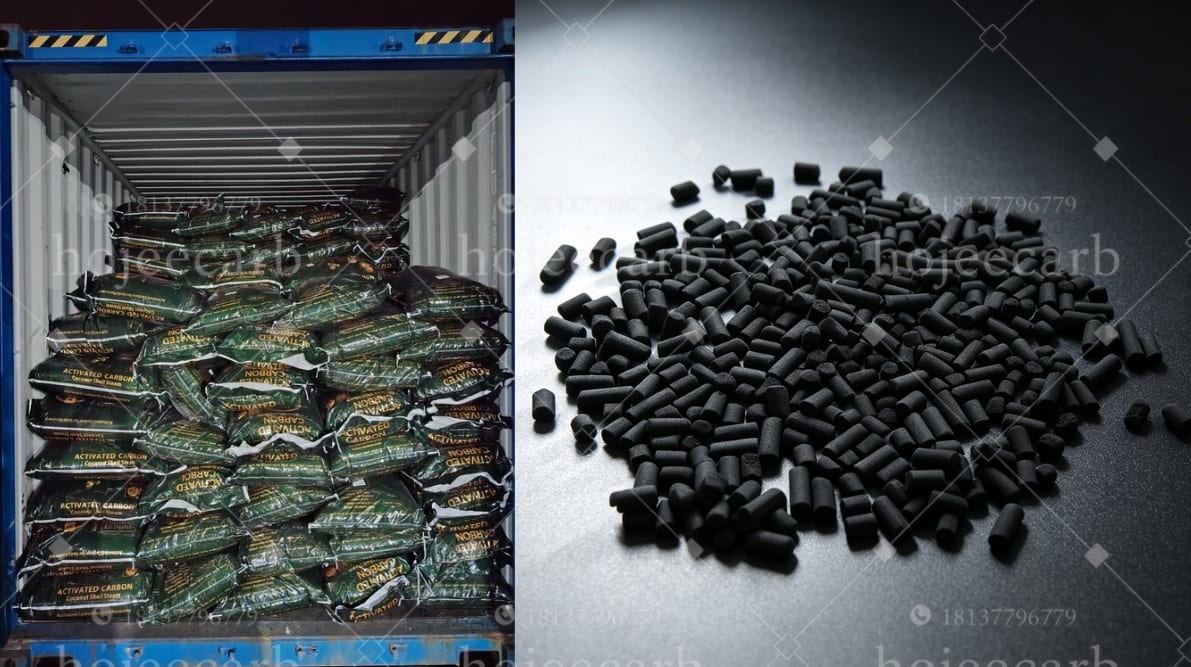
- Coal pellet Φ4mm
- Targets
- H₂S, SO₂, mercaptans
Related: All Impregnated Carbon · KOH Impregnated (higher capacity) · H₃PO₄ Impregnated (alkaline gas) · Get a Quote
The Removal Challenge
Why K₂CO₃ carbon when KOH is too aggressive
KOH- and NaOH-impregnated carbon are the workhorses of H₂S removal, but strong caustic brings real drawbacks: it attacks carbon-steel vessels and downstream piping, it demands strict PPE and handling controls at change-out, and spent media can be classified as a corrosive waste. Potassium carbonate offers a middle path. As a mild alkaline salt it still neutralizes H₂S and SO₂ to form stable potassium sulfide and sulfite salts locked in the pore network, but its pH is far gentler on equipment and on the people servicing the bed. Working capacity per litre is somewhat lower than a high-loading KOH grade, so K₂CO₃ is the right pick where vessel material, worker safety or waste classification matters more than squeezing out maximum capacity — typically biogas upgrading, sewage and WWTP odour control, and acid-gas polishing in mixed-material plants.
How K₂CO₃ Carbon Works
Mild alkali neutralizes acid gas without the caustic penalty
Base coal-pellet carbon is impregnated with 5–15% potassium carbonate, distributing mildly alkaline reactive sites evenly through the internal pore network.
H₂S and SO₂ diffuse into the pores and react with the carbonate to form stable potassium sulfide and sulfite salts, releasing only CO₂ and water — no aggressive caustic residue.
Because the media is a mild salt rather than a strong base, it is far less corrosive to carbon-steel vessels and piping, and safer for operators to load and change out.
Where It's Used
Applications for K₂CO₃-impregnated carbon
Carbon Selection
Choosing K₂CO₃ carbon by duty
Match base carbon, form and carbonate loading to your gas stream and inlet concentration. Every lot ships with a batch COA — iodine number, K₂CO₃ content, ash, moisture and H₂S capacity.
| Removal Duty | Recommended Base | Impregnant | Form |
|---|---|---|---|
| Biogas H₂S (mid inlet) | Coal-based pellet | K₂CO₃ 10–15% | Pellet Φ4mm |
| WWTP / odour polishing | Coal-based pellet | K₂CO₃ 5–10% | Pellet Φ3–4mm |
| SO₂ from flue gas | Coal-based pellet | K₂CO₃ 10–15% | Pellet Φ4mm |
| Mixed H₂S + SO₂ | Coal-based pellet | K₂CO₃ (+ KOH blend) | Pellet Φ4mm |
Process Design
Balancing capacity, corrosivity and cost
K₂CO₃ vs KOH trade-off
A high-loading KOH grade gives more H₂S capacity per litre of bed. K₂CO₃ gives up some of that capacity in exchange for much lower corrosivity, easier handling and simpler spent-media disposal. If your vessel is carbon steel or your HSE policy restricts caustic media, the trade is usually worth it.
Carbonate loading vs cost
Higher K₂CO₃ loading (10–15%) gives greater chemical capacity for mid-inlet biogas streams; polishing duty with low inlet H₂S runs economically at 5–10%. We size loading to your inlet concentration and target breakthrough.
Bed contact time (EBCT)
Acid-gas neutralization needs adequate empty-bed contact time — typically 1–2 seconds for H₂S duty. Under-sized beds break through early regardless of loading. Share your flow rate for a bed-sizing calculation.
Moisture matters
The carbonate reaction needs some water to proceed, so K₂CO₃ carbon performs best on humid streams (40–80% RH). Bone-dry gas slows the reaction; saturated gas floods pores. We advise on conditioning for your stream.
Technical Specifications
| Parameter | Coal Pellet (H₂S Duty) | Coal Pellet (SO₂ Duty) |
|---|---|---|
| Impregnant | K₂CO₃ | K₂CO₃ (±KOH) |
| Impregnant Content | 10–15% by weight | 10–15% by weight |
| Iodine Number | ≥700 mg/g | ≥700 mg/g |
| Form | Pellet Φ4mm | Pellet Φ4mm |
| Target Gas | H₂S, mercaptans | SO₂, H₂S, HCl |
| H₂S Capacity | 0.12–0.22 g/cm³ | — |
| Ash Content | ≤15% | ≤15% |
| Moisture | ≤5% | ≤5% |
| Bulk Density | 0.45–0.60 g/cm³ | 0.45–0.60 g/cm³ |
Field Performance
Proven acid-gas scrubbing in the field
Case: biogas plant replaces KOH carbon with K₂CO₃ grade to protect carbon-steel vessels
A European biogas upgrading facility had been using KOH-impregnated carbon for H₂S removal but experienced accelerated corrosion of its carbon-steel adsorber vessels at every change-out cycle. Switching to K₂CO₃ carbon at 12% loading maintained H₂S removal above 95% while eliminating the caustic attack on vessel internals. The plant also simplified its spent-media disposal classification and reduced PPE requirements for maintenance staff.
Related Products
Explore other impregnated grades and base carbons. Contact us for a tailored recommendation.
Impregnated Activated Carbon (Overview)
All impregnant types — KOH, sulfur, silver, KMnO₄, KI, K₂CO₃, H₃PO₄, CuO/MgO
KOH Impregnated Activated Carbon
Higher H₂S capacity when corrosivity is not a constraint
Phosphoric Acid Impregnated Activated Carbon
For alkaline gas — ammonia, amine removal
Coal-Based Pellet Activated Carbon
Base carbon for K₂CO₃ impregnation
K₂CO₃ Carbon — Frequently Asked Questions
What is potassium carbonate impregnated activated carbon used for?
K₂CO₃ (potassium carbonate) impregnated activated carbon is used to remove acid gases — primarily hydrogen sulfide (H₂S) and sulfur dioxide (SO₂) — from biogas, landfill gas, natural gas and industrial exhaust. The mild alkaline carbonate neutralizes these acid gases with much lower corrosivity than strong caustic (KOH/NaOH) impregnation, making it the preferred choice where vessel material, worker safety or waste classification is a concern.
How does K₂CO₃ carbon compare with KOH-impregnated carbon?
KOH gives higher H₂S capacity per litre of bed because it is a stronger base. K₂CO₃ trades some capacity for much lower corrosivity — it will not attack carbon-steel vessels or piping, needs less PPE at change-out, and produces non-corrosive spent media. For mid-inlet biogas streams and polishing duty the capacity difference is small enough that K₂CO₃ is the better economics-and-safety package.
What K₂CO₃ loading should I choose?
10–15% loading suits mid-to-high-inlet biogas H₂S streams where maximum chemical capacity matters. 5–10% is economical for polishing duty with low inlet concentration. We size loading to your gas analysis and target breakthrough.
Does K₂CO₃ carbon need moisture?
Yes. The carbonate neutralization reaction requires some water, so K₂CO₃ carbon performs best on humid streams (40–80% RH). Bone-dry gas slows the reaction; saturated gas floods pores. We advise on stream conditioning for your application.
What base carbon and form is available?
We supply K₂CO₃ impregnation on coal-based extruded pellet (Φ3–4mm), offering low pressure drop and high mechanical strength. Custom sizes and loadings are available on request.
What is the MOQ and lead time?
MOQ is 1 ton with custom K₂CO₃ loading. Standard lead time is 10–15 days factory-direct. Packaging: sealed 25 kg bags or 500 kg jumbo bags with PE liner to prevent moisture uptake. Private-label available. Every lot ships with a batch COA.
Need K₂CO₃ carbon sized for your acid-gas duty?
Tell us your gas composition, flow rate, temperature and inlet H₂S / SO₂ concentration. Our engineers will recommend the carbonate loading and bed size — and ship a free sample for evaluation.
Request a K₂CO₃ Carbon Quote