
Shipment Case Study
48 Tons of HojeeGold CG33 Gold Recovery Carbon Shipped to a South African CIL Circuit
A South African gold operation running CIL on high-TDS recycled process water placed a 48-ton order of HojeeGold CG33 — 6×12 mesh, iodine 1100 mg/g, ball-pan hardness ≥99%. On this circuit the grade was not decided by headline iodine. It was decided by how well the carbon resists calcium fouling and how many reactivation cycles it survives before it turns to fines.
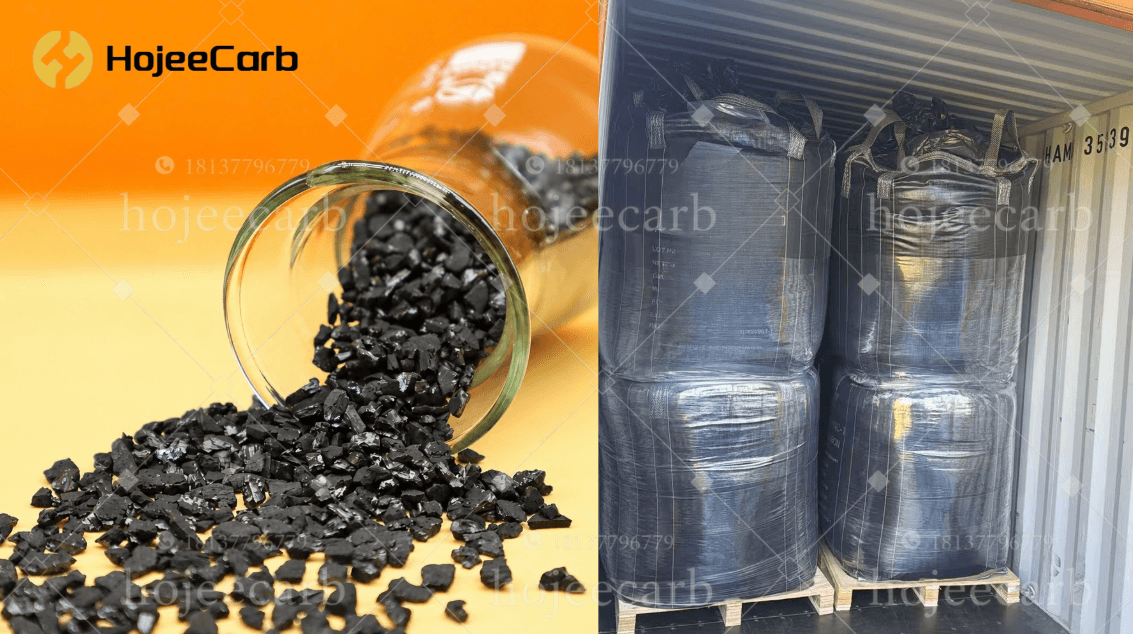
HojeeGold CG33 6×12 granules (iodine 1100 mg/g, hardness ≥99%) and 550 kg lined FIBC bulk bags stowed inside a 40ft container — 44 bags per box, about 24.2 tons per container, two containers for this 48-ton order to Durban.
We just shipped 48 tons of coconut shell gold recovery carbon to a gold producer in South Africa — two 40-foot containers of HojeeGold CG33 for a carbon-in-leach (CIL) circuit. The requested spec: 6×12 mesh, iodine 1100 mg/g, CTC 60%, ball-pan hardness ≥99%, ash under 3%. South African buyers do not usually open with iodine number. The first question we get from a Gauteng or North West plant is a harder one: how does your carbon hold up on recycled, high-salinity water, and how many reactivation cycles does it take before attrition losses eat the saving? That is the question this article answers.
South Africa’s ore body is unlike anywhere else we ship to. The Minerals Council South Africa describes the Witwatersrand Basin as the world’s largest gold resource; after 120 years of mining, operations there have reached 4,000 m depth, where natural rock temperatures hit about 50 °C. The country produced 84 tonnes of gold with 93,841 people employed in the gold sector, and the Council states that more than half the industry is marginal at current prices. That last point is the one that shapes carbon buying: when margins are thin and ore is deep, a plant cannot absorb avoidable carbon losses. Alongside the deep mines, a large share of South African output now comes from surface tailings retreatment — DRDGOLD’s Ergo plant at Brakpan reprocesses century-old Witwatersrand dumps through a 50 km pipeline network. Deep ore and reclaimed tailings both feed carbon circuits very different from a shallow, free-milling West African pit.
This Shipment at a Glance
- Volume: 48 tons contract net weight — 2 × 40ft HQ containers, 44 × 550 kg bulk bags (≈ 24.2 tons) loaded per container
- Grade: HojeeGold CG33 coconut shell — 6×12 mesh, iodine 1100 mg/g, CTC 60%, ball-pan hardness ≥99%, ash ≤3%
- Packing: 550 kg lined FIBC bulk bags, 44 bags per 40ft container, batch-numbered
- Quality control: single production batch, one composite COA covering every bag in both containers
- Route: Durban, then road haul to the Gauteng / North West interior
Order Summary
| Client region | South Africa (Witwatersrand Basin — Gauteng / North West) |
| Circuit type | CIL — Carbon-in-Leach (cyanide leach, recycled process water) |
| Product | HojeeGold CG33 — Coconut Shell Activated Carbon |
| Iodine value | 1100 mg/g (ASTM D4607) |
| CTC activity | 60% |
| Ball-pan hardness | ≥ 99% (ASTM D3802) |
| Mesh size | 6 × 12 (ASTM D2862) |
| Ash / Moisture | ≤ 3% / ≤ 5% |
| Total volume | 48 tons contract net weight (≈ 48.4 tons as loaded) |
| Containers | 2 × 40ft HQ — 44 bulk bags per box, ≈ 24.2 tons per container |
| Packing | 550 kg lined FIBC bulk bags — 44 bags per 40ft container |
| Production | Single production batch — one composite COA |
| Routing | Durban, South Africa (direct inland haul to site) |
| Ship date | November 2026 |
Why South African Circuits Judge Carbon on Fouling, Not Iodine
On a West African pit the carbon question is adsorption kinetics. In South Africa the binding constraint is usually what the carbon picks up besides gold. Three ore and circuit realities drive it:
- Recycled, high-TDS process water. South African plants are water-stressed and recycle heavily, so leach solutions carry high calcium and magnesium hardness. In an aerated, high-pH cyanide circuit, calcium carbonate precipitates onto the carbon surface as scale. That scale blinds the pores the gold needs — classic inorganic fouling — and it builds faster here than on fresh-water circuits.
- Deep and retreatment ore brings organics. Mature Witwatersrand ore and reclaimed tailings carry residual flotation reagents, humic matter and fine carbonaceous material. These organics adsorb onto the carbon and compete with the gold-cyanide complex — organic fouling and partial preg-robbing that drag down loading if the carbon cannot be cleaned back.
- Carbon is reactivated, not discarded. At South African scale, operators run acid wash and a thermal reactivation kiln and cycle the same carbon many times. Each kiln pass at 650–750 °C recovers activity but mechanically punishes the granule. A carbon that is soft, or whose pore walls collapse after a few regens, turns into fines and leaves with the tails — carrying gold with it.
So the honest selection logic for South Africa is: pick a carbon whose fouling comes off in a standard acid wash, and whose skeleton survives repeated reactivation. That is a hardness and pore-structure question before it is an iodine question.
Why CG33 for This CIL Circuit
HojeeGold CG33 is a coconut shell carbon, and coconut shell is the right base for this duty for a specific reason: it is dominated by micropores with a hard, dense granule structure. That gives two things a reactivation-heavy South African circuit needs — a high ball-pan hardness (≥99%) that resists attrition in pumps, screens and the kiln, and a pore network that reactivates cleanly rather than slumping. Iodine 1100 mg/g and CTC 60% confirm the working micropore volume is there for fast, high gold loading in a CIL tank; the hardness is what lets you keep that volume through cycle after cycle.
| Parameter | HojeeGold CG33 (this order) | Why it matters in South Africa |
|---|---|---|
| Base material | Coconut shell charcoal | Micropore-dominant, dense granule — reactivates cleanly |
| Mesh size | 6 × 12 (ASTM D2862) | Standard CIL/CIP inter-stage screen size |
| Iodine value | 1100 mg/g (ASTM D4607) | Ample micropore volume for fast gold loading |
| CTC activity | 60% | Confirms transport pore network for kinetics |
| Ball-pan hardness | ≥ 99% (ASTM D3802) | Survives acid wash + repeated thermal reactivation |
| Ash | ≤ 3% | Low inorganic load, less scaling seed material |
| Moisture | ≤ 5% | Accurate dosing by dry weight |
| Apparent density | 480–520 kg/m³ | Consistent tank inventory and screen behaviour |
The point we make to South African buyers is the same one we made on the spec sheet: do not pay for iodine you will foul over within a cycle. Pay for hardness and a reactivable skeleton, because that is what determines your real carbon cost per ton of gold over a year — not the number on the first COA.
Need activated carbon?
Get Factory-Direct Pricing — No Middlemen
20+ years manufacturing. MOQ 1 ton. Free samples. Reply within 2 hours.
The Real Cost Is Attrition Over Reactivation Cycles
Here is the arithmetic that matters on a reactivating circuit. If a carbon loses an extra 1–2% of its mass to fines on every acid-wash and reactivation cycle, and you reactivate monthly, a soft carbon can be physically gone — and quietly carrying gold to the tails the whole way — long before a hard carbon needs replacing. The cheaper carbon per ton is routinely the more expensive carbon per ounce recovered once you count makeup volume and the gold lost in fines.
That is why ≥99% ball-pan hardness is not a vanity spec for South Africa. It is the number that decides how many reactivation cycles you get, which decides your annual makeup tonnage, which decides your carbon budget. We would rather be chosen on that math than on a headline iodine figure.
How to Select 6×12 Activated Carbon for South African Gold Mines
If you run a Witwatersrand Basin circuit — deep-mine CIL or surface tailings retreatment — here is the order we would work through, tied to the spec sheet rather than to a brochure:
- Fix mesh to your screens first. 6×12 is the standard size for inter-stage screening in CIL and CIP. Get the particle size distribution right for your screen apertures before anything else — undersized fines pass the screens and leave with the tails carrying loaded gold, whatever the carbon’s other numbers say.
- Set hardness against your reactivation frequency. If you acid-wash and thermally reactivate monthly, specify ball-pan hardness ≥99% (ASTM D3802). If you run a short-life, low-regen operation, you have more room. Hardness is the lever on attrition loss per cycle, so it should track how hard you cycle the carbon.
- Match iodine and CTC to kinetics, not vanity. Iodine 1050–1100 mg/g with CTC around 60% gives the micropore and transport-pore volume a gold-cyanide circuit needs. Paying for 1200+ iodine makes little sense if high-TDS water will foul part of that surface within a cycle.
- Keep ash low for high-hardness water. Lower ash means less inorganic seed for calcium scaling. On recycled, hard process water this matters more than on fresh water.
- Bench it on your own solution. Specs narrow the field; a side-by-side K-value and attrition test on your actual gold-cyanide solution and water picks the winner. Numbers on a COA do not predict how a carbon behaves on your ore.
For this South African order those steps pointed to HojeeGold CG33: 6×12 mesh, iodine 1100 mg/g, CTC 60%, hardness ≥99%, ash ≤3% — a coconut shell grade built for a reactivation-heavy circuit on hard water. For the full parameter-by-parameter breakdown, see our 6×12 gold recovery carbon specification guide.
Quality Control — One Batch, One COA
All 48 tons came off a single production batch — same coconut shell charcoal source, same activation furnace run, same screening pass — so one composite COA honestly represents every bag in both containers. When a supplier blends lots to make up 48 tons, bag-to-bag iodine and hardness drift, and a circuit tuned on the first lot behaves differently halfway through. One batch, one COA keeps the carbon predictable through the order.
Before loading, our in-house lab tested:
- Iodine value — composite sample from the production lot (ASTM D4607)
- Ball-pan hardness — minimum 99% (ASTM D3802)
- CTC activity — 60%
- Moisture, ash content and particle size distribution by sieve analysis
- 6×12 mesh confirmed (ASTM D2862)
The COA travelled with the shipment alongside the packing list, weight certificate and fumigation certificate. We also support SGS or Bureau Veritas pre-shipment inspection at origin on request — standard for operations reporting to corporate procurement or lenders.
Packaging and Routing — 550 kg Bulk Bags via Durban
South Africa has direct deep-sea access, so routing is simpler than for its landlocked neighbours. This order moved through Durban, the usual gateway for the Gauteng and North West gold districts, then inland by road to site.
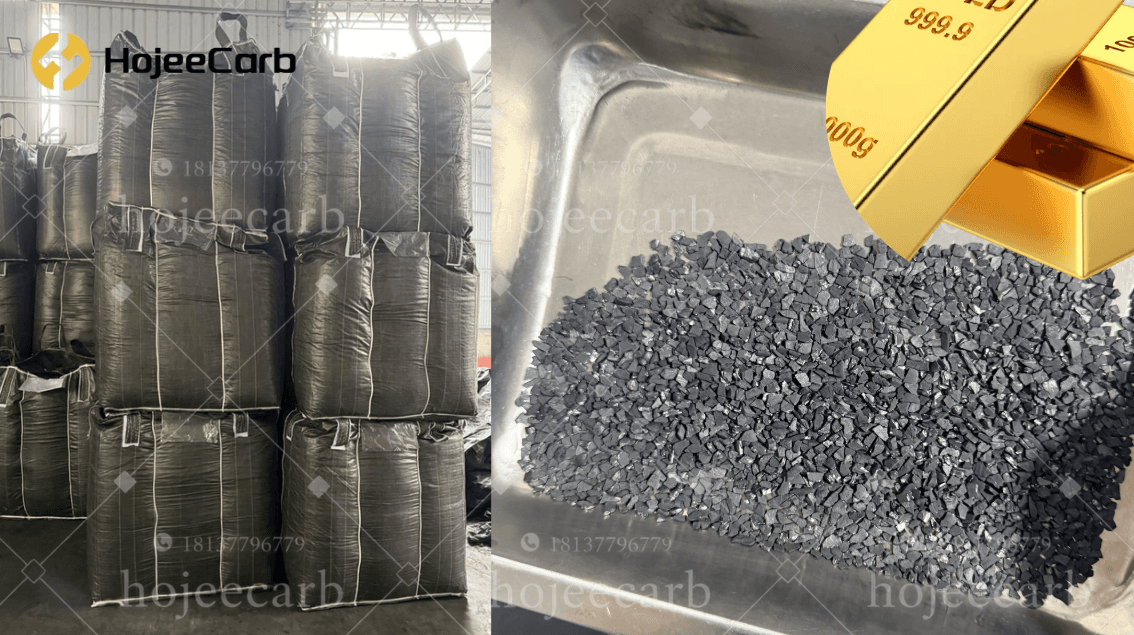
550 kg lined FIBC bulk bags of HojeeGold CG33 in factory stock before loading, and the 6×12 granule that does the gold loading. Holding finished stock in bulk-bag form is what lets us ship a 48-ton order from one batch instead of blending lots to make weight.
- Packaging: 48 tons in 550 kg lined FIBC bulk bags at 44 bags per 40ft container, four-loop single-trip construction with an inner liner against moisture pickup on the ocean leg. The site runs loaders, so bulk bags beat 25 kg sacks here — far less handling labour per ton and carbon goes to the adsorption tanks straight from the bag. We also supply 25 kg PP bags for sites that dose manually or stage by stage; the choice should follow what the site can lift.
- Container count — the number buyers get wrong: a 40ft container holds 44 bulk bags, which at 550 kg a bag is about 24.2 tons per container — so this 48-ton order loaded as two 40ft boxes. Bulk bags cube out long before they weigh out: the limit is floor space for 44 bags, not the container’s payload rating. If a quote shows 28 tons of bulk-bagged carbon in one 40ft container, the stow does not work and the freight line will not hold it. We give the bag count and the container count on the quote so your landed cost is right the first time.
- Routing: ocean leg to Durban, then road haul to the interior. Durban is the lowest landed-cost gateway for most Witwatersrand Basin operations; we quote it against alternatives so the buyer sees the real delivered number, not a generic “we ship worldwide” line.
- Documented loading: every bulk bag weighed and verified against the packing list, timestamped photos at fill stages, container seals recorded. The full document set — COA, packing list, weight certificate, fumigation certificate, bill of lading — was bundled before the vessels sailed so customs clearance at Durban did not stall the cargo.
Test Our Carbon Against Your Current Grade
The right way to buy gold carbon is to bench it on your own ore and water. Send us a sample of your current carbon, or bring it to the plant, and we run both side by side on the same gold-cyanide solution at the same dosage and contact time — you see K value, hardness and attrition directly. If you want a third party, we coordinate SGS, Intertek or Bureau Veritas to witness testing and inspect loading.
Tell us your circuit (CIL, CIP or tailings retreatment), your process water hardness, your reactivation frequency, and your tonnage. We will match a grade and a delivered price to Durban.
Request a Quote
Get South Africa Gold Recovery Carbon Pricing — Factory Direct
Tell us your circuit type (CIL, CIP or tailings retreatment), process water hardness, reactivation frequency, and tonnage. We reply with a factory quote and delivered pricing to Durban within 24 hours.
Get a Quote
Running a CIL, CIP or tailings-retreatment gold circuit in South Africa and need carbon that survives high-TDS water and repeated reactivation? Do what this client did: get a sample and bench it against what you run now. Tell us your mesh size, iodine/hardness target and tonnage (we start at 1 ton and consolidate small orders). We send a spec sheet, a composite-sample COA, pricing and free samples within 24 hours — in 25 kg bags or 550 kg bulk bags, whichever your site can handle.
Prefer to talk to a person? Call or message our sales line direct: +86 181 3779 6779 (WhatsApp, same number). Send your mesh size, iodine/hardness target and tonnage and we reply with specs, a COA and delivered pricing to Durban.
Related Resources
- Gold Recovery Carbon Specifications: 6×12 Mesh, Iodine 1050+, Hardness 98%+
- Carbon Fouling in Gold Recovery: Calcium, Organics & Restoring Activity
- Gold Carbon Reactivation: 50–100 Cycles at 650–750°C (When to Replace)
- Activated Carbon for Gold Mining: CIP vs CIL Guide
- 26 Tons Gold Recovery Carbon to Zimbabwe — CIP First Order
- Activated Carbon for Gold Recovery — CIL/CIP Application Guide
- Coconut Shell Activated Carbon — Specs and Factory Pricing
- Gold Recovery Activated Carbon Supplier by Country
FAQ
What activated carbon grade is best for a South African CIL gold circuit?
A 6×12 mesh coconut shell carbon with iodine around 1100 mg/g (HojeeGold CG33) and ball-pan hardness ≥99%. South African circuits commonly run on recycled, high-TDS process water and reactivate carbon repeatedly, so the grade has to resist calcium and organic fouling and survive multiple thermal reactivation cycles. Hardness and a clean, reactivable pore structure matter more than chasing a premium iodine number you cannot keep clean.
Why does fouling resistance matter more than iodine number in South Africa?
Many South African plants recycle water and run high calcium and magnesium hardness in the leach solution. In a high-pH cyanide circuit that precipitates calcium carbonate scale onto the carbon, blinding the pores the gold needs. Deep Witwatersrand ore and reclaimed tailings also carry organics that compete with gold for adsorption sites. If the carbon cannot be acid-washed and reactivated clean, extra iodine on day one is wasted — so buyers judge carbon on how it holds up to fouling and reactivation, not on the opening iodine figure.
Why does activated carbon hardness matter in gold recovery?
High ball-pan hardness reduces mechanical abrasion in pumps, screens and the reactivation kiln, so the carbon produces fewer fines and holds its granule size through more cycles. That protects gold, because fine carbon passes inter-stage screens and leaves with the tails still carrying loaded gold. But hardness is not the whole story: actual gold loss also depends on screen design and aperture, the carbon's particle size distribution, and operating conditions such as pulp density, agitation and transfer rates. Hardness lowers the attrition that a well-designed circuit then has to catch — it does not replace good screening.
How many reactivation cycles does HojeeGold CG33 survive?
Cycle life depends on your acid wash and kiln conditions, but the driver is ball-pan hardness. CG33 is a dense coconut shell carbon at ≥99% hardness, which limits mass loss per reactivation. The practical test is attrition per cycle on your own circuit: a carbon losing an extra 1–2% to fines each regen is physically gone — and carrying gold to the tails — far sooner than a hard carbon. We recommend tracking makeup tonnage per month as your real cost signal.
Do you ship activated carbon to South Africa, and through which port?
Yes. We route through Durban, the usual gateway for the Gauteng and North West gold districts, then road haul to site. Durban is the lowest landed-cost option for most Witwatersrand Basin operations. We quote the delivered price so you can compare against your current supplier, not just the FOB number.
550 kg bulk bags or 25 kg bags — which should a South African gold plant order?
It depends on your site. 550 kg FIBC bulk bags suit operations with loaders or forklifts: fewer units to handle, much less labour per ton, and carbon discharges straight into the adsorption tanks. 25 kg PP bags suit manual handling or stage-by-stage dosing. This 48-ton order went out in 550 kg lined bulk bags, 44 bags per 40ft container, which is about 24.2 tons a box — so a 48-ton contract quantity loads as two containers. Plan freight on that number: with 550 kg bulk bags your ceiling per 40ft box is roughly 24 tons, well under the container payload limit, because bulk bags cube out before they weigh out.
How do you prove the carbon is consistent across a 48-ton order?
All 48 tons were produced in one batch — same charcoal source, same activation run, same screening pass — and tested on a composite sample before loading, so one COA honestly represents every bag in both containers: iodine, hardness, CTC, moisture, ash and particle size. Ask any supplier whether your tonnage is one batch or several lots blended to make weight; blended lots drift bag to bag.
Can I test your carbon against my current supplier's before ordering?
Yes, and we encourage it. Send a sample of your current carbon or bring it to the plant, and we run both side by side on the same gold-cyanide solution at the same dosage and contact time, so you see K value, hardness and attrition directly. For a first order we also support SGS or Bureau Veritas pre-shipment inspection at origin.