
GAC vs Ion Exchange vs Membrane for PFAS Removal
The US EPA recognizes three Best Available Technologies for PFAS — granular activated carbon (GAC), ion exchange (IX), and reverse osmosis (RO). Each has a different cost profile, short-chain performance, and waste-stream burden. Here's an honest side-by-side comparison to help you choose — or combine — the right technology.
Short Answer
For most municipal and large-flow PFAS systems, granular activated carbon (GAC) is the most cost-effective technology. Ion exchange performs best on short-chain PFAS and needs the smallest footprint, while reverse osmosis offers the broadest removal at the highest cost. Many utilities pair GAC with an ion-exchange polishing step.
Side-by-Side
GAC vs Ion Exchange vs Reverse Osmosis
A quick-reference comparison across the factors that drive technology selection. Ratings are typical for PFAS drinking-water duty; your water matrix and PFAS profile shift the details.
| Factor | GAC | Ion Exchange (IX) | Reverse Osmosis (RO) |
|---|---|---|---|
| Capital cost | Low–Medium | Medium | High |
| Operating cost | Low | Medium–High | High (energy) |
| Long-chain PFAS (PFOA/PFOS) | Excellent | Excellent | Excellent |
| Short-chain PFAS (PFBS/PFBA) | Moderate | Excellent | Excellent |
| Footprint | Larger | Smallest | Medium |
| Water recovery | ~100% | ~100% | 75–85% |
| Waste stream | Spent carbon (reactivatable) | Spent resin (single-use) | Reject brine (needs disposal) |
| Media regeneration | Reactivation possible | Typically single-use | N/A (membrane cleaning) |
| Best fit | Municipal & large flows | Short-chain polishing | Small flows / high purity / reuse |
Key Takeaways
- The EPA recognizes three Best Available Technologies for PFAS: granular activated carbon (GAC), ion exchange (IX), and reverse osmosis (RO).
- All three remove long-chain PFOA/PFOS well; they differ most on short-chain PFAS, cost, and waste handling.
- GAC is the most cost-effective choice for most municipal and large-flow systems.
- Ion exchange excels at short-chain PFAS and gives the smallest footprint, at a higher media cost.
- Reverse osmosis removes nearly all PFAS but is energy-intensive and produces a concentrated reject stream that still needs disposal.
- Many utilities pair GAC with an ion-exchange polishing step for the best balance of cost and short-chain compliance.
Why This Choice Matters
One Decision That Drives Capital, Operating Cost, and Compliance
Reviewed by HojeeCarb application engineers \u00b7 Updated September 2026
With EPA limits now set at 4 ppt for PFOA and PFOS — and a hazard index covering short-chain PFHxS, PFNA, PFBS and GenX — the treatment technology you select shapes your capital budget, operating cost, footprint, and how you handle spent media. There is no single winner: the right answer depends on your PFAS profile (long- vs short-chain mix), flow rate, water matrix, and disposal options. Below we compare all three head-to-head, then give a clear selection framework.
The three technologies compared here are the Best Available Technologies named in the US EPA drinking-water PFAS program, and they align with treatment guidance from the American Water Works Association (AWWA).
The Three Technologies
How Each Technology Removes PFAS
Granular Activated Carbon (GAC)
Most cost-effective at scalePFAS adsorb onto the vast internal pore network of the carbon via hydrophobic attraction. Water passes through fixed beds, usually in a lead-lag configuration, with change-out driven by short-chain breakthrough.
Strengths
- +Lowest capital and operating cost for most flows
- +Simple, proven, widely permitted technology
- +Spent carbon can be reactivated and reused
- +Excellent for long-chain PFOA/PFOS
Limitations
- \u2212Shorter bed life on short-chain PFAS (PFBS, PFBA)
- \u2212Requires EBCT of 10–20 min and breakthrough monitoring
- \u2212Larger footprint than ion exchange
Best fit: Municipal drinking water and large groundwater flows where long-chain PFAS dominate and cost control matters.
Ion Exchange (IX)
Best short-chain performancePFAS-selective anion-exchange resin captures the negatively-charged PFAS head group through electrostatic plus hydrophobic attraction. Highly selective single-use resins target both long- and short-chain species.
Strengths
- +Excellent on both long- and short-chain PFAS
- +Smallest footprint — short empty-bed contact time
- +Very high, consistent removal to low ppt
- +Fast startup, compact vessels
Limitations
- \u2212Higher media cost than GAC
- \u2212Resin is typically single-use (not reactivated)
- \u2212Spent resin needs incineration or landfill
- \u2212Can be sensitive to competing anions
Best fit: Short-chain-heavy water, tight footprints, or as a polishing step after GAC.
Reverse Osmosis / Nanofiltration (RO/NF)
Broadest removalA semi-permeable membrane physically rejects PFAS along with most dissolved solids. Water is driven through the membrane under pressure; PFAS concentrate in the reject stream.
Strengths
- +Removes nearly all PFAS — long and short chain
- +Also removes many other contaminants
- +Highest treated-water purity
- +Good for water reuse applications
Limitations
- \u2212Highest energy and operating cost
- \u2212Produces concentrated reject brine needing disposal
- \u2212Membrane fouling and pretreatment needs
- \u2212Lower water recovery — wastes a fraction of feed
Best fit: Small high-purity flows, water reuse, or highly contaminated streams where broad removal justifies the cost.
Where PFAS Comes From
“Forever Chemicals” Are Everywhere — Which Is Why Treatment Matters
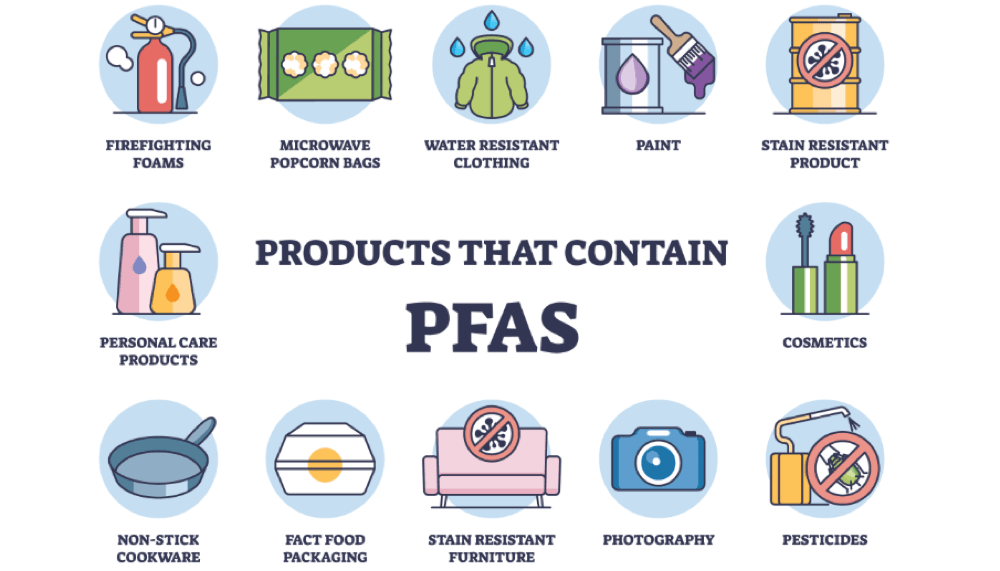
PFAS enter water supplies from firefighting foam (AFFF), industrial discharge, landfill leachate, and thousands of consumer products — non-stick cookware, water-resistant fabrics, food packaging, cosmetics, and more. Because the carbon-fluorine bond is so stable, they persist in the environment and accumulate in drinking-water sources. That widespread, persistent contamination is exactly why regulators now mandate parts-per-trillion treatment.
How to Choose
A Simple Selection Framework
Long-chain dominant + cost-sensitive
Choose GAC. For municipal drinking water and large groundwater flows where PFOA/PFOS dominate, GAC delivers compliant water at the lowest total cost, with reactivation reducing lifecycle spend.
Short-chain PFAS are significant
Choose ion exchange — or GAC followed by an IX polishing step. IX resin captures short-chain PFBS/PFBA that break through carbon early, giving reliable compliance in a compact footprint.
Need broad removal or water reuse
Choose reverse osmosis. When you must remove nearly everything — or produce high-purity water for reuse — RO is the most thorough option, provided you can manage the reject stream and energy cost.
Want the best balance
Combine GAC + IX. A GAC lead bed handles the bulk long-chain load cost-effectively, while a downstream ion-exchange vessel polishes short-chain PFAS — the configuration many utilities now favor.
PFAS Technology Comparison - Frequently Asked Questions
What are the three EPA Best Available Technologies for PFAS?
The US EPA recognizes granular activated carbon (GAC), ion exchange (IX), and reverse osmosis / high-pressure membranes (RO) as Best Available Technologies for PFAS removal in drinking water. All three can bring PFOA and PFOS below the 4 ppt limit; they differ in cost, short-chain performance, footprint, and waste handling.
Which is best for PFAS removal — GAC, ion exchange, or reverse osmosis?
There is no single best technology. GAC is the most cost-effective for most municipal and large-flow systems where long-chain PFAS dominate. Ion exchange performs best on short-chain PFAS and needs the smallest footprint. Reverse osmosis removes the broadest range but is energy-intensive and produces a concentrated reject stream. Many utilities combine GAC with an ion-exchange polishing step.
Why is GAC the most common choice for PFAS?
Granular activated carbon offers the lowest capital and operating cost for typical municipal flows, is a simple and widely-permitted technology, and the spent carbon can be reactivated and reused. It removes long-chain PFOA and PFOS extremely well, which covers the primary regulated compounds for most utilities.
Does activated carbon remove short-chain PFAS?
GAC removes short-chain PFAS such as PFBS and PFBA, but at lower capacity than long-chain compounds — they break through the bed earlier and set the change-out schedule. Where short-chain loads are high, pairing GAC with PFAS-selective ion-exchange resin, or using ion exchange alone, gives more reliable compliance.
What happens to the PFAS waste from each technology?
GAC produces spent carbon that can be sent for high-temperature reactivation (destroying adsorbed PFAS) and reused. Ion exchange produces single-use spent resin that requires incineration or landfill. Reverse osmosis produces a concentrated reject brine that still contains the PFAS and needs further treatment or disposal.
Can I combine GAC and ion exchange for PFAS?
Yes — combining them is increasingly common. A GAC lead bed removes the bulk of long-chain PFAS cost-effectively, and a downstream ion-exchange vessel polishes the short-chain compounds that break through carbon first. This train balances cost with robust short-chain compliance.
Is ion exchange better than activated carbon for PFAS?
Neither is universally better. Ion exchange captures short-chain PFAS (PFBS, PFBA) more effectively and needs a smaller footprint, so it wins where short-chain compounds dominate or space is tight. Activated carbon is more cost-effective for long-chain PFOA/PFOS at large flows and allows spent media to be reactivated. The best choice depends on your PFAS profile, flow rate, and budget — and many systems use both in series.
How much does PFAS treatment cost?
Cost varies widely with flow rate, PFAS concentration, and technology. GAC generally has the lowest total cost for large municipal flows because capital and media costs are modest and carbon can be reactivated. Ion exchange carries higher single-use media cost but a smaller footprint. Reverse osmosis has the highest operating cost, driven by energy and reject-stream disposal. For an accurate estimate, we size the system to your specific PFAS analysis and flow.
Not Sure Which Technology Fits Your Water?
Send us your PFAS analysis (EPA Method 537.1 or 533), flow rate, and target limits. We'll recommend a GAC grade — or a GAC + ion-exchange train — sized for your PFAS profile and budget.
Request a PFAS Quote