
Honeycomb
Activated Carbon
Structured carbon blocks with ultra-low pressure drop for high-volume industrial VOC removal. The efficiency of activated carbon without the fan energy penalty.
⚡ Quick Answer
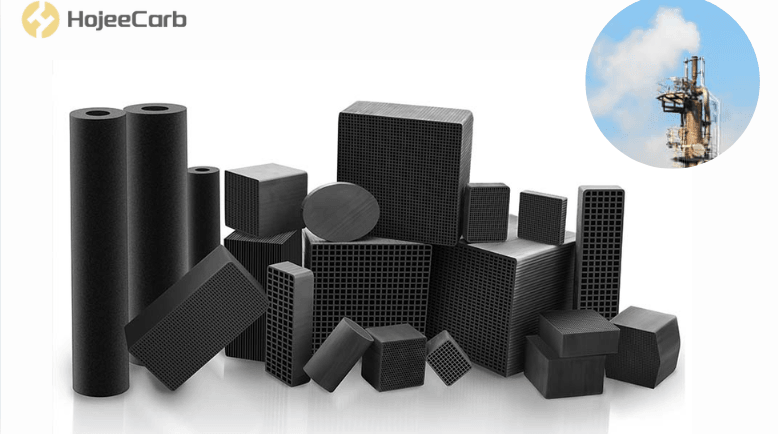
Honeycomb activated carbon (HojeeTech BH400) is a monolithic block with 100–200 cells/in² channel structure, iodine number ≥ 400 mg/g, CTC ≥ 35%, compressive strength ≥ 0.8 MPa, and bed pressure drop < 300 Pa at 1 m/s. The honeycomb geometry offers very low resistance and large geometric surface area per volume, making it ideal for high-flow VOC abatement ducts, industrial exhaust treatment, and solvent recovery where traditional packed beds would be impractical.
- Cell Density
- 100 – 200 cells/in²
- CTC
- ≥ 35%
- Pressure Drop
- < 300 Pa @ 1 m/s
- Compressive Str.
- ≥ 0.8 MPa
Related: All Specialty Carbon · VOC Removal · Air Purification · Get a Quote
Low Pressure Drop, High Efficiency
Honeycomb activated carbon solves the fundamental trade-off in air treatment: how to maximize pollutant contact without creating excessive backpressure. The extruded honeycomb structure creates hundreds of parallel channels that allow air to flow through with minimal resistance while maintaining a large active surface area.
At 1 m/s face velocity, a 100 mm deep honeycomb bed creates less than 300 Pa pressure drop — compared to 800–1500 Pa for an equivalent granular packed bed. This translates directly to lower fan power consumption, reduced noise, and compatibility with existing HVAC systems.
Key Advantages
Pressure Drop
At 1 m/s, 3–5× lower than granular
Contact Area
200 cells/in² = massive surface
Regenerable
Hot air 120°C desorption, 2–3 year life
Custom Sizes
Standard 100×100×100 mm
Applications
- VOC removal from spray painting exhaust
- Printing & coating industry off-gas
- Semiconductor fab chemical scrubbing
- Furniture factory exhaust treatment
- Petrochemical benzene/toluene/xylene removal
- Building ventilation air purification
- Adsorption-desorption catalytic combustion (RCO pre-stage)
- Odor control for food processing plants
Honeycomb vs Granular Carbon for Air Treatment
| Factor | Honeycomb | Granular Bed |
|---|---|---|
| Pressure Drop | < 300 Pa | 800–1500 Pa |
| Fan Energy Cost | Low | High |
| Capacity per Volume | Moderate | Higher |
| Dust Generation | None | Some |
| Regeneration | In-situ hot air | Remove & reactivate |
| Best For | High volume, low conc. | High conc., batch |
Technical Specifications
| Model | HojeeTech BH400 |
| Form | Honeycomb block |
| Dimensions | 100×100×100 mm (standard) |
| Cell Density | 100, 150, 200 cells/in² |
| Wall Thickness | 0.5 – 1.0 mm |
| Iodine Number | ≥ 400 mg/g |
| CTC Adsorption | ≥ 35% |
| Compressive Strength | ≥ 0.8 MPa |
| Moisture | ≤ 5% |
| Bed Pressure Drop | < 300 Pa (at 1 m/s) |
| Temperature Range | ≤ 80°C (standard) |
| Base Material | Coal-based / Coconut shell blend |
Full adsorption isotherm and breakthrough data in TDS
Get QuoteRelated Products
Available Configurations
High capacity, moderate flow
Thicker walls, more carbon per volume. Best for higher concentration VOC streams.
Balanced performance
Most popular choice. Good balance of capacity, pressure drop, and structural strength.
Lowest pressure drop
Thinnest walls, maximum open area. Best for very high air volumes with low VOC levels.
Frequently Asked Questions
What is honeycomb activated carbon?
How does honeycomb carbon compare to granular carbon for air treatment?
What is the difference between water-resistant and standard honeycomb carbon?
How often does honeycomb carbon need replacement?
Can you supply custom dimensions?
Need Custom Honeycomb Dimensions?
We manufacture to your equipment specifications. Tell us the size, cell density, and target pollutant.