
Quick Answer
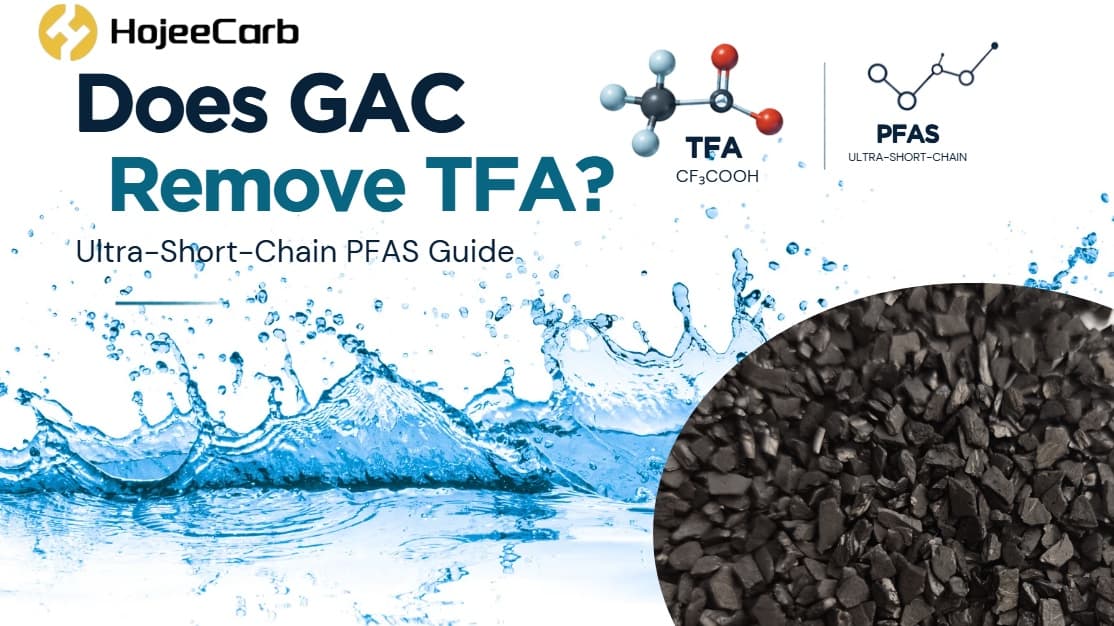
No — granular activated carbon (GAC) does not meaningfully remove TFA under normal water-treatment conditions. GAC captures PFAS mainly by hydrophobic attraction to the fluorinated chain, and trifluoroacetic acid (TFA) is a two-carbon molecule with almost no hydrophobic tail. GAC works well on long-chain PFAS (PFOA, PFOS), moderately on short-chain PFAS (PFBA, PFBS, with earlier breakthrough), and very poorly on ultra-short-chain PFAS like TFA. Removing TFA realistically needs reverse osmosis or nanofiltration inside a multi-barrier train — not carbon alone.
GAC Performance Across PFAS Chain Lengths
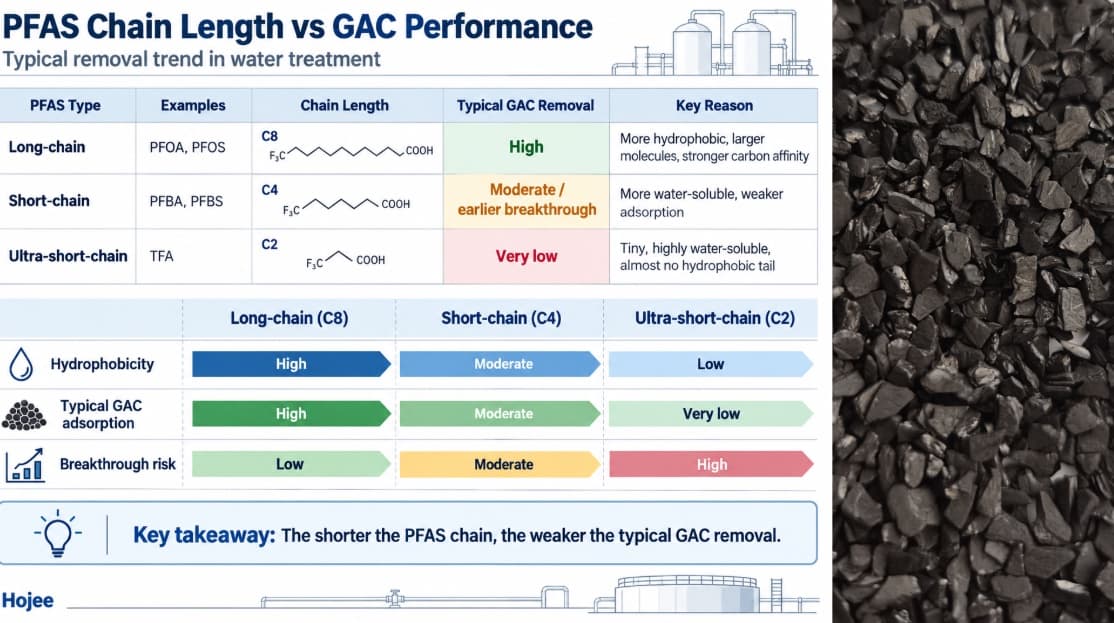
Here is the whole picture in one table before we break it down. Chain length is the single best predictor of how a PFAS molecule behaves on carbon — the longer the fluorinated chain, the stronger it sticks.
| PFAS class | Examples | Carbons | GAC removal | Why |
|---|---|---|---|---|
| Long-chain | PFOA, PFOS | C8 | Strong | Highly hydrophobic, large molecule, strong carbon affinity |
| Short-chain | PFBA, PFBS | C4 | Moderate / early breakthrough | More water-soluble, weaker adsorption, displaced by long-chain PFAS |
| Ultra-short-chain | TFA, PFPrA | C2–C3 | Very poor | Tiny, extremely water-soluble, almost no hydrophobic tail |
Chain-length classes per npj Clean Water (2026): ultra-short 2–3 carbons, short 4–6, long 7+. GAC removal ratings reflect typical full-scale drinking-water practice and the studies cited below.
What Is TFA, and Why Is It Called Ultra-Short-Chain PFAS?
Trifluoroacetic acid (TFA, CF₃COOH) is a per- and polyfluoroalkyl substance with just two carbons. Reviews of PFAS fate classify perfluorocarboxylic acids by chain length: ultra-short-chain at 2–3 carbons, short-chain at 4–6, and long-chain at 7 or more. That makes TFA about as small as a PFAS gets, and its size drives everything that follows.
TFA reaches water from several directions. Fluorinated refrigerant gases break down to TFA in the atmosphere and return in rainfall; a range of PFAS pesticides degrade to TFA in soil and run off into surface water; and industrial discharges add local hotspots. Germany's Umweltbundesamt (UBA) describes TFA as highly mobile — it barely adsorbs to soil or sediment and spreads readily through the water cycle. Once released, it is effectively impossible to recover from the environment at scale.
Regulators are catching up fast. In 2026, EFSA lowered the acceptable daily intake for TFA to 0.014 mg/kg body weight per day (down from 0.05) and set a first acute reference dose of 0.07 mg/kg, after animal studies pointed to developmental, reproductive and thyroid effects. We cover what the numbers mean for water limits in the regulation section below.
Does GAC Remove TFA? The Honest Answer
Under normal drinking-water conditions, GAC removes very little TFA. To see why, it helps to be precise about how carbon captures PFAS in the first place. Adsorption onto activated carbon is driven mainly by hydrophobic interaction between the fluorinated carbon chain and the carbon surface — bench studies show GAC uptake rising with each additional CF₂ unit in the chain. Long-chain PFAS have a long, water-repelling tail that anchors strongly to the carbon. TFA has essentially none.
The field evidence lines up with the theory. In a 2026 study of eastern Massachusetts drinking water published in Environmental Science & Technology Letters (Liddie et al.), plants using GAC and ion exchange removed nearly all other organofluorine compounds from the finished water — yet TFA concentrations were essentially unchanged by treatment and ended up higher than every other measured organofluorine. The researchers' own summary: GAC and IX removed almost all organofluorine except TFA.
Two honest caveats. First, "very poor" is not the same as "exactly zero" — a fresh carbon bed will adsorb a small, short-lived fraction of TFA before it breaks through, and performance depends on the carbon grade, EBCT and the water matrix. Second, this is specifically about ultra-short-chain PFAS. For long-chain PFOA and PFOS, GAC remains one of the most reliable and cost-effective barriers available.
Why Chain Length Decides Everything
The mechanism is laid out clearly in a 2026 review published in npj Clean Water (Lee et al., vol. 9, art. 35): perfluoroalkyl chain length governs hydrophobicity, molecular volume and C–F bond dissociation energy (~485 kJ/mol), and those three properties together determine how any treatment process handles a PFAS compound. The review confirmed that GAC adsorption capacity increases with CF₂ unit count, and that short-chain PFAS initially taken up by GAC are progressively displaced by long-chain homologs over time — a chromatographic roll-up effect that practitioners in lead-lag GAC systems will already recognize.
Adsorption is not the only process affected. The same chain-length hierarchy shows up in membrane rejection and ion exchange. For NF/RO, machine-learning analysis of removal data identified chain length as the dominant predictor: short-chain PFAS require pore sizes of ≤0.4 nm to achieve >90% rejection, while long-chain PFAS are well rejected at ~0.8 nm pores. Ultra-short-chain PFAS showed behavior that differed markedly from longer homologs — in one system, rejection of ultra-short-chain species actually decreased with increasing pressure under acidic conditions, though it improved at alkaline pH, reaching up to 91.4% at pH 9 in that specific pilot setup.
For a detailed comparison of breakthrough volumes across chain lengths and how to design lead-lag GAC for a mix of long- and short-chain PFAS, see our long-chain vs short-chain PFAS removal guide.
Get Factory-Direct Pricing
Request a quote from our team — coal-based, coconut shell, or specialty activated carbon delivered worldwide.
What the 2026 Regulations Say About TFA
TFA sits at a regulatory crossroads. It is covered by some water-quality rules and excluded from others — and understanding the difference matters when you are designing a treatment system or advising a client on compliance.
| Regulation | TFA status | Limit / value |
|---|---|---|
| EU DWD 2020/2184 — PFAS Total | Included | 0.50 µg/L (total PFAS) |
| EU DWD 2020/2184 — Sum of PFAS | Excluded | 0.10 µg/L (≥C3 subset only) |
| EU Directive 2026/805 — surface water EQS | Included (RPF 0.002) | Sum of 25 PFAS as PFOA-equivalents |
| German UBA drinking-water guidance value | Specific value set | LWTW 60 µg/L; target ≤10 µg/L |
| EFSA health-based guidance values (2026) | New, more stringent | ADI 0.014 mg/kg bw/day; ARfD 0.07 mg/kg bw |
Sources: EU DWD 2020/2184 Annex I (EUR-Lex, verified); EU Dir. 2026/805 signed 30 March 2026 (EUR-Lex 2026/805); UBA, October 2020; EFSA, July 2026 (DOI 10.2903/j.efsa.2026.10227).
The DWD distinction is worth spelling out. The stricter 0.10 µg/L "Sum of PFAS" parameter covers only PFAS with a perfluoroalkyl moiety of three or more carbons — meaning TFA's two-carbon chain puts it outside that list. TFA only shows up in the broader 0.50 µg/L "PFAS Total" parameter, which the directive describes as the totality of per- and polyfluoroalkyl substances. Member States must comply with the stricter group and, separately, decide whether to monitor PFAS Total as well — the two limits run in parallel, not in place of each other.
EU Directive 2026/805 — signed 30 March 2026 and in force twenty days after publication — adds TFA to the surface-water priority-substances framework for the first time, within a sum of 25 PFAS expressed as PFOA-equivalents using relative potency factors (TFA RPF = 0.002). The directive's preamble explicitly cites TFA's toxicity, persistence and multiple sources — including PFAS pesticides and fluorinated refrigerant gases — as the reason for inclusion. Groundwater quality standards under the same framework take effect from December 2027, with the aim of achieving good status by December 2039.
Germany's UBA moved earlier: the 2020 guidance value of 60 µg/L was toxicologically derived, replacing a precautionary 3 µg/L value, but UBA still recommends aiming for ≤10 µg/L as a practical target. At the same time, UBA stated explicitly that no method is currently known for removing TFA from water at proportionate cost — even within drinking-water treatment. That is the operational reality driving the search for upstream source-control and, where needed, high-barrier treatment.
Ion Exchange, RO, and the Case for a Treatment Train
If GAC alone is not the answer for TFA, what is? The short version: no single technology is. Each available barrier has a role, and TFA — if it must be reduced — calls for combining them.
Ion exchange resin
Anion-exchange resin outperforms GAC on short-chain PFAS. Bench data in the npj Clean Water review show PFBA uptake of roughly 19–52 mg/g on IX resin versus about 4–5 mg/g on activated carbon. In the Massachusetts field study, the IX plant removed over 99% of targeted PFAS (37 compounds below detection limits), making it significantly more effective than GAC for shorter-chain acids. The same study showed, however, that TFA remained essentially unchanged at the IX site as well, consistent with TFA's very low affinity for standard ion-exchange media in typical operating conditions. For short-chain PFAS management, IX is clearly the stronger choice over GAC; for TFA specifically, it is not sufficient on its own.
Reverse osmosis and nanofiltration
Pressure-driven membranes are the most reliable technical route to TFA removal. A Swiss drinking-water pilot reported more than 99.9% TFA removal with reverse osmosis, according to Ecotox Centre Switzerland (2026). That is a strong removal number, but the same report flags the practical constraints clearly: RO produces a concentrated reject stream, and the energy and capital cost is high enough that it is not considered appropriate for wide-scale deployment. The npj Clean Water review adds that ultra-short-chain PFAS rejection varies with operating conditions in ways that differ from longer homologs — in one forward osmosis/NF pilot, rejection of ultra-short-chain PFAS decreased at higher pressures under acidic conditions, while alkaline conditions improved it. In other words, process conditions matter and RO is not a "set and forget" solution for TFA.
The multi-barrier argument
For a PFAS-impacted source water that contains a mix of long-chain, short-chain and ultra-short-chain compounds, a layered approach makes the most practical sense:
- GAC (lead-lag, coal-based, iodine ≥1,000, EBCT 10–20 min) — handles long-chain PFOA/PFOS at high capacity and lowest cost per unit volume treated. Provides pre-treatment that reduces the load on downstream processes.
- Ion exchange resin (downstream of GAC) — captures short-chain PFAS that GAC passes at lower bed volumes. Regeneration or single-use PFAS-selective resins depending on volume.
- RO or NF (final barrier, where TFA limits apply) — provides the broad-spectrum rejection needed to address TFA and other ultra-short-chain species, plus a further polishing step on anything that slips through earlier stages. Concentrate management must be planned from the start.
For a side-by-side comparison of how GAC, ion exchange and membrane systems are positioned across different PFAS treatment scenarios, see our GAC vs ion exchange vs membrane guide.
Where GAC Still Wins
Pointing out GAC's limits on TFA is not an argument against using carbon. In most PFAS treatment scenarios, GAC earns its place — the question is designing it to do what it is actually good at.
Long-chain PFAS such as PFOA and PFOS are still the dominant regulated compounds in most drinking-water and groundwater contexts — the US EPA set limits of 4 ng/L for each in 2024 — and coal-based GAC with iodine ≥1,000 mg/g running at 10–20 min EBCT achieves 40,000–100,000+ bed volumes to breakthrough on these compounds. That is a proven, scalable, and relatively low-cost solution that no other technology matches at the same capital and operating cost for bulk long-chain PFAS removal. Short-chain PFAS still reach 15,000–40,000 bed volumes on GAC, which is meaningful treatment even if ion exchange or RO is needed downstream.
We supply coal-based GAC in 8×30 and 12×40 mesh, iodine ≥1,000 mg/g, configured for PFAS treatment trains — including lead-lag vessels, spent-carbon logistics, and factory-direct pricing from China. If your project involves a mix of chain lengths, we can help you size each stage.
Working on a PFAS treatment project?
Tell us your compound list, flow rate and target effluent limits — we will recommend the right carbon grade, vessel configuration and EBCT, and send a quote within 24 hours.
Request a QuoteFrequently Asked Questions
Does GAC remove TFA from drinking water?
Not meaningfully under normal water-treatment conditions. Granular activated carbon (GAC) adsorbs PFAS mainly through hydrophobic attraction to the fluorinated carbon chain, and trifluoroacetic acid (TFA) has only two carbons with almost no hydrophobic tail. In a 2026 field study of eastern Massachusetts drinking water (Liddie et al., Environ. Sci. Technol. Lett.), GAC and ion-exchange plants removed nearly all other organofluorine compounds, yet TFA concentrations were essentially unchanged by treatment. GAC is highly effective on long-chain PFAS such as PFOA and PFOS — just not on TFA.
What is TFA and why is it called ultra-short-chain PFAS?
Trifluoroacetic acid (TFA, CF₃COOH) is a per- and polyfluoroalkyl substance (PFAS) with a two-carbon backbone. Reviews classify perfluorocarboxylic acids as ultra-short-chain at 2–3 carbons, short-chain at 4–6, and long-chain at 7 or more (npj Clean Water, 2026). Because it is so small, highly water-soluble and mobile, TFA behaves very differently from the long-chain PFAS most carbon systems were designed to capture.
Is reverse osmosis better than GAC for short-chain PFAS and TFA?
For TFA, yes — membranes outperform adsorption, but with caveats. Reverse osmosis and nanofiltration can reject TFA, and a Swiss drinking-water pilot reported more than 99.9% TFA removal (Ecotox Centre, 2026). However, rejection of ultra-short-chain PFAS is lower than for long-chain PFAS and shifts with pressure and pH, and RO produces a concentrated reject stream plus high energy and cost. That is why RO is deployed as part of a treatment train, not as a universal fix.
Does ion exchange remove TFA?
Anion-exchange resin removes short-chain PFAS better than GAC but is still limited on TFA. Bench data compiled in npj Clean Water (2026) show PFBA uptake of about 19–52 mg/g on ion-exchange resin versus roughly 4–5 mg/g on activated carbon. In the 2026 Massachusetts field study, however, the ion-exchange site removed over 99% of other PFAS while TFA stayed essentially unchanged — so ion exchange helps on short-chain PFAS but is not a reliable barrier for TFA on its own.
What is the EU limit for TFA in drinking water?
TFA is covered by the EU Drinking Water Directive 2020/2184 'PFAS Total' parameter of 0.50 µg/L (the totality of PFAS), but it is excluded from the stricter 'Sum of PFAS' value of 0.10 µg/L, which only counts PFAS with three or more carbons. Germany's UBA set a toxicological drinking-water guidance value of 60 µg/L and advises aiming for 10 µg/L or less. In 2026 EFSA lowered the TFA acceptable daily intake to 0.014 mg/kg body weight per day.
Related guides
Key sources cited in this article
- EFSA (2026) — Consumer health-based guidance values for TFA. DOI: 10.2903/j.efsa.2026.10227
- Lee et al. (2026) — Chain-length-dependent PFAS fate and treatment. npj Clean Water 9, art. 35.
- Liddie et al. (2026) — TFA in eastern Massachusetts drinking water. Environ. Sci. Technol. Lett. 13(8), 1157–1163.
- UBA (2020) — Trifluoroacetate: persistent substance found everywhere.
- EU Drinking Water Directive 2020/2184 (EUR-Lex).
- EU Directive 2026/805 — water policy EQS update, signed 30 March 2026 (EUR-Lex).