
Applications
Activated Carbon for Bass Traps: How It Absorbs Low Frequencies
Activated carbon is not the first material most people reach for when they build a bass trap. Foam and mineral wool are. But if you have ever tried to kill a 45 Hz room mode with foam, you already know the problem: to absorb bass with a porous absorber, you need depth you do not have.
Activated carbon solves that a different way. It does not absorb low frequencies by being thick. It absorbs them by adsorption — the same pore physics we sell it for in gas and water treatment, applied to sound. This is why studio builders and loudspeaker engineers fill sealed cavities with carbon, and why one of our steady product lines is 5 mm coal-based columnar activated carbon going to acoustic customers.
Here is how it works, and why the 5 mm coal-based columnar grade is the one that gets specified for it.
Why Low Frequencies Are Hard to Absorb
Sound is a pressure wave, and the lower the frequency, the longer the wave. A 40 Hz bass note has a wavelength of about 8.6 metres. A 100 Hz note is about 3.4 metres.
A porous absorber like foam or mineral wool works by friction: air moves through the material and loses energy. That friction is only significant where air velocity is high, which is roughly a quarter-wavelength away from the wall. For a 40 Hz wave, that is over 2 metres of standoff. Nobody builds a 2-metre-deep wall panel, so foam simply does not touch the low end. It handles treble and upper mids and gives up below 200 Hz.
That is the gap activated carbon fills.
How Activated Carbon Absorbs Bass
Activated carbon has an enormous internal surface area — hundreds to over a thousand square metres per gram — packed into a network of micropores. In gas and water treatment, we use that surface to hold molecules by adsorption. In an acoustic panel, the same pore network does something related but distinct.
When a low-frequency pressure wave enters a sealed cavity packed with carbon, air molecules are pushed into and out of the micropores as the pressure rises and falls. Two things happen:
1. Adsorption and desorption cycle with the pressure. As pressure rises, more air molecules adsorb onto the pore walls. As it falls, they release. This cycling lags the pressure wave and dissipates energy as heat.
2. The pore network behaves like a larger volume than the box actually is. Because gas can pack into the micropores, a sealed enclosure filled with activated carbon acts acoustically as if it were larger than its physical size. Loudspeaker designers exploit this exact effect to make a small sealed subwoofer box behave like a bigger one and reach a lower tuning. In a bass trap, the same "virtual volume" lets a shallow panel damp long wavelengths that its physical depth should not be able to touch.
The result is an absorber that works low — down into the 30–80 Hz range where room modes live — without the metre-scale depth a porous trap would need. That is the whole reason carbon gets used here.
Why Coal-Based Columnar Carbon
Not every activated carbon is right for this. The acoustic customers who order from us specify coal-based columnar carbon, and there are concrete reasons.
Coal-based, not coconut shell. This is the opposite of what we recommend for drinking water. Drinking water wants coconut shell for its low ash and micropore dominance. Acoustic use wants coal-based carbon because its broader pore distribution — a mix of micro-, meso- and macropores — gives the pressure wave more accessible pore volume across the frequencies that matter. Pure micropore material is not the goal here; a fuller pore spectrum is.
Columnar (extruded pellet), not granular or powder. Columnar carbon is extruded into uniform cylindrical pellets. That shape matters for three reasons:
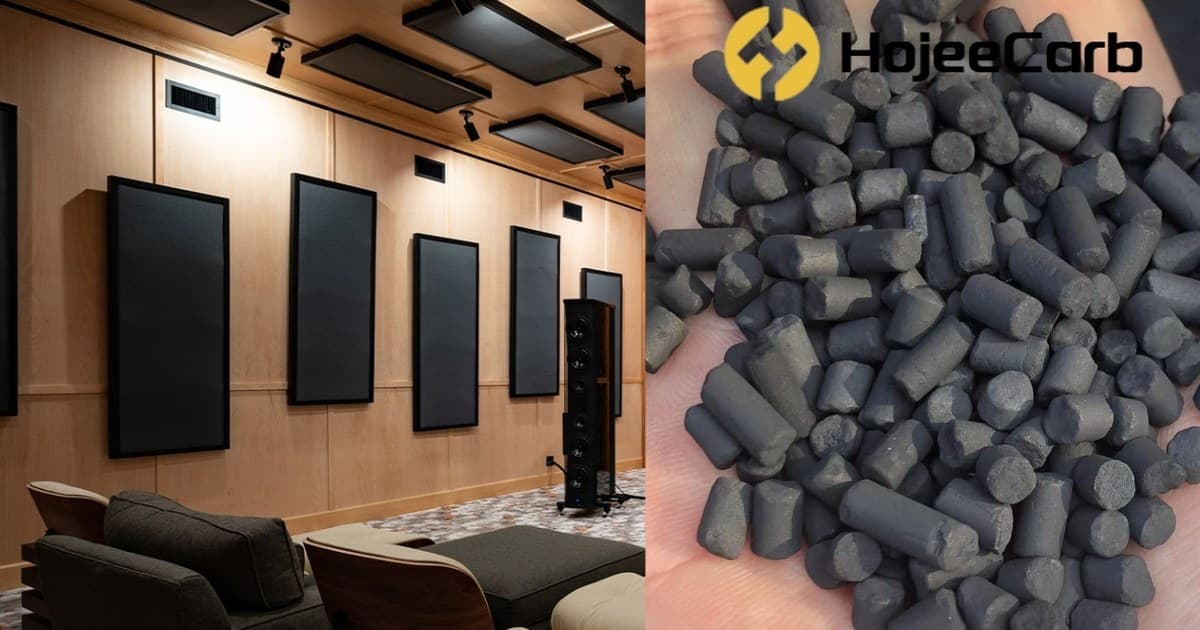
- Consistent packing. Uniform pellets pack to a predictable, repeatable density in every panel. Granular carbon of mixed sizes settles and channels, so two panels filled from the same sack can perform differently.
- Low dust. Extruded pellets are hard and shed very little fine dust. Powdered or soft granular carbon sheds dust that migrates through fabric and coats a studio. For a product that sits in a room full of microphones and electronics, low dust is not optional.
- Open airflow between pellets. The gaps between uniform cylinders let the pressure wave reach the pellet surfaces evenly, instead of hitting a packed, low-permeability mass.
Need activated carbon?
Get Factory-Direct Pricing — No Middlemen
20+ years manufacturing. MOQ 1 ton. Free samples. Reply within 2 hours.
Why 5 mm
Pellet diameter is a balance, and 5 mm is the size acoustic customers keep coming back to.
Smaller pellets (3 mm and below) pack tighter and expose more surface, but they also restrict airflow between pellets and add weight. Larger pellets (8–9 mm) let air move freely but leave large voids and less working surface for a given cavity.
5 mm sits at the point where the pellets pack densely enough to load the cavity with active surface, while the inter-pellet gaps stay open enough for the pressure wave to penetrate the full depth of the fill. It also keeps panel weight manageable — a carbon-filled trap is already heavy, and jumping to a smaller pellet raises fill density and weight without a matching acoustic gain.
Typical Specification for Acoustic Grade
This is the grade we supply to bass-trap and loudspeaker customers. The batch certificate of analysis governs any individual shipment.
| Parameter | Specification |
|---|---|
| Raw material | Coal-based (bituminous) |
| Shape | Columnar / extruded pellet |
| Diameter | 5 mm |
| Iodine value | ≥900 mg/g |
| Specific surface area (BET) | 900–1100 m²/g |
| Moisture | ≤5% |
| Ash | ≤15% |
| Apparent density | 0.45–0.55 g/cm³ |
| Hardness | ≥90% |
Note the priorities are different from a water grade. Iodine value and surface area still matter — they measure how much active pore volume you get — but for acoustics we care more about consistent pellet size, low dust and repeatable packing density than about squeezing iodine value to the top of the range.
How Customers Use It
The usual build is a sealed panel or box with a rigid back, filled with 5 mm columnar carbon, faced with an acoustically open fabric or perforated panel that lets pressure through while holding the pellets in. It sits in a room corner where bass pressure is highest, often stacked floor to ceiling.
Two practical points customers ask about:
Sealing and dust. Even low-dust pellets need containment. A breathable inner liner (a fine fabric bag) around the fill keeps stray fines out of the room while letting the pressure wave through. We can supply the carbon in inner-lined bags if it helps your build.
Weight. Carbon is dense. A full-height corner trap can weigh tens of kilograms. Plan the frame and floor loading for it. This is the trade for the low-frequency performance — there is no light way to damp a 40 Hz mode.
For the underlying pore physics behind all of this, the standard reference on adsorption surface area is the IUPAC recommendations on physisorption, which define the BET method used to report the surface area figures above.
Why Order From Us
We are a factory, not a trader. Our base sits on a coal source that suits coal-based columnar carbon, and we run the extrusion and activation ourselves. That is what lets us hold pellet diameter and packing density consistent from batch to batch — the thing that matters most for an acoustic fill, where every panel needs to behave like the last.
We supply trial quantities as well as bulk, and we can deliver the carbon inner-lined for dust control if your build needs it. If you are unsure whether 5 mm is right for your cavity depth, tell us the panel dimensions and we will talk it through rather than just quote a number.
Need 5 mm Columnar Carbon for Bass Traps?
Tell us your quantity, packing preference, and destination. If you need the carbon inner-lined for dust control, let us know and we will quote accordingly. Trial quantities welcome.
Frequently Asked Questions
Does activated carbon really absorb bass better than foam?
For low frequencies, yes, at a given panel depth. Foam and mineral wool work by airflow friction and need roughly a quarter-wavelength of depth to be effective, which is impractical below ~200 Hz. Carbon works by pressure-driven adsorption in a sealed cavity, so a shallow panel can damp much lower frequencies than foam of the same depth.
Why coal-based instead of coconut shell for acoustics?
Coconut shell is micropore-dominated, which is ideal for drinking water but not the target here. Coal-based carbon has a broader pore distribution that gives the pressure wave more accessible pore volume across the low-frequency range. For acoustics, coal-based columnar is the standard choice.
Why 5 mm and not smaller or larger pellets?
5 mm balances packing density against airflow. Smaller pellets pack tight but restrict the pressure wave from penetrating the fill; larger pellets leave big voids and less working surface. 5 mm loads the cavity with active surface while keeping the inter-pellet gaps open.
Will the carbon shed dust into my studio?
Extruded columnar pellets are hard and low-dust, far cleaner than powdered or soft granular carbon. We still recommend a breathable inner liner around the fill for containment, and we can supply the carbon inner-lined.
Can I order a small trial quantity?
Yes. We supply trial quantities as well as bulk, so you can validate a single panel build before committing to a full room.