
Application Guide
Activated Carbon for Swimming Pool Water Treatment: 5 Specs That Matter
Published May 30, 2026 · 12 min read
⚡ Quick Answers
- What type of activated carbon is best for swimming pool water treatment?
- Coconut shell GAC in 8x30 mesh is the industry standard for swimming pool filtration. It has the highest micropore volume (0.4-0.5 cc/g) for chloramine and THM adsorption, plus superior hardness (97%+) to resist abrasion from backwashing cycles. Coal-based 12x40 is a budget alternative for large municipal pools where cost per ton matters more than per-unit performance.
- How often should activated carbon be replaced in a pool filtration system?
- For commercial pools: every 12-18 months under normal loading. Municipal aquatic centers with high bather loads may need replacement every 8-12 months. Monitor by testing effluent chloramine levels — when breakthrough exceeds 0.5 mg/L consistently, it is time to change. Some operators extend life to 24 months by using a lead-lag configuration with two GAC vessels.
- How much activated carbon does a commercial swimming pool need?
- Calculate bed volume using: Flow Rate (m³/h) × EBCT (minutes) ÷ 60. For a standard 50m Olympic pool circulating at 200 m³/h with 10-minute EBCT, you need 33.3 m³ of GAC bed volume, which equals roughly 15-17 tons of carbon at 450-500 kg/m³ bulk density. Most commercial pools use 2-8 tons depending on pool volume and turnover rate.
- Can activated carbon remove chlorine and chloramines from pool water?
- Yes. GAC removes free chlorine through catalytic decomposition (not just adsorption), which means the carbon does not get exhausted as quickly for chlorine removal. Chloramines are removed through adsorption and require more contact time — minimum 5-minute EBCT for monochloramine, 10 minutes recommended. This is why pool GAC beds are sized larger than drinking water systems.
If you run a commercial pool or aquatic center, you already know chlorine alone does not solve your water quality problems. Chloramines build up, THMs form, and swimmers complain about eye irritation and that harsh chemical smell. Granular activated carbon (GAC) is how you fix this — it strips out disinfection byproducts while keeping your water crystal clear.
We have been supplying pool-grade GAC to water parks, hotel chains, and municipal pools across 30+ countries for over 15 years. Here is what actually matters when you are sourcing activated carbon for pool water treatment.
Quick Comparison: Pool-Grade GAC Options
| Specification | Coconut Shell 8×30 | Coal-Based 12×40 | Why It Matters |
|---|---|---|---|
| Raw Material | Coconut shell | Bituminous coal | Determines pore structure |
| Mesh Size | 8×30 (0.6-2.4mm) | 12×40 (0.4-1.7mm) | Flow rate & contact time |
| Iodine Number | 1050-1100 mg/g | 900-1000 mg/g | Adsorption capacity indicator |
| Hardness | 97-99% | 90-95% | Resists backwash abrasion |
| Bulk Density | 480-520 kg/m³ | 450-500 kg/m³ | Bed weight calculation |
| Micropore Volume | 0.4-0.5 cc/g | 0.25-0.35 cc/g | Chloramine removal efficiency |
| FOB Price | $1,450-1,950/ton | $450-1,550/ton | Total cost of ownership |
| Best For | Hotels, water parks, competition pools | Large municipal pools, budget projects | Match to your priority |
Why Swimming Pools Need Activated Carbon
Activated carbon in pool filtration removes what sand filters and chlorine cannot — specifically disinfection byproducts (DBPs) that form when chlorine reacts with organic matter from swimmers (sweat, skin oils, cosmetics, urine).
The three main problems GAC solves in pool water:
- Chloramine removal — Combined chlorine (mono-, di-, and trichloramine) causes eye/skin irritation and that harsh "pool smell." GAC adsorbs chloramines through both physical adsorption and catalytic decomposition. Target: keep combined chlorine below 0.5 mg/L per WHO guidelines.
- THM reduction — Trihalomethanes (chloroform, bromodichloromethane) are regulated carcinogens. EU Directive 2020/2184 limits THMs to 100 µg/L in pool water. GAC typically achieves 60-80% THM removal.
- Taste, odor & color improvement — Removes dissolved organics that cause yellow tinting and unpleasant taste. Swimmers notice the difference immediately.
According to the German DIN 19643 standard (the gold standard for pool water treatment), GAC filtration is mandatory for public swimming pools. Most European countries follow this requirement. If you are building or upgrading a commercial pool, GAC is not optional — it is required.
How GAC Works in Pool Filtration Systems
GAC is installed as a secondary filtration stage after your sand/multimedia filter and before the disinfection dosing point. The typical treatment train looks like this:
- Pool water → Hair/lint strainer (pre-filtration)
- → Sand/multimedia filter (removes particles >10µm)
- → GAC adsorber (removes dissolved organics, chloramines, THMs)
- → UV or ozone (optional secondary disinfection)
- → Chlorine dosing (maintains residual)
- → Back to pool
The GAC vessel operates as a fixed-bed adsorber. Pool water flows down through the carbon bed (downflow mode), and contaminants are trapped in the carbon's pore structure. Backwashing every 1-2 weeks removes trapped particulates and prevents channeling.
Key design point: the GAC bed must be sized for adequate Empty Bed Contact Time (EBCT). Too short = poor removal. Too long = unnecessary cost. We will cover sizing in detail below.
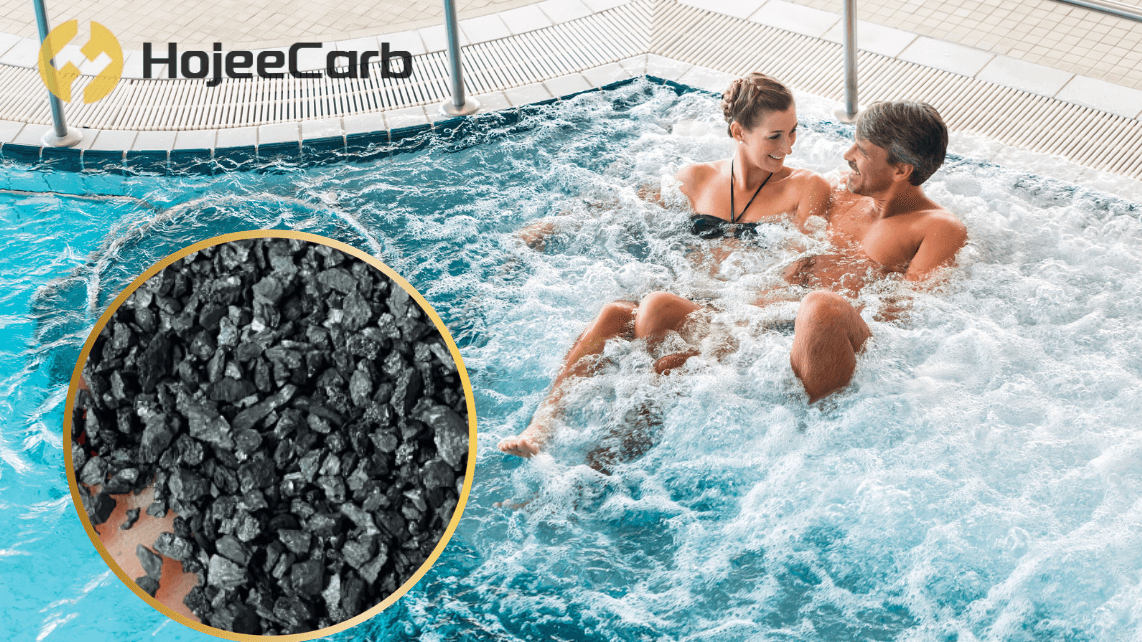
5 Specifications That Determine Pool GAC Performance
Not all activated carbon works well in pool applications. Here are the 5 specs you need to check before ordering:
1. Mesh Size: 8×30 Is the Sweet Spot
8×30 mesh (0.6-2.4mm particle size) provides the optimal balance between adsorption kinetics and hydraulic performance for pool systems. Smaller particles (12×40) give slightly better adsorption but create higher pressure drop and more fines during backwashing. Larger particles (6×12) have lower pressure drop but slower kinetics.
For pools with flow rates above 50 m³/h, stick with 8×30. For smaller residential or spa systems under 10 m³/h, 12×40 can work if your vessel design handles the pressure drop.
2. Iodine Number: Minimum 1000 mg/g
Iodine number indicates total adsorption capacity. For pool water treatment, you want minimum 1000 mg/g — this ensures enough capacity to handle the continuous organic loading from swimmers. Our coconut shell GAC tests at 1050-1100 mg/g consistently.
Below 900 mg/g, you will see premature breakthrough and need more frequent replacement. Not worth the savings.
3. Hardness: 95%+ for Pool Applications
Pool GAC gets backwashed regularly — typically weekly. Each backwash cycle creates abrasion between particles. Low-hardness carbon breaks down into fines that wash out of the system, reducing bed volume over time.
Coconut shell carbon naturally achieves 97-99% hardness (ball-pan test). Coal-based typically hits 90-95%. For pools with aggressive backwash schedules, coconut shell pays for itself through longer bed life.
4. Ash Content: Below 5%
High ash content means mineral impurities that can leach into pool water, affecting pH and potentially causing cloudiness. Coconut shell GAC typically has 2-3% ash. Coal-based runs 8-12% unless acid-washed.
For pool applications, specify maximum 5% ash content. If using coal-based carbon, request acid-washed grade to bring ash below 5%.
5. Moisture Content: Maximum 5% at Delivery
You are paying per ton — moisture is dead weight. More importantly, high moisture carbon takes longer to wet and activate in the bed, meaning your first few days of operation may show poor performance. Specify maximum 5% moisture at delivery.
Need pool-grade activated carbon?
Get Factory-Direct Pricing — No Middlemen
20+ years manufacturing. MOQ 1 ton. Free samples. Reply within 2 hours.
Need bulk pricing for pool-grade activated carbon?
Factory-direct rates, MOQ 1 ton. Get a quote in 24 hours.
GAC vs PAC for Pool Water: Which to Choose
For swimming pool applications, GAC (granular) is almost always the correct choice over PAC (powdered). Here is why:
| Factor | GAC (Granular) | PAC (Powdered) |
|---|---|---|
| Installation | Fixed bed in pressure vessel | Dosed into water, removed by filtration |
| Operating cost | Lower (reusable for 12-18 months) | Higher (single-use, continuous dosing) |
| Consistency | Steady removal, predictable | Variable, depends on dosing accuracy |
| Backwash waste | Minimal (carbon stays in vessel) | Generates carbon sludge |
| Best for pools? | ✅ Yes — standard approach | ❌ Only for emergency/temporary use |
PAC has one niche use in pools: emergency treatment after a contamination event (fecal incident, chemical spill). You dose PAC at 20-50 mg/L for rapid adsorption, then filter it out. But for continuous treatment, GAC in a fixed bed is the industry standard.
For a deeper comparison, see our complete GAC vs PAC guide.
System Design: EBCT, Flow Rate & Bed Sizing
The critical design parameter for pool GAC systems is Empty Bed Contact Time (EBCT) — the time water spends in contact with the carbon bed. For swimming pools, recommended EBCT values are:
- Chloramine removal: 5-10 minutes EBCT (minimum 5 min)
- THM removal: 7-15 minutes EBCT
- Combined chloramine + THM: 10-15 minutes EBCT (recommended)
Sizing Calculation Example
For a 25m × 12.5m commercial pool (312.5 m³ volume) with 4-hour turnover:
- Flow rate: 312.5 m³ ÷ 4 hours = 78 m³/h
- Target EBCT: 10 minutes
- Required bed volume: 78 m³/h × (10 min ÷ 60) = 13 m³
- Carbon weight: 13 m³ × 500 kg/m³ (bulk density) = 6,500 kg = 6.5 tons
- Vessel diameter: For 5-10 m/h linear velocity → 3.1-4.4 m² cross-section → 2.0-2.4m diameter vessel
This is a typical mid-size commercial pool. Olympic pools (2,500 m³) need 20-30 tons. Hotel pools (150 m³) need 2-4 tons. Contact us with your pool specs and we will calculate exact requirements.
For dosage calculations on other water treatment applications, try our activated carbon dosage calculator.
Replacement Cycle & Monitoring
Pool-grade GAC typically lasts 12-18 months before requiring replacement, depending on bather load and water chemistry.
Factors that shorten GAC life:
- High bather load (>40 swimmers/hour) — more organics to adsorb
- High water temperature (>30°C) — reduces adsorption capacity
- Poor pre-filtration — particulates clog carbon pores
- High chlorine residual entering GAC bed (>2 mg/L) — accelerates oxidation
How to monitor GAC performance:
- Weekly: Test combined chlorine in GAC effluent. Fresh carbon: <0.1 mg/L. Approaching exhaustion: >0.3 mg/L.
- Monthly: Test THM levels. If exceeding 50% of your target limit, plan replacement within 2-3 months.
- Quarterly: Check pressure drop across bed. Increasing pressure = compaction or fouling. May need backwash optimization before full replacement.
Pro tip: use a lead-lag configuration (two GAC vessels in series). When the lead vessel is exhausted, swap positions — the lag becomes the lead, and you replace only the exhausted vessel. This gives continuous protection with no downtime.
Bulk Sourcing: MOQ, Pricing & Shipping from China
China produces over 60% of the world's activated carbon, and factory-direct pricing is typically 30-50% below what European or American distributors charge. Based on our 20+ years of export experience, here is what pool operators need to know:
Pricing (FOB Ningbo/Shanghai, 2026)
- Coconut shell 8×30, iodine 1050+: $1,450-1,950/ton
- Coal-based 12×40, iodine 900+: $450-1,550/ton
- Acid-washed coal 12×40: $900-2,000/ton
MOQ & Packaging
- Minimum order: 1 ton (for trial orders). Standard orders: 5-20 tons.
- Packaging: 25kg bags on pallets, 500kg/1000kg jumbo bags, or bulk in container liner
- Container capacity: 20-22 tons per 20ft container
Shipping & Lead Time
- Production: 7-15 days after order confirmation
- Shipping to Europe: 25-35 days (Ningbo → Rotterdam/Hamburg)
- Shipping to North America: 20-30 days (Ningbo → LA/Long Beach)
- Shipping to Middle East: 15-20 days (Ningbo → Jebel Ali)
Quality Assurance
We provide COA (Certificate of Analysis) with every shipment, tested by SGS or our in-house lab. Key parameters tested: iodine number, mesh distribution, hardness, moisture, ash content, pH. Free 500g samples available for your own testing before bulk order.
For more on sourcing activated carbon from China, see our complete water treatment applications guide and coconut shell GAC product page.
Coconut Shell vs Coal-Based: Which Is Better for Pools?
For most commercial pools, coconut shell GAC delivers better performance per dollar despite the higher unit price. Here is the math:
- Coconut shell lasts 15-18 months in pool service (higher hardness, less degradation)
- Coal-based lasts 10-14 months (lower hardness, more fines generation)
- Coconut shell removes 20-30% more chloramines per kg (higher micropore volume)
- Net result: coconut shell costs ~15% more upfront but lasts ~30% longer = lower total cost
Exception: if your pool is very large (>1000 m³) and budget is the primary constraint, coal-based 12×40 at $450-1,550/ton makes sense. You will replace more often, but the lower unit cost offsets it at scale.
Detailed comparison: Coconut Shell vs Coal-Based Activated Carbon.
Request a Quote
Get pool-grade activated carbon Pricing — Factory Direct
Tell us your application and required quantity. We reply with a factory quote within 24 hours.
Frequently Asked Questions
What type of activated carbon is best for swimming pool water treatment?
Coconut shell GAC in 8x30 mesh is the industry standard for swimming pool filtration. It has the highest micropore volume (0.4-0.5 cc/g) for chloramine and THM adsorption, plus superior hardness (97%+) to resist abrasion from backwashing cycles. Coal-based 12x40 is a budget alternative for large municipal pools where cost per ton matters more than per-unit performance.
How often should activated carbon be replaced in a pool filtration system?
For commercial pools: every 12-18 months under normal loading. Municipal aquatic centers with high bather loads may need replacement every 8-12 months. Monitor by testing effluent chloramine levels — when breakthrough exceeds 0.5 mg/L consistently, it is time to change. Some operators extend life to 24 months by using a lead-lag configuration with two GAC vessels.
How much activated carbon does a commercial swimming pool need?
Calculate bed volume using: Flow Rate (m³/h) × EBCT (minutes) ÷ 60. For a standard 50m Olympic pool circulating at 200 m³/h with 10-minute EBCT, you need 33.3 m³ of GAC bed volume, which equals roughly 15-17 tons of carbon at 450-500 kg/m³ bulk density. Most commercial pools use 2-8 tons depending on pool volume and turnover rate.
Can activated carbon remove chlorine and chloramines from pool water?
Yes. GAC removes free chlorine through catalytic decomposition (not just adsorption), which means the carbon does not get exhausted as quickly for chlorine removal. Chloramines are removed through adsorption and require more contact time — minimum 5-minute EBCT for monochloramine, 10 minutes recommended. This is why pool GAC beds are sized larger than drinking water systems.
What is the price of bulk activated carbon for pool water treatment?
FOB China pricing for pool-grade GAC: coconut shell 8x30 mesh ranges $1,450-1,950/ton, coal-based 12x40 mesh ranges $450-1,550/ton. Minimum order is typically 1-5 tons. Delivered price to Europe or North America adds $200-400/ton for shipping. Volume discounts apply above 20 tons — contact us for exact quotes based on your specifications.
Ready to Source Pool-Grade GAC?
Whether you are building a new aquatic center or replacing exhausted carbon in an existing system, we can help. Tell us your pool volume, flow rate, and target contaminants — we will recommend the right carbon grade and calculate exact quantities.
- Free 500g sample for lab testing
- COA with every shipment (SGS tested)
- MOQ 1 ton for trial, volume discounts above 20 tons
- DDP delivery available to EU, US, Middle East