
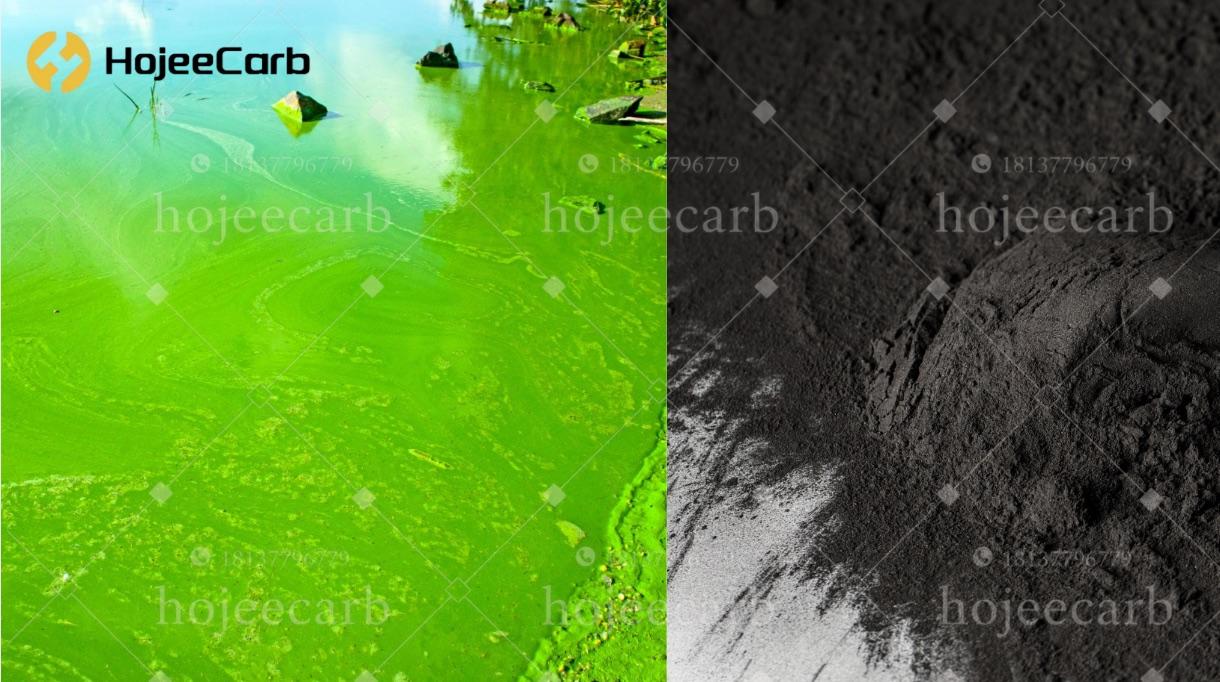
When a harmful algal bloom reaches a reservoir intake, two separate problems can arrive at the same time. The first is taste and odor — the earthy, musty smell caused by geosmin and MIB, which we cover in a separate guide. The second is more serious: the same cyanobacteria release cyanotoxins such as microcystins, which are a genuine health hazard at concentrations in the low microgram-per-litre range. This article is about that second problem.
Short answer: activated carbon removes dissolved cyanotoxins, and it is one of the most widely deployed treatment barriers available to water utilities. But it only works if you match the pore structure to the target molecule, place adsorption and oxidation in the right order for your water, and understand what conventional filtration can and cannot do on its own.
The Three Cyanotoxins You Plan For
| Toxin | Produced by | Drinking-water guideline or health advisory | Adsorbs on carbon? |
|---|---|---|---|
| Microcystins (incl. MC-LR) | Microcystis, Planktothrix | WHO provisional 1 µg/L total microcystins (lifetime, all congeners, free+cell-bound); EPA 10-day HA 0.3 / 1.6 µg/L (age groups) | Yes — mesopore-dependent |
| Cylindrospermopsin | Cylindrospermopsis, Raphidiopsis | EPA 10-day HA 0.7 µg/L under-6 / 3.0 µg/L school-age+ | Yes — harder, more polar |
| Anatoxin-a / saxitoxins | Anabaena, Aphanizomenon | No federal MCL; advisory levels vary | Partial — PAC helps, data thinner |
Cyanotoxin — definition. A toxin produced by cyanobacteria (blue-green algae) during a harmful algal bloom. In water it exists in two forms: locked inside intact cells (intracellular) and dissolved freely in the water (extracellular). Conventional coagulation–sedimentation–filtration removes intact cells. Activated carbon is what removes the dissolved extracellular fraction that filtration cannot catch.
That distinction shapes the treatment sequence. A strong oxidant dosed early can rupture intact cells and release dissolved toxin, so one common approach keeps cells intact through the early stages and lets carbon handle the dissolved fraction. Whether oxidation belongs before or after adsorption depends on the target toxin, the state of the cells, raw-water quality, and the plant's existing process — set it from testing, not a fixed rule.
Why Microcystin Is Harder to Adsorb Than Geosmin
This is the technical point most carbon suppliers skip, and it explains why a carbon that handles geosmin well can fail on microcystin even though both come from the same bloom.
Geosmin and MIB are small molecules — 168–182 g/mol, roughly 1.5–2.0 nm across. They adsorb efficiently into micropores (under 2 nm), where adsorption energy is highest. That is why high-micropore coconut shell activated carbon is the first choice for taste and odor control.
Microcystin-LR is a cyclic heptapeptide with a molecular weight of roughly 995 g/mol — about five times larger. A molecule that size cannot enter the tightest micropores at all. It needs mesopores (2–50 nm) to reach the internal surface.
Why iodine value misleads you here. Iodine number, the standard carbon quality test, measures micropore surface area. It predicts geosmin removal well but under-predicts microcystin capacity, because the large peptide is excluded from the pores iodine probes. For cyanotoxin duty the more relevant figures are methylene blue value (a mesopore proxy) and a direct microcystin jar test.
| Target compound | Molecular weight | Pore range that matters | Carbon that fits |
|---|---|---|---|
| Geosmin / MIB | 168–182 g/mol | Micropore (<2 nm) | High-micropore coconut shell |
| Microcystin-LR | ~995 g/mol | Mesopore (2–50 nm) + transport macropores | Mesopore-rich wood-based or selected coal |
| Cylindrospermopsin | ~415 g/mol | Micropore + small mesopore | Coconut or mesopore-rich, bloom-dependent |
This is why wood-based activated carbon, which carries far more mesopore volume than coconut shell, often outperforms a higher-iodine coconut PAC on microcystin removal. The same bloom can produce both geosmin and microcystin, but one carbon grade does not solve both. Many utilities run a wood or coal PAC for the toxin and coconut GAC for the taste, and treat them as separate barriers.
PAC vs GAC During a Bloom Event
| Factor | PAC (powdered) | GAC (granular bed) |
|---|---|---|
| Best for | Seasonal bloom spikes, emergency response | Chronic bloom seasons, standing final barrier |
| Capital cost | Low — uses existing chemical dosing | High — dedicated contactor vessels |
| Operational flexibility | Dose adjustable day by day | Fixed bed; a change is a media swap, not a dial |
| Response speed | Effective same day | Requires ongoing operation and media management |
| Toxin-removal assurance | Raise dose the day raw-water toxin climbs | Steady baseline; watch breakthrough late in the run |
| Spent media handling | Removed with sludge at the clarifier | Reactivation every 6–18 months, site-specific |
Use PAC when your bloom season is a 6–10 week event and the plant already has slurry dosing. You can run zero powdered activated carbon most of the year and raise the dose the week raw-water microcystin rises, with jar testing on your own raw water to set each dose change.
Use GAC when cyanotoxins appear in source water for more than three or four months a year, or when you need a permanent barrier. One caveat specific to toxins: a granular activated carbon bed that has run 12+ months in taste-and-odor duty may already be loaded with natural organic matter, leaving little capacity for microcystin. A bed still removing geosmin can let the toxin break through. Verify against the toxin itself, not odor reduction.
An important operational note. During a bloom event, the smell of geosmin or MIB is not a reliable guide to whether cyanotoxins are present or have been removed. A carbon bed can still strip earthy odors while toxin passes through — and a bloom with no detectable odor can still carry significant toxin concentrations. Test for the target toxin in treated water to confirm removal, regardless of how the finished water smells.
Need activated carbon?
Get Factory-Direct Pricing — No Middlemen
20+ years manufacturing. MOQ 1 ton. Free samples. Reply within 2 hours.
Setting the PAC Dose for Dissolved Microcystin
There is no universal mg/L figure to copy. The right PAC dose, contact time, and carbon grade depend on the dissolved toxin level and congener, NOM load, pH, and water temperature — all of which vary by source and by week. Set them from a jar test on your own raw water, then confirm against treated-water toxin monitoring before relying on the dose operationally.
As a published reference point, the US EPA notes that PAC doses in excess of 20 mg/L may be needed for complete toxin removal, especially where NOM is high — but it frames this as water-quality-dependent, not a set-point. Your jar-test result and treated-water monitoring are the governing numbers, not a table value.
Three factors that quietly cut removal at a given dose:
- Oxidant placement. An oxidant dosed upstream of carbon competes for adsorption sites, and pre-oxidation can lyse cells and release intracellular toxin. Decide the adsorption/oxidation order from your target toxin and water quality rather than a blanket rule, then verify with treated-water monitoring.
- High NOM. Natural organic matter competes for the mesopores the toxin needs, so higher DOC generally calls for more carbon or longer contact. How much more is a jar-test question on your raw water, not a fixed percentage.
- Short contact time. Microcystin adsorbs more slowly because of its size, so very short contact windows depress removal. Confirm the contact time your process actually delivers against jar-test performance.
GAC Design Parameters for a Cyanotoxin Barrier
| Parameter | Guidance (verify by site test) | Why it differs from T&O duty |
|---|---|---|
| EBCT (empty bed contact time) | Longer than for taste-and-odor — set by pilot or jar test on target toxin | Microcystin adsorbs more slowly than geosmin, so a bed sized for taste-and-odor duty may be short; the requirement is set by pilot data on your water and carbon |
| Bed depth | Sufficient for transfer zone — 1.5–2.0 m is a common design starting point | Provides transfer zone for the larger molecule |
| Surface loading rate | Comparable to taste-and-odor bed | Less sensitive than contact time for large-MW toxins |
| Carbon type | Mesopore-rich wood or selected coal | Match pore size to toxin MW, not iodine value |
| Methylene blue value | Specify a minimum as initial screening criterion | Mesopore proxy; use direct toxin jar test on project raw water to confirm capacity |
| Reactivation trigger | Microcystin breakthrough in treated water | Running on headloss or odor reduction alone leaves a health risk |
The key design difference from a taste-and-odor bed is a longer contact time and a mesopore-biased carbon grade, because microcystin adsorbs more slowly than geosmin. How much longer is site-specific: it depends on raw-water NOM, the target toxin congener, and the carbon grade. Determine the requirement from a pilot or column test on your raw water, then verify in service with treated-water microcystin monitoring. The EPA also notes that GAC condition matters — a bed loaded with organics may need more frequent reactivation to hold adsorption capacity through a bloom season.
Where Carbon Fits in the Full Treatment Sequence
Activated carbon handles one specific role — removing the dissolved extracellular toxin. It sits inside a multi-barrier system, not outside it.
- Gentle coagulation and sedimentation removes intact cells carrying intracellular toxin. If oxidation is required at this stage for another treatment objective, use a dose and oxidant selected to minimise cell lysis, then account for the additional dissolved toxin load on downstream processes.
- Activated carbon (PAC dosed into raw or settled water, or a GAC contactor) adsorbs the dissolved extracellular fraction and any toxin released from cells during upstream handling.
- Conventional filtration removes PAC and floc.
- Oxidation / disinfection — chlorine or ozone can destroy residual dissolved toxin. Oxidant choice is toxin-specific: free chlorine is effective on microcystins (pH below 8) and cylindrospermopsin but not on anatoxin-a; ozone handles microcystins, anatoxin-a, and cylindrospermopsin but not saxitoxin. The actual adsorption/oxidation sequence should be confirmed by testing on your water and target toxin.
According to the US EPA's guidance on managing cyanotoxins in public drinking water systems, conventional treatment removes intact cells and low toxin levels, but severe bloom events need additional measures — activated carbon being the most widely deployed of them.
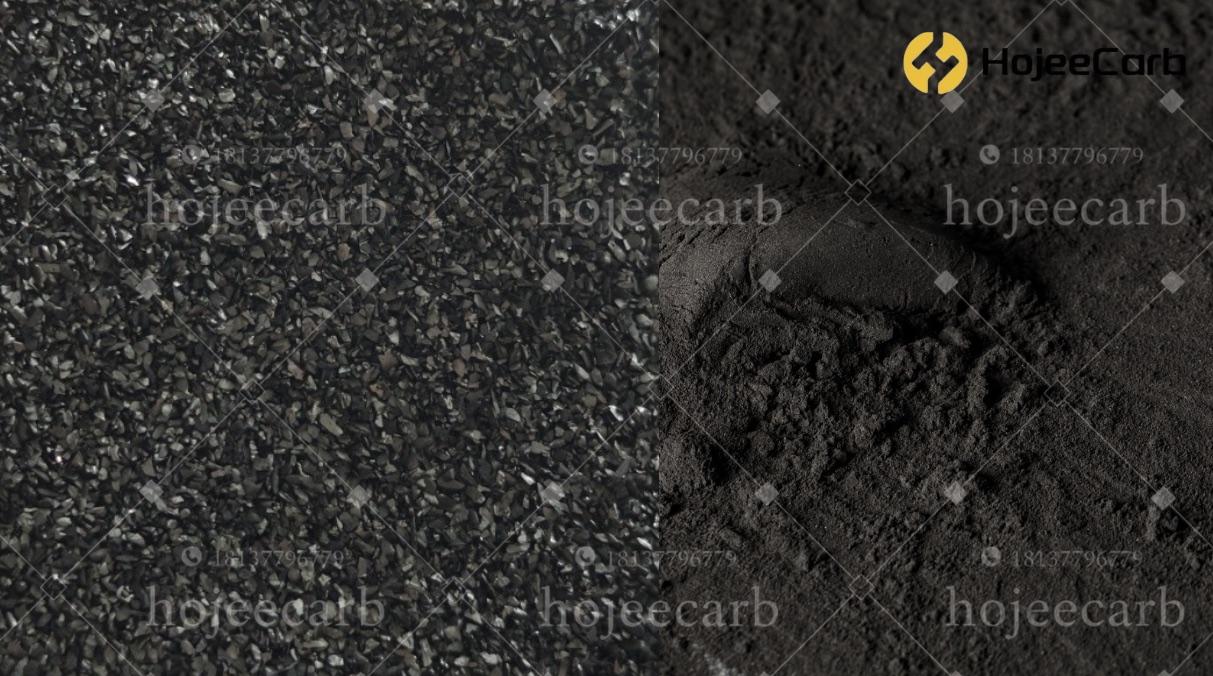
Coconut shell granular activated carbon (left) and wood-based powdered activated carbon (right). The same bloom can call for both: coconut GAC handles geosmin and MIB; mesopore-rich wood PAC is the first candidate for dissolved microcystin.
What to Request From a Carbon Supplier for Cyanotoxin Duty
Most suppliers quote iodine value. For microcystin that is the wrong pore being measured. Request these instead:
- Methylene blue value — initial screening proxy for mesopore capacity. Useful for narrowing the field, but not a substitute for direct testing on your water.
- A direct jar test on project raw water using your target cyanotoxin at the concentrations you expect. Jar-test results on your raw water trump iodine value, methylene blue number, or geosmin data from a different source.
- Carbon type matched to target — mesopore-rich wood or coal PAC as the first candidate for microcystin and cylindrospermopsin; high-micropore coconut if geosmin/MIB is the primary concern; separate grades if you are dealing with both.
- Third-party COA (SGS, Bureau Veritas, or equivalent) for batch specification verification, referenced against WHO drinking-water quality guidelines. The COA confirms what you are buying; treated-water toxin analysis confirms whether it is working.
A supplier who answers "what is your microcystin removal?" with only an iodine value does not have data for cyanotoxin duty.
Our Carbon Supply for Bloom-Response Programmes
We supply activated carbon to water treatment contractors, trading partners, and EPC firms across the Middle East, Southeast Asia, and Africa. For bloom-response enquiries we can quote two grades, because the toxin and the odor need different pore structures:
- Mesopore-rich wood-based PAC — the first candidate for microcystin and cylindrospermopsin removal, based on pore structure. Specified by methylene blue value; actual suitability should be confirmed by a jar test on your raw water. Available in 25 kg bags or 500 kg bulk bags.
- High-micropore coconut shell GAC and PAC — for the geosmin/MIB taste layer that may arrive with the same bloom and needs different pore coverage.
Standard commercial terms:
- MOQ: 1 ton PAC / 5 tons GAC
- Lead time: 15–20 days from order confirmation
- Testing: SGS or Bureau Veritas COA for batch specification; treated-water toxin analysis on your side confirms removal performance
Send us your raw-water DOC, pH range, and typical peak toxin concentration and we will suggest candidate carbon grades to put into your jar test. The dose and contact time for your plant come out of that testing, not from us. See our water treatment applications page for the full range.
Summary
- Cyanotoxins (mainly microcystins and cylindrospermopsin) can appear in the same bloom events that cause geosmin/MIB odor — but they are a separate removal problem requiring different carbon.
- Coagulation and filtration removes intact cells; activated carbon removes the dissolved extracellular fraction that filtration misses.
- The WHO provisional lifetime guideline value for total microcystins is 1 µg/L (all congeners, free plus cell-bound), not MC-LR alone. EPA values of 0.3 / 1.6 µg/L are 10-day health advisories for different age groups.
- Microcystin-LR (~995 g/mol) needs mesopores. Iodine value measures micropores and under-predicts — and can mislead — cyanotoxin capacity. Use methylene blue value as an initial screening reference, then confirm by jar test on project raw water.
- Mesopore-rich wood or coal PAC is the first candidate for microcystin; coconut stays the better grade for geosmin and MIB.
- The right adsorption/oxidation sequence depends on target toxin, raw-water quality, and existing treatment — set it from testing, not a fixed rule. Oxidant choice is toxin-specific: free chlorine does not oxidize anatoxin-a; ozone does not oxidize saxitoxin.
- Dose, contact time, and when to adjust must be set from raw-water jar testing and treated-water toxin monitoring for your specific water and carbon.
- Verify GAC performance against actual microcystin, not odor reduction. Even a bed that still removes geosmin can allow toxin breakthrough — odor absence does not confirm toxin removal.
Frequently Asked Questions
Does activated carbon remove microcystin from drinking water?
Yes. Both PAC and GAC remove dissolved microcystin, but the carbon must have adequate mesopore volume. Microcystin-LR has a molecular weight of roughly 995 g/mol — far too large to adsorb primarily through micropores. Mesopore-rich wood-based or selected coal PAC typically outperforms high-iodine-value coconut shell carbon on this compound. Confirm removal with a direct microcystin jar test, not iodine value alone.
What is the safe limit for microcystin in drinking water?
The WHO provisional lifetime drinking-water guideline value is 1 µg/L for total microcystins — the sum of all congeners, free plus cell-bound, not microcystin-LR alone (the value is derived from MC-LR data, which is why it is provisional). The US EPA figures of 0.3 µg/L and 1.6 µg/L are 10-day health advisory levels for different age groups: 0.3 µg/L for children pre-school age and younger, 1.6 µg/L for school-age children and adults. For cylindrospermopsin, the EPA 10-day advisory values are 0.7 µg/L and 3.0 µg/L respectively.
PAC or GAC for a harmful algal bloom emergency?
PAC suits seasonal spikes — you can dose it into raw water during the event and adjust as conditions change. GAC suits chronic multi-month bloom seasons as a standing barrier. Many plants run both: a GAC contactor as the baseline and PAC dosing capability upstream as a surge buffer on peak toxin days. Set the actual dose, contact time, and when to adjust or stop from raw-water jar testing and treated-water toxin monitoring, not from a fixed number — keep dosing until treated-water results confirm the target is met.
Why doesn't my geosmin carbon remove microcystin?
Different molecule, different pore. Geosmin (168–182 g/mol) adsorbs into micropores under 2 nm, where high-iodine coconut shell carbon excels. Microcystin-LR (~995 g/mol) needs mesopores of 2–50 nm to reach internal surface at all. A carbon specified only by iodine value can have excellent micropore area and very little mesopore volume, making it strong on taste and odor but inadequate for the toxin arriving in the same bloom.
Should chlorination happen before or after activated carbon during a bloom?
It depends on the target toxin, the state of the cells, raw-water quality, and the existing treatment train — there is no single right order. The risk to weigh is that pre-oxidation can lyse cyanobacterial cells and release intracellular toxin, and an oxidant upstream of carbon also competes for adsorption sites. But oxidant choice matters per toxin: free chlorine oxidizes microcystins (pH below 8) but is not effective on anatoxin-a, while ozone handles microcystins, anatoxin-a, and cylindrospermopsin but not saxitoxin. Use the EPA cyanotoxin treatment guidance and your own jar testing to set the sequence, then monitor treated water to confirm it worked.