Top 10 Activated Carbon Manufacturers in China (2026)
China produces over half the world's activated carbon. With 15+ years in the industry and three manufacturing bases across Ningxia, Fujian, and Shanxi, we've compiled this insider guide to help buyers find the right Chinese manufacturer for their specific application.
Table of Contents
Need activated carbon?
Get Factory-Direct Pricing — No Middlemen
20+ years manufacturing. MOQ 1 ton. Free samples. Reply within 2 hours.
Why Source Activated Carbon from China?
China dominates global activated carbon production with an estimated annual output exceeding 1.2 million metric tons — roughly 50–55% of global supply. The country's dominance stems from three key advantages:
- Raw Material Abundance: China has vast reserves of bituminous coal (Shanxi, Ningxia) and access to coconut shell supply chains through Southeast Asian partners. Wood-based activated carbon production thrives in Fujian and Jiangxi provinces.
- Cost Advantage: Factory-direct pricing from China is typically 30–50% lower than equivalent products from North American or European manufacturers. A 20ft container of coal-based GAC (8×30 mesh, iodine ≥900) costs $580–1,350/ton FOB, compared to $1,200–2,500/ton from US domestic producers.
- Product Range: Chinese manufacturers collectively offer the broadest product portfolio — from coconut shell GAC for drinking water to specialty impregnated carbons for mercury removal, gold recovery carbon, and powdered activated carbon for municipal wastewater.
According to Fortune Business Insights, the global activated carbon market reached $5.62 billion in 2025 and is projected to hit $11.9 billion by 2034 (CAGR 8.8%). Asia-Pacific accounts for 43.95% of demand, with China as both the largest producer and a major consumer.
⚠️ Important: US Import Tariffs
US buyers should factor in Section 301 tariffs of 25% on Chinese-origin activated carbon (HS 3802.10). Even with tariffs, Chinese carbon remains price-competitive for many applications. See our import tariffs guide for landed cost calculations.
China's Activated Carbon Market in 2026
Several trends are reshaping China's activated carbon industry this year:
- Reactivation Goes Mainstream: Driven by ESG pressures and raw material cost increases, Chinese manufacturers are investing heavily in reactivation capacity. Companies that offer supply + reactivation services have a competitive advantage in long-term contracts. (See our reactivated carbon guide.)
- Coconut Shell Supply Tightening: Indonesian coconut shell exports have declined, pushing coconut shell activated carbon prices to $2,900–4,500/ton FOB — up 15–20% year-over-year. Manufacturers with diversified raw material sources are better positioned.
- Global Expansion: Major Chinese producers like Yuanli (元力股份) are acquiring overseas assets — their recent 49% stake in Mexico's Clarimex signals accelerating internationalization.
- PFAS Driving Water Treatment Demand: EPA PFAS MCLs are creating sustained demand for high-quality coal-based GAC. Chinese factories that can supply NSF 61-certified carbon are winning large municipal contracts.
- Energy Storage Frontier: Activated carbon for EDLC (supercapacitor) applications is a fast-growing segment, with Cabot, Haycarb, and Calgon expanding production lines.
Top 10 Activated Carbon Manufacturers in China (2026)
This ranking is based on production capacity, product range, export volume, certifications, and industry reputation. We've visited or worked with most of these companies over the past 15 years.
1. Yuanli Active Carbon (元力股份)
📍 Nanping, Fujian | Listed: SZ 300174
China's largest publicly listed activated carbon producer. Yuanli specializes in wood-based activated carbon with annual capacity exceeding 100,000 tons. Their 2026 acquisition of 49% of Mexico's Clarimex signals aggressive international expansion. Primary products include powdered AC for sugar decolorization, granular AC for water treatment, and specialty carbons for pharmaceutical applications.
2. Huamei Carbon (华美活性炭)
📍 Ningxia | huameicarbon.com
A Ningxia-based manufacturer specializing in coal-based activated carbon. Huamei has built a strong reputation for water treatment grade carbons and maintains presence in both domestic Chinese market and export channels. Located near China's premium Taixi anthracite coal deposits, they benefit from raw material proximity. With over 30,000+ tons annual capacity, Huamei is a top-tier supplier for industrial water treatment buyers.
3. HojeeCarb
Our Factory📍 Ningxia, Fujian & Shanxi (3 Bases) | activatedcarbonfactory.com
With three manufacturing bases across China's key activated carbon producing regions, HojeeCarb offers the broadest product range from a single supplier: coconut shell GAC, coal-based GAC/PAC, wood-based PAC, columnar/pelletized carbons, and specialty impregnated carbons. Annual capacity: 20,000+ tons with exports to 50+ countries. Our multi-base model gives us unique flexibility — coconut shell processing in Fujian, coal-based pellet & granular production in Shanxi, and coal-based GAC/PAC in Ningxia.
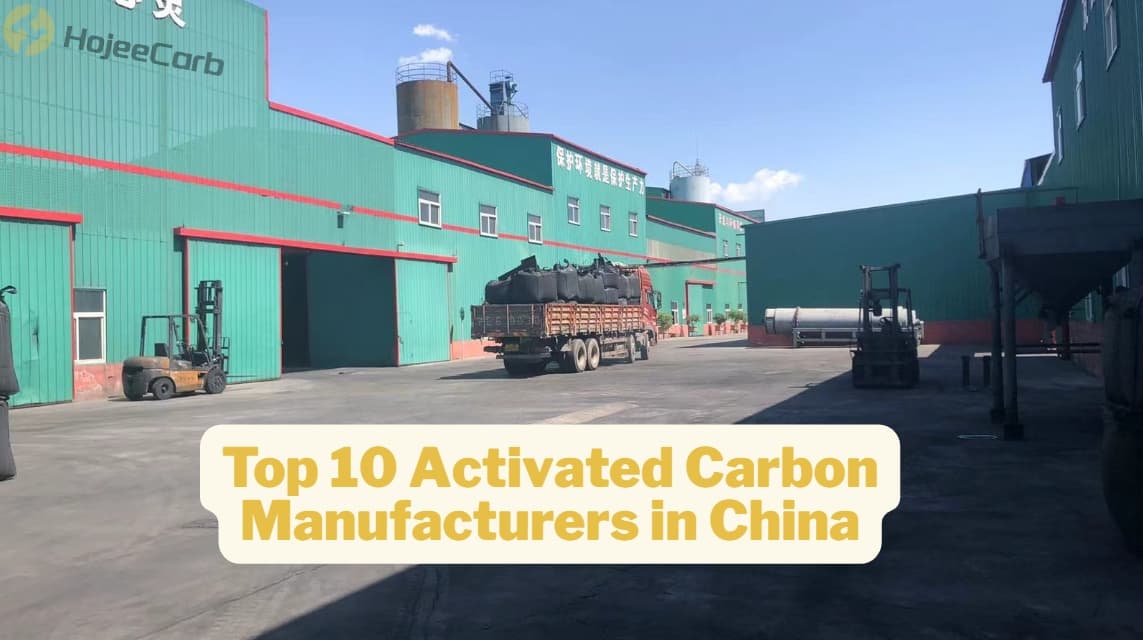
HojeeCarb factory yard — daily loading & logistics operations
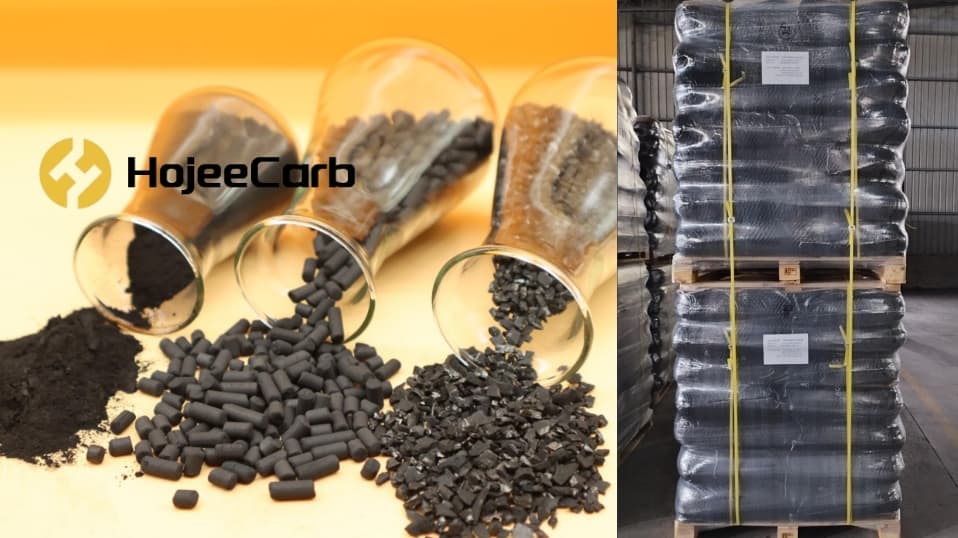
Product forms: powdered, pelletized & granular activated carbon
4. Xinhua Carbon (新华活性炭)
📍 Datong, Shanxi
One of the oldest and largest coal-based activated carbon producers in China with 60,000+ tons annual capacity. Xinhua supplies major water utilities globally and has strong OEM relationships with North American distributors. Their coal-based GAC is particularly competitive for municipal water treatment and industrial gas purification.
5. Xinsen Carbon (鑫森炭业)
📍 Fujian
A major wood-based activated carbon producer focused on industrial gas treatment. Xinsen has been actively developing technology for VOC treatment aligned with China's upcoming National VII emission standards. Their activated carbon products are widely used in automotive emission control and industrial air purification systems.
6. HANYAN Activated Carbon (韩研活性炭)
📍 Guangdong | hanyancarb.com
Recognized as a top enterprise in Guangdong's activated carbon industry, HANYAN collaborates with South China University of Technology and holds over 205 patents, including 82 invention patents. Their research-driven approach makes them a leader in specialty and high-performance activated carbon products. They partner with over 100 listed companies and state-owned enterprises in China.
7. Nature Carbon (奈驰碳业)
📍 Jiangsu | naturecarbon.com
Established in 1985, Nature Carbon is one of China's oldest activated carbon manufacturers. With nearly four decades of experience, they produce a wide range of coconut shell and coal-based products. Their Google Ads presence indicates active investment in international business development.
8. XMACC / AllCarbonTech (厦门全碳科技)
📍 Xiamen, Fujian | allcarbontech.com
An innovative manufacturer pushing bamboo-based activated carbon as a differentiator. XMACC markets under the Acarbon brand and emphasizes "negative carbon footprint" as a unique selling proposition targeting ESG-conscious buyers. Their aggressive Google Ads campaigns and "Top Supplier Guide" content strategy have earned them strong SERP visibility in 2026.
9. Zhixing Activated Carbon (芝星活性炭)
📍 Fujian | zhixingcarbon.com
A Fujian-based manufacturer specializing in coconut shell and wood-based activated carbon. Zhixing has established a solid reputation for food-grade and pharmaceutical-grade products, with ISO 9001 certification and a focus on export quality. Their production facility in Fujian benefits from proximity to Southeast Asian coconut shell supply chains, ensuring consistent raw material quality.
10. Xingguang Carbon (星光活性炭)
📍 Ningxia | xingguangcarbon.com
Ningxia Xingguang Activated Carbon is a well-established manufacturer focusing on coal-based activated carbon for industrial applications. Leveraging the region's premium Taixi anthracite resources, Xingguang produces high-iodine-value GAC and PAC with competitive pricing. Their products serve water treatment, gas purification, and chemical processing sectors across Asia and the Middle East.
Quick Comparison Table
| Manufacturer | Location | Specialty | Capacity (tons/yr) | NSF 61 | Best For |
|---|---|---|---|---|---|
| Yuanli (元力) | Fujian | Wood-Based | 100,000+ | ✅ | Sugar, Pharma, Food |
| Xinhua (新华) | Shanxi | Coal-Based | 60,000+ | ✅ | Municipal Water |
| HojeeCarb ⭐ | 3 Provinces | Full Range | 20,000+ | ✅ | Multi-Application |
| Xinsen (鑫森) | Fujian | Wood-Based | 30,000+ | — | VOC Treatment |
| Huamei (华美) | Ningxia | Coal-Based | 30,000+ | ✅ | Water Treatment |
| HANYAN (韩研) | Guangdong | Specialty / R&D | 10,000+ | — | High-Performance |
| Nature Carbon | Jiangsu | Full Range | 15,000+ | ✅ | General Purpose |
| XMACC (全碳) | Fujian | Bamboo-Based | 10,000+ | ✅ | ESG / Sustainability |
| Zhixing (芝星) | Fujian | Coconut Shell/Wood | 10,000+ | ✅ | Food & Pharma |
| Xingguang (星光) | Ningxia | Coal-Based | 12,000+ | — | Industrial Grade |
How to Choose the Right Chinese Manufacturer
Choosing the right manufacturer depends on your application, volume, and quality requirements. Here's our decision framework based on 15+ years of industry experience:
🔀 Manufacturer Selection Decision Tree
Step 1: What's your primary application?
- Drinking Water (NSF 61 required): Xinhua, HojeeCarb, Huamei, Xingguang
- Industrial Wastewater: HojeeCarb, Huamei, Zhixing, Xingguang
- Air/Gas Treatment: Xinsen, HojeeCarb, Xinhua
- Food/Pharma/Sugar: Yuanli, HojeeCarb
- Gold Recovery: HojeeCarb, Huamei
- ESG/Sustainability Priority: XMACC (bamboo-based)
Step 2: What's your annual volume?
- <100 tons/year: HojeeCarb, Huamei, Nature Carbon (flexible MOQ)
- 100–500 tons/year: Any manufacturer on this list
- 500+ tons/year: Yuanli, Xinhua, HojeeCarb (capacity matters)
Step 3: Do you need multiple product types?
- Single product type: Choose the specialist (e.g., Xinhua for coal GAC)
- Multiple products from one supplier: HojeeCarb (3 bases, full range), Nature Carbon
Factory Audit & Due Diligence Checklist
Before committing to a large order, conduct thorough due diligence. Here's the checklist we recommend (and the one our own customers use when auditing us):
📋 Documentation
- ☑️ Business license & export license
- ☑️ ISO 9001 / 14001 certificates (valid)
- ☑️ NSF/ANSI 61 certificate (if for drinking water)
- ☑️ Product COA with batch numbers
- ☑️ MSDS / SDS sheets
- ☑️ REACH registration (for EU exports)
🔬 Quality Verification
- ☑️ Request free samples (standard practice)
- ☑️ Test iodine number, BET, moisture, ash
- ☑️ Verify mesh size distribution
- ☑️ Independent lab verification (SGS, Bureau Veritas)
- ☑️ Check batch-to-batch consistency
- ☑️ Ask for production records / QC reports
🏭 Factory Audit
- ☑️ On-site or video factory tour
- ☑️ Verify actual production capacity
- ☑️ Check raw material sources
- ☑️ Review QC lab equipment
- ☑️ Assess environmental compliance
- ☑️ Confirm warehouse & logistics capability
💰 Commercial Terms
- ☑️ FOB/CIF pricing clarity
- ☑️ Payment terms (T/T 30/70 is common)
- ☑️ Lead time (typically 15–25 days)
- ☑️ MOQ flexibility for trial orders
- ☑️ After-sales technical support
- ☑️ Claims process for quality issues
For a detailed audit guide, see our Supplier Audit Checklist article.
Import Tariff Considerations for 2026
US tariffs remain the biggest factor for North American buyers. Here's the current landscape:
| Market | HS Code | Base Duty | Additional Tariff | Total |
|---|---|---|---|---|
| 🇺🇸 United States | 3802.10 | 4.8% | 25% (Section 301) | ~29.8% |
| 🇪🇺 European Union | 3802.10 | 2.1–5.5% | None | 2.1–5.5% |
| 🇮🇳 India | 3802.10 | 10% | Varies | ~15% |
| 🇯🇵 Japan | 3802.10 | 3.2% | None | 3.2% |
| 🇦🇪 UAE / GCC | 3802.10 | 5% | None | 5% |
Even with the 29.8% US tariff, Chinese activated carbon remains competitive for many applications due to the significant factory-direct price advantage. For a full breakdown, read our Activated Carbon Import Tariffs Guide.
💡 Pro Tip: Competitive Positioning from Calgon Carbon
Calgon Carbon launched "Operation Bedrock" (operationbedrock.com) specifically marketing tariff-free US-made GAC as an alternative to Chinese imports. While their product quality is excellent, pricing is typically 40–60% higher than Chinese equivalents. For many applications, the cost savings from Chinese carbon still outweigh tariff impacts.
Frequently Asked Questions
Why do most buyers source activated carbon from China?
China produces over 50% of the world's activated carbon, offering the broadest product range (coconut shell, coal-based, wood-based, specialty carbons) at competitive prices. Chinese manufacturers hold ISO 9001/14001, NSF/ANSI 61, and HALAL/KOSHER certifications, meeting international quality standards. Factory-direct pricing is typically 30–50% lower than buying from distributors in North America or Europe.
What certifications should a Chinese activated carbon manufacturer have?
Essential certifications include ISO 9001 (quality management), ISO 14001 (environmental management), and NSF/ANSI 61 for drinking water applications. For food and beverage applications, look for Food Grade certification. HALAL and KOSHER certifications are important for Middle East and specialty markets. REACH registration is required for European Union exports.
What is the typical MOQ when buying from Chinese activated carbon factories?
Most Chinese manufacturers have a minimum order quantity of 1–5 metric tons for standard products. For a full container load (FCL), expect 20–26 metric tons in a 20ft container. Some factories offer trial orders of 500 kg–1 ton for new customers. Custom specifications (special mesh sizes, impregnation) may require higher MOQs of 5–10 tons.
How do I verify the quality of activated carbon from China before placing a bulk order?
Request free samples and test them against your application requirements. Key parameters to verify: iodine number (mg/g), BET surface area (m²/g), moisture content (%), ash content (%), mesh size distribution, and CTC value for gas-phase applications. Ask for the manufacturer's COA (Certificate of Analysis) and cross-check with independent lab testing. A factory audit — either in person or through third-party inspection services like SGS or Bureau Veritas — provides additional assurance.
What are the import tariffs on Chinese activated carbon?
Import duties vary by country. The US HS code for activated carbon is 3802.10, with a base MFN duty of 4.8% plus Section 301 tariffs of 25% on Chinese-origin activated carbon (as of 2026). The EU charges 2.1–5.5%. Many countries in Southeast Asia, the Middle East, and Africa have lower or zero duties on Chinese activated carbon under bilateral trade agreements. Always verify current rates with your customs broker.
Ready to Source Activated Carbon from China?
As a manufacturer with 15+ years experience and three production bases, we can supply coconut shell, coal-based, and specialty activated carbon products. Get factory-direct pricing and free samples shipped worldwide.
Request Factory-Direct Quote & SamplesFree samples • MOQ from 1 ton • FOB/CIF pricing • 15–25 day lead time