
Application Guide
Activated Carbon for Biogas Purification: H2S & Siloxane Removal
Carbon selection, specs, bed sizing, and pricing for biogas plant buyers sourcing from China.
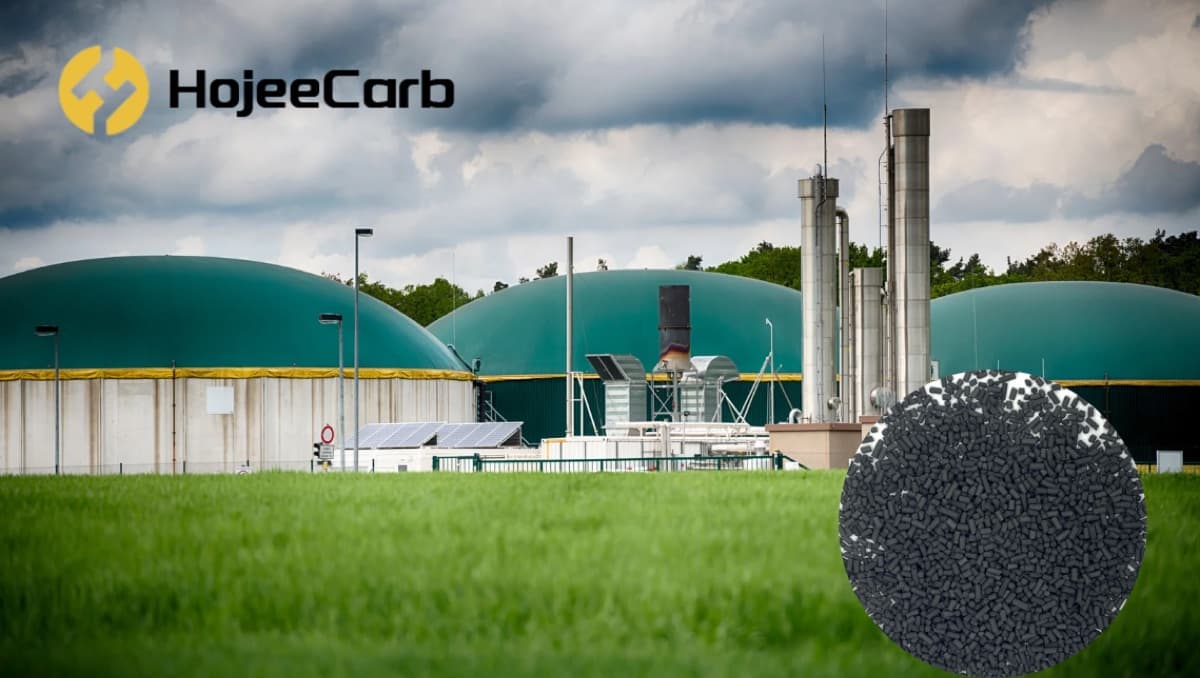
Biogas contains H2S, siloxanes, VOCs, and moisture that damage engines, turbines, and upgrading membranes. Activated carbon is the most common removal method — but one carbon type doesn't handle everything. You need different carbons for different contaminants.
We supply activated carbon to biogas plants in Europe, Southeast Asia, and South America. Anaerobic digesters, landfill gas, wastewater treatment plants — we've seen most setups. Here's what actually works, what to specify, and what it costs.
Quick Reference: Carbon Types for Biogas
| Contaminant | Carbon Type | Mechanism | Capacity | Price FOB China |
|---|---|---|---|---|
| H2S (<500 ppm) | KOH impregnated pellet | Chemical | 0.15–0.20 g/cc | $1,800–2,200/ton |
| H2S (500–2,000 ppm) | NaOH impregnated pellet | Chemical + physical | 0.12–0.18 g/cc | $1,600–2,000/ton |
| H2S (>2,000 ppm) | KI impregnated pellet | Catalytic oxidation | 0.20–0.30 g/cc | $2,500–3,500/ton |
| Siloxanes (D4, D5) | Virgin coal-based pellet | Physical adsorption | 5–15 wt% | $1,000–1,500/ton |
| VOCs / Mercaptans | Virgin coconut shell GAC | Physical adsorption | Varies by compound | $1,500–2,200/ton |
1. H2S Removal: Why Impregnated Carbon Is Non-Negotiable
H2S is the primary concern in any biogas system. Concentrations range from 100 ppm in well-managed food waste digesters to 10,000+ ppm in landfill gas. At even 200 ppm, H2S corrodes engine components, poisons fuel cell catalysts, and creates SO2 emissions when burned.
Virgin activated carbon can adsorb some H2S through physical adsorption, but the capacity is low — maybe 0.02–0.05 g/cc. That means frequent change-outs and high operating costs. Impregnated activated carbon solves this by adding a chemical reaction layer on top of physical adsorption.
KOH impregnated (potassium hydroxide): The workhorse for biogas H2S removal. KOH reacts with H2S to form potassium sulfide, which stays trapped in the carbon pores. Capacity: 0.15–0.20 g H2S per cc of carbon. Best for inlet concentrations below 2,000 ppm. This is what 70% of our biogas customers use.
NaOH impregnated (sodium hydroxide): Similar mechanism to KOH but slightly lower capacity (0.12–0.18 g/cc). Costs 10–15% less. Good option when budget matters and H2S is moderate (200–1,000 ppm). Also picks up some light mercaptans.
KI impregnated (potassium iodide): For the tough jobs — landfill gas with 2,000–10,000 ppm H2S. KI acts as a catalyst for oxidizing H2S to elemental sulfur. Higher capacity (0.20–0.30 g/cc) but costs 40–60% more than KOH. Worth it when you'd otherwise be changing KOH beds every 4–6 weeks.
Key Specs to Request for H2S Carbon
| Parameter | Target Value | Why It Matters |
|---|---|---|
| H2S Breakthrough Capacity | >0.15 g/cc (KOH) | Directly determines bed life |
| Impregnation % | 5–15% by weight | Too low = poor capacity; too high = blocked pores |
| Hardness | >90% (ASTM D3802) | Impregnation weakens structure; low hardness = dust |
| Moisture | <5% | Excess moisture reduces effective capacity |
| Pellet Diameter | 4mm standard | Balance between pressure drop and contact time |
| CTC Value | >40% | Indicates pore volume available for reaction products |
One thing we see often: buyers compare H2S capacity numbers between suppliers without checking test conditions. A capacity of 0.20 g/cc tested at 1% H2S in dry nitrogen is very different from real-world performance at 1,000 ppm in humid biogas. Always ask what test protocol was used — ASTM D6646 is the standard reference.
Need activated carbon?
Get Factory-Direct Pricing — No Middlemen
20+ years manufacturing. MOQ 1 ton. Free samples. Reply within 2 hours.
2. Siloxane Removal: Virgin Carbon with the Right Pore Structure
Siloxanes come from personal care products (shampoo, deodorant, cosmetics) that end up in wastewater sludge. The main culprits are D4 (octamethylcyclotetrasiloxane) and D5 (decamethylcyclopentasiloxane). When biogas containing siloxanes is burned, they form silicon dioxide (SiO2) — basically glass — that deposits on engine pistons, turbine blades, and heat exchangers.
Repair costs from siloxane damage: $50,000–200,000 per incident. One engine overhaul pays for years of carbon treatment.
Siloxane removal is purely physical adsorption — no chemical reaction needed. What matters is surface area and pore size distribution. D4 and D5 molecules are large (molecular diameter 0.8–1.0 nm), so you need mesopores (2–50 nm), not just micropores.
Coal-based activated carbon with steam activation develops a good mix of micro and mesopores — ideal for siloxanes. Coconut shell carbon has mostly micropores (<2 nm), which are too small for efficient siloxane capture.
Siloxane Carbon Specs
- BET surface area: >900 m²/g — more surface = more adsorption sites
- Iodine number: >900 mg/g — correlates with micropore volume
- CTC value: >55% — indicates mesopore development (critical for siloxanes)
- Form: 4mm pellet or 4×8 mesh granular
- Ash content: <12% — high ash blocks pores
Typical siloxane loading capacity: 5–15% by weight, depending on inlet concentration and competing adsorbates. In practice, expect 6–12 months of bed life when the carbon is placed after an H2S removal stage.
3. Two-Stage System Design: The Standard Approach
Most biogas-to-energy plants use a two-stage activated carbon system. It's not complicated, but getting the sequence right matters.
Stage 1 — H2S removal (impregnated carbon): This bed takes the heavy hit. H2S concentrations drop from hundreds or thousands of ppm to <1 ppm. Bed life: 3–6 months depending on inlet loading. This stage also catches some mercaptans and light sulfur compounds.
Stage 2 — Siloxane polishing (virgin carbon): With H2S already removed, this bed focuses on siloxanes, remaining VOCs, and trace contaminants. Lasts 6–12 months because Stage 1 handles the bulk of the work.
Why this order? If you put virgin carbon first, H2S would quickly saturate it (virgin carbon has poor H2S capacity), and you'd be replacing expensive beds every few weeks. Impregnated carbon first is always more cost-effective.
When to Add a Third Stage
- Mercury removal: Landfill gas can contain mercury. Add a sulfur-impregnated carbon bed after the main stages.
- Chlorinated compounds: Some industrial waste digesters produce chlorinated VOCs. A dedicated virgin carbon bed with high mesopore volume handles these.
- Biomethane upgrading: If you're injecting into the gas grid, tighter specs may require an additional polishing stage.
For most CHP (combined heat and power) applications, two stages are enough.
4. Bed Sizing: How Much Carbon Do You Need?
This is where many buyers get it wrong — either oversizing (wasting money) or undersizing (frequent change-outs). Here's the calculation.
H2S Bed Sizing Example
Let's say you have:
- Biogas flow: 500 Nm³/h
- H2S concentration: 1,000 ppm (= 1.52 g/Nm³)
- Target bed life: 6 months
- Carbon: KOH impregnated pellet, capacity 0.15 g H2S per cc
Daily H2S load = 500 Nm³/h × 1.52 g/Nm³ × 24h = 18,240 g/day = 18.2 kg/day
6-month load = 18.2 × 180 = 3,276 kg H2S
Carbon bulk density ≈ 0.50 kg/L
Carbon needed = 3,276 / (0.15 × 1,000 × 0.50) × 1.2 (safety) ≈ 52,416 L ≈ 52.4 m³
Weight ≈ 52.4 × 500 = 26,200 kg ≈ 26 tons per change-out
That's roughly 1.3 FCL (full container loads) of carbon every 6 months. At $2,000/ton FOB, your carbon cost is about $52,000 per change-out, or $104,000/year. Sounds like a lot — but compare it to one engine overhaul from untreated gas.
For smaller systems (50–100 Nm³/h), you might need only 2–5 tons per change-out. That's where our LCL shipping option makes sense.
5. Pellet vs Granular: Which Form Factor?
| Factor | Pellet (4mm) | Granular (4×8 mesh) |
|---|---|---|
| Pressure Drop | Lower ✓ | Higher — irregular shapes create resistance |
| Flow Distribution | More uniform ✓ | Can channel, especially in tall beds |
| Dust Generation | Minimal ✓ | More fines during loading/unloading |
| Impregnation Uniformity | Better ✓ | Varies with particle size distribution |
| Price | 5–10% premium | Baseline ✓ |
| Best For | Most biogas systems ✓ | Small systems, budget-sensitive |
Our recommendation: 4mm pellet carbon for any system above 100 Nm³/h. The 5–10% price premium pays for itself in lower pressure drop (= lower blower energy costs) and more predictable bed performance.
6. Moisture and Temperature: The Hidden Performance Killers
Biogas leaves the digester saturated with water vapor — typically 100% relative humidity at 35–55°C. This moisture is the enemy of activated carbon performance.
What moisture does to your carbon bed:
- Water molecules compete for adsorption sites, reducing H2S and siloxane capacity by 10–30%
- Condensation in the bed creates channels where gas bypasses the carbon entirely
- Wet carbon is heavier and harder to handle during change-outs
- In cold climates, condensation can freeze and block flow
The fix: Install a gas cooler/chiller upstream of the carbon vessels. Cooling biogas from 40°C to 5–10°C condenses most of the moisture. A simple knock-out drum catches the liquid. This one step can extend your carbon bed life by 30–50%.
Temperature matters too. Chemical reaction rates (for impregnated carbon) increase with temperature, but physical adsorption capacity decreases. The sweet spot for most biogas carbon systems is 20–35°C. Above 40°C, siloxane adsorption drops significantly.
7. Carbon Selection by Biogas Source
Not all biogas is the same. The source determines what contaminants you're dealing with and which carbon you need.
| Biogas Source | Typical H2S | Siloxanes? | Other Concerns | Recommended Carbon |
|---|---|---|---|---|
| Landfill Gas | 500–5,000+ ppm | High (D4, D5) | Mercury, chlorinated VOCs | KI impregnated + virgin coal pellet (2-3 stages) |
| WWTP Digester | 500–3,000 ppm | Moderate to high | Mercaptans | KOH impregnated + virgin coal pellet (2 stages) |
| Food Waste Digester | 100–2,000 ppm | Low | Terpenes, ammonia | KOH or NaOH impregnated (1-2 stages) |
| Agricultural Digester | 1,000–5,000 ppm | Very low | Ammonia, moisture | KOH impregnated pellet (1 stage often enough) |
| Industrial Waste Digester | Varies widely | Depends on feedstock | Halogenated compounds possible | Custom — analyze gas composition first |
If you're not sure what's in your biogas, get a full gas analysis before ordering carbon. We can recommend the right product once we see your gas composition report.
8. Sourcing Biogas Carbon from China: What to Know
China produces a large share of the world's activated carbon — both virgin and impregnated grades. Main production regions: Shanxi and Ningxia (coal-based), Fujian and Hainan (coconut shell). For biogas applications, coal-based pellet carbon from Shanxi is most cost-effective.
5 Things to Verify Before Ordering
- H2S breakthrough capacity — with test report. Don't accept spec sheet numbers alone. Ask for the actual test report showing test conditions (gas composition, flow rate, temperature, humidity). Some suppliers quote lab numbers that don't reflect real-world performance.
- Impregnation uniformity. Poor impregnation means some pellets have 15% KOH and others have 2%. The bed performs unevenly and breakthrough happens early. Ask how they verify uniformity — good factories test multiple samples per batch.
- Hardness after impregnation. The impregnation process (soaking in alkaline solution, then drying) can weaken the carbon structure. Hardness should still be >90% after impregnation. Below that, you get excessive dust and channeling.
- Packaging and shelf life. Impregnated carbon is hygroscopic — it absorbs moisture from air. Proper packaging: sealed PE-lined bags or drums. Shelf life: 12 months from production date. Don't accept carbon that's been sitting in a warehouse for 2 years.
- Third-party test reports. SGS or Intertek reports carry more weight than in-house COAs. For the first order, insist on third-party verification. See our quality testing guide for what to test.
Pricing Guide (2026, FOB China)
| Product | Price Range (FOB) | MOQ | Lead Time |
|---|---|---|---|
| Virgin coal-based 4mm pellet | $1,000–1,500/ton | 20 tons (1 FCL) | 2–3 weeks |
| KOH impregnated 4mm pellet | $1,800–2,500/ton | 10 tons | 3–4 weeks |
| NaOH impregnated 4mm pellet | $1,600–2,000/ton | 10 tons | 3–4 weeks |
| KI impregnated 4mm pellet | $2,500–3,500/ton | 10 tons | 4–5 weeks |
| Coconut shell GAC (siloxane grade) | $1,500–2,200/ton | 20 tons | 2–3 weeks |
Ocean freight from China to Europe: $80–150/ton (2026 rates). To Southeast Asia: $40–80/ton. Add 3–6 weeks transit time.
Our Biogas Carbon Product Line
We manufacture all the carbon types discussed above. Here's what we supply to biogas plants:
- KOH impregnated 4mm pellet — H2S capacity 0.15–0.20 g/cc, standard biogas desulfurization. Our most popular biogas product.
- NaOH impregnated 4mm pellet — H2S capacity 0.12–0.18 g/cc, budget-friendly option for moderate H2S.
- KI impregnated 4mm pellet — H2S capacity 0.20–0.30 g/cc, for high-H2S landfill gas applications.
- Virgin coal-based 4mm pellet — Iodine 900+, CTC 60+, BET >950 m²/g. Siloxane and VOC removal.
- Custom impregnation — KMnO4, sulfur, or other reagents for specialty applications.
MOQ: 10 tons for impregnated grades, 20 tons for virgin. We ship LCL (1–5 tons) for first-time buyers who want to test before committing to a full container. Free 25 kg samples available.
Common Mistakes We See
After supplying dozens of biogas plants, here are the mistakes that cost buyers the most money:
- Using virgin carbon for H2S. We've seen plants burn through 3x more carbon because they didn't use impregnated grades. The upfront cost of impregnated carbon is higher, but total cost of ownership is much lower.
- Skipping moisture removal. No gas cooler = 20–30% shorter bed life. A $5,000 chiller saves $15,000+/year in carbon costs.
- Oversizing the bed "just in case." A bed that's 2x too large means carbon sits unused for months, absorbing moisture and losing capacity. Size it right with a 20% safety margin.
- Not monitoring breakthrough. Install H2S sensors downstream of each stage. Replace at 80% breakthrough, not when the carbon "looks spent."
- Buying on price alone. The cheapest impregnated carbon often has poor impregnation uniformity. You save $200/ton but lose 30% capacity. Always compare on cost per gram of H2S removed.
Need Carbon for Your Biogas Plant?
Tell us your biogas source, H2S concentration, flow rate, and current carbon type. We'll recommend the right product, calculate bed sizing, and send samples for testing.
Frequently Asked Questions
What type of activated carbon removes H2S from biogas?
Impregnated activated carbon — KOH or NaOH impregnated pellets for low-to-medium H2S (100–2,000 ppm), KI impregnated for high H2S (>2,000 ppm). The impregnant reacts chemically with H2S, which is why virgin carbon alone doesn't work well for this application.
How long does activated carbon last in a biogas system?
For typical biogas with 500–2,000 ppm H2S, impregnated carbon lasts 3–6 months. Virgin carbon for siloxane removal lasts 6–12 months. Replace at 80% breakthrough. Actual bed life depends on inlet concentration, flow rate, humidity, and temperature.
Can one carbon type remove both H2S and siloxanes?
Not effectively. H2S needs impregnated carbon (chemical reaction), siloxanes need high-surface-area virgin carbon (physical adsorption). Most plants use two stages: impregnated first for H2S, then virgin for siloxanes.
What does biogas-grade activated carbon cost?
Virgin coal-based pellet: $1,000–1,500/ton FOB. KOH impregnated pellet: $1,800–2,500/ton FOB. KI impregnated: $2,500–3,500/ton FOB. Coconut shell options cost 20–30% more. Prices as of 2026.
Pellet or granular for biogas?
4mm pellets are preferred — lower pressure drop, more uniform flow, easier handling during replacement. Granular (4x8 mesh) works for smaller systems but creates higher pressure drop in tall beds.
What is the MOQ for biogas carbon from China?
Standard: 1 FCL (20 tons). For impregnated carbon, some manufacturers accept 10-ton minimums. We ship LCL (1–5 tons) for first-time buyers testing our product.
How do I size an activated carbon bed for biogas?
Calculate total H2S or siloxane loading per day (concentration x flow rate x 24h). Divide by the carbon's capacity (g H2S per kg carbon). Add 20% safety margin. For a 500 Nm3/h biogas stream with 1,000 ppm H2S, you need roughly 2–3 tons of KOH impregnated carbon per change-out.
Does humidity affect activated carbon performance in biogas?
Yes. Biogas is typically saturated (100% RH). High moisture reduces adsorption capacity by 10–30% and can cause bed channeling. Pre-cooling biogas to condense moisture before the carbon bed improves performance and extends bed life.